36: Jeff Gibbard shares his Lovable Leadership
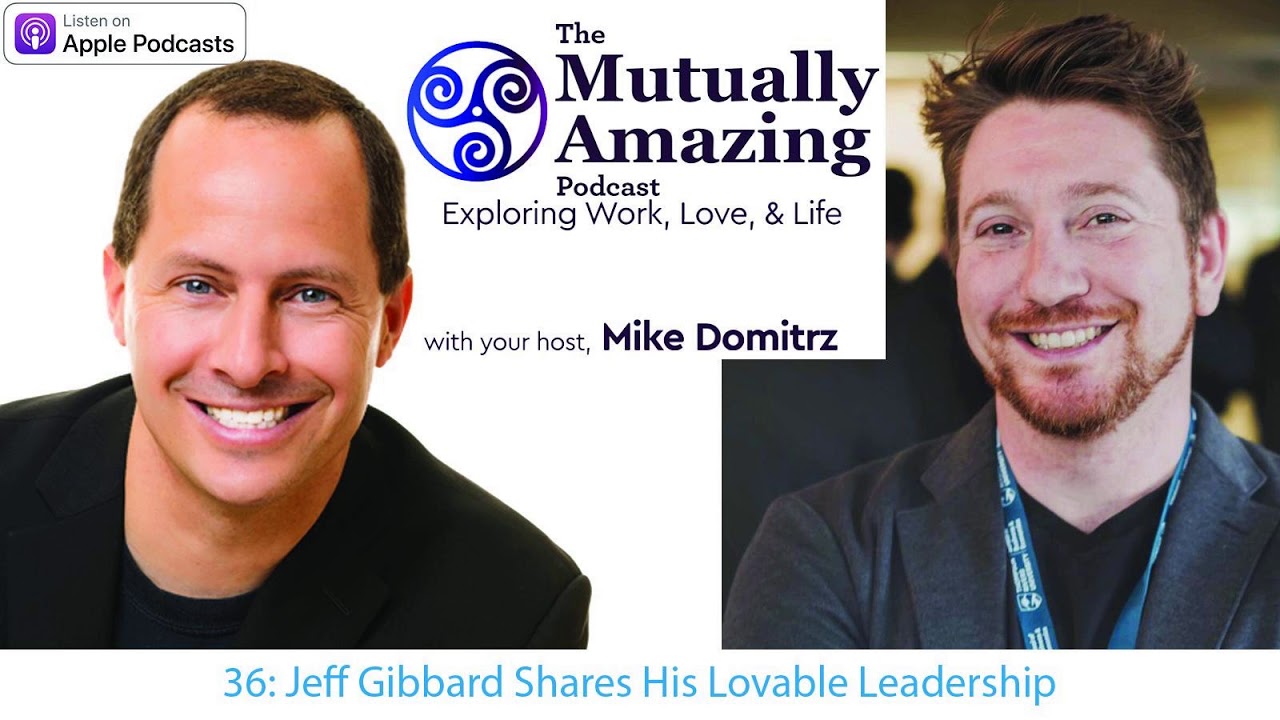
Jeff Gibbard, a content strategist at From the Future, introduces lovable leadership, a framework built on earning respect through service and genuine care rather than title. He emphasizes sitting on the same side of the table in conversations and removing the word wrong from feedback to build extraordinary company culture.
Chapters
Welcome to the Mutually Amazing Podcast. I'm your host, Mike Domitrz, with the Center for Respect. The episode you're about to listen to was recorded when this show used to be called the Respect Podcast. So, you might hear that mentioned during this episode. Well, let's get to the show. This week's guest, on his LinkedIn headline, it says, World's most handsome social media and content marketing strategist. Though Jeff Gibbard is rarely described as humble, he is a champion for building extraordinary company culture, growing the leaders of tomorrow, and using empathy in all areas of life, including technology. Jeff, thank you so much for joining us.
Mike, I am thrilled to be here with you today. Thanks so much for having me.
Absolutely. And for our listeners to know, you're also the host of the Shareable podcast, which I was just recently on. So I loved being interviewed by you. Thank you. That was a great time together.
Yeah, it's really cool that we get to kind of like turn the tables on each other, right? Like before it was me behind the mic asking you the questions and now we get to, we get to swap it.
Yes. Well, for a little bit of fun, we're going to start off because you said you lead with empathy and I can see some people going, but wait, if his title says most handsome social media and content marketing strategist, doesn't that put others below him? So is that empathetic or is he testing humor out with, you know, see if you're not, If you find that to be offensive, you might not be the right fit. How do you answer that?
So, I mean, people that know me, uh, know that I am, uh, I'm a pretty laid-back kind of guy. I'm definitely— I like to poke fun at things. I don't take myself too seriously. I don't take, you know, I don't take the world too seriously in general. I try to make sure that we're all having fun. Um, but I, you know, obviously I do still really deeply care about how other people react to things. So I've had people that have come up to me and You know, take an issue with it, and, you know, I apologize and let them know, like, I'm really not meaning to be conceited here. It's— the goal is that it is so ridiculous. To me, it's a little bit of like satire. It's such an absurd headline. But the key point of why I do that is that there are basically 2 different things that really precede me. One is that people know that I wear bright red sneakers all the time, and the other is that people will refer to me as the world's most handsome social media and content marketing strategist. And they are saying it tongue-in-cheek as well because they're in on the joke. It's absurd. So to me, it's a It's really about standing out, getting noticed, and, you know, having something that kind of precedes you as, as kind of a jumping-off point for conversation.
Absolutely. I appreciate that. Well, thank you for that. And now, obviously, we talk about respect. Who is someone for you that, that really has inspired you or you look up to, you have an immense amount of respect for?
The first person that comes to my mind, I mean, outside of my father, who I have just the world of respect for, uh, if I'm looking kind of who I look at and I say, you know, if I could be like anybody in business, who would I want to be like? I always look to Seth Godin. I'm currently listening to his book, This Is Marketing, and I just, you know, I get so little out of the idea of marketing just to sell more stuff, but when we really take it back to why people, like what's important to people in their lives and how we as businesses can serve those people and how we can help to alleviate pain in their lives or make their lives happier or, you know, just satisfy an itch that they have, that's when, you know, marketing makes any kind of sense to me or business makes any kind of sense to me, and when you look at the work of Seth Godin, He's asking those hard questions and he's holding people and businesses to a higher standard. And, uh, I really look at that and I respect that. It takes a lot of courage to not just say, oh, we're gonna, you know, play the, uh, the numbers game and just get, you know, X number of impressions and a percentage of that will convert. Instead, he's really trying to take a quantified approach rather than, you know, or I'm sorry, a qualified approach rather than a quantified approach.
How'd you get here? took your journey to where you are today?
Oh man, well, I mean, I've, I've really followed passion my entire life, uh, and, and that has led me down a number of different roads to failure, but each of those failures has been a stepping stone and, uh, just part of the pathway to get me to where I am today. I wanted to be a professional basketball player at 13, then a world-famous film director, and then a photographer who would travel the world taking pictures. And every time it was just about, you know, me Finding something that really made my heart sing and made me excited to get out of bed and go do whatever it was. So that's kind of how we found our way here and it was sometime in 2014— I'm sorry, 2004, 2005 where I had really taken passion about as far as it could go and I realized I wasn't going to make much of myself if I didn't round out my brain so I wasn't just so right-brain heavy and I went back to business school. That's when I came out with a different perspective and I think a more balanced perspective Uh, and that kind of took me on the path here where I started my agency in, uh, 2011. Uh, ran that for 7 years and then got acquired by an agency called From the Future where I now do a whole lot more things that I'm really interested in.
And your agency, what kind of marketing were they doing?
So my agency is a social media and content marketing agency, uh, social media, content marketing, and influencer marketing. That was the work that I was doing for approximately 8 years, uh, in my own agency. And then when we got acquired, The work that I'm able to do now extends beyond just doing the marketing work. A lot of what I'm accountable for these days is what does our client experience look like? How do we communicate with the people that we serve? And then how do we communicate with each other internally? So we're really trying to build a company culture of, and I'm not saying this just because it's the name of your show, but of respect where we really appreciate what everybody brings to the table and we have the empathy and compassion to allow people the space to be good, to be bad, uh, you know, to, to do their jobs well and I guess sometimes falter at their jobs, but that we all support each other. help each other grow. So that's a lot of what I'm focused on these days is really the people aspect more so than the work itself.
All right. And the work you do, obviously social media heavy, obviously by everything you've described repeatedly. How do you help people understand or avoid the pitfalls of social media? Because you're trying to use it to positively impact people by helping them find resources that can truly serve. But, but how do you in that process help people avoid The manipulation. You know, one of the books you have on your list is Influence by Robert Cialdini. That book is fascinating, but it can be used for good or bad.
Absolutely. I mean, I feel like anything can be good, can be used for good or for evil, depending on the person that's wielding the weapon, right? So I've always seen it as my responsibility. You know, I'm a huge fan of Spider-Man, and I always, you know, the whole with great power comes great responsibility. And, you know, I think of myself as a leader, as a business person, as a human being that If I have the perspective that no matter what, I'm going to try and do the right thing to make the world a better place, then I'm going to approach every one of my endeavors with that mindset. So when I got into social media, I actually approached it super bright-eyed and bushy-tailed and thought like, this is going to be a technology that changes the world. We're going to connect with each other across time and geography. We're going to be able to appreciate employees and customers and really hear and listen to each other and have the opportunity to be vulnerable and connect. Blah, blah, blah, and that was what I really— because that's how I saw the world. So I thought for sure that's what we're going to do and then fast forward 8, 10 years and look at what we've become and all the different problems we're having with hacking and trolls and all that, the divisiveness online. So in terms of how I stay true to it, I mean I just try to bring myself back and remember what it is I set out to do in the first place and a little bit of an epiphany that I had recently was that I was never actually particularly interested in the tools of social media.
Mmhmm.
What I always looked at is that I thought social media were a series of technologies that could amplify what already was. So if you had a great organization, social media would just naturally show that you were a great organization by way of how you interacted publicly or how your employees chose to go online and talk about their work. So I really just saw it more as a reflection, more so than, you know, a tactical advantage to utilize these tools to tell a story. I thought that the tools would be used and would just tell what the story was. So I just try to focus on Instead of helping companies to use these tools to accomplish something, I instead think, how do I help the organization to accomplish what it's trying to accomplish and use the toolset of social media?
Well, I think that's a great question for each of us to think of every time we go on social media. What am I here to amplify? If I'm sharing something, I'm amplifying something. What do I believe I want to amplify in the world? If I'm going to share tons of negative energy, Then I'm amplifying negative energy. So I think that we can all take that on a personal viewpoint of what am I— what do I want to amplify? And then when I go on Facebook, am I being intentional about amplifying what I want to amplify?
100%. And just one quick thing to add to that is that I think you're seeing in usage patterns of social media that people's behaviors are starting to change. We've been manipulated for a very long time by these networks to use the networks more, to post more, to do all these different things. And I think that we're starting to hit a point Uh-huh. Of diminishing returns and where people are kind of making a U-turn and thinking, well, what am I really getting out of this? Why am I doing it? What's the benefit? And hopefully I think we're being more selective about what we choose to share from our own lives and we're being more selective about what we choose to engage with based upon the one part being what shows up in our feed based upon what we engage with, but 2, what does it do to us personally? How does it make us feel when we engage negatively online versus when we go there to be supportive and amplify things that we believe in?
Well, I think that's the key. It has the possibility within the same minute to do both. Like, one minute you can be loving a positive thing, and then another one being sunk with this negative energy someone shared. And they meant well, like they were trying to create awareness, but it becomes this— I don't know about you, but I know about me that because of my high energy level, that when I'm around positive, I can soar, but when I'm around negative, I can also dive deep into that tunnel. And it can sink me quicker because of my energy levels. Facebook, social media, Instagram, Twitter, all of them have the capability to do both within seconds. So, you can be on a positive and suddenly in a negative.
Yeah, absolutely. And it's just a matter of the choices you make. And, and, you know, I, I'm— you know that I'm a huge fan of the work that you do. I, I think we could probably agree that there's a similarity in all of the different conversations, whether it be how we interact with each other on social media or how we gain consent in a romantic relationship or how we show respect in the workplace. It's all about the choices that we choose to make. Really, if I, if I take all of the work that I'm involved in and I take it back to the core, it's about installing mental frameworks and ideas around what is ideal look like? What does a great company culture look like? And if we can build that, then we can start to see how that amplifies out to social. And then if you look at what is— who do you want to be in the world as a company? Like what kind of, what kind of a change are you trying to make out there? You're going to conduct yourself and talk about things differently when you go online or even when you just go to a networking event.
Right, exactly. I mean, I always tell people, you know, when you post a negative post, let's say, up, you make a really negative statement. Would you do that standing in front of 5 people? And lots of us are like, well, no, of course you wouldn't do that because somebody could be offended. That's— which is such an interesting perspective, but online we'll share it. So I love that we're having this. Now let's take it to the in-person because you love talking about leadership. It's a passion of yours. You're writing a book on it right now. How would you define your philosophy of leadership?
So the philosophy of leadership that I'm, I'm trademarking, I'm coining, I don't know, I haven't trademarked it yet, but I will. Nobody out there trademark this, but it's called lovable leadership. So the, the name of the book I'm writing is called The Lovable Leader, and it comes down to the idea that you're not a leader because of the title that you were given. You may, you may be able to have the hierarchical status to be able to tell people what to do, but you don't earn people's respect and admiration by force and by title. You do it by the actions that you take on a day-to-day basis and how you make people feel about themselves and how you inspire them to work for themselves, how you help them to grow, how you support them. So my entire leadership philosophy— there's this whole idea of like service leadership, and then there's like, you know, command and control leadership. There's all these different philosophies. I call mine lovable leadership because what I'm trying to do at all areas of, uh, the company is to inspire, uh, a situation where people really love and respect each other. You know, obviously love can, can be, uh, displayed in a number of different ways, some appropriate, some inappropriate, but it's more about really coming back to what you talk a lot about is respect. Is if you respect someone enough to allow them the space to be who they are and you give them the support that they need to do what they need to do, And as a leader, you look for every possible way to grow them and be in service of them. All of those things combined, I think, help you to be a lovable person, and then people are going to naturally work harder for you. Now, inside of that leadership philosophy, you mentioned the book by Robert Cialdini, Influence. There's a lot of concepts that I pull from all over the place, from How to Win Friends and Influence People, from a book I love called Pitch Anything by Oren Klaff, by Influence by Robert Cialdini. All over the places I pull these different things, and a lot of those pieces of advice, all of those recommendations, they can be used for exceptionally nefarious purposes, but I choose to use them in a way that serves the people that I lead and, in the same way, seeks to grow them as leaders. When you have a company full of people who know how to communicate with each other respectfully and supportively, I think you're going to have an organization that is primed for success.
I love that. What are precise steps people can take to instill lovable leadership?
So I have one that I love to tell people about. I think it's— there are really 2 different things that are related that I think are kind of hallmarks to what I do, uh, in my role as a leader. And they're, they're 2 related concepts. The first is one that I call sitting on the same side of the table. And I think that if, if there's nothing that anybody else takes away from the things I say here, or that after you read my book, uh, you take nothing else away, I think it's this, is that too often in leadership roles, we sit on opposite sides of the table. If you can think of that kind of in your head with that Looks like. And that means you're talking at someone, right? You're, you're saying, I'm coming from over here and I'm telling you something over there. You're giving a directive, you're explaining why someone was wrong, et cetera. It's kind of a mental framework. But if you sit on the same side of the table with them, you're saying, we're in this together. I'm here to support you. Uh, a concept that, that goes right along with that is I always am very, very careful in the language that I use when giving any feedback to my team or even when I'm talking to a client. To remove any sense of wrong, any sense that would— any statement that would put the other person on the defensive and have them try to justify their action or explain why they were in fact right. I find that that is an impediment to a productive conversation. So instead, I sit on the same side of the table with them and I talk about where we are going together. I talk about the goals that this person has that I'm with and how I can help support getting them to where they're trying to go. So even when I'm giving feedback about something that didn't work, I'm still sitting on the same side and, and being in the trenches with that person and being their partner in getting to where they're trying to go. So sitting on the same side of the table and taking out the wrong are, are 2 of the really big ones.
All right, so that's 2 major ones. So now you are taking out the wrong, you're trying to be their teammate. What are some other key traps people have to be careful falling into? Like, I can think of one on the top of my head where you've predetermined what you want them to do. And so even though you are listening, you're not really, cuz you've got an agenda that is, that is stuck in your head, whether no matter what they're saying.
Yeah, I, I'd say that that's a pretty common one. I think the other thing is people in leadership positions too often speak from their own self-interest. And one of the things that you can, you can accomplish what you want, what your objective is as the business owner or the leader, but the only change you have to make is you have to understand that you have to tie it to what the person you're talking to already wants. So you can't assign meaning or goals. To somebody if they don't believe in it or buy into it or give you their kind of, you know, if they don't buy into the idea, right? So what I try to do is I first understand by asking, what is this person trying to accomplish? Where are they trying to go in their career? What are they trying to accomplish short-term, long-term? What inspires them? What motivates them? So when I can gather that information, I can then take all of that information and tie it back to what I want to have happen. You could hear that and say, oh, well, that's manipulative. Well, it's not. I'm actually looking for the overlap. If you think of it as a Venn diagram, there's what I want, there's what you want, and I look for the place where those 2 things overlap so that we both get what we want. Again, it's sitting on the same side of the table, looking for common goals and working together to get there.
Well, I love that idea of the same side of the table, because even when you're sitting at a small little, you know, coffee table and you're across from each other, it is, it does, can feel like a sales pitch to people. Like I'm being sold or I'm being interviewed. But if I'm sitting next to you, it feels like a partnership, right? When you go to dinner and you have a— you're a couple and you often sit next to your partner and the other couple sits across from you. So you're partner to partner. So I love that you're creating that in the corporate atmosphere of this teamwork setup. What are some meaning well tactics people have that can get into trouble? Like, all right, I'm sitting next to them. Here's how I'm going to do, like you said, find out what they want. I love the Venn diagram concept. What are some mistakes people can make accidentally?
I think that any of the mistakes I've seen in this is that, you know, there's a lot of leadership concepts that I have that I buy into that I've borrowed from elsewhere that I've recombined. And I think the reason why they tend to work for me is because at the core, there's a foundation that it's built upon around really deeply caring about my people, deeply caring about where we're going. And the mistakes I generally see is the people that will look at a book like the one I'm writing or the advice that I'm giving and they'll think, oh, that's a good tactic. That's a thing I can use. If I say these words right, it will work. So they think of it more like a script rather than a mindset. So there's always like the how do you give feedback thing, right? So a lot of the times when you're giving feedback to someone, the advice is you say a good thing, then you say the bad thing, and then you say the good thing, right? The classic sandwich. Sure, that works, but people see right through it. And then also when, even if you're doing it that way and you're doing it as a tactic, it comes off very cold and calculated rather than deeply caring. One of the fundamental principles of lovable leadership is that you actually deeply, truly, really have to care with every fiber of your being about what happens on your team and about each of your people. Because if you don't, it's just gonna come through as hollow. The way I see it, a lovable leader, that there are kind of 3 3 ways to look at leadership, and it's actually all 3. Leadership is your burden, your privilege, and your responsibility. It is all 3 at all times. And I think that a true leader, when they approach any of these conversations, they are going into it with this mindset of what their role is in growing this person, as opposed to, you know, if I follow this formula, I'm going to get the best out of my people. So I think the biggest well-meaning thing is that people will read these books. Uh, not much, not just mine, but anybody's books. They'll read that, they'll watch YouTube videos, or they'll, you know, listen to podcasts and they'll think, okay, I've got a bunch of different things that I can say and I can do now. And they're well-intentioned, but they're not first going back to the start and saying, why am I in this? Like, who am I as a leader? What am I trying to accomplish? Who do I want to be in this world? And until you have that locked in, everything is just a tactic and you don't really see through to the end.
I love this insight. Now we're speaking about the, to the individual trying to connect with others. What do you think stands in the way of building better, more respectful, inclusive companies as a whole, or organizations, associations?
Yeah, I mean, I think one of the big ones kind of is very similar to the answer I just gave, which is like the reason that you're doing it. So like a good example, right? Like, what is diversity? Right? Is diversity like, okay, I have a checklist, and I need to have 2 of you and 3 of you. And I have 4 of these. So I need to get 2 of those. If that's the idea behind diversity, then I feel like it's missing the point entirely. It's not about creating an ideal headcount based upon some ratio of ethnicities, right? But if your goal through diversity is to ensure that you have a variety of different points of view so that you can better understand your customers, so that you can better create a workplace where you're being inclusive in how you're developing that company for scaling, That's a different way of going about it, right? So again, I think it comes back to leaders who are building a culture of respect because it starts with respect. It's not— respect isn't the end goal. Respect is the starting point. So you're starting with respect, and then everything that follows from that point on allows you to build a company of diversity and inclusion because you respect other viewpoints. You respect other people for being human beings, not just because they happen to have a different color of melanin in their skin.
Absolutely. When I'm doing programs or keynotes for corporations, associations, one of the things we talk about is the slope of respect. And disrespect is in the far left corner, the slope's going upwards to the upper right corner. And I say, what's the extreme opposite of respect? And people say disrespect. What's the extreme opposite of disrespect? And people say respect. And I say, no, no, respect's only halfway up the slope. Respect's the bare minimum of the positive half. So What comes once you have respect, then what follows? That, when you get all those things on there, that's the extreme opposite of disrespect. And so, it allows you to have a different perspective instead of thinking, oh, we just have to get to respect. That's such a low standard. That should literally be the bare minimum. Now, if once we have it, what can we do? Which is what you're talking about. I love it. I love how much that aligns.
What's your answer there? What is the opposite of disrespect? Disrespect if respect is at the middle point?
Yeah. Well, here's the cool thing. Every organization then gets to define that for themselves. So they'll have loving, caring, loyal, empathy, and they're adding all these words. And now respect has an image that's above it, right? This is what we strive for. And if we have all these things, respect will naturally be there together. Any one of them does not guarantee respect, though. Like, I could give you empathy, but then keep you in a position of where I have power over you and I manipulate that, even though I treat you with empathy. But if all of them are there, respect has to be present.
Yeah. No, that makes perfect sense. I dig that because I was thinking, once you get past respect, like, what's beyond? Because I agree with you, respect seems like that's— you should just have that for other people. And when you get past that, my first thought was love. Okay, when you love your people, when you really actually care what happens to them, Like, you're really, really truly honestly concerned with their growth and with them being the best that they can be. That seems like, for me at least, that's how I would identify as like the opposite of the disrespect. Yeah.
What's neat about it is if you think about parents and they, they love their children no matter what, right? A loving parent is, is unconditional love. And if you treated your employees, your teammates, your colleagues that way, Imagine how that changes everything. Now people go, what do you mean? Well, let me give you an example. They'll say, but I've got an employee who's acting totally this way, goes against everything we believe. Well, if you have enough kids, you'll get that at times. So that, you know, those things can happen with children. The difference is, even if it's an adult child or a younger child, as a parent, you still love them. And you look for the positives and you find a way, because that's your child, to find the positive in those moments. At least you tried to. Well, what if you did that in the workplace? So, man, I can't stand that they do 5, 6, 7, and 8, but I love that 1, 2, and 3, those traits. I love that about them. And if we could treat our colleagues, our coworkers, our teammates like that, our employees, it is leading with love.
Now, I love that, man. That's great.
Very cool. And that's why I love this idea of lovable leadership. I think it's so powerful what you've got there. Jeff, if you could correct any deficiency or problem in today's business environment that would end up resulting in more respect by making the correction, what would it be?
The first thing that comes to my mind as, as being like the, the thing that is lacking is I think what's lacking is, and it's, it almost feels corny to say it, but I really feel like empathy is the thing that's often missing. I think we get so trapped in our own perspective. We look at other people, we judge them for not getting the work done, and we, we, we often forget that these are human beings in our, in our work environments, that they have lives outside of the office, that they have, you know, potentially, uh, problems with, you know, a, a loved one, a spouse, a sibling, uh, one of their parents or something. Maybe they, you know, are struggling with mental health issues or any number of different things. I think so often we take what we see at face value, we judge it, we make an assessment, and then that becomes our reality. We start to see people through that lens and it deteriorates our relationships very quickly when we begin to think that we understand who somebody else is. Like, oh, I know who they are. They're this. They're lazy, or they're whatever, instead of treating each individual with the respect to have their good days and have their bad days. If you really do care as a leader, if you really do want to show that you're not just somebody who makes these snap judgments, then you actually take the time to get to know someone Figure out what's going on in their life and see how you can support them through it, because if you're part of a team, you're only as strong as the weakest link in your team. So you should always be looking to support every single link in that chain. So I think the biggest thing is, I don't know if there's such a thing as, as empathy training on a mass scale, but I would love to see more of that.
Yeah, I agree with you. I was once doing a program in the— out in the Pacific in Hawaii for the military, and An admiral said, "What's the one trait you've got to have as a great leader?" And people were saying loyalty, confidence, trust, and it was empathy. He said it's empathy. It's looking that cell in the eye, saying, "You know, how's your day going?" And listening and having compassion, which is just so powerful. I love that, Jeff. Now, for our listeners, I want to make sure they can find you. That's Jeff Gibbard dot com G I B B A R D, just like it sounds. So that's nice and easy dot com. And and of course, we're gonna have in the show. links, all the links to you, because there's several. They can look at Your Agency from the Future, your shareable podcast. We're gonna have all that available to you. You have 3 books you really love, and we've talked a little bit about one of them today. That's Influence. So let's talk about the other 2. Pitch Anything— what do you love about that book?
Oh God, that is my secret weapon. So anybody listening, uh, that is undoubtedly one of my secret weapons in life. Pitch Anything is essentially, um, it's a book that uses a concept known as neurofinance. It's this guy, Oren Klaff, who's pitched billions of dollars in deals. Essentially, he teaches a concept known as frame control. Frame control is this idea that if you understand that in every interaction you have with another human being, there's essentially your perspective, your frame, and somebody else's frame coming into collision. You're going to deal with people who feel that they're the dominant power frame, and then you're going to deal with people who are more analytical and they're looking for details. By understanding the perspective that somebody else is coming from, the frame that they're coming with, and what frame you need to use to essentially counter that to be able to have a productive conversation, then you're going to be more effective. So as somebody who does a lot of business development, and obviously I oversee a large number of people in different teams, it's essential that I understand how to appreciate the frame that somebody is coming with and be able to present them with an alternative so that they can hear what it is that I'm saying. And I found that it's just a super helpful book in my career. In, uh, in being more successful in sales and in leadership.
Love it. The other one we've mentioned a lot on this show, that's Dale Carnegie's How to Win Friends and Influence, uh, People. And so what do you love about that book?
I mean, that's the Bible. That, that is, that is the, the core book that every human being should read. And I read it every probably like 3 to 5 years. I'll read it, um, just because it's a reminder and, and it teaches you so many valuable concepts. Um, a lot of the concepts that I read in that book are things that have made their way in some Uh-huh. —form or another into my leadership philosophy, but I'll give you one really salient example is that the, the greatest desire that a human being will have is that to be acknowledged, right? We're social creatures. No matter whether we say, I care what people think, or, I don't care what people think, everyone wants to be acknowledged, to be validated, to be understood, to be heard. When you factor that into the way that you approach life, there's the saying in the book that says, you'll make more friends by being interested in other people than you will by being interesting. When you factor all of these things into the way that you approach your relationships, whether they be romantic relationships, whether they be business, personal, sales, colleagues, whatever it might be, and you try to be more interested in the other person and acknowledge and validate other people when you have the opportunity to, you are going to go exceptionally far in life. It's from COVID to cover probably the most important book I've ever read in my life. I cannot go— I love that enthusiasm.
Thank you, Jeff, for joining us. Just great today.
Thanks, Mike. I really appreciate it. I, I had so much fun talking with you, and, and just like when you came on my show, I feel like we could do this for hours at a time.
Oh, absolutely. You've been a great guest. So remember everyone listening, that's Jeff Gibbard. You're gonna find everything in the show notes at respectpodcast.com. And for our listeners, you know what's next. That is question of the day. Before I answer this week's question of the week, I'd love to ask you a question. Would you please subscribe to this podcast, The Respect Podcast with Mike Domitrz? By subscribing, you can make a huge impact. Now, you might be wondering, Mike, how does my subscribing to your podcast make a huge impact? Well, here's how. For every person that subscribes, it raises the rankings of the show in the search engines. So, for people who care about respect like yourself, When they're doing a search for podcasts, they're more likely to find this show, thus providing an awesome opportunity for us to spread more respect around this world. And all you do is hit subscribe under your podcast. Plus, the second benefit is by subscribing, you automatically get every episode right into your phone or whatever device you are listening to the podcast on. It happens automatically. So subscribing also makes your life easier. Now let's get into this week's question of the week. Oh, and by the way, you can always ask your questions of the week by joining us on Facebook in our discussion group. It's called the Respect Podcast Discussion Group. Go there on Facebook and ask whatever questions you would like me to answer and/or address in this segment of the show. And then listen to each episode to find out when your question is included. This week's question of the week is, Mike, what is one of your favorite books? And for frequent listeners, you know, we include this about once a month, once every 2 months. I add in a book that I've read that I've never heard a guest mention that I found to be powerful. This time I'm gonna share the book, If the Buddha Got Stuck by Charlotte Kasl. Kasl's K-A-S-L. If the Buddha Got Stuck. Really powerful, simple concepts, really make us think about, you know, how we're walking through life each day and with decisions we make. We'd love to hear your questions, your thoughts, and your ideas. And the best place to leave those with us is on our Facebook page at facebook.com/MutuallyAmazingPodcast. Of course, you can always contact us on our website at mutuallyamazingpodcast.com. Remember to subscribe to this show so you automatically get it every week. And if you could take one moment to leave a review, that really helps other people find the show, which we are greatly appreciative of. So thank you so much for joining us. May you make today and every Every day a life full of mutually amazing relationships.








