44: Elizabeth McCourt on Respect and Non-Linear Leadership
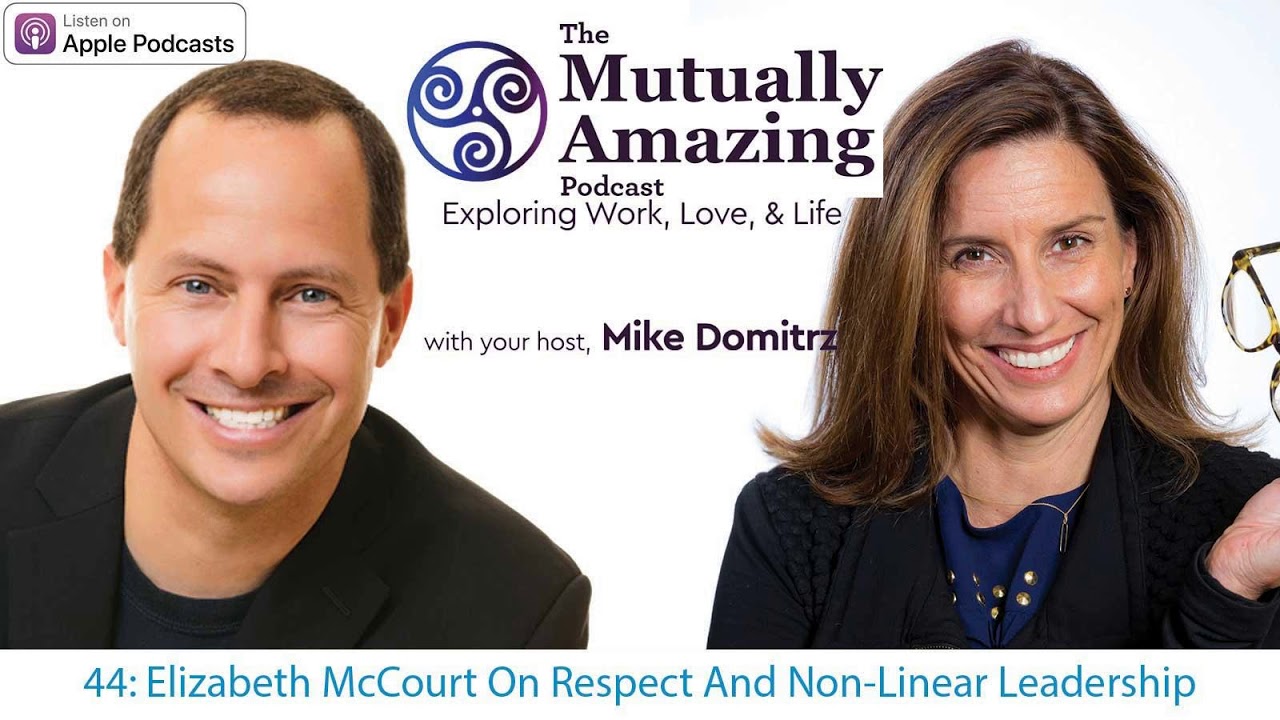
In this episode of the Mutually Amazing Podcast (formerly the Respect Podcast), host Mike Domitrz interviews Elizabeth McCourt, a coach, speaker, and writer who champions cultural diversity, generational inclusion, and a nonlinear approach to career development. The conversation explores how respect underpins effective feedback, the creation of safe spaces for honest dialogue (both in workplaces and mastermind groups), and the importance of understanding cultural and generational differences. McCourt shares practical frameworks—such as using “have you considered…?” instead of prescriptive language, setting ground‑rules for confidentiality, and balancing directness with caring (inspired by Kim Scott’s Radical Candor). They discuss the challenges of stereotypes about millennials, the value of reverse mentorship, and how to cultivate respect for oneself and others. McCourt defines a “nonlinear mindset” as leveraging the full, often jagged, trajectory of one’s experiences rather than a straight‑line career path, and ties this mindset to respect for both successes and failures. Personal anecdotes illustrate how she asserted respect in male‑dominated environments and how mastermind sessions can foster rapid, candid feedback when trust is established. The episode also highlights recommended reading (The Culture Map by Erin Meyer, Brené Brown’s work) and ends with a travel anecdote about Egypt, a call to subscribe, and a question‑of‑the‑week prompt.
Chapters
Welcome to the Mutually Amazing Podcast. I'm your host, Mike Domitrz, with the Center for Respect. The episode you're about to listen to was recorded when this show used to be called the Respect Podcast. So, you might hear that mentioned during this episode. Well, let's get to the show. And welcome to this week's guest. Elizabeth McCourt is a nonlinear thinker, practical, Creative, and conforming nonconformist. Cultural diversity and a passion for making better, more authentic leaders is the core of her work as a coach, speaker, and writer. Elizabeth, thank you so much for joining us.
Oh, thank you so much for having me. It's a pleasure to be on the show.
Well, we're excited to have you on it, and you love to discuss what we're just discussing— conforming, nonconformist, cultural diversity. How does understanding And respecting other cultures impact your work?
You know, it's something I work with all the time. I actually really enjoy diverse environments, generational, different generations. And a lot of my work is global. So working with a university based in France, I'm also often working with global leaders and need to have an understanding of cultural diversity because not everyone processes things the same way.
And so to be really aware of that is essential for So for those listening who think, well, I don't work globally, why do I need to think about respecting other cultures and how it impacts me?
I mean, I do. I believe it's important for everyone. I think in this dynamic work environment, we have the digital age. We don't have to go to an office and necessarily work in the same place. We're working across the country in the United States and sometimes with companies that are across the world. And I think in our— the workforce has changed. gotten more diverse in both age, male, female, cultural diversity. And so I think it's something that really needs to be top of mind in all of our interactions. So it's not just doing global work. It's really anytime you're working with people, certainly understanding how they like to work and how they receive feedback and whatnot is essentially important.
Well, yeah, and I think it's even in our own communities. If I'm open to understanding other cultures, there's a good chance I'm more likely open to different thoughts and different thoughts as far as ways of thinking. So if my neighbor thinks very different than me, but I have a mindset of trying to understand other cultures, I'm probably more likely to have a mindset of, I wanna understand why you think differently versus just thinking you're wrong. Is that true or do they not roll into each other that way?
I think you're right. I think it's really a matter of being open-minded that your way of doing things may not be, may be a great way to do it, But can you learn from other people? I think this is also my personal interest is how do we also learn from other people? And I think in essence, that makes us do what we do better if we're open to that concept.
And that's all about feedback, which you brought up a moment ago. So in the workplace, how does respect play a role specifically in both requesting feedback and receiving feedback? And we know sometimes unsolicited feedback. So that's why I gave you a multi-pronged question there. You can attack whichever one you want first.
That's all right. No, I think, I mean, feedback, if we wanna get better, we need to be able to be open to receive feedback, both, I think, both direct feedback and I don't know if it's indirect feedback, but I think we process feedback differently. I always say there's the American version of feedback is like a positive sandwich, the positive and then the constructive, and then another positive. But you might get a boss or someone you work with who just gives you super direct feedback without that positive sandwich, and you have to be able to understand where that's coming from. And that's receiving feedback. And I think in the same way, it's really important to understand who you're talking to, whether it is in the context of a speech, whether it's in the context of being a leader in an organization, is can you give the feedback in a way that it can be heard by people? Because if you're just barking feedback, people might not hear it, and therefore you're not being as effective as you might be. So feedback and how people receive it and perceive it is both— both things are important.
And is that really critical to what relationship you have in that moment? So for me, it's with an audience. It could be a relationship with the audience, whether I can give that really direct feedback, because there are times in my life where I Gave that direct feedback and it was not received as well because I had not established the relationship to that point to be heard, or the way I said it, like you said, is key. Do you think relationships, when they're healthy and strong, allow you to stop the positive sandwich? In other words, stop always having to go positive, feedback, positive. When you have a really healthy, wonderful relationship, can you cut right through to that and get to the direct feedback?
I absolutely think so. I think it's about developing, like you said, relationship and developing trust. Because if you're someone that is known to have integrity and trust and you're dealing with people and you've built those relationships, they know that— I mean, there's a balance, of course, to giving too soft feedback that has too much emotional intelligence tied to it that it's not effective, and then that harsh feedback. So can you find— I think that's in the book Radical Candor— can you find somewhere in the middle where is That balance of, I'm giving you this direct feedback because I actually really care about it. I think that's really where it has to come from. It's not just, you know, taking someone's legs out of harsh feedback.
Yeah, and that I care deeply about you in this moment. I think that's so important. Now, it's still important how we say it. I mean, if we're just rude, that being direct. And I was often very direct with people and people say, oh, Mike's really blunt. But there's a difference in being blunt caring and just blunt saying it with no care. And so people would say to me, well, I knew you cared, so I was okay with it. But I would later learn in life that there were people who didn't take it that way. And it could come off as arrogant, self-righteous. And you have to recognize, oh, I could have been just as blunt in a more caring fashion, just by simple change of language.
Oh, absolutely. I think the language that you use in feedback can be really important. And also asking some questions around it. Giving feedback and then maybe asking a question to have them perhaps, A, repeat it back that they understood it, or B, maybe a question to a context of understanding where it's coming from. And I think, like you said, because they knew who you were and they knew how much you cared, and so it didn't feel like just abrupt feedback. It was just coming— maybe you were busy, but you just wanted to give them 1, 2, 3, it sounds to me. That, that's something that happens. So, they knew it wasn't just you barking orders, barking feedback at people without any understanding or care.
Yeah. And that is the key, which still we have to always be accountable because we can disguise and say, well, I was doing it because I cared. Yeah, but I'm still responsible for how I do it. And so, that does fall on me. If I say the words, how I present them comes back to me. I think the relationship built that we're talking about is so critical. I just spent a day In masterminding with a group of people I had never masterminded with before. And I think what was neat about the power of one single day, being in a room with 10 people that you've never masterminded with before. And for anybody who's listening going, what's a mastermind? Imagine a company having a board of directors that you, that sees everything. You hold nothing back and they can give you feedback on your business, but you're doing this in a day with people you've never met before, maybe, or you've met them briefly and you're being vulnerable to helping each other's business grow. That's the setting I was in. The key for it to work was to set the ground rules.
Absolutely.
The ground rules were, we don't say should, you must, what are you thinking? We say, have you thought of this? Have you considered this from my experience? What about this possibility? And then you can be just as blunt after you say those words, right? So, have you considered this possibility that writing doesn't make money? Have you considered that as a possibility? Whereas if I had said just, hey, writing doesn't make money. And you're a writer, you could be like, how dare you? But if I go, what about the possibility that writing isn't the way to revenue? Like, just as an example, uh, it presents it completely differently. What I noticed was when we felt safe in that room, we were so blunt and so fast, but always caring. And it allowed us to be super efficient in helping each other.
And I think that's the key, isn't it? That you, you sort of set the ground rules of trust. And openness and the ability to be direct and the ability to be efficient with your words. So you set the— it sounds like you didn't just jump in there and start with super direct feedback. You had some context to what you were trying to accomplish for the day so that it could really be productive and effective. And my guess is that if someone felt like the feedback wasn't quite working or it was a little too direct, that there was permission there to say, Hey, that felt like this. Did you mean that? So that you could be constructive about it.
Yeah, that's great you point that out because we actually gave examples. The facilitator and others in the group gave examples of healthy examples, not healthy examples. So, example, let's say that I had 23 minutes in my given time for everybody to give me feedback. That included the time I was going to talk in there. So, they actually said, hey, when we give you feedback, Try not to feedback us on our feedback. Just listen. So, you're going to want to push back and go, well, I've tried this. I've tried that, but, but, but. No, if, unless you're saying, okay, I once did that. How could I overcome this? That's different than I tried that, but it doesn't work. So, listen and be— what it did, it gave us an exact example. I thought, oh, don't do that. Because when it came to my time, there are a couple of times you want to do that. You're like, nope. Agreement was I wouldn't do that. So, Just listen. And by listening, where the feedback went took me in some directions that would have been shut down had I just cut it off right there. So that's what I love about feedback. It's about both how we receive it, how we're giving it. Now, on the giving it, they said, hey, if somebody in the room is talking to— not getting to the point, we're going to say, hey, land the plane. Like, we're giving each other permission to just say, land the plane, because we have limited time. I love this. What are you talking about? And by us saying that early on, if somebody did it later, it wasn't offensive. It was like, okay, I'm doing it. I, you're telling me that because I'm making the mistake. So yeah, I think setting the parameters is so important to feedback. And in a place I love that you point out, it's all of our growth can happen because of feedback. It's just when we're willing to listen.
Exactly. And you've said this a couple of times and I couldn't agree more. Sometimes it's really important to just listen and absorb and not be— not sort of fight the urge to be defensive or have an opinion about it, but just really to absorb and listen. And I always say that just because you're getting a bunch of feedback doesn't mean you need to take all of it. I mean, we are— we know what we will and won't do, and we know where we might push ourselves ultimately. And that's part of my work as a coach, is that I don't tell people what to do, is that you know what to do, but to really decide on where you can push yourself, or maybe there are some ideas that you haven't tried already, but to really listen, because it's absolutely an opportunity in a mastermind. It is a wonderful opportunity to get perspective that you might never have in a regular office environment or in the real world, you know.
Yes, absolutely. So when— let's look at that difference of that workplace versus the mastermind. There are some ways a mastermind is scary but safer Because you're not working with those people every day.
Right.
Whereas in the workplace, that impact of how you impact the people in the room shows up tomorrow when you come back into work, shows up the next day when you come back into work. So what are some things that I can create a safer environment for myself and for everyone?
Absolutely. And it's funny, this is something that I absolutely do in my work, is this group coaching and sort of the masterminding facilitation. And I think it's so important to create that environment of confidentiality, number one, because if you were to be Yeah. In that environment and not know that it was confidential, you would be willing to share less. So I think we call it contracting upfront. Again, sort of the rules of engagement, the rules of the game, but one of the most important ones is confidential information will be in the bubble of your mastermind. Because like you said, it's things that you might not share. And I think in the work environment, it's different. When you're working with people and you're getting feedback, that tends to be— it feels less confidential. in certain circumstances. So, it's harder, I think.
Well, and I always tell people, even in a mastermind, I'm a believer of there is no confidential safe space because I can't guarantee you somebody's going to walk out of here and not say it. So, while I want us to know that we're going to do our best to be safe, know that if you in any way fear saying something could ever leave the room, you don't have to say it because we said this is a safe space because I can't guarantee you anything. And I think one of the mistakes we make in the workplace is we tell people that our workplace is a safe space when we know we can't guarantee that.
Right.
And then somebody's betrayed and you never get that back.
That's true. I, I think you're right about that. I always say to people too, if there's something that you don't want to share, that's totally okay. But you're right, you have to feel really comfortable and confident and, and Unfortunately, not everyone has integrity and trust. You hope in these circumstances that people do, but I think you're right. If there's something that's very delicate and you feel uncomfortable, I think whenever you share something, and I've talked about this in my TEDx, is that trust is the first thing. You have to trust the environment, otherwise, and perhaps even have processed some of what you're sharing yourself so it's not totally raw when you share it.
Yeah. And trusting yourself, right? That if I'm going to say this, not that it doesn't make me look perfect, because that defeats the whole purpose. You want vulnerability. Otherwise you can't really have honest feedback without vulnerability. But am I sharing this in a way that's true? Because like you said, if it's raw, you might even say something that's not true. Just, you don't mean to say an untruth. You're just exaggerating because you're in an emotional place where exaggeration takes place. So I love that you said, Hey, make sure I'm in a place where I'm okay with this. I think that's so important. Now, you talk about respect when it comes to multicultural, multi-generational work environments. How do we work with respect in those capacities?
You know, it's funny. I did a workshop not too long ago. It was about— it was for millennials in a multi-generational workspace. And one of the rules of engagement was not to use the word millennial in it. And you're thinking, how can you do a workshop for millennials without saying the word millennial. And what it boils down to is people are just people. So people are different. We, you know, we sort of— we're the same in a way, but we all have different life experiences and different skill sets. So can we respect and be curious about other people, whether they're young, they're old, they're from another culture? If you're curious, ask the question and be respectful.
And what do you think are the biggest barriers that people have when they discuss generations? You know, you have the, the millennials. People will horrifically say millennials are lazy, and I've never found that to be true. I work with millennials a lot. I have just not found that to be true. So how do you overcome it? And by the way, I think every generation has been— that's been said about at a certain phase of their lives, like in a certain era. We've said that about every generation. So, what are the stereotypes that people tend to fall in and how can we help them realize, look, that's just not factual?
Yeah, I think that's the number one. I think we've heard that, oh, they're lazy, everything, they expect everything to come to them. And I think it's really unfair. If someone is working, if they're a younger person in the workplace, I always say there's reverse mentorship opportunities. There's something to be learned from someone who's younger as much as there's someone to be learned Mm-hmm. From someone older and more experienced. So can you share your experience in some way without having a prejudice against that person coming into the workspace? Because like you said, I think one of the prejudices of, like, they want to know more or they may be more experimental. I think the key is understanding the motivations of the person that you're working with. What are their goals? What are their desires? Where they want to go? And then you can direct your conversation and/or your feedback into that direction of goal so that it feels more satisfying to that younger worker perhaps.
And Elizabeth, you sent me a question before the show that I thought was interesting. It says, what did you do to feel respected in your work? So can you, one, explain the question? I obviously want to hear the answer.
Ah, you know, it's funny. I was reading over my own question and I was pondering that too when I wrote it because I think Honoring your skills and your own experiences as you go into a job, whatever that may be, or if you're an entrepreneur and you're crafting your own position and crafting your business, it's respecting both your strengths and your weaknesses as much as you're respecting that of others. And how can you— I always say, how can you leverage your own experience? To make you who you are or make you better and more successful in the workspace? And then also doing the same for others. How can others help you do that? But really sort of respecting both your limitations and your goals and your aspirations as much as you do that for other people as well. And I think that will help you be more successful and more curious and more open to feedback and enable you to sort of embrace the wealth of knowledge and experience that you have.
Yeah, and it allows me to acknowledge that I'm fallible without shame about it or guilt about it.
Yeah.
Because of course I have weaknesses along with my strengths. So, be proud of my strengths, own those, like, yes, this is who I am. And these weaknesses, that's part of who I am. So, if I'm aware of that, okay, then I can be cautious of falling and letting the weakness lead the way or being arrogant or stubborn. And I'm not gonna act like I don't have that weakness. And so, now I come off as self-righteous and know-it-all. So, having all that, and I can tell you, I certainly had the ability to come off that way at times in my life, that's for sure, because I thought I had to look that certain role and we fall into that trap. But what I also love about what you said here is that if I understand that that coworker who frustrates me has strengths and weaknesses, so that's their— so they have a weakness that frustrates me. I have weaknesses. They frustrate people. So, why am I getting mad at theirs? It makes it much more human.
It really does. I think, I think we're stepping into a world that there's more a holistic approach to the work environment. We— I talk to people and I say, you can't be a person at work and a person in your home life and a person outside of work and all these different facets of your personality. Why not take the best of all of you and bring that to whatever you do?
Yes. And I love when a friend of mine, Sean Stevenson, was doing an event several months ago. I was at speaking with at his event, and it was helping people become better speakers. And he said, look, if you want to be a world-class speaker, you have to be a world-class person.
I love that.
I love it. And imagine if more companies understood that if we want a world-class operation, everyone in our organization needs to be world-class, which means we have to help you believe you are because you are. You may just not realize it. So, I want to find that in you and draw that out of you as an organization. And speaking of being able to do that, when it comes to leaders, how do you help new leaders understand the importance of respect and treating others with respect?
I mean, I really feel like there's a golden rule that I'm sure you've used throughout your life as well that I use is you treat everyone the way you want to be treated.
Yeah, I actually have a tougher standard and I'm not knocking that standard. But because of the line of work I've been in for so long, I've seen people who don't believe they deserve to be treated well. So it's easy to treat others poorly. And so I'm always careful of treat people the way you want to be treated, because that can be an awful standard. So it makes us raise the bar and go, you know, treat everyone like they're— like they deserve dignity and respect. Treat everyone like they have strengths and weaknesses and they're valued as a human being. So I'm using your own language. I'm going backwards here in our— in our interview, but pulling that language out and treat them that way because you might not be treating yourself with any respect.
I really love that, Mike. I think that's so important because like you said, with the population that you work with, that's essentially important. And, and I always say, I don't care what someone's position is. If you treat people with honor and respect from a job, from the lowest job to the highest job, I, I feel like that helps everyone move forward.
Yes.
And I do think also that sometimes I work with some millennials on occasion that feel like, you know, their age is a detriment and that they won't be respected because of their age. And so it's really about owning your confidence and also being humble to, like we've been talking before, like understand what you don't know and be open to learn. So that open-mindedness, so sort of that lack of arrogance that you You know it all, or you, or maybe if you don't know it all, but having that confidence and respect in what you do know and the ability to ask for help when you need help.
And you refer to a nonlinear mindset and respect and how they go together. So first of all, for our listeners, what is a nonlinear mindset? And then how is that a connection to respect?
Well, the nonlinear mindset is really about what I talk about is taking the entirety of your experience. And leveraging that for your success. So it doesn't mean— I think a lot of people think that you should do this. You should go to school and you should do this and you should do this and you're supposed to do this. And I've had a path that's a little more curvy than that and encourage people that when you take a jag in your career path and maybe do something that brings you in a different direction, either good or bad or success or failure, that don't think of it as, oh, I went off the path. Use that as experience to leverage that into what you're actually doing. So it's the culmination of experience, that more holistic approach to leadership and you know and success. And I think it's it's respecting both the fail respecting the hiccups and the failures as much as we respect the successes and the accolades. To know that you you may have gone one way and it didn't work out so well, but you learn something. So it's always about. Learning from these pivots and jags so that ultimately it brings you to where you want to be, and respecting that process because it's not always— it's not always straight and linear. So respect that you're still going in the right direction and have confidence in that.
I love that because that's fluid. Yes, that's about the journey more so than the outcome necessarily. The outcome teaches us, but Well, the journey is flexible.
Absolutely. How could it not be? I mean, I think I always say it's what you should do and what you end up doing could be 2 different things, right? So embrace that everyone is different and we're all flawed. But ultimately, if we're, you know, if we're using our integrity and going on the right path, it will turn out.
What brought you to your journey in this, this focus point?
Well, a nonlinear path for sure. I think I determined that what I love to do is help people embrace this part of their journey. And from me being in investment banking to trial lawyer to headhunter to coach, it really— that's the trajectory of what brought me to where I was. And I always found that, one, by respecting other people and other cultures, I could really have deep connection with people to help them, get what they want or achieve their goals or not be afraid to do things a little bit differently. And I think that is— I think that's how I've crafted my entire career is to do that in the realm of both coaching people and speaking on stage and in my writing as well, is I get to do all of that, that theme of embracing your nonlinear path in everything that I do.
And so can you think back to a time When you were really taught a strong lesson for yourself about respect, either like, I, I am going to stand for this from now on because of this experience, some way that you said, hey, respect matters and I'm going to move forward with it because of this experience.
I've always been a woman in male-dominated industry throughout my entire career, and I realized very early on that I was really going to have to stand in my confidence and hold my own so I wouldn't get my opinion steamrolled. I think when I realized long ago when I was one of very few women in a very large room of men and I needed to get my point across, I think that was very much a pinnacle moment for me to realize who I was, you know, what I stood for. And that I had both the intelligence and I call it the street smarts to do it just as well as anyone else. I always say that if I can do it, then you can do it. And that's very much sort of the resilient mindset that I bring to people that I work with and who I am. I'm very attracted to and inspired by people who are very resilient.
So how do you, in those moments where you feel it's not, you're not being treated that way, what's your approach or strategy to speaking up or to making sure that you say, hey, this is not how I'm going to be treated, you know what I mean? Or I'm not going to be disrespected this way. It doesn't have to be speaking up, but how do you make sure you stand for respect?
I think there's a moment where you actually have to use your voice. It's not easy. And oftentimes it's really scary. To speak up in this regard. But I think that if you're feeling— if something is churning in your head and you're feeling uncomfortable, I think I really try to empower myself and to others to raise your hand and to say it because what's the worst that can happen? That it won't be heard?
Right.
Or someone will dismiss it. But I think sometimes we really have to— you have to put yourself out there and say, you know, you're not respecting my opinion. This is my opinion. I think there's a difference between being defensive and stating your point. So come from a place, like you and I were talking before, of using your words in a way that don't come from that defensive place, but come from a more empowered place. And also understand that— It can be scary, and that's actually where the learning is. I'm not saying it's always easy for me too, but if I'm scared and I do it anyway, the empowerment that I feel afterwards is always worth it.
I love that. And you have specific books that you really love, though you brought up the one already, Candor. Can you tell us what you love about that book?
Oh, it's Radical Candor by Kim Scott. What I love about that book is that it's that balance of in a simple way, the balance of giving very direct feedback and also giving it from a place of caring. Too much of either one is ineffective, but how to find that balance in the middle. And I think as leaders and as people, that's something we're always grappling with is where to find that balance of directness and also showing someone you care. And the other book, I think if you're doing international work or you're working with diverse cultures, is called The Culture Map by Erin Meyer, a professor at INSEAD. And I think this book is really interesting from a cultural perspective, just to understanding how different cultures, including our own culture being based in the United States, how we process feedback, how we— our sort of cultural norms in business environments. It's a very insightful book that I think for global business or diverse workspaces is really important.
I know the other one you love is Brené Brown, uh, and we're going to provide the links to all of both Brené Brown's books, both books you've referenced. I want to thank you for sharing the resources. Also, more importantly, thank you for sharing your experience and your brilliance.
Oh, thank you so much for having me on. I think you're doing great things for your audience and it's a privilege to be on your show.
Well, that means the world to me. So thank you. And for our listeners, next up is our question of the week. Before I answer this week's question of the week, I'd love to ask you a question. Would you please subscribe to this podcast, The Respect Podcast with Mike Domitrz? By subscribing, you can make a huge impact. Now, you might be wondering, Mike, how does my subscribing to your podcast make a huge impact? Well, here's how. For every person that subscribes, it raises the rankings of the show in the search engines. So for people who care about respect like yourself, when they're doing a search for podcasts, They're more likely to find this show, thus providing an awesome opportunity for us to spread more respect around this world. And all you do is hit subscribe under your podcast. Plus, the second benefit is by subscribing, you automatically get every episode right into your phone or whatever device you're listening to the podcast on. It happens automatically. So subscribing also makes your life easier. Now let's get into this week's question of the week. Oh, and By the way, you can always ask your questions of the week by joining us on Facebook in our discussion group. It's called the Respect Podcast Discussion Group. Go there on Facebook and ask whatever questions you would like me to answer and/or address in this segment of the show. And then listen to each episode to find out when your question is included. This week's question is, Mike, what's the most awestruck location you've ever been into traveling to do this work? And for me, it's Egypt. That is Cairo and Luxor, because we're sitting there literally at the pyramids, in the pyramids, at the temple of gods, the kings and the queens. And it's unbelievable. You're talking about 10,000 years of history, and you can— and it's like it's— you're there from 10,000 years. The paint is exactly— they haven't renovated it. It's that blue and the reds you're seeing in the paintings inside the tombs or inside the pyramids is original. It's just awe-struck. And I was very fortunate that I got to do this with one of my sons, Stephen. And so that made it extra special. For me, that's it. It's Cairo and Egypt. We'd love to hear your questions, your thoughts, and your ideas. And the best place to leave those with us is on our Facebook page at facebook.com/MutuallyAmazingPodcast. Of course, you can always contact us on our website at mutuallyamazingpodcast.com. Remember to subscribe to this show so you automatically get it every week. And if you could take one moment to leave a review, that really helps other people find the show, which we are greatly appreciative of. So thank you so much for joining us. May you make today and every day a life full of mutually amazing relationships.








