48: Joe Mull on Reducing Team Drama in Your Organization
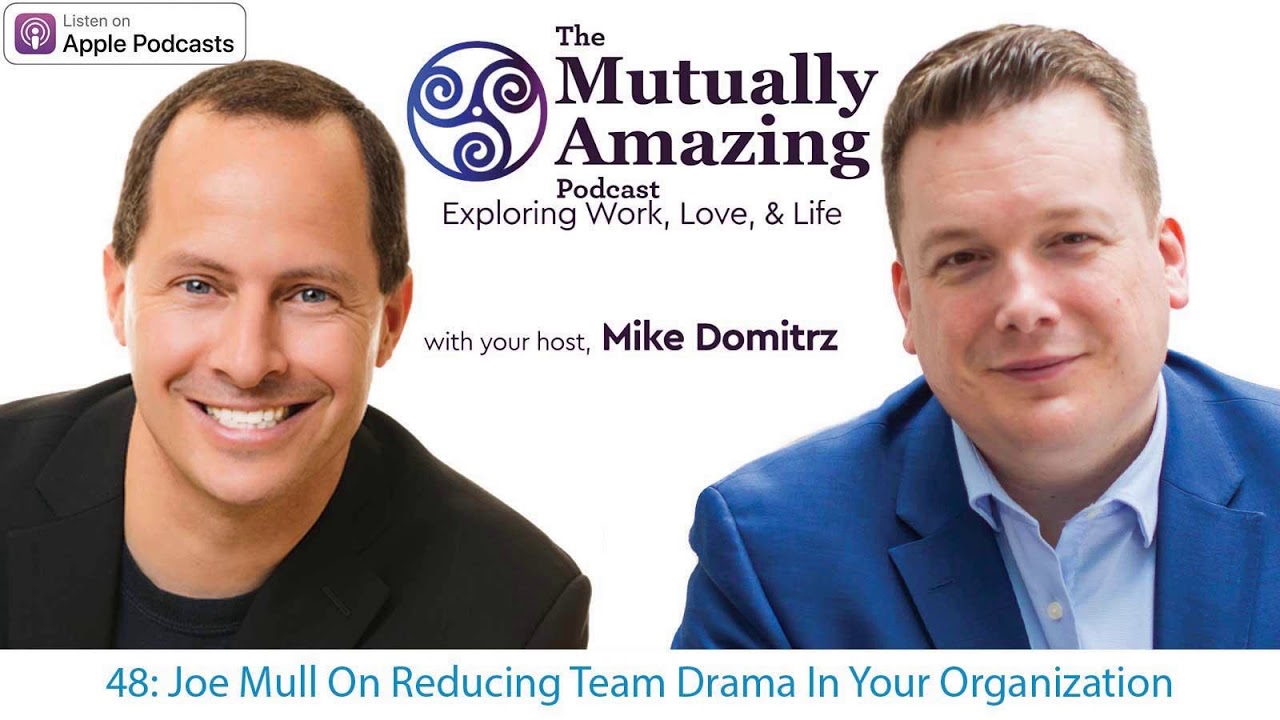
Joe Mull, author of No More Team Drama, explains how gossip, cliques, and score-keeping damage teams. He shares a four-pillar framework (courtesy, camaraderie, conflict, cause) and concrete tools like asking "Is there a perfectly good explanation for why this person acted this way?" to shift how teams handle conflict and build trust.
Chapters
Welcome to the Mutually Amazing Podcast. I'm your host, Mike Domitrz, with the Center for Respect. The episode you're about to listen to was recorded when this show used to be called the Respect Podcast. So, you might hear that mentioned during this episode. Well, let's get to the show. Yes, and welcome to this week's guest. It is Joe Mull. He's the former head of training for one of the largest physician groups in the US, the author of 2 books, Cure for the Common Leader and No More Team Drama. He spent the past 5 years teaching healthcare professionals across the US how to be better bosses and build stronger teams. Joe, thank you very much for joining us.
My pleasure to be here. Thanks for having me.
Absolutely. And I love your topic because you discussed team drama. So how did you become an expert in team drama in the workplace?
Oh, goodness. You know, I've been doing leadership and team development work for a long time now. And what the impetus for zeroing in on that subject recently was actually born out of the first book that I wrote, which suggests that there are 7 strategies leaders have to deploy in order to create environments that lead employees to care and try and give their all. And as I traveled the country for the better part of 4 years, speaking and training on that material, I found that I was discussing one of those strategies with team leaders more than any other, and it was this idea that leaders need to learn how to foster group cohesion and team spirit. And so even though we were spending a lot of time doing that kind of work with teams, I didn't feel like I had really a satisfactory answer or set of strategies to help leaders get better at that. So about 2 years ago, I decided that I wanted to try to answer a simple question, which is Why do some teams become high-performing, close-knit workgroups while others get mired in dysfunction and drama? And so I spent about 2 years researching and writing and testing that material, and that's how I ended up writing that book and zeroing in on that particular issue recently.
And so your discovery was that those who did not have team drama had excellent performance than those who did not? Was that the outcome that made you go that direction?
Well, yes. What we find out is the stuff that I define as team drama is the stuff that tends to live in a gray area. There are things that happen in the workplace that are abhorrent, things like threats and physical intimidation and bullying and harassment. That's not team drama. That's not what I wrote the book about. Those are behaviors that are illegal and have no place in any work environment. Team drama are things that live in a kind of gray area, like gossip and cliques and infighting, people who keep score for what other people are doing. And, you know, a lot of leaders and members of teams struggle with whether or not that is something they should just learn to endure and live with, or if they should speak up and challenge it. And so the environments where team drama is low There's an absence of those kinds of things, and there is a higher prevalence of engagement and satisfaction in the workplace. When team drama is low, we see that people are happier and outcomes are better and performance is higher.
Can you give us an example of a case of team drama?
Sure. So I had a client recently up in the New England area who came to me about a year ago. It was a small medical practice group that had undergone quite a bit of transition. And they asked me to work with them to help improve the quality of the interactions that take place across the members of their team. And so I did a needs assessment with them and really got into a conversation that focused on some of the habits that they would get into around communication. And so one of the things that we know about team drama is that it's often born out of people reacting to their perceptions of how they were treated by someone else. And one of the things we know about human beings, and that is shown over and over again in social science research, is that our perceptions of why other people do what they do and say what they say are horribly inaccurate. We make up stories and fill in the gaps for why people show up in certain ways, and those are often untrue. And so the client that I had in New England, we spent a lot of time talking about biases, talking about the stories that we make up about other people when we don't know them well or when we are just left our own devices sometimes. And so by giving them a couple of simple tools, a couple questions to ask themselves from time to time when they are bothered by or frustrated by something that someone else says or does, we're actually able to improve the quality of those interactions. I have found that one of the most powerful questions you can give a member of a team to ask themselves when they are frustrated or upset with somebody else is to pause and ask, Is there maybe a perfectly good explanation for why this person acted this way? That actually forces our brains to stop filling in the gaps by assuming malice and to actually use a completely different part of our brains where we think more creatively and step back from the situation to say, hey, what if there's a perfectly legitimate reason that this person took this action? If there is, what might that be? Suddenly we become a more forgiving, tolerant person, and we don't react to things that aren't in evidence.
I love that. And could it be a question also, for instance, such as, uh, what would be, what would be a reason they said that, that had nothing to do with me? Is there a possibility that what they just said had nothing to do with me? And what could that be?
Absolutely. So one of the things that I teach around team drama is that there are 4 things that teams have to get good at together. To reduce team drama: courtesy, camaraderie, conflict, and cause. And when we talk about conflict, we talk about a pattern of behavior that tends to unfold pretty frequently in the workplace. And it's something that's referred to as the drama triangle. And in the drama triangle, when I am upset or bothered by something that someone else says or does, it's pretty rare that I go directly to that person and say, hey, this bothered me, help me understand this, can we talk about it? Because I'm having a reaction. Instead, what we do is we go to another person and we say, hey, can you believe that this person said this thing or did this thing? And then that other person says, oh, I know, tell me more about that. And all of a sudden we've formed this little triangle, and it's a predictable pattern of behavior where we're reacting to the perceptions we have about others. And half the time, just like you said, those reactions have nothing to do with the other person. The role that we see that first person taking in that drama triangle is typically referred to as the victim. And what we have to equip people with is some insight and some self-talk and some strategies to help them understand that we need to question that. Am I really helpless here? Am I really a victim? Am I being victimized in some way? Uh, or does this have nothing to do with me?
Yeah. And you know, we call it in the Landmark world, if anybody's ever taken a Landmark forum or any of that, I shouldn't say we, I'm not part of it, but anybody who's ever taken that, it's, you know, are you running a racket here? What story are you running? Uh, that has, that you've created. It's all about me. And we do that as human beings. We wanna think you gave me an attitude because of me versus you gave me an attitude cuz you're having a bad day. Maybe, maybe something at home's not going right. Maybe something happened in a meeting you just came from at work and I'm making it all about me. I'm saying, oh, your attitude is because of me, which is weird because when you do that, you have to be a pretty awful person to be impacting all these people negatively all the time. Yeah.
That's right. You know, and there's an unconscious part of this too, because our brains are hardwired to more favorably judge ourselves and to more harshly judge others than they should be. There's something called the illusory superiority bias, where we, we overestimate our own capacity and capabilities. We inflate our own suffering. There was a research study where drivers were asked to rate themselves and their driving ability, and 93% of respondents rated themselves as above-average drivers. In other words, on a scale of 1 to 10, everybody thinks they're a 7, but we also tend to think that everybody else is a 4. And when we apply that biased thinking, and most of the time it's unconscious, to others, we end up moving through the workplace with an angel on one shoulder who says to us over and over again, you're the best, you're amazing, you're such a great person, and a devil on the other shoulder who says, That person, man, they're the worst. They're not even trying. They're lazy and selfish and entitled. And all of a sudden we've got these 2 voices in our ear and both of them are skewing our perceptions of others. And then we react to those perceptions and we get caught up in team drama, gossip, cliques, et cetera.
Yeah. And then, and what's funny about it or ironic or sad is that we think we have that much control over others. Like you, how dare you say that to me, implying that it was about you. As if every time gossip or drama happens in your life, it's all about you, which, which is just a silly concept. And letting it go and saying, hey, why am I getting caught up in their attitude? Uh, I had a friend who once said, if somebody's mad at you, it's none of your business. You know? And, and the idea is that you don't have the right to tell people they can't be mad at you, or you don't have the right to tell people they can't be disappointed in you. Now, I think there's an extreme of that that's not true either, because if you caused something. If you did genuinely cause something, that's your business cuz you caused it. You said or did harm. And so there is responsibility there. So I love how this helps people address what are the possibilities and explore them. What's the language you tend to advise people to use to go direct? One thing I learned years ago was to say to someone, to come up to 'em and say, you know, the story I'm telling myself in my head is, and that means it's not about you did this. This is a story I'm telling myself. Is that you're upset with me right now because of the way we just had that conversation? And it's a story I'm telling myself. It may not be true, but allows the person to go, "Oh, it's not true," or they'll say, "You know what? Yeah, you did something." Yeah.
So you know when I when I work with teams and when I work with leaders, I really try to to help them give their personnel the skills and tools they need to get better at giving and receiving feedback. It's such a core foundational skill, and it almost seems absurd that in the workplace we need to teach adults how to do that, but it's true. And we don't really set aside time to help prepare people when they enter the workforce to do that well. So I try to give them a couple scripts and a couple tactics to use. One of the things that I give them is the scripting that you just heard me use a few minutes ago with the phrase, help me understand. You know, if we do need to go to someone directly, To work through a situation or to better understand why something is happening, instead of leading with, you do this and you do that, we just change that pronoun to I. I'm having a reaction to this. Can you help me understand why this occurred or why this action unfolded? It's less threatening. It's less of a verbal poke. Half the time, the work that we need to do with team members comes before that. It's doing some proactive work with teams to say, hey, if you're bothered by something that somebody says or did, how are we going to handle that as a team? What do you want our general mantra to be or our general agreement to be? And most of the time, members of teams will say, well, if somebody's frustrated with me, I would want you to come to me. And so when you can have that conversation proactively, you have that to lean on the next time an employee walks into a boss's office and says, I'm so frustrated with so-and-so. That boss can then say, okay, timeout. As we talked about before, we agreed that your first step was going to be to go to that person. Have you done that? And if they say no, then that's an opportunity to challenge that person to say, hey, you stood in a room and said that this was how you were going to show up. And if you want us to trust you, then you have to live on that. You have to act on that. It's easy to do that in a vacuum when we're all standing in the room together. But now the rubber is meeting the road here and you need to act on that. So I can't have that conversation for you, but what I can do is sit down with you and help you prepare for that conversation. So why don't we do that now? So that's one of the other things that I do. I think the other important piece is helping people in those conversations understand the difference between intent and impact. So if a member of a team sends an email to everybody else on the team and that email provokes a reaction and people say, boy, this email was curt, or I felt attacked, Then, and they— somebody goes to that person and says, hey, you sent this email, I think it was out of line. In most cases, the very first thing that the emailer is going to do is defend their intent. They're going to say, I was trying to be efficient or get this taken care of or cut through the chase. And what we have to teach people to do is recognize that often their intent is good, but to listen for the impact and to recognize that their intent did not occur and it didn't produce the results they were looking for.
That's brilliant. And I love that you're bringing people together to lay out the guidelines early on. I think this is where people miss it. They think, hey, I'm gonna go in and tell everybody, this is how we handle that. But nobody has buy-in on that. Whereas what you're describing is bringing the team together and saying, hey dude, what's the best way we all agree to this? Because then when somebody doesn't, you go, hey, we agreed to this. Now, if somebody's like, well, I'm just not gonna do that, even though everybody else agreed with it, well then you might not belong here. I mean, that may not be an immediate reaction, but that's something a leader could decide. Is this somebody that we should keep on our team if they're not willing to respect the guidelines?
I've even advised a leader to ask the team member who refuses to go and have that uncomfortable conversation, how can we ever trust you again? And it sounds stark, but if you are going to create a culture where there is a, a minimal amount of team drama and where people treat each other with courtesy, And respect at all times, and they work through conflict in a healthy manner, then it's necessary to make the stakes that high. Otherwise, people aren't going to buy in because those conversations will never ever be comfortable. If people are waiting around for them to be easy, that's never going to be the case. We have to be willing to step into the discomfort of that conversation because we know that the pain we experience by doing it is much more shorter term and less significant than if we let those things fester or we let them blow up into full-blown team drama.
Absolutely. And I love that question. And then how can I trust you going forward? And I think for listeners, that's important to consider. They go, why would you say that? Well, what I, I think I understand you're saying, Joe, is that, hey, look, if you agreed in the room that this was the approach we're gonna take, and now you are not agreeing to the approach now that it's actually happening in real time, there's no integrity to your original agreement.
Absolutely.
And therefore there's a lack of trust. Is that, is that a correct, uh, analysis?
It is. And you know, uh, I think it does raise the stakes a little bit because sometimes it feels like maybe as an employee that I shouldn't have to do this, this isn't part of my job, whereas the leader needs to say, no, the ways in which we communicate and collaborate is at the center of your job. And if you can't do that successfully and effectively, and if you aren't willing to be both vulnerable and uncomfortable when necessary, it's hard to suggest you're giving it all that you've got, and it's hard to suggest that you are putting in the effort that somebody else would have to put in to show up with you in the opposite way. What I mean is, is that we often have to challenge members of teams to recognize that sometimes they're trying to move through the world with 2 different sets of rules. If somebody comes to a manager and says, I'm really bothered by this other person, or even a coworker, I'm really frustrated with so-and-so, one of the first things we can do is ask that person, Well, listen, if somebody was upset with you, would you want their first step to be talking about you to somebody else? Or would you want their first step to be to just come to you and talk about it? And 99 times out of 100, I just made up that stat, but it's probably true. That person's going to say, no, if somebody's upset with me, I would want their first step to be to come to me. And so that's an opportunity right there for that manager or that colleague to say, okay, great, but you've got to show up in the same way. You've gotta honor that exact same preference. Otherwise, you're moving through the world with 2 different sets of rules, one for you and one for everybody else, and that's never gonna work.
So Joe, how do you respond to the person who says, look, I've got this person on my team that if I asked them that question, hey, would you want this to handle this, they would respond with something like, I don't care what people say about me.
Yeah, yeah. You know, oftentimes that's a defense mechanism, and I think in those circumstances, what really needs to happen is for that that manager to deploy some coaching skills, right, to help them explore what is this behavior costing you, or what does avoiding the conversation cost you? What would the benefit to being— what would the benefit be to engaging in this interaction even though it's uncomfortable? It may not be the kind of thing that that person can move through conversationally with that person in a 5-minute conversation, That might be something they have to chip away at over time to help that person see that they will experience some benefits to having that conversation and some consequences to not.
Yeah, I think it's an important one. You might, if the person's name is Aaron, you might be, Aaron, could we explore that? When somebody says, I don't care what people think about me, Eric, can we take a moment and discuss that? Because that impacts how you are projecting yourself in this organization. in our team and how people see you. If you're— if it's a view of, I don't care what others think or feel.
You know, we may have to just approach it from a performance management standpoint, which is to say, I understand that you don't care what people think or say, but I do. And that's a significant part of the results that you are or are not getting here in your role. And so, we may just have to tie this back to your work product. You're not able to successfully execute your work product because you're not willing to invest in the types of communication approaches or, or, or collaborative interactions that are a key part of getting to your work product in a successful way. Another way that we may be able to point to that from a performance management perspective is through organizational competencies. Every client I've ever worked with does annual reviews, and almost every one of those annual reviews has competencies of some kind built in there— teamwork, customer service, accountability, etc. And often leaders don't know how to Talk about some of these squishy things, uh, in a, in a much more concrete way. And I always advise them, look at your competencies, point back to those. That's exactly where you put this stuff, and that's the language you can use to frame it and, and try to address it.
What I love about that is we talk to organizations all the time about, look, if I look at your core values, does respect really look like it's a core value? And that's what this is coming down to. If you're gonna say our culture's important to us, is it in your core competencies? Is it in your core values? Does it show up in a regular analysis? Where we would, it has to be in everything we value in our employees and every person. So I think that's so important and for people to think about, do I have that in my annual review? Is that there? So that was great, Joe. Thank you.
Thank you.
Yeah, absolutely. What are root causes of team drama? Like where at the root does this often come from?
Well, we started talking about this a, a few minutes ago. It, it's this idea that people react to their perceptions of how they are treated by someone else and that there's some hardwiring we all have. that leads us to have these surface-level reactions to why other people do what they do and say what they say, but those surface-level reactions are inaccurate. Sadly, the pace and speed of our work often prevents us from ever going deeper on those reactions. We just respond to that reptilian thinking at the front level and it becomes fact. We assume malice in how other people show up and then we react to it. Really, at the root cause of team drama is not having people on site who will challenge some of those false assumptions we make about other people. At the same time, though, there's some more concrete things that have to be put in place. So one of the 4 things that teams have to get good at in order to reduce team drama is courtesy. And I use that word really to start a conversation about what behaviors are expected in the workplace and are not tolerated. Most organizations I've worked with are absolutely devoted to promoting respect in the workplace, and they have lots of conversations about respect in the workplace. But that's a subjective term, and the person speaking about it knows what they mean, but we rarely get to the concrete. What are the behaviors that are unacceptable? What are the behaviors that we need to use in place of other behaviors in order to really live that as a shared value in our organization? So when I wrote my book, I ended up doing some additional research on disruptive and disrespectful behavior in the workplace. I do a lot of work in healthcare. Most of my work is in that area and most of my clients are in healthcare. And so I ended up pulling some research from the AMA, the American Medical Association, the ANA, the American Nurses Association, and some additional research for some really smart doctors in Ontario who were studying incivility in the workplace. And we pulled together a list of 18 disruptive and disrespectful behaviors that we can use to have a deeper, more concrete conversation about courtesy and respect in the workplace. So some examples of those would be things like swearing, things like not responding to a request for assistance, negative nonverbal reactions like eye rolling or sighs or dismissive waves. When we can have a conversation about respect, But go past that word and into specifics and concrete behaviors like that, it becomes far easier to ask people to adopt new behaviors and to stop using problematic ones.
So let's pause on that. Somebody could hear that and you said swearing, and some people go, whoa, whoa, whoa, swearing's just free expression of language. Uh, a lot of brilliant people swear, so why would that be in this discussion?
You know, I think it depends on the culture. Um, I have worked with organizations where, uh, it would be impossible to remove that from the culture. It's on the list because for some people in some places it is experienced as disruptive and disrespectful. What I think is important is for any team or any organization to be having a conversation about the nature of communication in their workplace and to decide and determine if swearing is a part of the culture there, if it's an acceptable and tolerated part of that culture. The other thing about that list is that they're not in any rank order, and some are gonna be more significant or tolerable than others on that list. And so that's a conversation for individual teams to have as well.
Well, and I love the explanation you gave because it allows each organization to decide for themselves, which is, look, we're actually gonna say if somebody's swearing not at you, but in their language, that's their expression, and don't make it about you. Now, if somebody's telling you to F off or something, that's, That's a whole different discussion because that's not even about the swearing. That's about total disregard. And, you know, it's a violent use of language. That's a different use of— and I'm sure there's clarification in those communications.
Absolutely. And if we think about somebody who's changing jobs, who's joining your organization, and maybe they've switched industries or they've changed roles and they come into a place where that kind of language is is prevalent and accepted and just part of the cultural norms of that institution, but this person came from a place where it was not, that could be jarring for that person. And that person might even misunderstand the use of that language and experience it as disrespectful behavior when that is not the intent at all. It might just be a cultural thing.
Yeah, well, how do you define respect?
Oh, you thought, you'd think I would have thought about that before our call today. You know, I would love to give you the pithy one-sentence answer, and I don't think that I have it. And that's probably because I'm, you know, I'm verbose. I'm a bit of an academic, and I love the complex and the social science research behind things. I think it's about the quality of the interactions that we have with each person on a daily basis and whether we are doing our best to listen and understand the perspective that other people are coming from and putting ourselves in their shoes whenever possible. For me, I guess I would define respect as constantly asking that question that I threw out there earlier, which is, Uh, help me understand why this person is doing what they do and saying what they say. And is there a perfectly legitimate reason for why they're acting that way?
I love that. And that, that allows us to constantly be self-aware. It gives us a mindfulness approach to the word respect. So that's beautiful. I appreciate you sharing that, Joe. You have 3 books you really recommend, uh, and what, in addition to your own, obviously, uh, one of them is Thinking Fast and Slow. by Daniel Kahneman. Is that correct pronunciation?
Yes, sir, that's correct.
And so what do you love about that book?
You know, when you read that book, you get a sense very quickly that you might be hearing from one of the smartest people who ever lived. Excuse me. So Daniel Kahneman is a Nobel Prize-winning economist who wrote about behavioral theory. So a lot of the understanding we have about human behavior. It was born out of his research with another gentleman named Amos Tversky, and their research changed the face of our understanding of how our brains work. So the argument that he puts forth in his book is that basically we have 2 systems of thinking: our fast thinking, which is emotional reactive, and our slow system of thinking, which is much more deliberate and thoughtful, but that our brain has trained itself to respond to most circumstances and situations with our fast thinking. And we do many of the things that we've been talking about during our call today, in that we fill in the gaps with things that aren't true. We assume malice. We do not assume good intentions. A lot of that work was born out of his research for many years. And so that book really is just a cornucopia of insight into how the brain works and why people Uh, what makes people tick.
I love the word cornucopia. Your other book you recommend is Mindwise: Why We Misunderstand What Others Think, Believe, Feel, and Want by Nicholas Epley.
Great book. I think what Mr. Epley does in that book is he takes a lot of the same kinds of concepts that, that the Kahneman book does, but puts them into some very real-world situations, uh, to understand. Uh, the book opens with this really powerful anecdote about the author going to adopt a child. in the— in an African country, I believe, and he opens the book by sitting in a room and waiting for the child to be delivered, and the child is being delivered by its birth parent, and the birth parent is walking something like 20 miles in order to hand this child over to an American so that that child can be taken away, that they will never see that child again, and that child can live a better life. And the father-to-be, the adoptive father-to-be, the author, is just sitting there And going, how is this possible? What would motivate somebody to do this? Um, and, and be okay with it? And it, it led to him writing this book about understanding what other people think and feel. It's pretty powerful stuff.
I think I can imagine there'd be some discussion, maybe not in the book, but maybe, you know, between this, what they say between the lines, some privilege possibilities there.
For, for sure. Absolutely.
Yeah, definitely. And the last book people might know a little more of because this one's one that's mainstream bestseller, and that's Drive by Daniel Pink.
So a lot of my work with clients is on helping people become better bosses, to learn how to create the conditions at work that lead employees to thrive. And his book is such a beautiful summary of the conditions we need to create in the workplace that tap into intrinsic motivation. He talks about autonomy and mastery and purpose as really the things that we want leaders to create and to understand that The gifts and rewards and perks, um, they're motivators, but in a very specific kind of way and in a very limited set of circumstances. And that if we really want people to care and try and give their all, we have to, to push some completely different buttons and pull some totally different level levers from person to person.
That's awesome. So thank you for sharing those 3 books. Now, for anybody who wants to find you, it's joelmull.com, just like it sounds, M-U-L-L.com. Joel, who has been the greatest champion of respect?
Oh, goodness. You know, the first person I thought of was my wife. My wife is a board-certified music therapist who specializes in Alzheimer's and dementia care, and she's been doing that work for 15 years. And if any of your listeners have worked in a senior care setting, they know it takes a very special breed of person to do that. And every day she walks into an environment where she's not allowed to bring music. where you can encounter some challenging behaviors. You can see people on their worst day, and she is able to see past all of those things and to understand that, that she is there for that person's quality of life at that moment, despite how they might be showing up that day. It's a pretty profound thing, and I feel pretty lucky to witness it and to see the difference that she makes in the world.
That's awesome, Joe. Thank you so much for joining us today.
My pleasure. Thanks for having me.
Absolutely. And for our listeners, you know what's coming up next. That is Question of the Week. Before I answer this week's Question of the Week, I'd love to ask you a question. Would you please subscribe to this podcast, The Respect Podcast with Mike Domitrz? By subscribing, you can make a huge impact. Now, you might be wondering, Mike, how does my subscribing to your podcast make a huge impact? Well, here's how. For every person that subscribes, it raises the rankings Of the show in the search engines. So for people who care about respect like yourself, when they're doing a search for podcasts, they're more likely to find this show, thus providing an awesome opportunity for us to spread more respect around this world. And all you do is hit subscribe under your podcast. Plus, the second benefit is by subscribing, you automatically get every episode right into your phone or whatever device you are listening to the podcast on. It happens automatically. So subscribing also makes your life easier. Now let's get into this week's question of the week. Oh, and by the way, you can always ask your questions of the week by joining us on Facebook in our discussion group. It's called the Respect Podcast Discussion Group. Go there on Facebook and ask whatever questions you would like me to answer and/or address in this segment of the show. And then listen to each episode to find out when your question is included. This week's question is, Mike, how do you practice meditation? What's your favorite way? Well, I do have a favorite way. Not— and some people go, what do you mean a favorite way? But I have a way that I just find to be truly soothing and bring me serenity. I live near water, so I love kayaking out in the middle of this little lake. There's nobody out there, just me, and just stop the kayak, close my eyes for 20 minutes, and meditate. It's so peaceful. It's so serene. And then when I open my eyes, I'm still just surrounded by water. And I love that. And sometimes I might bring my phone out with me after that and put music on and just be there. And I just love that experience. I love the water. I love being on the kayak. So that's my little private personal moment of where I get to be away in nature that I love. We'd love to hear your questions, your thoughts, and your ideas. And the best place to leave those with us is on our Facebook page at facebook.com/MutuallyAmazingPodcast. Of course, you can always contact us on our website at mutuallyamazingpodcast.com. Remember to subscribe to this show so you automatically get it every week. And if you could take one moment to leave a review, that really helps other people find the show, which we are greatly appreciative of. So thank you so much for joining us. May you make today an And every day a life full of mutually amazing relationships.








