50: Phil Jones tells us What Exactly to Say
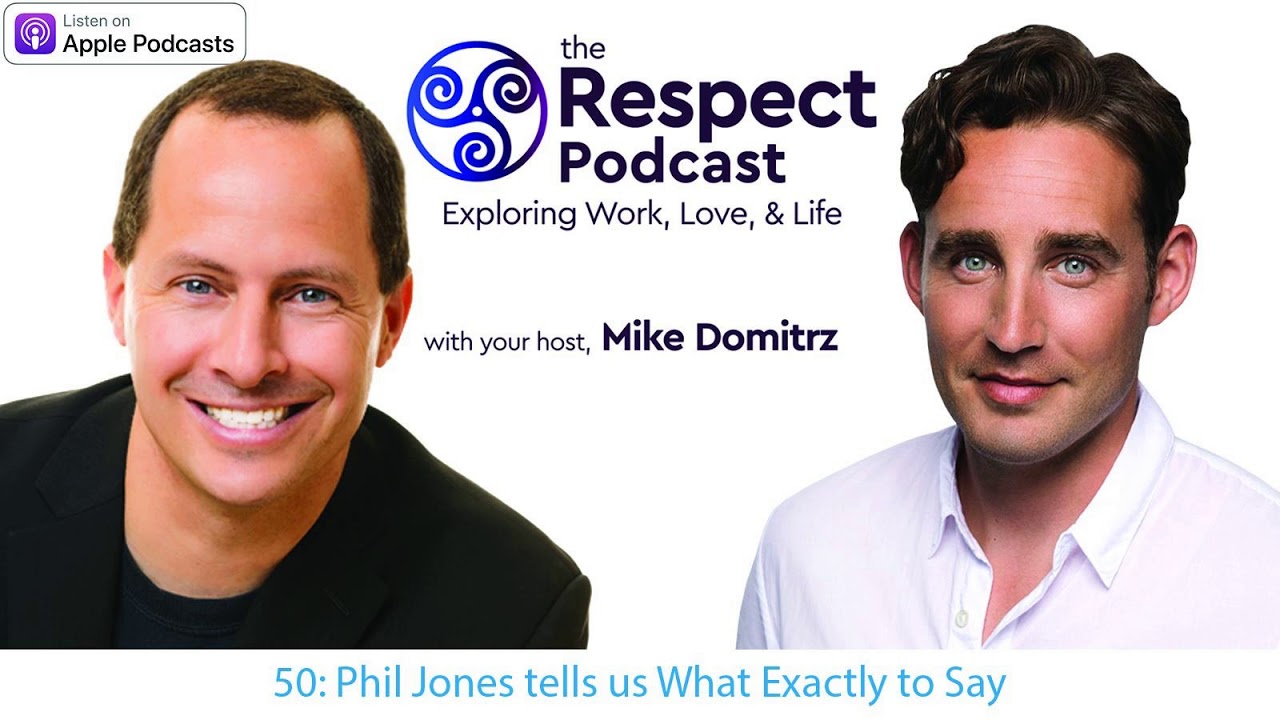
In this episode of the Respect Podcast, host Mike Domitrz interviews bestselling author and sales trainer Phil M. Jones. The conversation centers on how exact word choices shape outcomes in both professional and personal interactions. Phil illustrates the impact of phrasing with the classic "Do you have any questions?" versus the more empowering "What questions do you have for me?" and expands on a suite of "rejection‑free" opening formulas, such as prefacing requests with "I'm not sure if it's for you, but…" and probing openness with "How open‑mind are you to…?" He introduces a five‑step framework—questions → conversations → relationships → opportunities → action—showing how each stage builds permission and consent. Timing is highlighted through the distinction between "when is the time?" and "when would be a good time?". Throughout, Phil stresses that respect is earned through attentive listening, avoiding conversational hijack, and keeping the other person at the center of the dialogue. The discussion applies these techniques to corporate training, HR, sales, dating, and everyday family life. Phil also shares his personal backstory: starting a business at 14, leading a sales team at 20, and discovering the power of precise language through observation and experimentation. The episode closes with a "question of the week" about knowing when one is ready for a relationship, emphasizing self‑respect and independence as prerequisites for healthy partnerships.
Chapters
Welcome to the Respect Podcast. I'm your host, Mike Domitrz, from mikespeaks.com, where we help organizations of all sizes, educational institutions, and the U.S. military create a culture of respect. And respect is exactly what we discuss on this show. So, let's get started. And welcome to this week's episode. I want to immediately get in, dive right in, so you can meet this week's guest. Phil M. Jones is a bestselling author of exactly what to say, exactly how to sell, and exactly where to start. He had his first business at just 14 years of age and is the youngest recipient of the British Excellence in Sales and Marketing Award. To date, over 2 million people across 57 different countries have benefited from his lessons. And as a result, they now know exactly what to say, when to say it, and exactly how to make more of their conversations count. Please welcome Phil M. Jones. So thank you, Phil, for joining us.
Thank you for inviting me on the show. It's a pleasure to be here.
Absolutely. So why is it important that people know exactly what to say?
Why is it important? I think one of the biggest challenges that many people face is when they find themselves in a critical point in conversation or a key moment in time, they find themselves lost for words. So they don't say the right thing at the right time. They often say nothing, or worse than that, they end up saying completely the wrong thing that doesn't lead towards the outcome that was beneficial to both parties. And the majority of moments that are missed in certainly corporate conversations or even in day-to-day life are, are just lacking efficiencies and could be dialed up with some better word choices.
So if you could give us an example, whether personal or professional, where this frequently happens.
Okay. Why don't I just give you the quickest and easiest one? At the end of quite, quite a number of business conversations, people will find themselves saying words like, Do you have any questions? And that's a typical way that a conversation could finish, particularly in a presentation-style format. And that question itself conjures up a number of issues. When you say, do you have any questions? What you're suggesting to the other person is they probably should have questions. However, in most sets of circumstances, when that question is asked, the other person didn't have any questions, and you believe that they didn't have any questions. So we created unnecessary friction. What you also then create in that same set of outcomes is when you say, do you have any questions? And they don't have any questions, the other person feels dumb, thinks they need to say things like, I need some time to think about it, and they don't make a decision and they don't move forward. If we swap that question with the words, what questions do you have for me? Now all of a sudden we've got a situation where no being front of mind can come out and it can empower future-facing action. Or if they do have a question at the front of mind, that too has path of least resistance, could come out, and people can progress conversation easily.
Love it. You know, this is something I actually talk about when I'm doing train the trainers for either military or corporations. We say one of the worst things you can do when you're done talking is go, any questions? Which is— you're 100% correct. And the problem is, this is twofold. One is that if you're done or you're wrapping up, you don't really have the time to dive into a lengthy question at that point. And so you're doing it to almost look like, I want to care, I want to make sure I'm Helping you, but you're not actually providing the opportunity for that to take place fully. And I love what you said there about they might not have any questions, but now their brain goes, should I? And prior to that, they were totally on page with you. Like they were like, oh, I can't wait to leave and try this. I can't wait. Oops, should I have a question? And they lose focus. And that's a part a lot of people don't realize when you go any questions, you're actually killing the focus.
Well, you closed the box and now you just reopened it again with no chance to be able to add anything to it.
Yeah.
Yeah.
So, I love that example. And I love that you said— your example was to counter that was specifically, are there questions you have for me at this moment?
No, it's what questions? What?
There we go.
See, if it's are there, that's a yes/no.
Right.
Whereas we say, what questions have you got for me? They say, none, which actually makes it up. It empowers. It says, aha, I got no questions, which means I'm good to take action. I've got what I need. I'm ready to go. Whereas actually, if you say, do you have any questions? And their thought is no, they feel stupid. They feel like they should have. So simple phraseology turns something from a friction-based, I'm now a little bit undecided, to confidence, I've got the information I need and I'm ready to be able to move forward. Just a simple change of words.
Yeah. And timing of the words, I would assume, is something you may— I don't know if you talk about, but the example we just gave, timing is everything. If I'm halfway through a discussion and I say, what questions do you have for me? There's genuine opportunity to steer where we go based on your questions.
Oh, absolutely.
And I'm allowing when you have the confusion to address it right then instead of waiting till the end when you might now be confused in 3 different areas.
I start so many of my programs when I run a half-day or a full-day open workshop environment that starts with the, well, you came here with some purpose. What's that purpose? Where's your head at? What do we want to address or what do we want to achieve out of today? And then gain a list of objectives and then use that with permission to be able to structure and frame out the rest of the day and then come back to it and say, so have we made progress in this area, this area, this area, this area, this area? Now what we're doing is we're earning the right to make a recommendation with permission as opposed to just telling. Love it.
Now you're not trying to be the smartest one in the room. You're facilitating a conversation.
Right. And guiding it towards their objectives as opposed to mine.
Love it. Now, what would be an example that happens in personal life? Because that was def— that's a great one that happens in trainings and in speeches and professional, what would be one that you would hear people do commonly in, you know, family life or personal life?
Well, why don't we look at the fact that family life, personal life, business life are in fact all the same thing. They're just called life. One of the things that I often hear, and I work and operate in the world of sales, and I ask people why they don't ask for the things that they want in life. Because I've learned that if you don't ask, then you don't get. And if you try to take things without asking first, then that leaves you in an altogether different set of circumstances. So we have to learn to ask for the things that we want in life first. If I ask a room full of people why they don't ask for the things that they want in life, it's because they say they're fearful. They say they're fearful of things like rejection. So I figured, what if I could create a rejection-free opening formula that could allow you to ask just about anybody for just about anything in a rejection-free fashion? And I've learned that if you preface a direct question or a direct statement with the words, I'm not sure if it's for you, then what you can do is you can position an idea to the left or to the right of someone. Hey, I'm not sure if it's for you, but I do realize that, or I do know that if you put the time, effort, and energy into your homework, then there's a good possibility that what you'll do is you'll get better results at school. And we can position an idea to somebody by saying, I'm not sure if it's for you, giving the other person choice, and knowing that there's movement, and making no as an option, as opposed to, what I think you should do is. The key little word in that sequence, though, that makes it powerful is the word but. See, the word but, typically in a modern conversation, negates just about anything that comes prior to it. You could be receiving a piece of feedback from an employer that says, I love what you do, and I know that you're hardworking and committed and dedicated to the cause, but— now that you focus on everything that follows the but, it negates. So if I want somebody to consider an idea that I have for them in personal or professional life, I might say, I'm not sure if it's for you, but— and then insert the thing that I want behind it for them to be able to consider and at least give some thought towards, which leads to another example of the same kind of thing. Is a rejection-free opening formula can be played on the fact that as humans, we like to see ourselves as open-minded. If I ask a room full of 1,000 people who in the room sees themselves as open-minded, at least 2/3 of the hands are going to go up in the room, and the majority of other hands wouldn't raise regardless of what I asked. So I find myself in a situation— the belief that the majority of people like to see themselves as open-minded, you can use that within questioning By asking a how open-minded would you be to question. Hey, how open-minded would you be to going here on vacation? How open-minded would you be to trying this new place for dinner?
Well, I love that too, because in my line of work, we also talk on the sexual side of this when it comes to personal life. So, you know, how open are you to us doing fill in the blank? That's very different than will you do fill in the blank, because now there's a pressure that you expect me Or want me to do that thing you're asking for versus how open are you to this? Because you could be like, oh, I'm not really sure. Okay, well, I don't want to do anything you're not absolutely sure about, right? That makes it easy, much, very comfortable.
And it's okay to negotiate and converse in the gray area. And I think we need to find more confidence and comfort in having conversations in the gray area. It's how open-minded are you? Well, I'm open to discussing it. I'm open to thinking about it. I'm open to considering what it might be. Let's discuss some further opportunity or some further information. Now decisions can be made with, with consent. And whether we're talking about relationships or whether we're talking about a business transaction or a movement within the workplace in terms of a new career, sometimes we have to play out a situation with some questions in a hypothetical sense before we can move to making them reality. Because otherwise what happens is we stay in confusion. And if people feel forced into a situation without the hypothetical exploration first, That's where people end up with regret.
Yeah. Well, and what I love about, you know, how open are you to this is you may want to have the discussion then, but not want to do the thing right there and then. But by saying, how open are you to it? We— what I love about what you just mentioned there is the exploration. We can totally explore the possibilities and then go, you know what? I think in a little more time in our relationship, whether professional or personal, I could see myself being comfortable with that. I'm not there yet, but I could see that. And that tells me, oh, there's a possibility here. Okay. All right. Versus there's— they might say, I'm not open to that at all. That is never gonna happen. And that's still great for me to know, cuz I can go, okay, well then I can cross that off and know that's not gonna happen. I don't need to be frustrated about it or get my hopes up. Not gonna happen.
And look at how this maybe plays out in early relationship with regards to things like marriage or children. Hey, how open-minded are you to being married one day? How open-minded are you to having kids? We can now have a meaningful discussion about it without saying, do you want to have kids?
And, you know, how open are you if you're talking to your boss, right? How open are you to me being elevated in the company in the next year or 2 years or 3 years, right? You can explore just how open are you to that possibility, um, and/or restructuring how I'm paid. How open are you to that? You know, if they can be like, well, I'm not open to it at all. All right. Okay. But if they're like, well, what do you mean? Well, this now allows us to have a discovery together.
Well, let's, let's take some of the great work that you do in your world and think about the number of people that might even be listening from an HR point of view right now, where they were looking to be able to get more emphasis within the corporate agenda about the type of things that you talk about. What difference would it make if a, um, HR professional could say to the rest of leadership is how open-minded would you be to giving me 10 minutes at the next leadership meeting for me to talk about blank?
Yes.
And it gets them sat at the table that sometimes they're finding themselves hard to be able to get in at, or they think they need to create this elaborate pitch, or they think they need to bully their way in. They can just say, hey, how open-minded would you be? And it's very hard to say no to. Yeah.
And it's— well, the neat thing about it is it's not a no answer.
Well, that's the point, right?
Then that's what I love about the rejection-free. I get what you're totally— what you're saying. It's even if they say I'm not open to it, It's still not. It's not a direct no. It's and what's interesting about that is that's them saying I'm not open. That's not a you are bad, you are awful, you are. And when you ask a simple yes or no, people can take it very personal. But they have to answer I'm not open to that, and that actually falls on the other person. Then it's not about you.
And it also can allow timing to play into things. See, if I said how open-minded are you to having kids, they could say well look where my head's at right now. I'm so busy with blank blank and blank that it doesn't. really fall into my mindset at this point. Ah, that's not saying no. That's saying based on today's set of circumstances with the data points that exist at this moment in time, if I was to ask that question in this specific moment, the answer would be no. So it allows us to be able to consider things from a timing point of view. And this could even play out with relationships and sexualities and all sorts of other things because, because timing is a factor. What is a no today could just as easily be a yes in 6 months' time Once a number of sets of circumstances have changed.
Yes. And in going back to the HR example, if the person is, well, I'm not open to that right now. Oh, when would be a time you would see yourself being open to that? Because then, it also tells the leadership, hey, this is important to me. So, I'm willing to work when it's important, when it can fit in. But when is this? Because I'm not just giving up with a no because I didn't get a direct no. I got not right now. So when is this possible?
Ah, let's play on that. When is this possible? Sequence of words again and dial that up. It's another set of words from the book Exactly What to Say. It's not when is, it's when would be a good time?
Excellent.
If I can ask the question, when would be a good time for us to address this? Then what I've done is I've put all the onuses back on the other person to say, give me the window of time. If time is the issue, when's the window of time when it's not an issue? When would be a good time? There's also an undertone that says, There is going to be a good time. You just gotta tell me when it is. Not when is the time, when is a good time.
Right. So the, so the difference there is when is, when will be the good time versus when is or when would. There's a, I mean, that's a, which is really important where we're parsing words, but it plays a big role here. So for listeners, it's not when is, it's when would, cuz that, that's more open than assuming.
And it's also good time. Not the time. And, and again, that allows us to be able to play in the gray again. See, if we said when is the time, we're saying it has to be absolute and specific, and, and life is never absolute and specific unless it falls on the side of no. And there is where absolute and specific is important to consider. But maybe is a beautiful place for us to be able to operate as humans, to be able to actually allow decision to take some time to, to gestate, or whatever the word might be for that. So when we say when would be a good time, we're not saying when would be the best time.
Right. It's a huge difference. Cuz again, I don't know when my best time is, but if you had said when would be a good time, they might think, well, how about in 2 weeks? All right. I don't have to be specific. As you said, it leaves an opening.
Correct. Which allows conversation to continue. And there's, there's a 5-step process that I talk about often from stage that I believe will never go out of fashion. And it applies to business, it applies to personal, it applies to relationship. And it's that questions lead to conversations, conversations become relationships, relationships create opportunities, and only those opportunities step into action. So it's questions to conversations to relationships to opportunities to actions. And sometimes I replace the word action for sales, but it's the same difference in every given area. It all starts with questions, because questions create permission, and permission is when things move forward with consent. And that should be in a sexual scenario. It should also be in a business scenario. It should also be in a contract scenario. It should also be in an employment scenario. We should always be looking to move forward with the support of all key stakeholders involved.
Well, and that's what I love about when we talk about it in the workplace and in the home. We don't talk about a permission-based— like, people use the word permission-based marketing. I think it's an awful term. I think it should be mutually based.
Right. I agree.
Huge difference.
And I think permission-based marketing as a term is a misinterpretation of the word permission too. What they mean by permission-based marketing is that somebody at some point ticked a box in a form, probably misguided in how they got to be able to give permission. It's not truly permission-based. It's, it's legally compliant marketing more so than permission.
Right. How do I not get in trouble marketing? And, and even in the idea of permission-based sales, which is I'm getting you to say a yes. And the whole target is about you saying yes instead of, is this what you actually want? Like, am I making sure that I'm serving you in a mutual way? You want this and I can provide it. That's mutual versus I just gotta get you to say yes. I gotta get you to say yes. And if I only have to get you to say yes, this is just about permission. It's not about whether I need or want.
Permission can get you into the conversation. The conversation is what builds you the relationship. The relationship creates the opportunity. Now we lead to consent. And consent and permission are 2 completely different things.
That's correct. And so the formula there was questions to conversations to relationships to opportunity. The 5th one was?
It is action or sales, but let's call it action for any given area. But it has to go through all of those things. I joke from stage, and I shouldn't perhaps joke, particularly being in this conversation here, is that too many people look for something inappropriate on the first date. And I use that analogy to audiences talking about sales staff is that they come straight for the close, straight for the yes. And I use the inappropriate set of words, I guess, now thinking about it, is that they look for something inappropriate on the first date. But I think the key is to try and have more people exploring the space in the middle, which is the questions into conversation. It's, let's be prepared to talk about this thing first. Let's have a conversation. Let's build a relationship. And you can build a relationship quick. It doesn't need to be a 3-year-long relationship, but it just needs to be a point that both sides of a conversation can can understand that they know enough about each other to move forward, that's where the opportunity presents itself. And opportunities are the things that people want more of. To get that, they need more conversations, more relationships, more questions.
Well, and what I love about that is I think you're right that people come into first dates looking for something to go wrong because of past experience.
Yeah.
So I've been in some form, whether it be minor or more severely traumatized by past first date experiences Or relationships, I'm now bringing to the table what I fear you're going to do. So if you're just like, I'm just a, you know, a bull in a china shop and I'm just going to go for what I want. And yeah, I, that's exactly what I'm afraid of. I want to get to know you. And, and that can mean a lot of different things. Some people that can be one night, some people that could mean 3 months, but it takes everything you're describing to discover that. We need the conversation. Where do you think in the conversation piece of that formula people struggle the most?
Where they struggle the most is that they forget the most important person in the other conversation is the other person.
Yes.
Here's a very quick example. Is, Michael, tell me about the last place you went on your vacation.
Uh, Door County, Wisconsin.
Ah, Wisconsin. See, I don't get to go to Wisconsin that often, but I have been there a few times. I've been there for a couple of speaking gigs, see, because I'm a professional speaker. I can always see all around the world. I've spoken in some of the most fantastic places. I wouldn't say Wisconsin's there, but when I was there, it was crikey cold. I was there, it was freezing that time of year. It's a cold place, isn't it? But you see, some of the places that I have been to that have been way better than Wisconsin is I have been to Sydney this year. Sydney's been a magnificent place, probably one of my favorite cities. I could possibly live there one day. I've been like everywhere though, so I've got everywhere to compare. And I've been to like, worked in 56 countries in, in 5 continents, written 5 bestselling books. Did you know I'm freaking awesome?
So I love this because you're referring to the hijack, right?
That's exactly what happens too often when you say, where do people get lost in conversation? is that they realize in— or they forget to realize that the most important person should be the other person. So they ask a question of the other person, they hear their answer, and then they proceed to tell the other person their version of that answer instead of saying, keep going, keep going, keep going. Look how easily this plays out just in day-to-day. I see you in the street, see you at the conference, say, Michael, hey, how are you? What do you say back?
Hey, how are you, Phil?
And I say, I'm good too. Conversation's over.
Right, exactly.
So we're not well trained in this conversation thing. What we should view a conversation as is much more like the best game of tennis we've ever experienced, where it's a rally that goes backwards, forwards, backwards, forwards, backwards, forwards, backwards. Ooh, looping shot, backwards, forwards, quick rally, slam dunk. Now we can move things forward. And that was just one point. Now we take another point and we play the game again. Now we take another point and we play the game again. That's what a great conversation is. And if you've seen the movie Shrek, in the movie Shrek, they say ogres are like onions. They have layers. People are the same. We have layers. And we need to show somebody enough that we care. And we show them that we care by asking them some more questions about the thing that we asked the first question about. So we say, what do you do for work? And they say, I work in accounting. You don't jump off to the next line of conversation. You say, oh, how did you get involved in that then? Well, they say, well, I started here and my daddy was this. Okay. So, how does it feel doing the same thing as what your dad did? Oh, well, that feels like this. And you take their answer and you build on it. You take their answer and you do that 6 or 7 levels deep. You start to show that you care rather than say that you care.
Well, what I love about it is it reminds me of improv. In improv, there's a very simple one-phrase formula for improv and it's yes, and.
Right.
So, whatever's happening, oh yeah, and you keep asking. And you're right. And I think what's interesting is we can all hijack it. It depends on where we are in our lives at that moment, how aware we are of what's happening in our lives when we put it all back on ourselves. I know I've been guilty of doing it. Uh, and so being conscious of it makes a huge difference. When I'm conscious of it, I can catch myself going, don't do that. Exactly what you're saying. Explore, discover, explore. But it's being conscious of it. How do you help people become conscious of that? Okay.
Simple example is if you're at a date or a business meeting and you both have a drink in front of you, be very conscious of the fact that those drinks need to go down at a very similar level. If what happens is that your cup of coffee goes stone cold and theirs is drunk to the bottom, which way around has happened in the conversation?
Yeah, that, that, I love that analogy, that, that concept, that visual of, look, if, if I have not touched my coffee and theirs is gone, that means my mouth's been talking so much I can't be drinking. And I love that visual outside of the example where somebody is down on something. But other than that, that example works perfectly.
Right, right. And I think maybe it works better with a coffee than it does with a lineup of cocktails. But you get the point, right? Is whatever the thing is that you're supposed to be shared in doing and the conversation is framing that activity, is the activity moving with both of you making a similar level of progress in the activity that the conversation is supporting?
So, so now you have a relationship. How does that go to opportunity?
Well, that's discovery, right? That opportunity could well be in a business context where you uncover a problem that is a meaningful problem for that other set of people that you can add some value towards achieving. So it's not the opportunity is I can sell them my thing. The opportunity is I can help them to be able to uncover that problem that they've told me is important to them. Let's take the open-minded question again. Hey, would you be open-minded to perhaps working with us and helping you overcome that obstacle? They say, yeah, sure. How would that work? Now we've moved to a point where we can present our product, our service, our advice, our help, our, you know, all those things. In a human relationship scenario, where does the opportunity present? We find out through discovery that they've always wanted to go to Barbados. We say, well, What are you doing next spring? Well, I've got nothing planned. How would you feel if I looked into maybe some flights and some dates and some hotels and maybe we could go together?
Makes perfect sense. Phil, so this is— the formula is beautiful and your books are so powerful, so well known. How did you get started on this journey?
So, I've been in business since I was a kid. 14 years of age was my very first business. And I just learned that if you could ask nicely for the things that you want in life, then you can achieve quite a lot. So I've always outperformed my expectation by shooting a little higher than I was ever supposed to if I took the limitations of what my parents had presented me with. So at 14, my first business was me knocking on the doors of my neighbors asking them politely whether they would be interested in having their cars washed. Some said yes, some said no thank you, and most just asked me how much I would charge. That was as bad as it got. And I did okay with that little business. I think where I really got the fascination, though, about word choices is I found myself in a senior leadership position at the age of 20. So I was running a team of experienced sales professionals all over the age of 25. In fact, the company criteria was that they didn't recruit people over the age of 25. And I was in a leadership position steering these people, and I was 20, 21 years of age. Now, that's an awkward position to be in, but it taught me one of the most powerful lessons, is that respect is earned. It isn't something that a title gives you. It's something that you have to be able to actually get the sweat equity involved if you want to win the respect of other people. And I figured that if I need these people to put their trust in me to be able to lead them towards becoming better sales professionals, I need to firstly show them that I can at least power up alongside them, roll my sleeves up, and do the job I'm asking them to do. So what I did is I did exactly that, and I did a pretty decent job. Getting close enough to the action though, I started to realize that some of the differences between those that were doing good and those that were doing great wasn't just hard work and endeavor and product knowledge and having the skill and trying to do their best. What I realized real quickly is that those who were crushing it, they knew exactly what to say, when to say it, and how to make it count. They knew that words mattered, and this made me really pedantic about, well, what specifically was it? So I would observe, I would question, I would quiz, I would learn, I would sit back and I'd hide in— not hide as in like creepy hiding, but I would sit adjacent to a conversation that was happening between one of my sales staff and a customer. And I'd listen to see how they controlled a conversation with questions towards the benefit of the consumer. And then as I've done that through years, I saw repeated patterns. And this blew my mind. It was like that we're all working to some form of pre-programmed script within our subconscious. And the more I'd see these repeated patterns have the same results, I started to document it. And then I started to trial it myself. I started to share it with others through my trainings. When I started this business 11 years ago, started to pass those things on to others, and they started to have more confidence in conversation as a result. And they'd come back to me and say, this stuff works. So I was taking deep-rooted psychological principles and simplifying them down to a point that every man could use them. And the responses I was getting was just better and better and better from the people I shared it with. So it fueled the passion for me to explore it further. It came through the desire for me to want to earn respect and study what it was that made people successful, as opposed to just expect it and, uh, and just try hard.
Well, and what I love about that, you're referring to professional respect. We, we talk about on this podcast, everyone deserves a basic level of dignity, respect. What you're talking about is earning that professional respect of your colleagues and your peers. What I love about your work is that this approach, there's so much respect in it. I'm respecting the other person's space and answers. And that's really driving where we go or where we don't go. Where did you first— where was respect first instilled in you?
I think the family respect that I've just seen through the relationship between my mother and father. My mom and dad have a very traditional husband and wife type arrangement where my dad works hard like crazy, provides the money to be able to support the family. My mom runs the house and does a wonderful job of that and takes care of all the incidental that sit in between that, and both people are exceptional at the thing that they do and don't really tread on each other's toes in those other spaces and have nothing but respect for each other in that area. That's probably my earliest memory of it. And then outside of that family piece is probably through sport and playing team sports as a kid and seeing that go well and see it go badly when respect was missing. And how when, you know, there's a group of 11 players on a soccer pitch and also 6 guys on the sub bench and a family full of supporters and a referee and the trainer and the guy who carried the oranges and the older kid who carried the balls, et cetera, is seeing that everybody had a part to play. And then it worked better when you would respect everybody for the part that they played. And there was no one superstar. They were big subconscious lessons that I see bolder now looking back than I did even realize I was experiencing at the time.
That's powerful. Have you also seen it in the workplace? You were observing everybody's use of language. Were there times where you were going, oh my goodness, that's manipulative, versus—
Also, too many to remember. And also, I faced a huge amount of prejudice in my early career, huge amount, because not only was I young, I looked 4 years younger than I was. You'd experience this being disrespected in a number of ways. I also worked in a lot of very female-dominated environments in the retail space. So not only did I have this leadership proposition with male sales staff, I was also responsible for running lingerie departments and perfumery departments within one of the biggest department store groups within the UK. Almost all my staff were women, almost all my staff were older than me, and you saw examples of respect that were less than respectful in my eyes if I look back on that set of circumstances where it was Um, almost being manipulated through, through the fact that I was the only guy in that environment and I was 19, 20 years of age, that deliberately being made to make blush on a number of occasions, if, if I can kind of leave it there.
No, I totally understand. And it's, it's something that you hear whenever somebody's a minority group, whether it be 1 or 2 out of 20, how they can feel they are treated differently and And sometimes when you are typically the group that is considered a position of power, people can feel even more that it's safe to degrade.
Right.
Because you come from a place of power, so it's safe for me to degrade you. And that's not okay. We talk about that with, with our work, that it's not about which gender we're talking about, but that all human beings deserve to be treated with dignity and respect. So important. So I want to thank you, Phil. This— that was a great conversation. This Entire interview has been wonderful, so thank you very much.
And I, I think just one thing in conclusion I'll add to that point was, was in all of those scenarios, what I learned to do— and I'm only thinking about this almost in introspect right now— was, was the power to question it as opposed to call it out. You know, with a question like, you know, how would you feel if this was positioned that way around? You know, as the alternative of a group of guys versus, you know, a single guy. How would, how would you feel if you were in my shoes? Or how would you feel if this was Your son that was in a leadership position and the staff were responding like that. And I, and I learned the power of being able to question it in a, in an open and frank way that was, was enough to be able to call attention to it, but not to be able to attack the other person.
Well, it's brilliant. It's not a how dare you, it's are you aware? It's I, I'm genuinely trying to create a safer environment here. And so it's coming from a place of compassion. Versus rage or anger, which— and I'm not blaming the person who comes from rage and anger, because there, there are times where it goes that way because of someone else's actions. So, but I think what you've shared there is really helpful for those who may feel that they've been in a similar situation. What's it when I don't feel I have much of a voice? Well, here's a way. Hey, how would you feel? And it's a safe— it may feel safer than confrontation. So thank you for that, Phil.
You're welcome.
And thank you for all your insights. It's been wonderful.
My pleasure.
Well, we want to make sure that all of our listeners know next up is our question of the week. So, stay tuned as we dive right into that. Before I answer this week's question of the week, I'd love to ask you a question. Would you please subscribe to this podcast, The Respect Podcast with Mike Domitrz? By subscribing, you can make a huge impact. Now, you might be wondering, Mike, how does my subscribing to your podcast make a huge impact? Well, here's how. For every person that subscribes, it raises the rankings of the show in the search engines. So for people who care about respect like yourself, when they're doing a search for podcasts, they're more likely to find this show, thus providing an awesome opportunity for us to spread more respect around this world. And all you do is hit subscribe under your podcast. Plus, the second benefit is by subscribing, you automatically get every episode right into your phone or whatever device you are listening to the podcast on. It happens automatically. So subscribing also makes your life easier. Now let's get into this week's question of the week. Oh, and by the way, you can always ask your questions of the week by joining us on Facebook in our discussion group. It's called the Respect Podcast Discussion Group. Go there on Facebook and ask whatever questions you would like me to answer and/or address in this segment of the show. And then listen to each episode to find out when your question is included. This week's question of the week is, Mike, how should someone know when they are ready for a relationship? Well, one of the things I always talk to people about when it comes to relationships is that the most important one you're going to have is with you. If you don't have a healthy relationship with you, you really don't want to be bringing another relationship into that relationship with you. Work on you first. Know when you feel good about yourself. Know when you feel you don't need to have somebody else in your life to be complete. You're complete by yourself. See, a super healthy relationship is not two people becoming one. It's two independent people sharing a relationship, but the relationship does not dictate them, does not say who and define who they are. That's defined by their individual relationship with themselves, and that's the key one. So if you're questioning at all, am I ready for relationship? Ask, am I feel good about who I am? Do I feel good making independent decisions, or will bringing somebody in? Make me feel like I need to do what they do. If that's the case, maybe I want to pause and work on me so that I can feel independent. I can feel strong in declaring my boundaries, my wants, my wishes. On the flip side, that I'm also walking into a relationship where I look forward to hearing their ideas so that this is a mutual relationship where I'm not bulldozing and making all the decisions, but that this is a mutual relationship and that I'm ready for that. And I would enjoy that, and that I don't need that. Like I'm not desperate for that. All that helps us understand when we're ready for relationship. Do you know what I would love? I would love to hear your answer to this week's question of the week. So would you please answer what your answer would have been if you were asked that question today on the show? All you do is go to our Facebook page. We have a special group where we have these discussions called the Respect. Podcast Discussion Group. So the Respect Podcast Discussion Group, and share with us what would your answer have been to this week's question of the week. And if— take a moment, post us a new question for future episodes. What question would you like to hear me answer on an upcoming episode? That's all done at— on Facebook in our special group, which is the Respect Podcast Discussion Group. Can't wait to see you there.
Thank you.
Thank you for joining us for this episode of the Respect Podcast, which was sponsored by the Date Safe Project at datesafeproject.org. And remember, you can always find me at mikespeaks.com.








