51: Insights of Ford Motor Company's Transformation
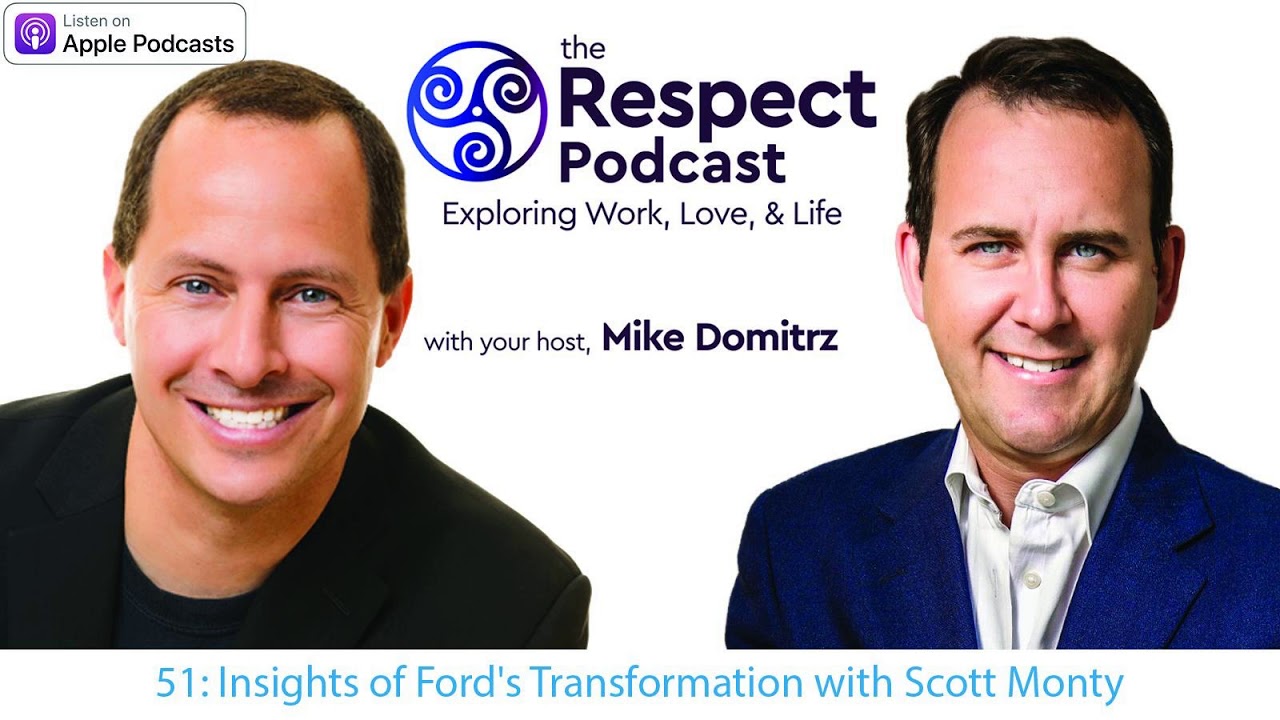
In this episode of The Respect Podcast, host Mike Domitrz interviews Scott Monty, a classics‑educated executive who led digital and social strategy for Ford Motor Company. The conversation weaves together ancient Stoic ideas of respect for self and others with the modern corporate transformation Ford underwent under CEO Alan Mulally. Monty explains how Mulally introduced the "One Ford" vision and weekly Business Plan Reviews (BPRs) that forced honest, color‑coded reporting, created psychological safety, and shifted the culture from knowledge hoarding to knowledge sharing. Concrete tools—an ID‑card acronym (F‑O‑R‑D) and a cascade of BPRs—illustrate how respect was operationalized at the executive level and then cascaded to teams. The dialogue also covers challenges of respectful communication, the language that prevents over‑bearing advice, and how to foster a safe space for collaboration. Monty then pivots to digital and social media, offering practical guidance on posting responsibly (pause before publishing, prioritize quality over quantity, maintain consistency without oversharing) and the importance of knowing one’s audience “avatar.” He advises solopreneurs to align personal and brand identities, focus on a few platforms, and seek feedback from a tight‑knit community. Personal anecdotes about mentors—Andy Ferrara and Alan Mulally—highlight the role of champions in modeling respect. Finally, Monty recommends daily Stoic practice (The Daily Stoic) as a discipline for perception, action, and will. The episode ends with standard podcast calls‑to‑action and a sponsor mention.
Chapters
Welcome to The Respect Podcast! I'm your host, Mike Domitrz, from mikespeaks.com, where we help organizations of all sizes, educational institutions, and the U.S. military create a culture of respect. And respect is exactly what we discuss on this show. So, let's get started. This week, so excited to introduce to you Scott Monty, who is an executive keynote speaker and Advisor, and probably is the only classics major who has been a global head of digital and social for a Fortune 10 brand. Scott, thank you so much for joining us.
It's my great pleasure, Mike.
Well, we're going to dive right in here. You were a classics major and yet you worked for a Fortune 10 brand. And so I'm going to let you tell everybody what brand was that?
It was Ford Motor Company.
Okay, awesome. And so how does respect come into the teachings of the ancient Greeks and Romans?
Well, look, I think there's so much that we can still learn from things that have happened in the past. We tend to be so forward-focused these days as technology and digital and social and the whole online world pushes us in a forward direction, and yet there is so much human wisdom, and it has to do with the collective human nature that we had then and we still have now that is wrapped up in some of these ancient texts. And, you know, I've been spending a lot of time recently rereading some of the old Stoics, the Stoic philosophers like Seneca and Epictetus and Marcus Aurelius. And it really has to do with respect for the self and respect for the individual, because in turn that leads to respect for others.
Oh, I love that discussion. We, we often talk about on the show that you don't change a culture, you change individuals, and actually they change themselves. That's what leads to a transformation of culture is individuals changing. You don't just go in and go, here's a culture change. You actually have to have people make significant changes as individuals.
Yeah. You know, and we, we saw that firsthand at Ford when Alan Mulally was brought in as the new CEO in 2006. He was brought from outside of the auto industry. He came in from Boeing and knew that Ford needed a culture change, and he was that change. He led as an individual, but he also gave his direct reports all of the tools and processes in order to start making those changes at the team level, and so there was this wonderful cascade So there was a learned behavior that was mimicked all throughout the organization. And I was fortunate to join about 2 years after Alan was there, and the culture change was already inherent based on all of those changed leadership behaviors, and it made my job that much easier.
So what would be some examples of specific actions that were taken to create or instill the respect?
Well, one of the things that we all had, and I still I still have it here. We all had an ID card, and there's a tag that went on the back of it that specifically said what the One Ford vision was. One team, one plan, one goal. But you turn it over and there was this acronym, FORD, and each section, F-O-R-D, had a bunch of descriptors underneath it. Own working together, which was the O. Believe in skilled and motivated people working together. Include everyone. Respect, listen to, help, and appreciate others. Build strong relationships. Be a team player. Develop ourselves and others. Communicate clearly, concisely, and candidly.
All right. So I love that because there are companies who will put respect into their core values, which is what that's referencing. That concept, what were things you actually saw people do to make sure that was being lived?
Well, one of the things that was remarkable in these BPRs or business plan reviews that we did every week, there was a time when everyone would go around the table and they would review where they were with respect to their plan. And it was all color-coded, green, yellow, red. And when someone came to a red, obviously it meant they were having trouble. And everyone would be listening intently. And as soon as they came to that red section and described what was going on, you would see hands shoot up from around the table of people saying, oh, I experienced something like that before in Brazil, or we went through this last year in Germany, or we saw that in the engineering department. And suddenly people would be jumping in to try and help each other out. And it was because there was respect for the process and there was respect for the individuals who were following that process that had been laid out.
And prior to that shift, and I know you said you came in about 2 years after, but it sounds like you've done a lot of study of the situation and how it changed. What was the difference in those kinds of experiences prior to this shift?
Well, there were, there were a couple of things. One is Ford had up until that point been a culture of knowledge hoarding rather than knowledge sharing. So people weren't likely to share what they had learned before and help others learn from the mistakes. And they were also— if anyone did admit a mistake, that was tantamount to being prepared for the guillotine. You know, there was a historic first meeting that Alan had when he ran his first corporate BPR, and he asked everyone to prepare their charts accordingly, and everyone came back the next week with green on all of their processes and all of their plans. And Alan said, well, let me get this straight. We're on task to lose $17 billion this year, and everything is going okay? I think we need a little more honesty here. And so the following week they came back and someone had one item lit up red and everyone looked around the table to see what Alan's reaction was going to be when that red item came up. And do you know, Alan stood up and he applauded that executive and said, this is the kind of honesty and integrity that we need in order to get us out of the rut that we're in. And from there, the whole culture around that table began to change and people saw that it was actually liberating, that the truth would in fact set you free.
That's awesome. So now you've got that culture starting to be built at the executive level. How does it get taken to the next level?
So every one of those people that was around the table with Alan had their own team BPR. So you had this process that was cascaded down. So everyone 2, 3, 4 levels below them knew the same process that they had to follow and knew the same kind of intellectual honesty and integrity that they had to put into their team interactions. It just got to the point where it wasn't tolerated to not participate. It was okay if you had a red. You weren't faulted for that, and your team members saw how they could actually pitch in and help you out. There was this wonderful culture of You know, when you see someone else helping someone else out, you're more likely to jump in and help someone else out yourself.
Absolutely. And what was the language that created the safe space? In other words, sometimes in those settings, myself included, especially younger, we jump in and go, oh, you got to do this, or you should do this, which can not feel safe in those moments, but you're genuinely trying to help, but you just, you become so passionate based on what worked for you. You want them to do what you did, but You wanna avoid that typically in those kind of meetings so that there's more ideas coming to the table versus one just dominating as a solution. How did they avoid that?
Well, interestingly, it was also right on that card as well. Show initiative, courage, integrity, and good corporate citizenship. Deal positively with our business realities and develop compelling and comprehensive plans. You know, it was really the notion of, you know, You're not faulted for trying. You are faulted for burying your head in the sand and ignoring it. And I think that notion of— wasn't necessarily tolerated failure, but it was acceptable to fail knowing that you had a better plan backing it up to go in and readdress that same problem.
Yeah, and so I apologize because I don't think I was clear there in my own communication. So I'm referring to the people around the table who think they have the solution for the person who's in red. And how did they make sure that they communicate in a way that was not overbearing on how to solve the problem?
Got it. Well, you know, it was, it was really a matter of people sharing their perspective, you know, giving a firsthand and true account of what they saw. Wouldn't necessarily be the answer, but it would be an additional perspective. That someone might not have known about. And certainly the offer to have my people follow it up, or I'll put you in touch with so-and-so. It was always a very, very open, positive, helpful kind of attitude.
And did you ever run into somebody— I mean, normally in those settings, somebody's going to want to be, no, you got to do it this way, you got to do it this way. How, when that would happen, especially early on in this culture shift, how did they address that? How would they say to that person, Oh, that's great. Maybe if you could say this by saying, in my experience, I've seen this, versus, this is what you should do.
Yeah, you know, it's funny because I don't think there was a lot of prescriptive types of feedback simply because Ford hadn't been in the habit of sharing in that way. You know, they had been holding back already, so to be able to say, in my experience, or this happened to us last year, or we just saw, was much more of a natural evolution from where the company was coming from.
Oh, that actually makes sense because they weren't used to, yeah, they weren't used to the freedom to express that way.
They didn't have to unlearn that kind of sharing because there was no sharing before.
Yeah, and so this is all at Ford. Where were you before Ford?
Before Ford, I was working for a small consultancy back in Boston that specialized in helping big brands understand corporate social strategy.
Okay, so how did you see respect show up in that setting where you're dealing with multiple brands, multiple companies?
Well, that was a little more difficult because herein you had some forward-thinking players on the team who saw the potential in the digital and social space. They were trying to convey that this effectively was the future. Oftentimes, they were coming up against individuals within the company who were very intractable, very much stuck in the past, or at least in the then-present. Folks didn't feel like they had the ability or the experience to be able to advocate for their own ideas effectively.
Ah, so that becomes an environment that becomes difficult to go back to what we said with Ford. It becomes difficult to share.
Some of the more forward-thinking people that, you know, can see the writing on the wall and see where the future is headed got very frustrated and almost very dismissive of their colleagues for not getting it, you know, for not being as prescient as they were. about the future. And really, our job as counselors to them was to help kind of back them away from the cliff, right? To bring down this strident tone that they may have had and help them understand how they could help their colleagues adapt to this way of thinking. So, for example, some of the ways that we would help them do it is to help them think in terms of analog. Right. If you're thinking of trying to move someone into the digital space, well, that's difficult if they don't have any kind of frame of reference. So back it up and help them understand something that's changed in their life over the course of their lifetime or that they've seen historically that's analog and literally make the analogy to them as to what it means to digital. So I'll never forget this story that someone told about a trade publication that they were reading. And there was a boss who was very skeptical of this new technology that had come into the workplace. And the employees were trying to push him in that direction. He was very skeptical, didn't want to give up the space, didn't want people wasting their time on it, didn't want corporate secrets getting out. And finally, the boss said, all right, I'll let you put kind of a central kiosk in the middle of everyone's desks on the floor so we can monitor how this technology is used and so that it won't be abused. And most people were thinking, oh, it's the computer, it's the internet, it's social media. And it turns out that article that was being conveyed in the trade publication was from the 1920s and the technology was the telephone. Right? So in that case, helping people understand how difficult it was for a certain generation to adapt a new kind of technology like the telephone into the workplace and to understand, well, look where we are now where the telephone is ubiquitous, right? So helping them understand how historically a frame of reference like that could be placed as a lens as to what their colleagues are trying to convey today.
And you do this specifically with social media, and that's your area is digital and social media. And what do you think, one, are the struggles with really letting respect choose your path, drive your path when it comes to what you post in social media?
The double-edged sword with social is, is that it's always on. Everyone has the ability to publish anything they want, text, audio, or visual anytime they want. I have found, and I still make these mistakes every week, every day, possibly, it's very easy to simply hit that send button or to hit that publish button when, in fact, the respectful leader certainly can have an emotional reaction to something, kind of a knee-jerk reaction, but it's always best To pause first, to wait 24 hours before you hit that send button or that publish button on something that's controversial, something that really gets your goat, and that may degrade the respect that others have for you if you did in fact hit send.
Do you find in the big corporate culture that when the reds are occurring and it's national PR nightmare, That the call is, we have to get on social instantly and respond.
Yeah, I mean, and I think that happened early on. I think now there's almost a sense of futility there because the negative moves so quickly, at light speed. I mean, it was always the case that, you know, the old proverb that a lie is halfway around the world before the truth has a chance to put its boots on. Now it's, you know, a thousandfold that. So I think the notion of quality over quantity, whether it's in a crisis mode or whether it's just in regular communications, quality over quantity is something that is valued more highly now than ever before, and that getting it right rather than getting it first is absolutely essential.
And what about quantity? So a lot of people out there are going, look, if you're going to use social media and be impactful, you've got to be on it. You've got to be regularly on it. Now that would contradict the making it about quality because the odds are if you're on it all the time and constantly posting, there's only so much quality that you're going to be putting out there. So how do you view that?
Quantity and consistency are not necessarily the same thing. So You can be on consistently every day but not be oversharing. You can have a regular cadence of when it is that you have office hours, so to speak, or when you engage with people. Certainly, you want to respond to people that are asking questions or that are trying to engage you, but in terms of the outbound stuff, in terms of the stuff that you produce for other people, obviously you want to tone that down but do it with regularity.
And how would you recommend the solopreneur, the individual who is the brand potentially, and yet also has a personal life and they wanna be on social media for so— how do you balance that? The speaker, the author, we have a lot of those who listen to the show. How do you help them realize, okay, if you were just a brand, none of 50% of what you're posting, you would never post. But you're not just a brand, you're a person too. So that argument is, but I'm a person, so I wanna post like people post. How do you balance that?
Yeah, well, I think the first and foremost, it's essential that your brand is who you are. There's no sense in having a professional you and a personal you if you're a solopreneur. You are you, period. Having a sense of consistency throughout is important. The other thing is you might want to pick and choose where you're spending your time. You can't spread yourself too thin and maybe you can only be on one platform. Or maybe just, just 2. But figure out which platform it is that makes the most sense for you, that fits your brand, that is where the people are that you're trying to reach, and that helps you tell your story the most effectively.
And what do you think when it comes to social media, what do you think are the keys to making sure that people are thriving in social media with respect as their foundation?
Well, I think they always need to be listening. They need to understand what's being said out there, what the current zeitgeist is, what people are talking about, what makes them move. But they also need to just understand what their audience wants from them. When I publish a blog post or even a podcast episode and I get feedback from my readers or listeners, I know that I'm doing something that's worthwhile. I'm getting that feedback and seeking that out, even asking for it sometimes is incredibly helpful because ultimately that's who you're there to serve. You're there to serve your audience. You're not there to serve some kind of wider agnostic public that isn't really paying attention to you. It really is about the people that you're building a relationship with over and over again.
And nowadays that's called your avatar. For listeners who are not aware of what I'm referring to, it's this idea that if I'm writing an article or I'm doing a podcast, I should in front of me be picturing a specific individual that would be the most likely demographic detailed description of the listener, let's say of this show. Or if I was writing for the Date Safe Project or for our work we do with corporations, I should be picturing the person within each of those worlds that is most likely to be reading this, that avatar. And is that what you're referring to also with social media of, hey, don't just send it out there to send it out there. Who are you trying to draw in with what you're sharing?
Yeah, I think that's exactly it. 'Cause you'll hear from people, you know, whether it's a coworker, a neighbor, you know, family member, whomever, there are people that you will begin to affect with what it is that you're saying. And don't be afraid to take a stand. You want to differentiate yourself from other people. You don't want to seem so completely bland and irrelevant that you fit every profile. But as you say, picture in your mind who those people are. Picture the last email comment you got or the last comment you got on your blog or a tweet or Facebook page or whatever it is. Think about that interaction that you had with that person and extend that conversation. If you were to turn this into the great conversation, what would it sound like on the other end?
Well, and I love this because I think a lot of times people think, well, my listeners are not the kind that interact or not this or not that. And I always want to pause and go, well, if you don't like who your listener is, why aren't you doing something for the listener you enjoy being with? Because that's the world you're building around you.
Well, that's exactly right. If we're solopreneurs and producing content, we do it for a reason. We do it because we're being helpful. We do it because we enjoy it. We do it maybe because it keeps us on the cutting edge. Whatever it is, you're looking for a reaction. If you're doing it only for yourself, well then maybe you should keep a journal and not do stuff publicly. There's good reasons for doing that as well. If you're doing it for an audience, Doing it for someone who enjoys what it is that you produce, then you should be looking for that kind of feedback.
Yeah, and thinking of the person that would give you that feedback is who you're talking to. 'Cause there are people who are gonna give you no feedback. Well then, if you need feedback, like I'm a person that does work off of feedback, I know that about myself, then I'm gonna wanna make sure that I'm drawing an audience that likes to give feedback. Otherwise, I'm gonna be frustrated in this process.
And absolutely, and it doesn't have to be a huge audience. I mean, you could put, a LinkedIn or Facebook group together of 10 people that are your audience, that listen to your show. And if you have a really robust discussion and feedback from those 10 people, that's amazing, right? And then you can grow it to 20 and then to 80 and then to 200, you know, and then it begins to really become something.
Yeah, love that. What are challenges, Scott, that you've faced along the way that taught you about respect?
You know, I think one of the most important ones is, you know, when I went from this small consultancy into Ford, realizing that I didn't— even though I was seen as the expert, I didn't have all the answers, and that it was far from a one-person job, you know, that there was shared responsibility And shared expertise and knowing when to step out of the way and let other people do what it is that they do better than me. I think just having respect for everyone's swim lane and what they can do and not trying to do everything yourself. As a solopreneur, you tend to have to do everything yourself or you want to do everything yourself. When you're part of a team, You know, you really need to learn to let other people shine.
Yeah, absolutely. In your own personal life, your own journey throughout life, I call it— we have champions for respect in our lives. Who were champions for respect in your life?
Well, I think an early one was a boss I had just out of grad school, a guy by the name of Andy Ferrara. Andy helped me understand how to respect my own station in life a little better. You know, he saw me struggling in a new industry and, you know, trying to gain relevancy. And at one point he sat me down and he said, you know, you just need to tell yourself, I have arrived, because from there everything will flow. And it's really a mental state about thinking highly enough of yourself To be able to understand that you've earned a right at the table. You can sit shoulder to shoulder with a C-level executive, et cetera. I think that was extremely important. Then the second one had to be Alan Mulally at Ford, just learning respect for others from him in a way that— Was almost bound by sheer joy. To see Alan interact with people, just in the hallway or in the elevator or at an event, he was so happy to see everyone, and he took the time to really engage with people and to make you feel like you were the only person in the room when he was talking with you. And that's a gift. And I, I don't know that I have that gift, but I think about Alan And I, I try to aspire to be more like him every day that I can.
Well, that's beautiful. And, and you refer to your original learnings as far as learning the classics, and you referred to it earlier about The Daily Stoic, the book. And now that's by Ryan Holiday and Stephen Hanselman. What about that book do you love, The Daily Stoic?
I mean, first of all, it's something that You know, can be a daily reminder. You know, it's set up in such a way that you can read just a single page a day and work your way through the whole book in a year and have it with you always. Or you can, you can do a deep dive into the sections that they have there and really understand the different perspectives that they've masterfully pulled out. The discipline of perception and the discipline of action and the discipline of will. Right. So there's whole sections in there that you can help guide yourself if you want to work on any particular aspect of your, of your personality.
I love that. Well, I want to thank you so much, Scott, for joining us. Our listeners, it's ScottMoty.com, just like it sounds, M-O-T-Y.com. Scott, thank you so much for joining us.
It's my great pleasure, Mike. Thank you so much for having me on.
Well, absolutely. And for our listeners, you know what's next. That's the question of the week. Before I answer this week's Question of the Week, I'd love to ask you a question. Would you please subscribe to this podcast, The Respect Podcast with Mike Domitrz? By subscribing, you can make a huge impact. Now, you might be wondering, Mike, how does my subscribing to your podcast make a huge impact? Well, here's how. For every person that subscribes, it raises the rankings of the show in the search engines. So, for people who care about respect like yourself, when they're doing a search for podcasts, They're more likely to find this show, thus providing an awesome opportunity for us to spread more respect around this world. And all you do is hit subscribe under your podcast. Plus, the second benefit is by subscribing, you automatically get every episode right into your phone or whatever device you're listening to the podcast on. It happens automatically. So subscribing also makes your life easier. Now let's get into this week's question of the week. Oh, and By the way, you can always ask your questions of the week by joining us on Facebook in our discussion group. It's called the Respect Podcast Discussion Group. Go there on Facebook and ask whatever questions you would like me to answer and/or address in this segment of the show. And then listen to each episode to find out when your question is included. The question I got is, Mike, what's your favorite movie? My favorite movie is— this is always a difficult one. I love movies. I am moved by music, by entertainment, by art, including film. But there's one movie that's always stuck in my mind, and I think because when it came out, I was struggling at the time. And so I have emotional attachment to the subject matter at hand, but I also thought it was a very powerful movie. And it's one that never gets talked about. So I'm going to discuss it. And that's called Prince of Tides. Barbra Streisand, Nick Nolte. I don't want to give it up. I'm gonna let you look it up. Prince of Tides is my movie that I'm sharing. Do you know what I would love? I would love to hear your answer to this week's question of the week. So would you please answer what your answer would have been if you were asked that question today on the show? All you do is go to our Facebook page. We have a special group where we have these discussions called the Respect Podcast Discussion Group. So the Respect Podcast Discussion Group and share with us what would your answer have been to this week's question of the week? And if take a moment. Post us a new question for future episodes. What question would you like to hear me answer on an upcoming episode? That's all done at— on Facebook in our special group, which is the Respect Podcast Discussion Group. Can't wait to see you there. Thank you for joining us for this episode of the Respect Podcast, which was sponsored by the Date Safe Project at datesafeproject.org. And remember, Or you can always find me at mikespeaks.com.








