58: Rachel Grant on Helping Survivors of Sexual Abuse
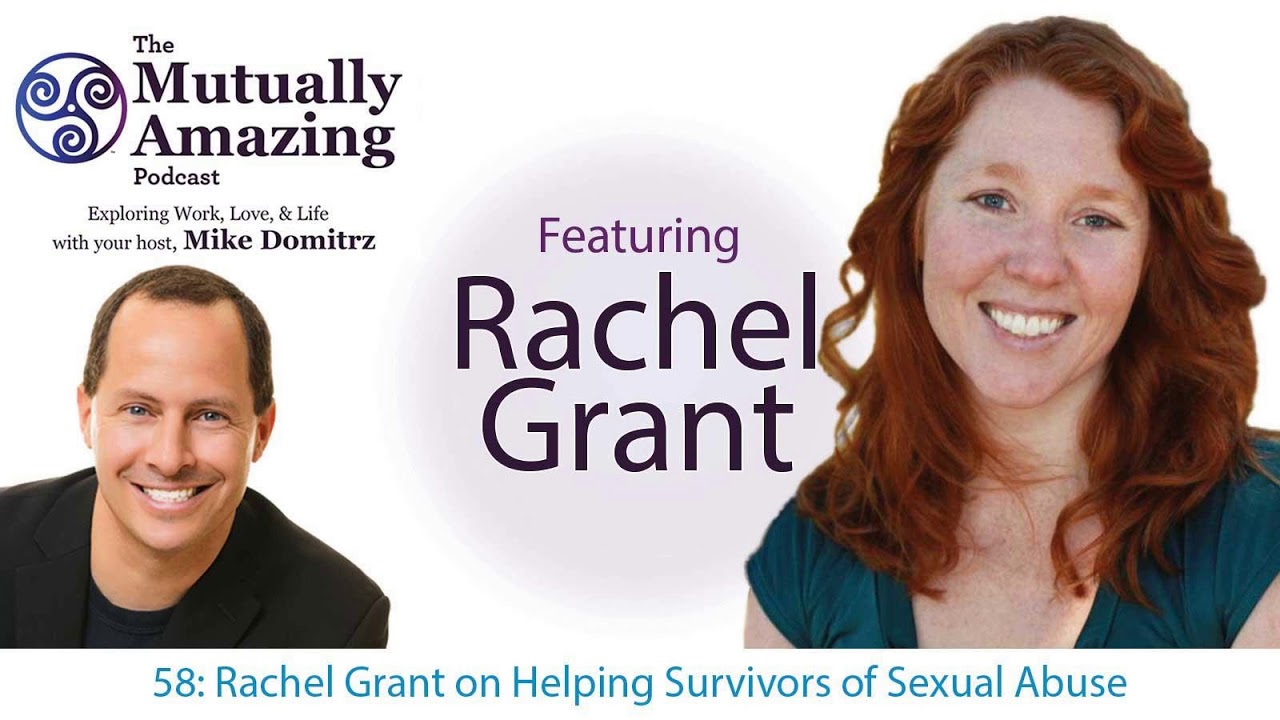
In this episode of the Mutually Amazing Podcast, host Mike Domitrz interviews Rachel Grant, a survivor‑turned‑coach who works with adults healing from childhood sexual abuse. Rachel shares her personal story of abuse by her grandfather beginning at age ten, the ensuing years of shame, anger, and failed therapeutic attempts, and how that pain drove her to create a new healing framework. She describes the typical but often hidden signs of trauma in children—high achievement, outward confidence, and episodic rage—emphasizing that survivors do not fit a single profile. Rachel outlines a staged model of recovery (victim, survivor, beyond survivor) and introduces a checklist on her website to help listeners identify their current stage and appropriate support. Central to her approach is viewing trauma as a physiological injury to the brain and nervous system, which reframes healing as a process of repairing neural pathways rather than merely recounting the story. She explains the Beyond Surviving program’s curriculum, which prioritizes overcoming shame before addressing relationships, trust, and sexuality, and stresses the importance of language, mindfulness, and an empowered voice for building self‑respect and setting boundaries. Rachel contrasts sexual‑abuse recovery coaching with traditional therapy, highlighting coaching’s focus on skill‑building, actionable tools, and avoiding diagnostic labeling. The conversation closes with practical advice for leaders on addressing sexual violence in organizations and Rachel’s core message: survivors are not too broken to heal. Contact information and recommended books are provided in the show notes.
Chapters
Welcome to the Mutually Amazing Podcast. I'm your host, Mike Domitrz, with the Center for Respect. The episode you're about to listen to was recorded when this show used to be called the Respect Podcast. So, you might hear that mentioned during this episode. Well, let's get to the show. And welcome to another episode. I'm so excited to have on a special guest here, Rachel Grant. works with survivors of childhood sexual abuse who are sick and tired of feeling broken and unfixable. She helps them break free from the pain of the past and move forward with their lives. Thank you, Rachel, so much for joining us.
Oh, Mike, I'm so glad to be here. Thanks for having me.
Absolutely. As you know, this is a big part of my mission, is working with survivors and working so this never happens to survivors. But when it does happen, we want to create a safe space for survivors to be able to come forward and live their lives fully.
Definitely, yes. You know, I think that's one of the things that's motivated me, um, for sure in my journey and in my work is finding ways to help people, you know, really break out of the— I think what is a myth that, um, abuse is a lifelong sentence and you're going to be dealing with it forever. And so certainly that's, uh, at the top of my mind in the work that I do every day with men and women.
And what brought you here? What got you to this journey?
Being pissed off about a lot of things, I would say, is the bottom line.
Hey, you know what? That does it. I tell people all the time, people come up to me and go, I want to speak for a living, but I don't know about what about. I'm like, well, that's a problem because that means you just want to talk, which is different than helping people, sharing with people. But they'll say, well, how do you, how does somebody find their passion? And I actually use the marker you just said. I said, what really ticks you off? Like, what infuriates you? Because typically the things that infuriate you is your true deepest passion. And that's for me, like you, I got started because I was coming from a place of anger. My sister had been raped and I was angry. And that's where it started. So you said from a place of being pissed off, and what do you mean by that?
Yeah, so I'll expand on that, of course. So when I was 10 years old, my grandfather began sexually abusing me. And for, you know, some time that continued and got worse. And I really didn't know how to handle that situation. as a 10-year-old, which is normal and usual. And I found myself very much stuck in this place of experiencing the impact of that trauma, feeling afraid of even just being in my own home. And when my parents discovered what was going on, they were really great, Mike. They got my grandfather out of the house. They supported me. They tried to get me to go to counseling, which I did not want to do. I wanted to try to pretend that, you know, everything was just normal and okay, and let's just all move on here.
Yeah.
But as we know, that doesn't really work. And so from 10 until about 18, 19, I was just in this place of struggling with all these feelings of worthlessness and having a hard time trusting people and feeling depressed and suicidal and struggling. And when I got to about 18, 19 was the time when I decided, hey, you know, I've really got to handle this and I've got to take a look at that. And that's what really set me on this path of beginning to try to heal From sexual abuse, but I kept hitting these roadblocks where I would sit in a therapist's office for weeks and weeks and weeks and feel like I was just talking about the trauma and rehearsing the trauma and going over it again and again and again. And, and, you know, that's an important part of the healing process, but at a certain stage, I started to ask different questions like, well, how do I actually change this? And I was so surprised at the lack of response to that question. Or worse, the response of, well, this is just the way it's gonna be. You're gonna learn to live with it.
Right.
And I was like, uh-uh, that is not the right answer. And it really upset me and made me angry. And I— when all of this is going on, I'm also in the middle of an abusive relationship. So I'm trying to heal past trauma while I'm actually in the midst of trauma at the same time. And when we divorced, I I just had a really clear moment as I sat in my new apartment with nothing but a sleeping bag and a lamp. Life had been stripped down. And I just really got clear that I had to do something pretty fast or I was going to be living the rest of my life just surviving, like just getting by. And I didn't want to do that. So, with that anger, with that frustration, with the stubbornness that has always been a marker of my personality, I set out to try to answer this question of how do we How do we heal from sexual abuse? And so I did my master's in counseling psychology. I studied neuroscience. I began using myself as a guinea pig and bit by bit, you know, started putting together the pieces. And honestly, I was just trying to get my shit together, Mike. I really wasn't exactly sure if this was what I was going to do as a profession. But at the end of that journey, I felt like I had hit on something and a way of working with trauma that was unique and that could actually make a difference for people. And so now, 12 years later, here I am doing this work and loving it and getting to spend my time, you know, every day with men and women who are ready to move past that stage of reflection and acknowledgement and are really ready to learn the skills and the tools and the interventions they need to change their lives.
That is awesome. I'm going to ask us to step— I'm going to step way back to those preteen years and teen years because You— we quickly went over it, but you said it was, you know, was it difficult? And you were struggling in a lot of different ways. And I think it's important for some people to understand what those struggles can be so they can identify, or if not themselves, maybe you're a parent and you see your kid showing some of these signs so they can be more supportive. And that doesn't mean to run in fear like, oh no, my kid's showing that they must have had this happen. That's not what we're referring to. Just that this would not be uncommon. So what were things you were seeing in your life during that time that That, as you said, it felt so hectic and trauma-filled and you were acting it out in different ways. What were those ways?
So what's really interesting about my case is it's not atypical, but it's often not what people most commonly expect to see. I was an A+ student. I was social. I was engaged. I had activities. I, you know, partook in volleyball and art and dance and all these different things. But my internal experience was so Different from what was externally being expressed. And there would be indicators that that was the case. It was kind of like this facade, this pretending that so many survivors perfect, of, hey, I'm gonna go out into the world and I'm gonna keep things looking nice. Hey, everything's fine, everything's good, nothing to see here. But the internal system is so dysregulated, so out of whack, your internal thoughts are so destructive and dark that eventually, from time to time, there are like these eruptions or these explosions. And so this is often a marker of sexual trauma. You have a child who seems to be excelling and doing well and thriving, but there are these one-off situations that, that you want to almost just dismiss because it seems like it is so random and not that big of a deal. For example, my biggest— my biggest behavior or problem behavior was really anger and rage. And so I would just go into these huge fits of anger, throwing things, hitting things, attacking my parents. It was not a pretty sight. And, you know, this felt so disjointed from what they knew of me as their daughter otherwise, you know. It was really confusing and scary for them. And, you know, we grew up in a small town, Oklahoma, so, you know, my parents are doing the best they can to navigate this situation. I think rebellion Rebellion is a common thing that we see in teenagers, but boy, I took it, man, Mike, I took it to a level. You know, I was sneaking out. I was running with the boys. And there was, you know, sexuality. You know, I was really experimenting with my sexuality, but not in healthy and safe ways. And there's only so much that parents can sometimes notice and see because a lot of survivors of trauma hide these behaviors. And learn because we're adept at pretending and hiding can, you know, really keep them behind doors. So those were some of the ways that the trauma activated and showed up in my life. You know, for parents who are looking at, you know, is my child okay? Has something potentially happened? There are definitely other markers, things like weight gain or weight loss, dropping, you know, out of school, having difficulties in school. There can be things like self-harm or suicidality or depression. These are some of the common— keys that we would notice. But there's also just this sense of anxiety and worry that comes to be very dominant for survivors of trauma because their system is dysregulated. And all I mean by that is the stress response system is so highly activated that they are never at what we call healthy nervous system regulation. They're always in that kind of activated fight, flight, freeze state. Right.
Well, and I think this is so important because I think people do have a stereotype that, that can be true for some survivors, but is not for so many. And I think what people do picture is the child hiding in the corner, staying in the room, keeping to themselves. And it's not what you described— the outgoing, the A student. And so that's why it's important to have these conversations, for people to recognize there is no one. There's no one profile here that's going to tell you this is what happens to a survivor and this is how they act. It just isn't true. Just like you said, Mike, I was sexually experimenting. And he being, you know, very sexually active. And a lot of people don't realize that's very common, actually. For, for some survivors, they feel it's a way of owning, like, you can't force me to do something because I'm choosing to be sexually active. So they can be very sexually active under that. That doesn't mean it's healthy, but it's a way of owning it. And so I think it's so important. So I appreciate you sharing all of that.
Sure thing.
Yeah, absolutely. And so now, for those listening and thinking, all right, For those of us who are survivors of abuse, what are some of the first steps we can take towards recovery?
So one of the things that I've really come to think about and believe through the work that I've done is thinking about trauma as a series of stages. And I think in a linear way, and so I'm gonna talk about it in a linear way with the caveat that it's not exactly a 1, 2, 3 process. There's sometimes meandering that happens here, but by thinking of healing as stages, This gives us a framework in which we can kind of wrap our head around what this is because I know in my experience, it often felt like a spaghetti mountain. I was like, okay, wait, where do I start?
What do I do?
I'd follow one thread and that would feel like it would lead to 20 other things and it got overwhelming and scary and too much. And so I would just give up. And so the first thing that I always recommend survivors of trauma abuse do is figure out which stage of healing you're in. And I have a guide that can support people with that on my website. You can go to rachelgrantcoaching.com/checklist and this is going to help you determine if you're in the victim, survivor, or beyond survivor stage. And with that, what are the types of support that are going to most help you at that stage? A lot of the frustration that I see for survivors who are diligently trying to heal, like they're real about it, they're trying, they're working at it, but they're hitting up Mm-hmm. Against all these frustrations, nothing seems to really be changing, is sometimes because there's a little bit of a cart before the horse situation happening. Maybe they're getting a particular type of treatment that isn't actually in alignment with the needs of where they are in their healing. Or maybe they're past a certain stage and they're still sitting in therapy and ruminating and talking about the trauma when they actually need support to become more active and get a little bit more street smart about trauma. What are those interventions? And so figuring out where you are in that process is very empowering because then you can focus in on your goals and you can focus on getting the right type of support.
That's powerful and so we'll have that link, the /checklist off your website. We'll put that in the show notes for everybody, too, so they can see where they're at because I think that's such a great tool you're providing. So thank you for that.
Sure thing.
You describe trauma as an injury to the brain and nervous system. Can you talk a little bit more about that, please?
Yes. Oh my goodness. This for me was so critical. This was such a turning point in my own healing journey when I began to look at the experience as an injury. What I want to offer to everybody who's listening is we often think about abuse as it's an emotional experience, and it is, and it's a psychological experience, and it's this It's this very wide, broad thing that happens and everybody's experience is unique. That is true. But what I started to think about was, okay, if we are experiencing trauma, there is something that is actually happening to us biologically and physiologically. It is not just this feelings thing or just an experience. It's actually having an impact on our very biology and physiology. And particularly, I'm interested in the brain and the nervous system. And so if we think about an experience of abuse as an injury to the brain, this changes the dialogue and the conversation about healing. We begin to treat it as, okay, you have been hurt, you have experienced this injury. Now how do we heal that injury? And how do we specifically heal the brain? And the nervous system. When people begin to understand what has actually happened to them on a neurological level as a result of trauma that explains all of these things they're experiencing like being triggered, being highly activated, being anxious all of the time, having all these rumination on negative thoughts, depression, then it becomes surmountable. It's kind of like— I might sometimes say like if you imagine that you're walking along and you trip and you fall. And you skin your knee. You know that you've had this injury and you go about fixing the injury, right? You have a process. You have a system. Oh, I put Neosporin on my knee. I put a Band-Aid on. I check it every once in a while. There's a step-by-step process. And I thought, okay, if trauma and abuse causes an injury to my brain, what are the step-by-step healings? processes? You know, is there a very particular way of healing the brain? And that's what I became fascinated by and began researching and studying and experimenting with. This is one of the reasons why I work with clients through the Beyond Surviving program, a specific curriculum. Sometimes people are surprised by that. They're like— because they're so used to the modality of therapy where you just kind of sit down and talk about whatever's on your mind.
Right.
But if we understand that the brain has been injured, if you take an injured person and you sit them on a couch and you just have them talk about their injury, nothing is changing. You're just talking about the injury.
No, that's brilliant.
And so, and actually at a certain point, you are reinjuring your brain, if you will. It is important that people get to tell their stories and there is— that is really a critical part of the healing process. At some point, it stops being healing and it actually becomes a way of reiterating the trauma on a neurological level. It's like you're lighting those pathways up every single time you tell that story. And if you don't move past the telling of the story to results and change, then you're just actually reinforcing all of the negative beliefs every single time you tell your story. So I use a structure and a curriculum that takes people step-by-step through this process of change and healing by thinking about the order of operations. If we do this before this, we get better results. If I try to take them to handle this before I try to have them do that, it re-traumatizes them. I'll give you an example. A lot of clients come to me and they want to have better relationships. I want to be able to trust. I want to be able to have sex. I want to be able to express myself. And in my program, we don't get to any of that until the last quarter of the program. Because what's actually foundational to all of that is overcoming shame. How are you going to build healthy relationships and trust people if you think you're a terrible person, or you think you're to blame for everything? Or you think you're not deserving of love.
Well, and the other thing I love about it is that when you have an injury, you don't sit there and go, I'm a horrible human being because I have this injury.
Yes.
Right? You, you say the— there's the injury and there's me. And when this injury heals, it's healed and I will move on. And so unless it's an injury of complete loss, even there, the other areas will heal so you can move forward. And so I love that, that it takes it away from the shame and the guilt that's often affiliated with this kind of trauma, unfairly, obviously.
Yeah, you know, and for me, when I began to understand that this was something that was done to me, it was an injury that was done to me, not because of me, not because of anything I said, not because of anything I did, not because of anything I didn't say or didn't do, that this person Someone made a choice to abuse me. And in the space of that choice, I was injured. And, you know, the shitty part of trauma and abuse is that we are responsible for healing the injury. The person who caused the harm is not responsible for that. They can apologize, but that even doesn't heal the injury. And that's a bummer, right? It feels so unfair.
Yeah.
And I remember fighting with that and battling with that for a long time. But once I finally got it that this was actually in my hands, there was a place of empowerment that actually came from that. I didn't have to, you know, go outside to the person who harmed me and wait for them to do something for me to feel better. I could put the hands on the steering wheel of my brain, of my life, of my body, of my nervous system, and I could take all of that back and own that. And that's really the, the heart and soul of the work that I do.
Well, I love that and I love the, the fact you mentioned, you know, I can put my hands on the steering wheel and I can drive what goes forward. And, and one of the areas you talk about is this idea of self-respect and building it back when you feel you've lost it. So what are steps you took? What are steps you help other people take to gain their sense of self-respect?
So when we think about the self, first of all, we have to have a powerful relationship to self. Who are we? Are we all of those things that we came to believe as a result of trauma and abuse or are we something else? And so the first step is actually understanding self from a new lens, from a new perspective, one that is separate and independent from abuse and trauma. And so we access that first and foremost in the Beyond Surviving program through language, using the power of language and also mindfulness. In the experience of abuse and trauma, particularly childhood, but also in the case of rape or assault as adults, we— the very first thing we always try to do is understand why. Why did this happen? Even if it's not a conscious question, that is what we are doing, is trying to understand the why. And in answering why, we always make mistakes. And so we make it about us. We make it about something about who we are. Something that we did. And those then become a way of seeing ourselves. Oh, I was weak. Oh, I am weak now. Oh, I didn't say anything. I'm an idiot. Oh, now I'm stupid. So your sense of self is framed and formed by that experience of trauma. And so we have to get out of that. We have to begin to challenge those beliefs. We have to— oh my gosh, I could talk for like 5 hours about how to do that. There's so many different processes.
What I love about that is this idea of, look, the only why is one answer, because somebody did this and it wasn't me, this other human being. And now I can choose whether forgiveness or not, that I can think in my mind, the mentally unhealthy person, right? We can write, we can think however that survivor chooses to move forward, but in the end it was that person, right? It's like when somebody says, but if I wasn't there— no, even if you were there and they didn't do it, it wouldn't have happened. So even if you took every parameter outside of every choice you made, if you included all of them and that person doesn't touch you, this doesn't happen. So it was because they made this choice. So I— what I love about that is the why is clear and obvious if we can look at it clearly and go, because this person chose to do this.
Yeah, and getting there is a little bit of mental gymnastics. So we spend a good amount of time in the Beyond Surviving program looking at it from this angle, from that angle, from this angle, so that people can really Mm-hmm. Deeply integrate the understanding and the reality that it's not their fault. And when that drops away, then we have access to the new self. And when we did— when we claim the new self, we are going to claim a self that is respectable and that we respect and that we love and that we want to protect. And that is how we step out into the world from a space of self-respect. I now care about this person that I am. I now honor this person that I am. Who quite honestly was always there. It's not like you build a new self. It's more that you just pull away all the layers and bullshit that's been added on as a result of trauma, get that out of your way so that your authentic, best, most wonderful self can show up in the world again and you're gonna respect that and you're gonna demand that other people respect it, too.
I love it. That's so powerful and speaking of that, on that journey, how does that survivor How do you, as a survivor, help set boundaries and command respect from others? You've mentioned prior to me that it's difficult for that to occur. So how have you learned to do that, to command respect from others and set boundaries for yourself?
The ability to set a boundary is first and foremost tied to the strength of your word. This is a missing piece that a lot of people don't have. A lot of the teaching that's out there about boundaries is, well, communicate your needs and tell people what you want and then, you know, stand strong in that. Okay, great. But the predecessor to being able to do any of that is language and voice. If you do not have your voice, if you do not have a strong relationship to your word, then you are not going to be able to do any of that. So as you develop that relationship to your word and to your voice too, I put that under the umbrella of integrity. That gives you the platform upon which you can go out and set boundaries. It just becomes a natural part of your being. It just flows naturally from that. It's not like you have to learn to set boundaries. It's more a matter of when you have an empowered voice, when you have respect, then boundaries just happen.
I love that. That's really powerful to think of. The goal is not declaring my boundaries, it's just realizing them and living to them, right? Being present to them. That's more powerful. That's— and it's simpler. It's a simpler concept. Now, what is the difference— because you mentioned earlier the idea between sexual abuse recovery coaching and therapy.
Oh yeah.
Because you talked about therapy earlier. So what's the difference in those 2?
So this is changing because when I started out 12 years ago, there was no such thing as a sexual abuse recovery coach. And most people working with abuse and trauma, they thought therapy first. That was the go-to modality. Um, but when I was looking at these 2 pathways in front of me, I decided that I wanted to go into the coaching field rather than the therapeutic field for a couple of reasons. First, I didn't want to deal with diagnosing. I don't think diagnosing is effective a lot of the times. I myself have been diagnosed as all sorts of things that are not real or true. And so— and I just didn't want to get wrapped up in it, Mike. I didn't want to sit in the office and have to think about how do I label you, how do I diagnose you so I can get the insurance reimbursement and all that stuff. I wanted to sit with people in the question of, what's your experience? What's going on with you? And what are we going to do about it? Without any labeling and diagnosing. That's one key difference between therapy and coaching. Another key difference is intention. Therapy is often a space where you are in the driver's seat. You sit down on the couch, you bring your issues to the table. Here's what's on my mind today. Here's what I'm struggling with today.
Mm-hmm.
And the therapist Yeah. And that just serves as a reflection. This is what I hear you saying. How are you feeling about that? Asking curious questions and curiosity questions to help you dig and find and discover. And that, again, is a really powerful space to be in, an important step and part of the healing process. But I didn't want to do that either. I didn't want to just sit with people and hold space for them and reflect for them. What I wanted to do was teach them. And coaching gave me access to be able to do that. So my work is one part, yes, listening, reflection, holding space, but it's also here, here's the tool, here's what you actually need to do to trust people, here's what you actually need to do in order to communicate a request to someone. When we are experiencing abuse and trauma, we are missing out on life skills. We cannot take it all in because our system is dysregulated. We don't even have the space and the energy for that. So a lot of people come to me in their like 40s and 50s are like, I don't even know how to like tap into what I need and then communicate that. So I love this process of coaching because we really get to be partners in the experience. I get to give them, you know, specific skills and tools and guidance and interventions. while also helping to reflect for them and help them— help my clients see themselves, you know, in ways and, and get those insights that they want.
Powerful. And we have about 30 seconds left here. What's the one thing you wish most survivors of trauma knew?
You are not too broken to heal.
That is an awesome way to end this show. This— that is such a powerful statement. Thank you, Rachel. This has been brilliant. And for anyone listening, Rachel is a coach. So you can reach out to Rachel. You're going to see all of Rachel's contact information in our show notes. It's Rachel Grant Coaching, just like it sounds, rachelgrantcoaching.com. Uh, you'll also see the books that Rachel recommends in our show notes, The Deepest Well, The Developing Mind, and Way of the Peaceful Warrior, which is a book that I personally love also. So thank you so much, Rachel, for joining us.
Oh, Mike, it's been a pleasure. Thank you.
Absolutely. And for all of our listeners, you know what's coming up next. That is question time. Mike, what's one of the biggest mistakes you see leaders make when it comes to addressing sexual violence in their organization? Well, here's the answer. It is this concept that leaders will go out in the public or go in front of those they lead and say, there will be no sexual violence in this organization as long as I'm a leader. None. Zero. Is that understood? Those kind of comments All they do is shut down survivors, many survivors, not all, but many survivors from feeling safe coming forward because you've set a standard that says this doesn't happen here. And now if you're a survivor and it's happened to you, you can be sitting there going, okay, well, what's going to happen if I do come forward? What's that going to do to the organization, the morale? How are people going to treat me? All of that's often already playing in the survivor's mind of sexual violence. But to now have a standard that says this doesn't happen here ever makes that, and can make that feel 10 times worse. What you want to be able to say as a leader is, look, sexual violence will not be tolerated in our organization, and survivors will absolutely be supported, will absolutely be supported, and perpetrators of sexual violence Will be held accountable. We are an organization that is founded in respect, and that will be held true at all times. And when it is not, when there are signs of somebody, an individual within the organization, not living by those standards, that person will be held accountable. It is a core value of ours. And if you're going to say respect is a core value, then you need to run an organization based on that, which means It means also respect the fact that there can be incidents in your organization where this happens, and you want to create a safe environment for survivors to come forward, not one that sounds like it never happens, and therefore you feel even more scared to come forward because of this expectation of zero— it never happens— versus zero tolerance of predators who do this.
Right?
Huge, huge difference in how that's discussed. That's really important for leaders to understand. We'd love to hear your questions, your thoughts, and your ideas. And the best place to leave those with us is on our Facebook page at facebook.com/MutuallyAmazingPodcast. Of course, you can always contact us on our website at mutuallyamazingpodcast.com. Remember to subscribe to this show so you automatically get it every And if you could take one moment to leave a review, that really helps other people find the show, which we are greatly appreciative of. So thank you so much for joining us. May you make today and every day a life full of mutually amazing relationships.








