77: Discover how ‘LAZY’ is a great title to be labeled if you want to be a successful CEO as...
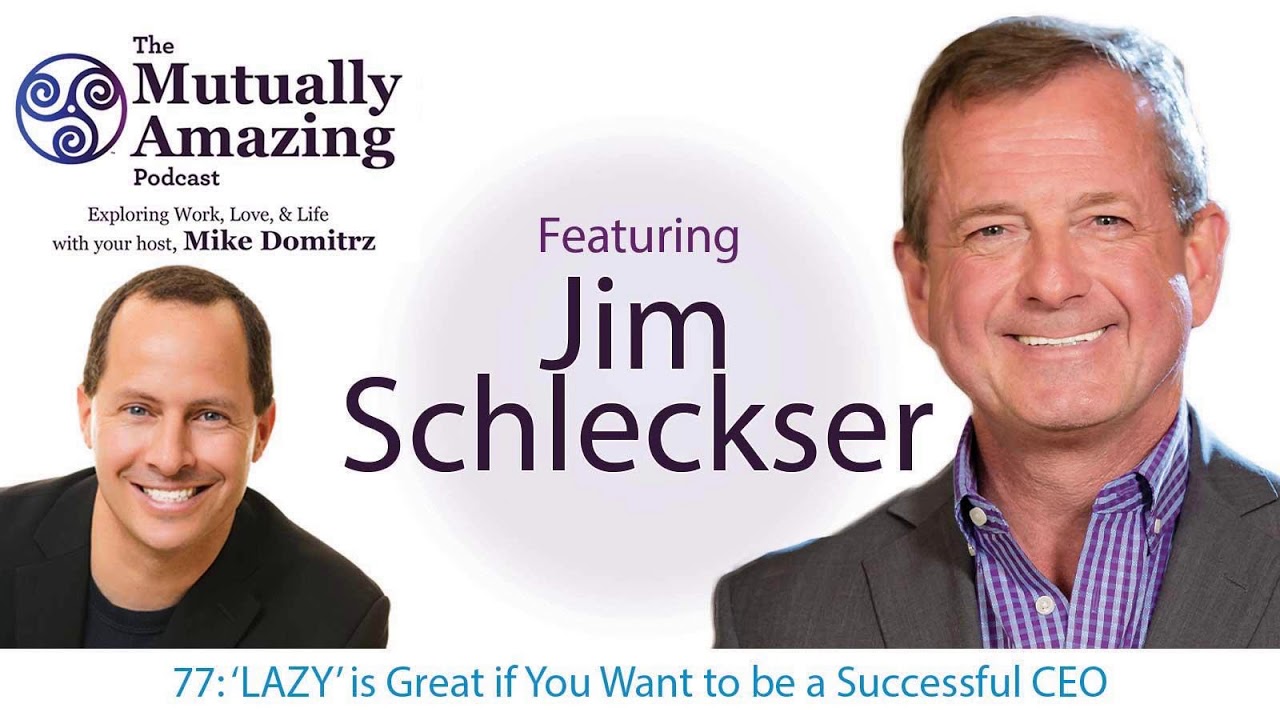
In this episode of the Mutually Amazing Podcast, host Mike Domitrz interviews CEO advisor Jim Schleckser, author of Great CEOs Are Lazy. Schleckser explains that the seemingly paradoxical label “lazy” actually describes CEOs who rigorously control their schedules, focus on high‑impact activities, and maintain a balanced life. He introduces the “kink in the hose” metaphor to illustrate how CEOs must locate and fix the single bottleneck that blocks results. The conversation expands into a practical framework for assessing personal balance across seven life domains—health, family, social, financial, business, civic, and spiritual—using a radar‑chart diagnostic. Schleckser differentiates habitual, sustainable behaviors from episodic, crisis‑driven overwork, offering a three‑step habit‑building process (intent, repetition, scaling). Respect is presented as a core leadership value: respect for oneself prevents self‑sacrifice, while respect for others shapes how feedback is given and received. He shares mental tricks for handling criticism, including treating feedback as a gift and visualizing the worst‑case scenario. To regain balance when out of sync, he recommends a triage approach—listing activities, ranking them by joy and impact, and deliberately dropping the lowest‑value items (“something has to go overboard”). He also mentions concrete tools (the radar chart) and personal influences such as his father’s legacy and Dale Carnegie’s How to Stop Worrying and Start Living. The episode concludes with resources (incceoproject.com, professionaldrinking.com) and a weekly quote on respect from Jackie Robinson.
Chapters
Welcome to the Mutually Amazing Podcast. I'm your host, Mike Domitrz, with the Center for Respect. The episode you're about to listen to was recorded when this show used to be called the Respect Podcast. So, you might hear that mentioned during this episode. Well, let's get to the show. Today, we have Jim Schleckser, who is a CEO advisor of high-performing leaders. His various members represent nearly $20 billion in revenue and 100,000 Jim, thank you so much for joining us.
I'm glad to be here, Mike. Thank you.
Absolutely. Let's dive right in. Could you give our listeners a little background on you?
Yeah, I, uh, I ran companies for people for many years, both public and private. And what really drew me was helping other people on their journey. And so that's what I do now. I've been doing it for about 15 years and I advise CEOs of fast growth companies. I've got a number of people that use the techniques I developed. And we really help them with the things that get in the way, the kink in the hose, if you will, as they go on their journey to scale their company and impact more people.
Awesome. And your book that got a lot of attention is Great CEOs Are Lazy. So, can you explain what that statement means?
Well, you know, some people hear the title and they go, I knew it all along that those guys were lazy and they weren't doing much in that office when they closed the door. But What the book is about is what we found in talking to well over 1,000 CEOs is that the really good ones have massive control over their schedule, live a balanced life, and they get great results. And so how they do that is they focus on what we call the kink in the hose. So you can imagine if you're untangling a hose, the water isn't coming out the end of the hose, you've got to go find the kink and open it up. That's the only thing that works. I could do stuff on any other part of that hose and I wouldn't create water flow at the end of the hose. Well, a business— more complex than a hose, but it's exactly the same idea. Somewhere in your business, somewhere in your life, there's a kink in the hose and you need to find that kink and open it up. And that's how you get the better results. And the really good ones do this sort of intuitively. They're constantly finding the kink in the hose and then opening up the kink in the hose. And that's how they get these great results. And yet they look like they're lazy.
So why does it look like they're lazy?
Well, because they're not working 80 hours a week. You know, when I talk to a CEO, I can tell in a couple of minutes if I got a good CEO or a bad CEO in front of me. And really, the fundamental question is, how many hours a week do you work? And if they work, you know, I'm working 80 hours a week and 90, and my kids hate me and the dog bites me when I come in and I don't know my kids' name. And well, that's probably a bad CEO. And others would go, well, I work, you know, 40, 50 hours a week. I work out. I, you know, I'm done. I go home and see my family. And, you know, they're living a very different kind of lifestyle. So it looks like they're lazy, but the reality is they work just probably more hard on the things that matter, maybe 2 or 3 times as hard on the things that really matter, and they get rid of all those things that don't matter.
And our show's all about respect. So, how does respect play into this? Because it sounds like a lot of boundaries are being honored in that situation.
They are. First, they have respect for themselves because it's very easy when you're in a leadership role to sort of sacrifice yourself on the altar of the company. And that's not healthy. That's not respectful to yourself. And it really ultimately doesn't yield the best result for the company. So, the first one is respect the fact that I'm going to work on what matters. And I'm not going to just sacrifice my life and my family and my health to do 80 hours or 90 hours a week for the benefit of the company. There's a balance that has to be established between my life and the needs of the company. And this is one of the ways they do them is by just working on what matters. And that means when they say, I'm not doing that anymore, some element that's no longer important, you know, there's a boundary being established. That's, I'm not going to that meeting anymore. I'm not attending that update anymore. And, uh, that's a boundary that allows them to, you know, live this more balanced and impactful life.
So how do they get their, their leadership boards, you know, their board of directors, others to buy into that philosophy? Or are they only going and working at places that already believe that?
Well, you know, results speak. I, I used to have a lot of, uh, salespeople working for me and I'd go, you know, I really don't care how many hours you work as long as you get the results that we're after. And only if you're not getting the results that we're after, I'll plunge in on how you're doing your job. And I think boards of directors look at it the same way. They want a healthy, focused, impactful leader running their business. And if that means that's 40 hours a week or 50 and not 80, you know, who really— you shouldn't care about it. Now, yet there's no doubt there's some that kind of old school, like count your hours, and somehow that's correlated to something good, you know, good intentions or something like that. But I think more modern thinkers go, look, I don't care how you do the job as long as the job gets accomplished well. And you certainly can if you're a lazy CEO.
Sure. That, that makes sense. And you have an article that we're gonna include in the show notes called 7 Secrets of Highly Successful People to Living a Balanced Life. So what are some of the secrets?
Well, the first secret, and, and people probably know this intrinsically, that is that you're out of balance. So I'll give you an example of that CEO I'm talking to, and they're working 80 hours a week and They're on their second or third spouse and their dog hates them and so forth. And they don't even realize that they're out of balance. And so that's the first one is just realizing you're out of balance. And what the article talks about is thinking about 7 elements of living a balanced life. And they are health, family, social, financial, business, civic, and spiritual. And, what I encourage people in the article is sort of on a— think about a radar chart with 0 at the center and 10 at the outside. Just rank yourself on a 0 to 10 scale. How's your health? Is it a 5? Is it a 2? Is it a 10? How's your family relations? 0, 5, 10, whatever, and so forth around it. And, you can imagine that a well-balanced life is kind of all sitting at the 8 or maybe optimally 10. Nice and round, nice and balanced. You're kind of caring for all of the things that give you joy in life. And so, that's the first one is just do a diagnostic on where, A, I'm out of balance, and then B, let's plunge to the next level on those 7 axes. Where am I out of balance? And that begins to drive into, okay, what am I going to do about it, which is the third step.
Well, I think you bring up a good point because usually when people hear balance, they think equal time, but that's not what you're referring to. You're referring to a 1 to 10 scale fulfillment, because you're not, you're not going to spend 10 hours necessarily on one area if you're doing 10 hours at work.
Correct. I'll give you an example there. I, um, I play a lot of soccer and I own a couple of CrossFit gyms. And there was a period of my life where I was playing, I don't know, 12 hours a week of soccer, and I was working out at the gym 20 hours a week. 30 hours on fitness a week. It was insane. I'm not going to be a bodybuilder or some professional model. I was just doing it for fun. But as I looked at it, I said, that's completely out of balance for my objectives around health. And so, I've changed that to a more reasonable number of hours, but I get joy out of right where I am. And I don't need more to have more joy. Even if I work 50 hours at work and 10 hours at health, I'm still happy.
So what's the key to staying in that balance? Because a lot of times we get there, right? But then something comes up or we get something new priority here and we're back to where we were before. And then we balance ourselves out and then we get out again, you know, we get out of whack and then we're back to where we were before. So how do you keep it consistently in there?
Yeah, I think the difference is habitual versus episodic. And so If it's habitual, meaning I work on my health, I lose the weight, I get looking good in my underwear, I'm feeling great about things, and then I start eating chips and Oreos and not working out, and I've done that 10 times. That's habitual, as opposed to in my business, I've got this amazing opportunity for an acquisition to really double the size of my business, and I'm going to plunge in. And work 60, 70 hours a week for a few months or maybe half a year. And I know I'm going to sacrifice some other things while I do that, but it's a conscious choice to go out of balance for a period of time to achieve an objective. And then my intention will be to come back into balance. So, I'm okay with, I'm going to plunge in on a particular topic, I'm going to go deep for a while, I may get a little out of balance while I do it. Knowing I intend to come back. But when it's sort of, it's just a habit of losing touch with friends or losing touch with family or overspending and get out of, getting out of financial balance. And I've done it 5 times and I've recovered and then I go and do it again. That's kind of the negative side of going out of balance. So there's a positive way to go out of balance and a negative way. And I think we just have to avoid the negative way and be thoughtful when we do choose to go out of balance.
So is there a way to do that? How do you avoid the negative way?
That's a multibillion-dollar question. That's Weight Watchers and Atkins and every gym on the planet and every financial planner. And it's hard to not run back in our ruts. I guess for me, when I think about habitual behaviors, I think about a mindset turns into a behavior. And if I implement that behavior often enough, it becomes a habit. And so, for example, skipping dessert, right? I have the intention to lose weight. And I've identified that I eat dessert at every meal, including breakfast, and I'm going to stop doing that. And so I begin the habit of skipping dessert, even if it's once a week or twice a week at breakfast. Then I go, all right, I'm beginning to build a habit by doing that repetitively. And then I can expand the habit to skip dessert at lunch, let's say, and then finally dinner. And now I begin to achieve my weight goals. So I, I'm about mental state Begin to do a habit. It's sort of fake it till you make it. And then if you do the behavior enough times, and they talk about 30 to 60 times is enough repetitive, uh, behaviors to create a habit. And so those are the 3 steps for me to avoid the habit of going down a negative path that I don't want to go down.
And you have a reputation for not letting things bother you. How do you do that? Especially for those who are listening, I can be this at times. You're a bit of a people pleaser. Uh, it doesn't mean you do everything people want, but just it impacts You more. So how do people avoid that?
Yeah, it's, it's a hard thing, particularly when you're a people pleaser. I think that's a difficult profile. But I'm a big believer in sort of the Dale Carnegie How to Stop Worrying and Start Living book. And it's an older book. But he said, look, you got to compartmentalize issues in your head. And so when there's an issue, it's sort of don't let it affect the other parts of your life. It is what it is. And then he said, think about the worst that can happen. Can you accept the worst that can happen? Like, somebody will be mad at me for a few days if I don't do what they want. Let's use that example. Okay, I won't like it, but I can live with it. All right, so you won't die if the worst outcome happens. That's great. What's the outcome you'd like to have happen? Well, I'd like them not to be mad at me. Have you done everything that makes sense for you to do to try to get the best outcome you can? Well, yeah, I have. I've done everything I'm able and willing to do. Then you got to let it go. And he talks about give it up to God and just let it go. But, you know, just let— saying that's no longer— I'm not going to allow that to bother me because I can accept the worst case if it happens. I've done everything I know how to do within my, my set, and I'm just going to accept the outcome at this point. And that's what works for me. And the other question is, you know, does worrying really help? Is it going to change the outcome? And the answer is no, it's not. I'll give you an example. I had a guy who worked for me, John. John was a pessimist. And when I would confront him, he was a leader in my organization. I struggle with pessimists being leaders because I think people find it hard to follow them. I said, John, you just got to have a little different attitude here. That pessimism is hard for people. He goes, I'm not a pessimist, I'm a realist. I said, well, that's what all pessimists say, but fair enough, you're a realist. You need to be more positive. So, here's the thing, John, you and I have the same situation and I'm optimistic, And you're a pessimist. The outcome will be identical, but guess who's gonna have more fun on the way there? Me, not you. So why not take the fun ride instead of the not fun ride? But he struggled with it. And I get that people do. Yeah.
Is that a profile of a person? Like, I'm wired to hear feedback differently than other people are wired to hear feedback. Can somebody who's a pessimist just go, all right, I'll be optimistic?
I go back to my, how do you create a habit? First is I want to be more optimistic. So what's the smallest incremental change I can make in that direction? So it's directionally correct, and I will repeat that for 60 days in a row. Now I've begun to build the habit. All right, let me try something a little bit larger. I'll give you an example. I had a boss that was trying to be— he was an introvert, and he was trying to be more extroverted. So he would, when he was in an elevator or something, he would say hi to people, random people. He had no idea who they were. And just talk to them. Now, the beauty of that move was he only had to talk to them for 30 seconds while he was in the inner— while he was in the elevator. But over time, he built a capability to talk to people longer and longer by establishing the habit, by starting it in, in the elevator. So, John, pick a small thing and grow it, right?
So let's take this a little different route, because what you're describing is worrying about an outcome. What about when somebody's impacted by someone else's words? So in other words, when somebody says something to you, not to take that and let that bother you. Because, you know, you had to— we said earlier about not letting things bother you, and you did a great job explaining that not to worry, it's the same result either way. But what about when the result's done and somebody gets constructive or negative feedback, and how do they not let that bother them?
Yeah, and it happens all the time. People very with positive intentions give you feedback and it's received negatively. Occasionally, occasionally somebody's truly trying to hurt you, and that's a separate conversation. But let's say they are genuinely trying to give you feedback and you just take it negatively. For me, and that happens to me too, by the way, I think it happens to all of us. I think you have to go to the mental place and say, I have a choice about how I'm going to interpret this feedback, and I choose to interpret it positively. Now, that's not easy because our little gremlins in our brain want us to interpret it negatively. And we go, no, no, she hates me and she thinks I'm a bad person. And that's an internal talk that you need to stop. And it's a decision to choose to be happy about the feedback and accept it. And so for me, I have a mantra that I use around feedback before they even start. They go, Mike says, Mike, Jim, would you mind if I give you some feedback? I go, and my mantra is feedback is a gift. I'd be happy to receive it. And so for me, when I put— say feedback is a gift, I put myself in a mental state to receive it positively, even if I don't agree with it, because they made the effort to give me the feedback. The other thing that helps me with feedback is what's the opposite of love? And some people say hate, but actually it's not. The opposite of love is ambivalence. I just don't care about you anymore. That's the opposite of love. So when somebody's giving me feedback, they're loving me. Like, it takes real effort. It's hard to give people feedback. You might offend them. You had to think about it. You— there's real effort involved in feedback. And so it truly is a gift coming from a place of love. So if you get your head in that direction, it's hard to take it negatively. So that works for me. I don't know if it would work for everybody.
No, that makes sense. It's great feedback. So no pun intended on how to take that. Thank you, Mike, for that.
And always say thank you after they give you feedback. That is important.
Absolutely. I'm a big believer in that. That is so important. So, the person who gets out of balance, how do they make the time to get back in balance? That seems to be people's struggle, right? They, we, especially when they're slipping out of balance, it's usually there's something, chaos taking place in some place that they don't feel like they have the time for.
For me, this goes down to triage. I sit back and think about my life, and if it's not going the way I want it to, and all right, we're going to need to make room for more of the good stuff in life and less of the bad stuff that's going on in my life right now, whatever category that happens to be— civic, family, business, whatever. And so, my question is, what's going overboard? Something has to go overboard. That's the only way to make time. I'll usually make a list of all the junk that's going on in my life, try to rank it in some order, generally with what I like the best, what's giving me joy in life, what I really enjoy, and I'm impactful, and I'm good at, and I make money if it's a money thing. And then at the bottom, there are these persnickety little things that I just don't like, and they don't give me joy. And usually, there's a sense of oughtedness. around that, like I ought to do this. It's like a guilt thing that I come from, from my heritage, having guilt. Many of us do. And I go, all right, I'm going to cross it off the list and I'm not going to do it and I'm not going to be guilty about it. And if you can pull that trick off enough times, you create space for good things to come into your life. And I really do believe in that sort of law of attraction. And so over time, you'll come back into balance. And if you're intentional about it, that I'm now getting rid of 5 negative things, gremlins that cause me pain and suffering, and I'm going to push that time in a direction that I want to— friends, family, fitness, whatever turns you on, spiritual. You can consciously move it in that direction, but something's going overboard. It's the only way to get there in my book.
And, is there a tool someone can use to assess their balance or lack of balance?
If you look at the article that I think you're going to link to, it'll actually talk—
Yeah, we have that article.
Absolutely. It'll talk them exactly how to sort of build that radar chart and assess how balanced you are. And, um, and I would say, you know, if you're, you've got some things that are very near the center of that radar chart, meaning they're highly out of balance, that may be the first place to focus some of your attention.
And you do this for CEOs. How does it apply for others?
Well, I think the balance, you know, for CEOs, the balancing is difficult because they do have a very stressful job, a very demanding job. You know, I talked, you talked earlier about the clients that I work with have almost $20 billion of revenue they're responsible for. And 100,000 people, and good leaders take that really seriously because it's not just who works for me; it's their family. You know, it's their home, their livelihood, their ability to put their children through college. I mean, the decisions we make as CEOs are really, really impactful. So you could get stressed out and out of balance out of balance really quickly. But having said that, we've all got our stresses, and I think exactly the same model of thinking about am I out of balance? And then using a diagnostic tool to figure out where I'm out of balance, what am I going to throw overboard to make room for more of the good stuff? Exactly that same trajectory could be used for anybody. It certainly is important for CEOs because of the stress, intrinsic stress level of the job. But, you know, I don't care who you are, we've all got some level of stress in our lives and it would be appropriate for everybody, I think.
No, that makes total sense. And you have a couple of books you really love and that you recommend. One was My Father, is that correct?
Well, they asked for where I got inspiration from.
Oh, okay. I'm like, I am not finding a book just titled— because I, when somebody shares the books with me before the show, I look them up and I'm like, all right, I'm gonna ask, but I'm— did he mean the book or the person? So, all right, so it's your father.
Yeah, he passed away unfortunately, but he was a wonderful influence on me.
Yes. That's powerful. And then you already mentioned Dale Carnegie's How to Stop Worrying and Start Living.
That's a big one. Yep.
Yeah. Awesome. Was there a story you had with your dad that really helped you teach these lessons?
He didn't talk about this particular topic. He just lived it. And it really struck me when he passed how many people came up to me, and it was dozens and dozens and dozens of people that came up to me and talked, and I had no knowledge of these people, how much he helped them, how much he changed their lives, what kindnesses he had offered to them. How he had made this extra effort to just impact people in his life and never talked about it. I didn't know 90% of these people. It was just really— makes you think about what is going to happen at your funeral and what are people going to say, and are you going to make a dent in the universe in a positive way? I don't need a statue. I don't need a building. I want to make the world a better place, and he certainly did that. And And I think when we're thinking about staying in balance and having a lot of impact, that's sort of the direction I go into is, will you be proud, you know, at the end of your life?
I love that. And what a wonderful way to end our discussion. I wanna make sure everybody can find you, Jim. And so all of your links are gonna be in the show notes for our listeners, but it is incceoproject.com is one link you have. We also will have the link to your article. We talked about a YouTube video. And then you're also a sommelier, correct?
I am a certified sommelier. Yeah. Just one of those balanced things I enjoyed doing.
Love it. And you have a website called professionaldrinking.com. So that's another link out there for all of our listeners. Jim, thank you so much for sharing with us.
Absolutely, Mike. It was a great pleasure. Thanks for the time.
Our pleasure. And for our listeners, you know what's next. It is question of the week. As you may have noticed in some questions of the weeks that we do is that I highlight famous quotes around respect. And whether we like that quote or dislike that quote or disagree with it or agree with it, this week I just love this quote from somebody who had to go through horrendous experiences of people treating this person with disrespect, with total disregard even for their human existence at times. And that is just unbelievable that people treat another human being this way, but they did. And the person whose quote we're going to be talking about this week Is Jackie Robinson. Jackie Robinson's quote is, "I'm not concerned with your liking or disliking me. All I ask is that you respect me as a human being." End of quote. And in our work, that's what we teach all over the world. It's not whether you like me or dislike me. It's not whether that person you're teamed up with on that project likes you or dislikes you. It's whether you're treating each other with respect. You can dislike someone and do amazing work together. Amazing work. You can actually have mutually amazing work relationships with people you don't like when you learn how to treat each other with respect. We'd love to hear your questions, your thoughts, and your ideas. And the best place to leave those with us is on our Facebook page at facebook.com/MutuallyAmazingPodcast. Of course, you can always contact us on our website at mutuallyamazingpodcast.com. Remember to subscribe to this show so you automatically get it every week. And if you could take one moment to leave a review, that really helps other people find the show, which we are greatly appreciative of. So thank you so much for joining us. May you make today and every day a life full of mutually amazing relationships.








