79: Randy Gage shares how he approaches life and decision-making along the journey.
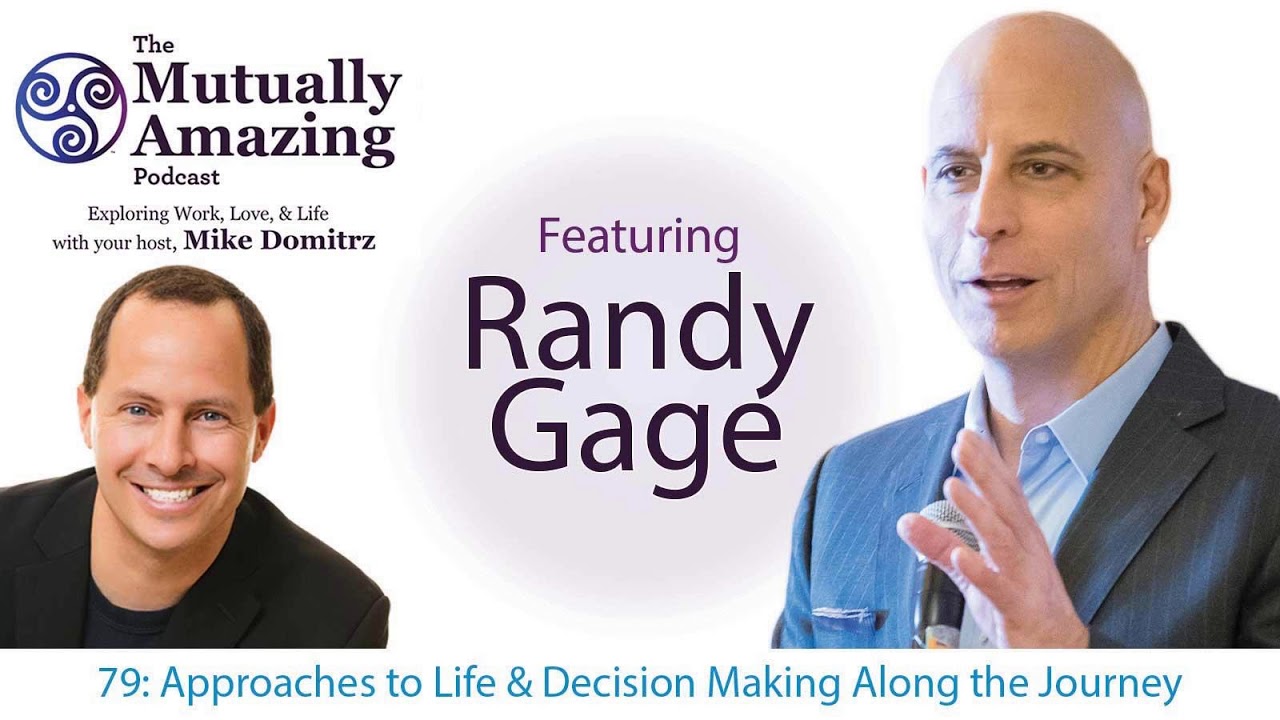
In this episode of the Mutually Amazing Podcast, host Mike Domitrz interviews thought‑leader Randy Gage, author of twelve international best‑sellers on prosperity. The conversation moves from Randy’s early life of teenage alcoholism, drug use, and a jail sentence to his transformation through self‑respect and introspection. A pivotal moment came when a teacher visited him in jail and affirmed his hidden potential, prompting a shift in self‑perception. Randy recounts his first entrepreneurial venture—a restaurant that failed and was seized by the IRS—illustrating that failure does not equal personal failure. He argues that the opposite of success is mediocrity, and that failure is a necessary stepping stone. Randy emphasizes curiosity as a super‑power, describing how a child‑like inquisitiveness drives hypothesis testing and value creation. He outlines a decision‑making framework for new ideas: does it add value or solve a problem? What is the potential return (10x, 100x)? Is the problem inevitable? Why hasn’t anyone solved it yet? He also references future trends, such as the imminent expansion of global broadband, to illustrate how he scans for lasting market shifts. The hosts discuss work‑life balance, which Randy dismisses as a myth, preferring a mindful, flexible approach to “life integration” that adapts to personal circumstances. Prosperity is defined holistically—money, health, relationships, spirituality, and environmental consciousness—rejecting the narrow view that prosperity is only material wealth. Randy defends a measured form of selfishness, arguing that meeting one’s own needs is prerequisite to helping others, and critiques extreme self‑sacrifice as unhealthy. Spectacular failure is presented as a marker of ambitious ventures; without the risk of a big loss, one is likely stuck in mediocrity. He cites Elon Musk, Steve Jobs, and Jeff Bezos as examples of leaders willing to risk spectacular failure. Randy also promotes his own Power Prosperity Podcast episode “Re‑Define Your Dreams – Rethinking Failure” as a resource. The episode concludes with Randy’s core message: everyone is born to be prosperous, but limiting beliefs (“mind viruses”) block that reality. By blowing up those beliefs and embracing self‑respect, curiosity, and mindful risk‑taking, individuals can achieve holistic prosperity and make a positive impact.
Chapters
Welcome to the Mutually Amazing Podcast. I'm your host, Mike Domitrz, with the Center for Respect. The episode you're about to listen to was recorded when this show used to be called the Respect Podcast. So, you might hear that mentioned during this episode. Well, let's get to the show. This week, we have Randy Gage, who's a thought leader on success and prosperity with 12 international bestsellers on the subject. Randy, thank you so much for joining us.
Hey, great to be on.
Absolutely. When I was first coming back to speaking on a full-time professional basis, I went to a National Speakers Association meeting in Madison, and you were giving a whole program on thinking big, on how far we want to reach and what a difference we want to make and having that prosperity mindset. And it had a huge impact on me. I started creating what we called like a mini magazine. You called that a magalog back then. We created one right away. It was about a 23-page one. So I wanna start by saying thank you for that impact.
That's cool. Yeah, Madison's my hometown. So I think I was going back to visit my mother and then just reached out to NSA if they wanted me to do something when I was there and that came about. So that's pretty cool.
Yeah, yeah. Well, you had a great impact and I appreciate that. I'm going to dive right in. We're all about respect on this show. What do you think is the single most important area for respect?
Self-respect. Because people who don't respect themselves don't respect anybody else. And that's where I think we get a lot of issues, right? I, you know, I remember some years back you were doing, uh, the Date Safe thing. Um, And, you know, nobody who self— nobody with self-respect is gonna drug somebody in a date, right? Or, uh, attack somebody. It's, it's, it all comes back to self-respect.
Absolutely. Self-respect can be incredibly important and powerful. And you had your own journey along this path. Was it— was part of your journey finding that?
A huge part of my journey. I was a teenage alcoholic, teenage drug addict. I was in jail in Madison at 15 years old for armed robbery. I was expelled from Madison West Senior High School because of that. So I made a lot of really poor choices, and which was the result of really low self-esteem, really having a low self-worth of myself. And I'm like, literally today as we're recording this, this is what I was writing on my blog, on my website. I was writing about here are some things I do for self-esteem because yeah, that was the big change for me is just like you can't love anyone else till you love yourself. You can't respect others until you respect yourself. And I had to really do some introspection And make some changes in my life and get to the point where I liked myself and respected myself and loved myself.
Was there something someone said to you at one point, or was there a low point you hit where you just said, there needs to be a massive change? What allowed that shift to begin for you?
Well, I had like 27 of those low point seminal moments turn this thing around. But, you know, some really big ones. The first one was when I was in jail, I was visited by teacher who was the father of a girl I went to school with, and he came in and told me, uh, you don't belong here. You're capable of great things. And I thought, this guy's so crazy, he doesn't even know what he's talking about. Does he realize who he's talking to? And I kind of told him that, and he said, no, I talked to your teachers. I pulled your transcripts. You skipped school for 18 days in a row, and then you go and take a test and you pass it. You've got reading comprehension above college level. You could do great things. You don't— but, and nobody had ever told me anything like that before in my life. And sitting in a jail cell, you're pretty much evaluating your choices that got you up to that point. And so at that— At that moment, I was ready for that message. And I desperately wanted to believe that what he said was true. And because I desperately wanted to believe it, I believed it. And because I believed it, it was true.
Yeah, right. The perception is reality, right? At that point, if you perceive yourself that way, that is who you are in that moment, which is so beautiful about that. And so you go from there to you end up starting a business, right? And I believe in Madison, correct?
No, Madison, I was working for some restaurants and then I moved to Miami when I was just about, just in my 16th year, I moved down to Miami and the business I started was down there. And I've done a number of business. I would be definitely what you'd classify as serial entrepreneur. Uh, but the first big venture out into the free enterprise system was a restaurant, because that's all I knew. I'd been a dishwasher who worked my way up to manager, right? And I started a restaurant with— and we didn't have enough money, and so it was just a disaster. So I ended up having my restaurant seized by the IRS to pay off the taxes. And kind of that was another one of those— That was when I was like 30, right? So when you're 18 and you're broke, it's almost romantic.
Yes.
You're supposed to be. It's like, yeah, and I'm going to make these bookcases out of boards and bricks. And look, somebody left a recliner on the sidewalk, and we could just put a sheet over it, and it'll work perfectly. That's OK at 18. At 30, I ended up selling all my furniture. Sleeping on the floor. And that is not romantic when you're 30. Right.
Right. So what got you to the next step then? Because for all of our listeners, I want them to understand Randy is a Hall of Fame speaker that speaks all over the world and you speak to massive crowds. I mean, tens of thousands at a time. So what was the jump then from that low spot, right? That, that failure moment in our lives to where you are today.
I came to understand that the fact that my business had failed did not make me a failure. That I came to recognize that— and again, a lot of introspection, a lot of soul-searching, a lot of personal development— and I just came to the awareness of realizing that, like, if you ask most people what's the opposite of success, They say failure, but I don't think that's true. I think the opposite of success is mediocrity, and I think failure is not the opposite of success because I think failure is very often a component of success. When we fail at things, we—that's kind of the wake-up call from the universe. Like for me, it was a good lesson. Like you know what? No matter how romantic it is and how dedicated you are and and and energetic, if you don't have enough. money to actually start the business and bootstrap it, it's probably a bad idea. You might need to rethink it next time you do something like that. You recognize that failure, challenges, obstacles, these are just the stepping stones to success. In terms of the context of your show and what people listen for, this whole idea of respect, That's the key for me. The key was that I respected myself enough to say, okay, I'm not a failure. I tried a business venture. The business venture didn't work. Now, I got to try something else, and I got to learn from that. I got to test and track and modify, learn the lesson, and then the next time around, I can be more successful. And that would be the best philosophy or approach to that that I could recommend to anybody listening right now.
And I agree with you wholeheartedly. When we've had our toughest struggles is when you go, how did you get here? And then you start to dive into all your numbers and you realize, why wasn't I looking at all these numbers way before now? And going forward, you run your organization very differently so that you'd never get there because now you learn the importance of that tracking of those numbers from failing to do it. So, I agree with you 100% there. In this show, our tagline is Exploring Work, Love, and Life. You have a take on that. So, what is your take on that subtitle of Exploring Work, Love, and Life?
What is my take on that? I guess my take on that would be the exploring part is the key because to me, the superpower is curiosity. Approaching thing with it. You don't have to be a child, but you have to approach life like a child. If you see a child, they're so inquisitive, they're so curious. So, and if you wanted to be analytical about what your toddler is doing or your baby, they're like a scientist, right? What do scientists do? They have a hypothesis and then they test the hypothesis to see if it works. So The toddler picks up something, puts it in his mouth, sticks it in his ear. I mean, right? He's just doing what a good scientist would do. But we beat that out of kids, right? Stop, don't do that. And we teach them all this regimented structure and everything, whereas we would do better to take more from them instead of giving them more from what we have, which is, hey, explore life, be inquisitive. Be curious.
So, when you're being curious, and let's say you come up with a big idea, you said earlier, hey, if you don't have the money for it, that's a sign right there of a red flag. Are there other certain questions you ask yourself when the big ideas come to you, when you're having that exploration, that curiosity, and you go, ooh, what about this? Is there a benchmark you run it against? Like, okay, that intrigues me. Now, here's my key factors that I need to look at, whether I want to actually keep pursuing that or not.
Yeah, key questions I ask are, OK, first of all, does this add value, solve problems, or both? Because if it doesn't do at least one of those things, and hopefully both of those things, then it's not really going to be a viable thing. The reason why Uber could disrupt the taxi industry, it added value. It solved problems. There was a lot of problems with the taxi business model, right? Airbnb, it solves problems, it adds value. So I look at that first. And then I look at other things like if it's an investment, I'm looking at, hey, am I going to 10x this? Can I 100x this? Because if it's a 2x or 4x thing, it's probably not a good investment. You're looking for 100x if you're going to invest in a venture. I'm asking, okay, what's inevitable? Does this solve a problem that's going to be around? Is this going to be a— why has nobody else created this? Why has nobody else come up with this idea before? Am I really a genius who discovered the solution to the biggest problem that nobody ever solved, or am I just deluding myself? I want to know that. I want to know— When I wrote the Risky Is the New Safe book, that was I always say I write all my books for me, but that one especially, I was crystallizing my thinking in terms of how you can look around the corner and see what's going to happen in the future. Because any futurist will tell you the future is always here. It's already here. It's just not evenly distributed yet. If we look at right now, the thing I'm thinking about is there are 2 billion people on Earth on broadband. Right now. Within 5 years, 4 billion more people will be on broadband because of the satellites that will be put out. And the, you know, broadband will be accessible to virtually 6 to almost maybe even 7 billion people on Earth. That will be cataclysmic. That will change our life in so many ways. What that will do for communication and networking and marketing and business and education. And so I'm always looking at things like that. I want to know what is going to be different in the future that's going to impact this? Then also, the thing I learned from Jeff Bezos was, because he was really brilliant in the sense that he did a letter to— might have been in his shareholder letter, or maybe it was just an interview I saw with him, but he was talking about everybody's looking for what's going to be different in the future. I'm always looking for what's going to be the same.
Right, right.
Yeah, he was saying 5 years from now, are people going to care about Low prices, fast delivery, free delivery. You know, are these things still going to be attractive 5 years from now? And the answer is yeah, those are not going to change. So that's what he built his business plan around. So those are the kind of things I like to look at, right?
I mean, McDonald's did that. It wasn't the burger that revolutionized McDonald's, it was the speed, right? And people were going to always want fast food. They got that concept. And ironically, our world's only gotten more faster, more chaotic Thus creating more of a demand, ironically. Uh, and yet it was considered innovative at the time. So that, that's, that's an awesome insight there. I appreciate you sharing that. Now, when it comes to this, we're talking about work-life love. Do you believe there's a balance, a work-life balance? What's the, your approach to that?
Yeah, I think the idea of work-life balance is preposterous. It's one of those ideas that sound good, look good, look good on paper, We have people who've written volumes about it, books about it, do seminars about it, TED Talks about it. Nobody's ever in perfect balance. That's just craziness. I mean, and if you are, I mean, obviously there's, there's probably 3 points during your life. If you live to be 112, there's probably 3 points that for half an hour you were in exact life balance between your health and your hobbies and your family and your work and your, you know, career and, you know, whatever. You've got to be flexible with that. If you just launched your company and you want to do an IPO 12 months from now, you're gonna have to go out of balance and work 80 hours a week because that's what it's gonna take, probably. If your elderly parents are really, you know, and they're They have got a degenerative disease, and you know they have only got— one of them only has 60 or 90 days to live, you are going to dial way back from the work, and you are going to spend as much time as possible with your parent. If you are a caregiver for an elderly person, or caregiver for a person with special needs, that is going to draw more out of balance in that. And then there'll be other times where you're gonna, you know, get out of balance in other ways. So to me, my take on that is you want to mindfully choose what you want to be out of balance with.
I love that language. It's so brilliant because I'm a— I, like you, I never believe in work-life balance. I think there's work-life integration, and even that's a dangerous phrase because it sounds like it's only work in life and it sounds like work is against life. You know, it's like it's not part of life. It should just be life integration and the 12 components of life in there because work-life implies that it's either work or life, which is a weird concept right from there. But I love the mindfulness of where I'm, where my integration, where if it's 80% there, 10% there, 5% there, it's being intentional, right?
That makes all the world Yeah, you're launching this new business. So you get the family together and you have a meeting. Hey kids, here's the deal. I'm going to be working at night, overtime for the next 6 months. It's going to be— but here's the deal. My goal is to open up this business on such and such a date. And once that happens, we're going to take 5 days and we're all going to Disney World. And we're just going to spend— and you You talk with the people around, communicate, create expectations so nobody feels left in the lurch and nobody feels neglected. But you— again, it's all the, the keyword there is mindful. If you're mindful about what you're doing, then you're going to come up with the results you're looking for.
Well, that walks us perfectly in the next discussion because when people think of Randy Gage, they think of the word prosperity. So anybody who knows you, that's what they tend to think of, and that's a mindfulness. Concept. It's a mindset. So what does prosperity mean to you? What do you think most people think it means versus how you evaluate it?
Most people think it means money and material things. And then, uh, well, let me take that back. There's a good number of people who think it's money and material things. And then there's another good number of people who think it's not money and material things. And I think both groups are wrong. I think true prosperity includes money and material things and health and wellness, satisfying relationships that enhance your life, a spiritual grounding, being conscious of the greater environment around you. That to me is true prosperity, where you're— it's all— it's a— it's very Prosperity needs to be very holistic. And the— of course, the superficial thing is, well, I just want to get rich. When I'm rich, I'll be happy. No, money doesn't buy happiness. Now, money and material things do allow you creative expression, and that can contribute to your happiness, right? But money and material things in and of themselves will not make you happy. So, um, but the other side of the coin is these people say, well, it's just money and it's just things. That's not the right approach either, I don't think, because God, I went to the— I had a veneer crack, one of my teeth, you know, have a veneer, and I went to the dentist. It was $4,000, the bill. I'm like, how would poor people pay for this? They wouldn't, because that's what poor people do is they don't get good dental care, right? Uh, what was the other thing I did the other day? Something I went in, the bill was whatever, and I was like, How could— but again, how— well, how do poor people do that? They don't do that. They have limitations to their life. And I know because I was broke for the first 30 years of my life. So I can look back on that time and realize, no, you know, money really is an important element of prosperity. It really needs to be all of those things.
And Randy, I know you're someone that comes from a place of spirituality. I've seen you speak about it. And so, for the person who pushes back and says, but wait, material things, that's focused on yourself and you and it's material. It's not about giving back to the world and serving the world. It's the wrong focus. How do you respond to that?
If you tell me your highest purpose in life is to serve God, I'm going to lock up my wallet and run away from you. If you tell me you're just here to save the planet, I'm going to run shrieking from the room because I think you're, you're more dangerous than a con artist. Because a con artist, we know they're con artists, whereas people who give up everything for themselves to serve everyone around them, they're just emotionally crazy people. They're not well-balanced. They're not mentally stable. It's not a healthy relationship, right? It's not a healthy mindset. Ayn Rand wrote— she's famous, of course, for Atlas Shrugged and The Fountainhead, but Her best work, I think, was a book called *The Virtue of Selfishness*, which was a collection of essays put together into a book. And when it came out, it was of course all this consternation, and she was being interviewed and said, "Why do you use that word selfish?" And she said, "For the very reason it scares you." But I do think there is virtue in selfishness in the sense not of be a hedonistic jerk. But there is virtue in understanding that you have to get your own needs met first before you can help anyone else. So you're telling me, yeah, I want to save the rainforest, and I want to save the whales, and I want to save the tofu burgers. And great, but if you can't find the money to pay your rent, you're not helping anybody, right? So you have to get your own house in order in for you to be able to help others. Money and material things are part of that. If you don't have security, if you don't have shelter, if you don't have financial security, you're not going to be able to help other people or causes or the greater world. There is, again, not to be hedonistic and just self-serving and everything's all about you, no, but You pick things that enhance your life, right? I, you know, I'm a writer. I'm writing all day long, so I don't go and buy groceries. I pay extra money to Instacart, and I tip the guy $10 and get them delivered, right? So that's a selfish thing. Okay, you could call me selfish, but makes sense to me.
Well, what's interesting about that too is you're, you're helping someone else in that process. Somebody's getting paid for all those services. And that's what people forget. Yeah. I heard a quote in the last year that I loved, which is, if you think money can't— now this argument of can it buy happiness? This comment back was, if you think money can't buy happiness, you haven't given enough away. Which is when you have certain levels of income, you can actually bring happiness to others through your financial stability and what you're able to do. Uh, and you, you referenced that a little bit there and what you're able to give back.
Yeah, and the other part of that equation is poverty doesn't buy happiness either.
Right, right. So why not, why not have safety?
Okay, poverty sucks. Poverty causes people to lie and cheat and steal and even kill. There's nothing noble or spiritual about prosperity.
Do you mean prosperity or poverty?
I mean poverty.
That's what I thought. I just want to make sure. All right. So the person who pushes back on that going, wait, Randy, are you saying everybody who's in poverty is more likely to be bad people?
No, I'm saying that as much as they want to be good people, they're not going to be able to help other people as, as much as they could if they were financially viable.
Yeah. Yeah. That makes total sense. And you're a big believer in strive big, strive for spectacular failures. So what do you mean by spectacular failures? And Is there a danger that if it's too big of a dream, it becomes, as you're getting there, you're not getting there, you start to give up sooner 'cause it doesn't feel realistic?
Yeah, great, great question. And let me give a resource to your listeners. I also do a podcast like you do. It's called the Power Prosperity Podcast. And I would suggest people look it up and find the episode called Re-Define Your Dreams. Rethinking Failure. It's come out just like a week or two ago. Rethinking Failure, Power Prosperity Podcast.
I'm going to have this in the show notes too.
Okay, perfect. Because it's always cute and catchy to say sacred cows make the best hamburgers and you want to fail fast and you want to fail big, but let's not misconstrue it to mean You should intentionally try to fail. No, we don't want that. But here's what I know with every essence of my— every fiber of my essence is that if you're not willing to fail spectacularly, then you're not doing something amazing. If you don't have a risk of a major failure, I would say you're mired in mediocrity.
Right.
Because to really accomplish something great, you have to— for Elon Musk to get people to Mars, he's got to be willing to chance a spectacular failure. For him to make Tesla electric car company work, he's got to be willing to chance a spectacular failure. Jobs was willing to take the chance of a spectacular failure with Apple. So that's the Again, one of the things I say on that podcast is approach your ventures like a venture capitalist does. They create a fund, they are going to invest in 100 ventures, and they know that 60 of them probably are not going to make it to market at all. 30, 35 will make it, but they will not really be a big return on investment. Some of them will pivot and be successful, some will not, but hopefully, 2 out of that 100 will be the unicorns that just go crazy. If they give it their best shot, they run the business with integrity, they keep the investors informed, and then they come and say, hey, we've just found— you know what? The market is just not buying it. They're just not into this product. It's not working. We're going to shut it down. We've got 20% of the money left. We're going to refund that to the investors. And we gave it our best shot. If they were honest and did their best work, you would invest in them again. You'd say, hey, they ran it right. It didn't work, but I believe in that CEO. So, give yourself that same benefit that, hey, okay, so I had some failures, but that's just part of my portfolio. There's lessons. Again, if you learn from the lessons, then it's going to be all right in the end.
Absolutely. And so, what is it, Randy? What's the most important thing you want people to take away from your work?
You were born to be prosperous. There's so much programming against that. There's so much negative limiting beliefs, mind viruses floating out there that money is bad and rich people are evil and it's spiritual to be poor. You just got to blow up all those limiting beliefs and you've got to recognize that you are meant to be healthy, happy, and prosperous.
Well, and what I love about that is if somebody is saying, well, wait, I'm coming from a place of faith or spirituality— if you are, then you, you must believe God wanted you to be prosperous, right? I mean, that would be common sense, that God didn't want you to just suffer forever with no success, with no victories. In fact, God wants you to find those victories and make an impact in this world, right? Make a positive impact with those victories. So I think that's what works so beautifully along the way. This has been A great conversation. Love all your insights. I want to make sure everybody can find you. The good news is it's easy because your name sounds the way it spells, which is randygage.com, which is G-A-G-E dot com. So randygage.com. The show is The Power of Prosperity is the podcast that's out. Rethinking Failure is the episode you already referenced. We'll also have your Twitter account on our show notes. Thank you so much, Randy.
Thanks for having me on. A great conversation today.
Well, I appreciate that. And for our listeners, you know what's next. It is Question of the Week. This week's question is, Mike, what's an additional quote you really like about respect? Now, the one I'm sharing this week, I talk about when I'm doing workshops for corporations and organizations, whether it's with their leadership, their management, or the entire organization. It's Bryant McGill. And the quote is, one of the most sincere forms of respect is actually listening to what another has to say. The reason that's so beautiful is that when I travel the world working with audiences of all different ages and all different sizes, especially in the corporate world, and we talk about what does respect feel like and look like, people say it's to be heard, to be seen, to be valued, and to be heard for what I'm saying, not just what they want to take out of what I'm saying. So, to truly listen is one of the most respectful acts You can ever engage in. We'd love to hear your questions, your thoughts, and your ideas. And the best place to leave those with us is on our Facebook page at facebook.com/MutuallyAmazingPodcast. Of course, you can always contact us on our website at mutuallyamazingpodcast.com. Remember to subscribe to the show so you automatically get it every week. And if you could take one moment to leave a review, that really helps other people find the show, which we are greatly appreciative of. So thank you so much for joining us. May you make today and every day a life full of mutually amazing relationships.








