82: Find out why nonprofits and leaders of all kinds of organizations can struggle with treating...
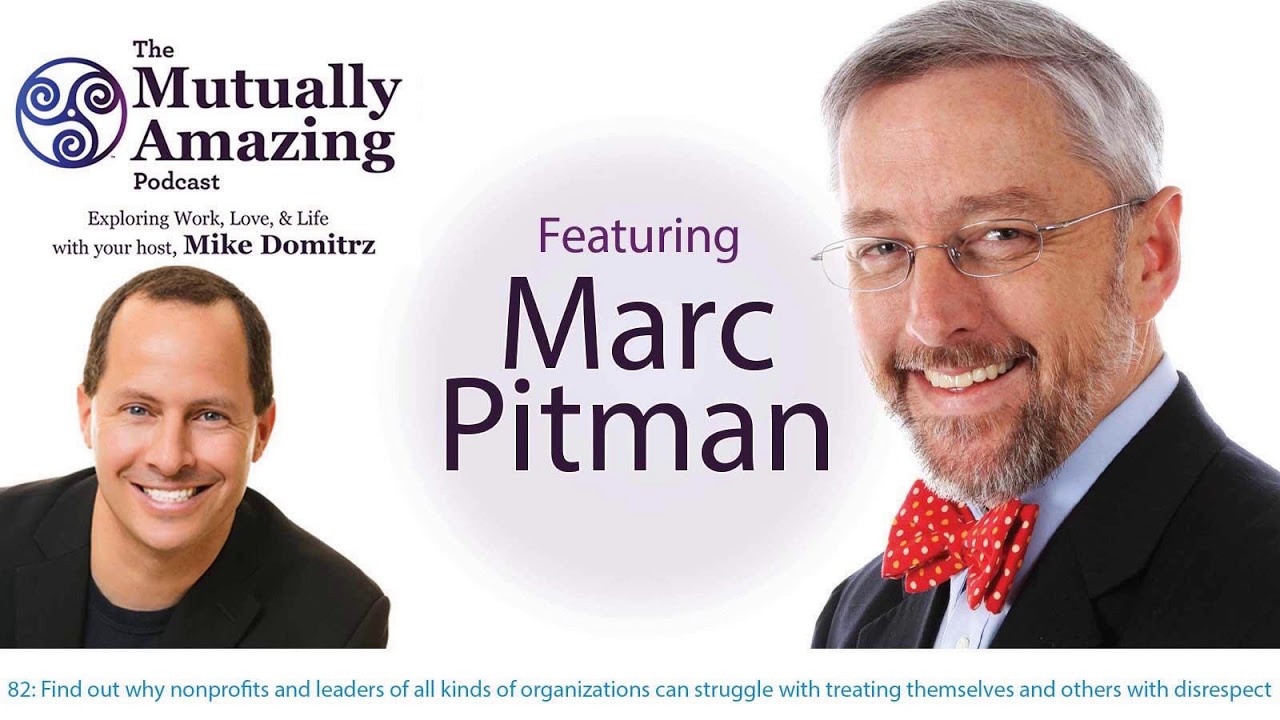
Executive coach Marc A. Pittman explains why nonprofit leaders struggle with self-respect and how it sabotages their work. He shares the Magnet Goals exercise, where leaders list 100 aspirations to uncover hidden motivations, and introduces three assessment tools: DISC, the Highlands Abilities Battery, and the Enneagram. Poor sleep, inability to celebrate wins, and bad time management are signs of low self-respect that leaders can fix with small rewards.
Chapters
Welcome to the Mutually Amazing Podcast. I'm your host, Mike Domitrz, with the Center for Respect. The episode you're about to listen to was recorded when this show used to be called the Respect Podcast. So, you might hear that mentioned during this episode. Well, let's get to the show. This week, I'm so excited to introduce you to Marc A. Pittman, Executive Coach and CEO of the Concord Leadership Group. He's the author of 8 books, including Ask Without Fear, runs fundraisingcoach.com, and directs the Nonprofit Academy, a training resource for nonprofit leaders and board members. Marc, thank you so much for joining us.
Oh, it's my pleasure to be here. Thanks for having me.
Absolutely. We're going to dive right into this. You've coached leaders around the world. Is there a common aspect of respect that you see or a lack of respect?
It may be counterintuitive for people, but I think one of the When it comes to respect and leadership, it's usually themselves that they don't respect the most. I think most leaders think that they should just get it and things should just work for them because they learned a skill as an employee and they learned proficiency at that, but they forget that when they went into management, they had to learn how to deal with people 'cause the skill proficiency wasn't enough. You have to learn how to deal with people, and I don't think our culture often helps people make the bridge from management to leadership either. So we get proficient managers and we promote them into leadership and expect them to figure it out as they go. So I see a lot of unhealthy habits and a lot of berating people, berating themselves, 'cause they feel like the weight of the entire organization does rest on their shoulders, so they just keep doing things that do not help sustain themselves. So one of the examples, in my leadership intensives, I have people write a list of 100 different goals and dreams and And fantasies and stuff that they wish that could happen. And I like doing 100. I call it the Magnet Goals process. I like doing 100 because it forces people to get out of their logical mind and into a creative space. Usually the first 10 come easily. They're usually work-related. But what I hear from participants regularly is that they're shocked to see 2 things. One, how many personal things come on this list and how energizing that is. It's as though they forget that their whole life is— they are a whole human being. They think of just themselves in terms of work. When they start bringing in some of their own interests and goals, then they find that there's a whole new renewed energy about their leadership and they become more interesting to the people that they lead too.
So what would be an example of something they might put on there that helps them with that awakening? What answers have you seen?
Well, so there was one person I was coaching who was a major gift fundraiser for a university that happened to work with people that were in the arts and particularly theater. Her interest was theater and arts, and she never realized that she wanted to get more into the art scene and the acting scene in that particular area where the university was. She had never given herself permission to prioritize her major gift prospects that were also in the acting scene. So she had this list of portfolio. For people that don't know, for nonprofit fundraisers, it's often 100 to 125 relationships that our major gift person's managing. So they're all qualified prospects. And there was no reason why she couldn't kind of front the people or prioritize the people that had interests that could help her in her own aspects of life as she was still having the integrity of making the major gift asks and doing all the things that were for her job.
Was it— was there a concern of conflict of interest? Like if I ask these people who are donating money to connect with them into the theater and the arts separately, That, that could be a conflict? Was that the fear?
It may have been the fear. What I coached her to do was to just be curious. Ask them, what's the scene like here? How did you get into this? What are the biggest mistakes you see people making? Doing the— using it as research for her own interactions because she's naturally curious. And when you're naturally curious in somebody else's story, you become much more interesting to them. When you're just going through the motions and you have no idea about something, it can be a little bit harder. So people would be much more eager to meet with her Or at least should be a live conversation when she was having, 'cause usually you have conversation with people before you just come right out and ask 'em. You get to know them a little bit. And so that was, I think, I don't know if she thought it was a conflict of interest, but as long as she kept it in terms of gathering information, that could definitely work. And then if it became a relationship, there's any number of things when they find out, oh, you graduated from here? Are you still doing acting? Those sort of questions could have allowed it to go in the direction that would help her that way.
And you specifically said that a lot of organizations are weak at developing their leaders. And therefore, the leaders don't have training, education on leading with respect. Why do you think that is?
It's crazy, isn't it? Because the leadership skills industry is huge. There are books and degrees and seminars and podcasts. I don't really know. I was just talking to a business friend of mine that it seems like we all Computers can get an update and an upgrade, and from then on, that operating system doesn't need to deal with the stuff that it had before, the issues that it had before. But human beings don't seem to have that sort of Matrix-like download of information or upgrade. It seems like we all have to go on the same path, on the same journey. And I think it blindsides each of us that we still need to have those learning experiences. And I think organizations also— I think it's probably like buying software. When you buy software, a CRM or something like that, you think you've made your decision. decision, but you're really only 30% through the process because you actually have to implement the use of the software and then get used to using it. So it's also similar with leaders. Once you promote a leader or hire a leader, it's not just set it and forget it. There's still going to have to be some sort of growth and grooming going no matter how good the leader is. They're going to have to understand the organization. They're going to have to understand the goals. There's a lot that I think people Just figure, well, they seem to have it all together. So—
Yeah. What would be a clue to somebody that they're lacking respect for themselves as a leader? Because, you know, leaders will listen to this and go, I don't— what? I run this organization. I've gotten all the way I am. I don't lack respect for myself. So, what are clues that you might that you're not aware of?
Well, here's one. And I do work with nonprofit and for-profit leaders. This happened to be a bunch of executive directors who are in their 3 to 5 years in their position. of organizations, so nonprofit CEOs. We were at the end of our breakout at a local conference, and I turned to them and I thought I was giving them a softball question. I said, so how did you learn to deal with the sleepless nights? And there was this awkward pause in the room, and they all said, oh, I haven't learned to deal with those. I still get them. So, one sign could be if you're not able to sleep through the night because the pressure on leaders is tremendous. There was a recent study done by the Center for Creative Leadership that There's pressures from all sides— bosses, customers, peers. Their leaders are literally getting drawn and quartered. So one thing could be that you are— you're not sleeping well at night. Could be a very real physical reality. It could also be diet and exercise. I understand that. Another one that is interesting, and I'm not sure how to implement it here in the United States, but in Scandinavian countries and European countries like Denmark and the Netherlands, if you're spending a lot of time at work, that means you're a poor time manager. If you're not able to get the work done in the time allotted, then you've got issues with yourself. And there's something along with that, that in America we have a different expectation of leaders, that they're in before everybody else and they leave after everybody else. So I'm not sure how to— that has to be tailored per culture. But there has to be areas where you're learning to reward yourself. And one of the things that I ask leaders a lot is, how do you celebrate success? And most of the time, if there's— most of the time, none of us can answer. I don't know how to celebrate success. I just move on to the next thing because there's always something else to do. But oftentimes there are people who have usually a food-related thing. So there was one guy that would get a— before he could afford it, he would get a latte, a vanilla latte from Starbucks after he made a sale, a sales call. Every time he had a sales call with a very clear call to action. That was the activity he wanted to reinforce in himself. So he'd buy himself a more expensive drink than he could normally afford.
Yes, I could hear it. I could hear it. We've had people on the show on financial advice be like, no, don't reward by spending. Right, exactly. Uh, but you know what? It is an important discussion about rewarding the small daily successes. And it doesn't even have to be financial, right? Just, I give myself 5 minutes to listen to music that I wasn't going to listen to. I mean, something. That says, this is my moment of celebration. We have a word we use in our office and every so many years we change it. So there's more variety, but if something good happens, it's whoop whoop, you know? So everybody sends around a whoop whoop, but one time it was hooray and another time, but it allows you to celebrate the small successes.
Oh, that's great. Uh, we had whoop whoop when I pastored a church, it was whoop whoop because there was a wine out of Australia, Shiraz, that was whoop whoop. And so our, our leadership team started like whoop whoop. And then we started imitating the corkscrew with the arms going up and down, you know, When we were taking off. Oh, I love it. There's another person, one, one place I was in, whenever they had a win, they would do it. They had it. It was goofy as all get-out, but they had a rally monkey, they called it. They had a little stuffed monkey that they'd run around. The person with the win would run around, and usually it was the executive director because other people weren't. The leader has to set the tone for this is acceptable behavior.
Right.
But sometimes there's, yeah, bells are ringing. I love that you guys have words. That's really smart. And it's hard. I think we feel like it's foolish, but I think it's one of those things that really feeds our spirit. when we have some way of acknowledging, hey, we did the right thing. And a lot of times it has to be personal. So this is where I love— I'm a student of Stephen Covey's 7 Habits of Highly Successful People and the other type, all the other books that came from that. I really think that no matter whether you have the leadership title or not, I think we all are leaders. I think we all have influence in spaces. And I think building that trust with yourself is going to— is where you can build your circle of influence, expand your circle of influence, because you're keeping the— I think it's Life at the Speed of Trust or Leadership at the Speed of Trust. They talk— Stephen Covey's son, Stephen Covey, talks about how building trust starts with keeping commitments to yourself and celebrating and honoring those. I know earlier this year there was a video game my kids decided to stop playing with their consoles. I put it in the office and I would give myself at certain times if I'd done something 15 minutes to play, which was really cool because I don't allow myself to play video games for decades now because it doesn't seem productive, which I always used to love. I happen to live in the Southeast now, and so I like to go out and have lunch outside for 10 minutes. I don't normally allow myself to get away from my desk for lunch, which is silly because I'm self-employed, but my boss can be a real jerk at times. So getting outside of the office and just Just sitting and reading something on my Kindle, even if it's not work-related, it's amazing how that just recharges my batteries.
Yeah. For me, I live near water. And so, for me, it's to step outside and to just sit and take the view in. You know, that type of a— it's big. Now, a key to respect is understanding others. It's a huge key. In your years of coaching and training, are there any tools that particularly help you with this that you share with people for helping understand others?
Wow, there's one. Okay, so we, we, for years I've taught the DISC, you know, uh, 4 quadrants, ancient Greek sanguine, choleric, melancholy, phlegmatic sort of, uh, method framework or matrix. Love that. It was frustrating to me, um, as a speaker that that was the part that people got the most out of my talks. I would create content about all sorts of things, but it was DISC, that really, you know, this 2,000-year-plus-year-old thing that people really got. Um, so that's been really helpful. I also like the Highlands Abilities Battery. I've been using that for years, which is a A battery of tests that measures how you actually perform under time pressure. You have 5 minutes to do something and does it come naturally to you or not? Are you able to perform it or not? So it's not the mind game of, you know, I think I'd rather respond this way or I think I'd respond that way. It's actual performance on tests. But the one that is exciting me in the past year is the Enneagram. It's a tool I've been using for about 30 years in my own personal growth, but only in the last year or so have I started using it with coaching clients and training and trainings. There's a woman named Beatrice Chestnut who wrote a book called The 9 Types of Leaders, and that just broke down for me how this very interesting typology methodology is able to be used by leaders too. So, uh, the Highlands Ability Battery talks about what you can do well. It's your kind of hardwired abilities. The next one, um, the DiSC one is your behaviors, your observable behaviors. So you can look at other people too and observe them. What I love about the Enneagram is that it gives a— it's an ancient— we think it's an ancient typology that gives 9 different kind of ways of looking at the world. So 9 different narratives people live within and it talks about their motivations. So you can see 2 very hard-driven people that are goal-setters and go-getters, but they may be operating from very different stories. And so it breaks down into 9 different stories where people are coming from and that can help you as a leader really learn to respect somebody else's story because somebody may be trying to look successful. So when you're criticizing them, it may be very important for you to say, this is really good to do that kind of compliment sandwich. Say something nice, give them the criticism, say something nice again. But there's another type of person, an 8, that wouldn't need that at all. They just want to know, am I doing well or not? And, you know, get out of my way so I can do better.
Well, what's interesting about Enneagram is that it tells you who your strength is and who your, who your challenge might be. So if you're— it tells you what number is probably not going to work well with you. So what you need— and it doesn't mean you're not going to ever work with them, but you need to be very aware of when you are working with them Here's where you two might struggle with each other. And then who's ideal? Like, who aligns with you really well? Who's not your number? Because your number might not be the right alignment at all to be with because you're too alike. But that's the beautiful thing about it that I love.
And I love the dynamism in it too. You can, like, you can respect yourself. Myself as a 7, I know that when I start getting black and white in my— it's either this or that— I'm shifting into the negative energy of the number called 1, which is very black and white. So there's a, there's a pathway for stress that I can, I can be a warning sign to myself of, oh, I must be stressed. I'm, I'm moving in this space. And there's also a sign for growth where you're moving towards a 5, which is much more objective and does deep dives into things. So I love the dynamism in that for my own— that's where I'd used it, Mike, for so many years of just my own personal ability to, to learn and grow.
Yeah, I, I love it. And, and Mark, you have found that in the latest study, 4 out of 5 leaders of nonprofits Struggle with confidence. 1 in 10 don't believe they have the abilities to lead the organization. Do you think that is unique to nonprofits, or do you think those numbers would be the same in what people would call corporate America? And either way, why, why is this, do you feel?
Yeah, um, I don't know if it's— I haven't done the study, I haven't seen the research. I have my master's in organizational leadership, but I haven't seen the, the research in the for-profit world. Um, I'm not sure why it is, um, in nonprofits other than the fact that people Well, nonprofits in particular, I know that there's— in a business, you're the boss and you have a staff and you service clients. And as you service clients, they resource your organization. They provide the income that then makes the whole thing flow. In a nonprofit, it's not that way at all. You're the executive director, but you're not the boss. You have this board of directors, and sometimes they individually think that they're the boss as individuals, where they're never that. It's only when they're together meeting as the board that they're the boss. But then you've also got your staff who thinks you know what you're doing, and then you've got the clients that you're serving for your mission, but the clients are the ones that don't resource anything because that's a nonprofit. So you have this 4th group, the donors, and nonprofit leaders are kind of drawn and quartered. And that's why I think it really hits the confidence levers for people, for sure. Yeah.
And I think there's also this element of to be the executive director of a nonprofit. Some people in our world, if you were the same role, the president of a major corporation, you'd be given more respect than the person of the nonprofit. The nonprofit sort of gets, isn't that nice? You know, versus, wow, look at what they've built in corporate. Nonprofit, wasn't that nice?
And that's why I try— when I go around talking, I call executive directors of nonprofits CEOs because people have a respect level for CEO that the executive director, they don't really know what that means. I think the other thing with a lot of organizations, for-profit, not-for-profit, is if they're given a list of objectives to do by a board, let's say, they often take those as their own personal list to do for the year. And then they try to be good servant leaders and turn to their staff and say, what do you need to do? What kind of help do you need for the coming year? Instead of taking that list from the board and saying, these are the organization's objectives. Because when they take it as their own objectives, they have their list of things that they're going to be graded on at the end of the year, but they also are trying to serve their staff, which is— it's a false dichotomy. And they feel torn. When they're with their staff, they know that there's stuff that's not getting done for the people, you know, for the objectives that they're going to get assessed on. And when they're working on the stuff that they're going to get assessed on, their staff often wonders, where are they? And I think that also does a lot to erode at confidence of the leader because when the leader can say, these are the organizational objectives, where do you see yourself helping with this? You'll find things like the CFO saying, I can help with sales. There's this aspect of sales. I'm not going to do sales. My job is CFO, but I could be really helpful for the sales team because I have a number story that I can tell. And you'll see some cross-disciplinary approaches to things that you just wouldn't expect. If you're holding onto that list yourself.
All right. So let's dive into that because that self-doubt, that is a real issue and we're all about respect here. So how you believe people can use self-doubt as a catalyst to growth. So what do you mean by that and how does someone do it?
Well, if you could picture a 4-quadrant thing, there's a confidence is the vertical axis. Uh, so the confident, high confident at the top, unsure at the bottom. And then there's the external cues on the left and the internal cues on the right. Most people in the leadership start out with high in the quadrant of High confidence, looking at external people. So they see other people leading and they are excited because they've seen other people lead and they know they can lead. And then they— it doesn't work out that way for them. People don't always follow. Things don't always work out right. So they start waning in confidence and they move down to what I call quadrant 2, which is they're still looking externally, but they start consuming books and they're starting to consume podcasts and go to seminars and trainings and all. Most people in organizations get stuck there. The book says this is going to change my life. I do it and it doesn't change my life. There must be something fundamentally flawed with me or something fundamentally flawed with my organization. I like working with leaders that I think that can be actually when you feel like there must be something fundamentally wrong with you, that you could be on the verge of greatness. And that's where you move over to what I call quadrant 3, where you're still unsure of yourself. It's the lower right-hand quadrant. You're unsure of yourself, but you start looking internally like, why doesn't that resonate with me? Why doesn't that seem to fit our culture? And what parts can I? I had a mentor early on in my life say, eat the chicken, spit out the bones. In any book you're getting, there's chicken and there's bones. So, uh, you know, for my example is Getting Things Done. When I read Getting Things Done, I thought this was going to be the end. This was going to bring order and stability to my life. I thought it was so great because you write lists and you put— you make lists of lists and you have files of lists and everything. It didn't work for me. But when I, when I finally got over the fact of maybe I'm just totally messed up because it didn't work for me, I started realizing one thing that really did work for me from that book was writing lists and then putting the next action. What's the next action to get this list done? When I had that, that became part of how I was able to tailor my own leadership suit as opposed to trying to fit into David Allen's style. I could be myself and grow into myself. I think that's the invitation when you're really lacking confidence in yourself. There's an invitation to grow into the fullness of what you, you can be uniquely and what your voice can offer to the world and to the organization instead of trying to copy others.
Yeah. Let's go to an example of that because you have a personal example of where the opposite happened, where you thought somebody was a certain profile and they weren't, and it was in your own home. And today's show, you know, our show's always exploring work, love, and life. And so let's go into the personal side of where this can show up in someone's life. Can you share with us that story?
Sure thing. Yeah, I, I have 3 wonderful kids and a really cool wife, and we look at these things all the time. And so one of the models that we— I like is DiSC. And I would ask one of my kids, I'd ask them, and I've gotten permission to share the story, I'd ask them a question and this— she'd come back with more questions. She'd ask me a question, I'd give her an answer, she'd come back with more questions. So I thought that was high D, high extrovert, high task-centered. So I would try to push back with her and try to talk that dialect of pushing back and kind of, you know, being driven and a little dominating. And my wife was able to say to me, you're crushing her spirit. And when we finally did DiSC with her, with, with her, we found out that she was actually a high C, very task-oriented but introverted, and high I, very extroverted and people-centered. She was both. So she had all the superpower questioning of the Cs. Cs come up with questions all the time. And All of the verbal extrovert— the verbal processing of an I. I's don't really know how to think without talking first. Once they've said everything and it's verbally processed, then they can make up a decision because they know what they're thinking. So she had that same both/and going on where she had all the questions but she needed to verbalize them. And so it was much easier for me to be able to— not easier, but it was remarkably— it was like I felt like a light had broken over my marble head where I was able to to finally see exactly what my wife was saying, that she was— that I was crushing her by trying to be this D, High D. And when we went through the assessment together, we are also— Extended DISC is what I'm certified in, and they have you go through, think of somebody in your life. Are they high people or high task? Are they high active or reserved? And the person she thought of was someone who was a High D, and I was explaining how High Ds work, and they don't really care how you feel so much. They want to know what the task is. And as we were going through it, she looked at me and she said, Dad, that's you. When I come into your office and I ask and I say, hey, how are you? What are you doing? And you just wanted me— you wanted me to cut to the chase because you know you want— I want to get a ride somewhere. And so now she'll come into my office and say, hey, how are you? Oh, you don't care. Okay. I'd like to go get something at the store. Do you have time at 3 this afternoon to take me or not? So it's been very helpful for us as a touchpoint in our family, which is Um, help— helps us respect each other more for sure and gives us a few good laughs along the way too.
Sure. Well, and I mean, that's neat that your kids have grown up being used to that, right? So if, if you suddenly do that a certain place in life as they're older, they could push back like, hey, I'm not taking some test. What are you talking about? You're going to analyze me, right? But you've created an atmosphere that says this is the norm.
Oh, that's interesting. Yeah. Thank you for that reflection. I grew up in a family where I had homework for school and I had homework because I was a pitman. So I'd do all my schoolwork, you know, all the 3 hours or whatever, but then I'd listen to Zig Ziglar and take notes on Dale Carnegie and other books, uh, because that was part of my job as being a Pitman. So I grew up in that kind of environment and I hadn't even thought about the fact that something of that is being passed on. So thanks, Mike.
Yeah, because very few people have that. That's really cool. So I appreciate you sharing that. Look, Mark, this has been amazing. I want people to be able to find you and there are a couple of ways. concordleadershipgroup.com is one. Another one is fundraisingcoach.com, thenonprofitacademy.com. We're going to have all of these on the show notes. Thank you so much, Mark. This has been awesome.
Thanks. It's been a blast. The time flew by.
I love that. And for our listeners, you know what's coming up next? That is question of the week. Today's question of the week is, Mike, how do I respect other human beings? Like what's an actual lesson plan for respecting other human beings? And when you ask people around the world, what does it mean to be respected? They tell you it means to be seen, to be valued, to be appreciated. And there you go. See people. Don't write the script, as my friend Jessica Pettit says, don't write the script about someone and have a preconceived notion and allow no room for change in that script. Allow them to show themselves to you and for you to value them for who they are, not for who you want them to become, not for the better version of themselves. See them for who they are in that moment and really get to learn and discover and appreciate them. That is what it feels like to be respected, to be seen, valued, and appreciated. We'd love to hear your questions, your thoughts, and your ideas. And the best place to leave those with us is on our Facebook page at facebook.com/MutuallyAmazingPodcast. Of course, you can always contact us on our website at mutuallyamazingpodcast.com. Remember to subscribe to this show so you automatically get it every week. And if you could take one moment to leave a review, that really helps other people find the show, which we are greatly appreciative of. So thank you so much for joining us. May you make today and every day a life full of mutually amazing relationships.








