84: Parents, how do you get your kids to co-operate? Discover with parent educator, Alyson Schafer.
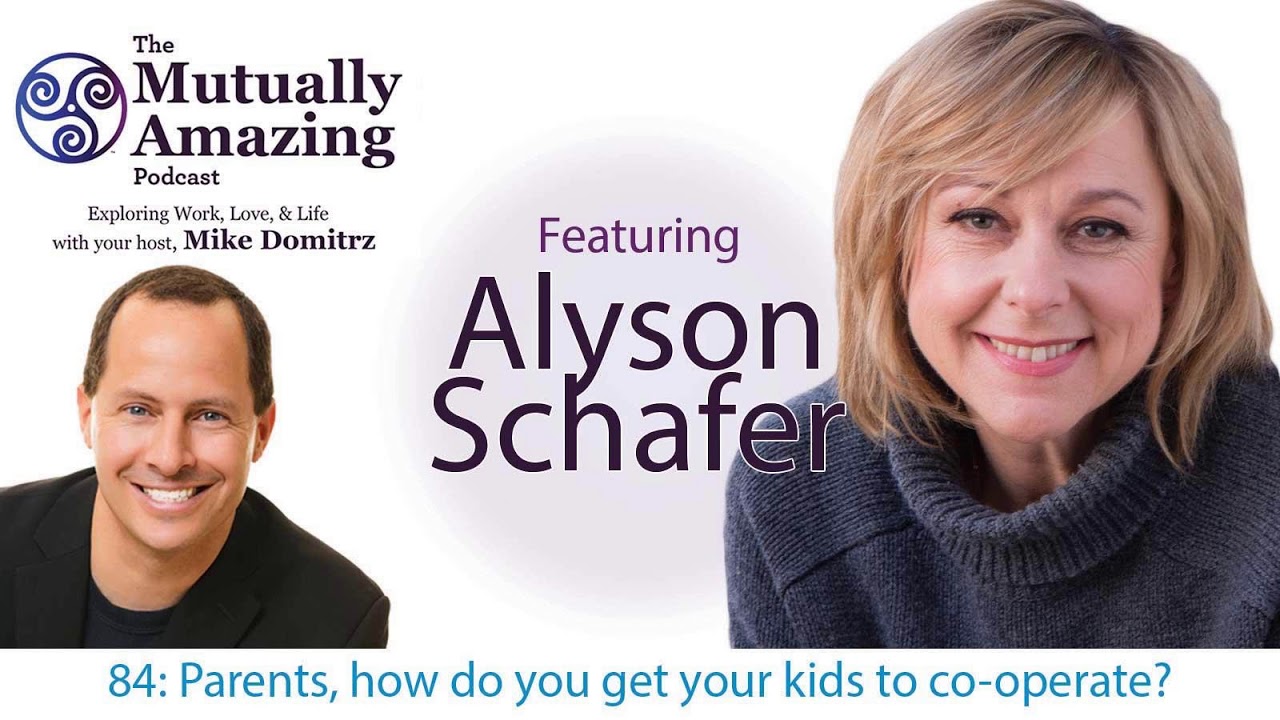
Alyson Schafer, an Adlerian parenting educator, argues that obedience-based parenting creates power struggles. Instead, she teaches cooperation through natural consequences, family council meetings, and understanding what a child's misbehavior is actually trying to accomplish. When kids feel respected and included in decisions, they cooperate.
Chapters
Welcome to the Mutually Amazing Podcast. I'm your host, Mike Domitrz, with the Center for Respect. The episode you're about to listen to was recorded when this show used to be called the Respect Podcast, so you might hear that mentioned during this episode. Well, let's get to the show. This week we have Allison Schaefer with us. She is a family counselor, parenting expert, and bestselling author. She speaks internationally about democratic parenting practices. Alison, thank you so much for joining us.
Such a pleasure. Very, very nice to be participating with you.
Oh, absolutely. And you know, we're all about respect here and we love respecting people's story too. What's your story about how you became a parenting expert? Because you, you and I both know when you talk to parent groups, I've had the same thing sometimes. I'm sure you get it. Somebody's standing there and go, and what makes you an expert?
Yeah, I know, the eyeballs roll.
Yes.
Who qualifies as an expert? No one's an expert. And I totally agree. I don't actually like that title, to tell you the truth. It just is what is recognizable. I think the better word is parent educator. But I do have a unique story in that I'm the 3rd generation in my family to bring parent education to their community. So my grandmother was actually friends with somebody called Rudolph Dreikurs, who wrote a book called Children: The Challenge, which was considered, and still is by the Library of Congress, to be a seminal work on child discipline, and he was a student protégé of Alfred Adler. So, all my training is in Adlerian psychology. And, many people don't know the name Adler, so just to put him in context, there was Sigmund Freud, everyone knows, Carl Jung, everybody knows, and then this third guy, Alfred Adler. And, they were intellectual sparring partners at the turn of the century. And, the 3 of them are responsible really for what is modern-day psychology. It's just Adler's name or brand kind of got lost in the mix, but his ideas Really infiltrated family counseling. And, um, so, so I'm sort of, um, a purist in, in Adlerian psychology. And he had as his, uh, main emphasis cooperation, respectful relationships. And whether that was within the marriage, parent and child, or in the workplace, or in our greater communities, um, that was really his, his emphasis.
And I've actually had one other guest on that brought— also very big believer, same philosophies, the The same names you brought up. So why— you brought up a key word there about cooperation. Why is it do parents struggle so much? And this is what I like about you bringing up. This wasn't brought up in past episodes. Why do parents struggle so much with getting cooperation? Why do they feel it's so hard? I mean, I've been there as a parent. Like, you know, every parent's been there.
Yeah. So to your point, we have this idea that we like the idea of being in respectful relationships with our kids.
Philosophically.
But then where the rubber hits the road is, you know, it's time to get in the car and your kids aren't getting dressed and they're dawdling and you're late and we end up yelling. And so when we yell, we just think that's just a parent trying to discipline and manage their children. Now, if a child yells at us, we call that disrespect. That many of our parenting practices, if we really unpack them, are not really based on winning our children's cooperation. A lot of what we end up doing is trying to get our kids to mind our will. And that really is an obedience model. And we think that because we have good intentions, like shouldn't they get in the car, shouldn't they eat their carrots, shouldn't they wipe their own bum, they're 4 and a half, you know, these basic family problems really stymie parents. But they still go about it in a much older kind of societally archived way, which is really just hoping that our kids will mind our will. And it simply does not work. Kids have a greater sense of social equality in our society, which I think is brilliant. We're doing a much better job of that. They're less and less tolerant when parents try to control them. So, it's— the issue is becoming bigger in modern-day families than in the past.
So, how do we do it?
So, yeah, right. So, that's the million-dollar question. So, I like to say— so, just if parents can get in their mind there is a difference between the end goal of obedience Do as I say because I say so, but I'm going to give you good instruction, which is— we can argue that's false for a lot of parents. Or how can I stimulate you to want to do prosocial behavior? It's a different goal, different methods. So cooperation from kids is actually a byproduct. That's what I like parents to think of, that if we could agree that human beings are social creatures, that the natural wiring of us is to be pack animals, herd animals, social clan-type animals, and we're wired for cooperation. Something has to go off the rails for that not to work. That's our natural state. So the conditions that, that flourish cooperation is when kids feel a sense of belonging, like affinity. So they feel a part, a part of the clan, a part of the family group, which is the first social group a child's born into. So they have to feel that they belong and have their place. And then the second is to be in that mutually respectful relationship, which means that neither parent nor child is in a one-up, one-down position. The parent isn't controlling the child or demeaning the child, nor can I say— because I see this more in modern families— neither should the child be the tyrant who demeans the parent by, you know, um, demanding, you know, special, uh, service or demanding that I, you know, I don't like what the family eats, I want to have French fries and chicken fingers, so go make me a special meal, which is demeaning to the rights of the parent. So it's about moving out of these slave-tyrant relationships and moving to mutual respect. So you got to learn how to do discipline in a way that is effective but non-demeaning, and that is where we don't have a cultural tradition to draw on. And it's why going to parent education classes is— well, just unloads all these tools. So there's many, many tools to stimulate cooperation and be an effective disciplinarian. Whereas when we're trying to gain obedience, we basically just have, you know, sticks and carrots. It's just punishment and rewards. And that'll work temporarily, but it's got some bad outcomes as we know from research.
So, let's go to the child who's not cooperating.
Yeah, you want to give— I know people want live examples, right?
Right, exactly.
Let's give me one of those tools. Okay, so here would be a great example. If we're going to be in a mutual respectful relationship, then rather than the parent being the highest authority, Don't get me wrong, parents are an authority in that they have a different role in the family. They're the leader of the family. So I kind of differentiate, it's different being a boss than being bossy. So you're the leader, you have different roles, responsibilities, you know, you do. But the highest authority is what are the needs of the situation? And so we need to not control children, but we need to control the social order. That's our parenting job. So I might, for example, say, well, in our culture, the needs of the situation are, When we come to the table, we stay at the table while we eat and we ask to be excused and when we get down that means we're done the meal. So, if a child gets up and down from the table, I can't make them stay at the table, but I can say a requirement of eating is to stay at the table. If you get down, that lets me know that you're done. And, I pop their plate away and you can wait till the next meal, the next time we sit at the table. But, we have to be able to follow through on that and do it in a way that is firm and that we do it, we actually take the plate away. And friendly. This is the part that parents have trouble with. They're so— they so think kids have to be in pain to learn. You know, they want to do it, you know, they take away the plate and then they say, well, don't come to me if you want a snack in 15 minutes. Like, you know, you messed up, you're— you decided to get down. We got to do it in an okay, you know, tomato, tomato, you know, eat or don't eat, get down, don't, it doesn't matter, but the plate goes away. I can't make you wash your hands to come to the table, but I can say needs of the situation, we need to have clean hands to have a meal. So When your hands are clean, this is a when-then statement. When your hands are clean, then I know you're ready for dinner. So, we're still very much enforcing prosocial behavior but we're not controlling the child. We're leaving them free to see, well, that just makes good sense. They're actually learning. So, it's an educative model which is really what the root word of discipline is where now we're stimulating intrinsic motivation. It's in my best interest to wash my hands because I really do want to have dinner with everybody. So, it's a shift in the emphasis. And, those are just 2 tools. I just used natural or logical consequences and when-then statements as 2 very powerful but effective methods that when parents try them, they're like, hot diggity, I did that 3 times and we don't have that problem anymore. And, it's respectful and it worked. And, that's really what parents are looking for.
So what if a parent says, okay, I do all of that, I stay calm, but when they get in the real world, their boss is not going to be calm when they don't do what they say. So they're going to have a wake-up call that I'm not preparing them for.
There are disrespectful workplaces. I am not going to make my parenting philosophy based on the world is disrespectful, so I better teach my kid to be disrespectful in it because that's going to make— I want to have inspirational parenting that says if you're in a workplace like that, Then as an adult, you're actually allowed to say, "I don't like this work culture. I'm going to go to some other Fortune 500 company or World Blue company that espouses my values, where I'm respected," which is why we need to do so much training in workplace culture, which is where you're doing a brilliant job, so that kids can say, "If I was raised in a respectful family, I wouldn't tolerate a boss like that. I wouldn't tolerate a culture that didn't agree with that." If we speak to people that are in HR or whatever, they'll say we've got lots of smart people, but what we have a deficit in. is people who can get along with one another. So, I think teaching kids to cooperate whether that's with peers, people in junior positions or whether it's people they report to, that training happens at home. So, I don't want to lower the bar just because the world needs to improve.
Wow, I love that philosophy by the way. That's great. So, why do you think people struggle with understanding respect in the family unit?
I think one of the problems is parents think that Respect is owed. Meaning, I'm your parent, I'm older than you, I gave birth to you, because I have this title, you need to respect me. And they also incorrectly ascribe behavior as disrespectful that isn't always, meaning it's not the child's motivation. So one of the things that I think is important for parents to know that differentiates Adlerian psychology and the message that I bring versus some other parent educators is in Adlerian So, in child-rearing psychology, we're always talking about the goal of misbehavior. What's the usefulness? What's the utility? Why does the child choose to do this behavior? And, once you understand what the child's goal is, what the utility is, then you're better armed at figuring out how to change the transaction. So, a lot of my work, Mike, the majority of my work I can say, is getting parents and children out of power struggles.
Okay.
And, and so when you realize that a lot of times why the child isn't washing their hands is to come to the dinner table is not so much that they care about clean hands or that they don't want dinner, it's just that the parent has often tried to control and micromanage kids and they're— and they nag and they go on and they, they're constantly on them. And the child feels like they want to prove to their parent, I will not be your puppet. And so, once we get into a power struggle, then the child will defy the parent by refusing. And you see this, I mean, I have parents where the kids don't shower for 2 weeks or they refuse to eat for days or they won't go to the bathroom. They'll hold their bowels until they're lying on the floor in pain. And it's not that they don't want to eat or go to the bathroom, it's just they're ego-bound to not submit to their parents' control. So, once we understand that it's really, it's not about respect and it's not that the child doesn't want to do prosocial behavior, but they become embroiled in a power struggle, then we can teach the parent how to get out of that power struggle and free the child to make better decisions for themselves because it isn't embedded in the relationship. That actually kids often, you know, if in the right conditions, make all kinds of good choices, but parents just get so on them and so controlling that it triggers that defiance in our kids.
And, if somebody's just going, yeah, but I've already made the mistakes.
Yeah. Well, the good thing is things can always change. It's the one great thing I love when parents will— when I do my intake interviews with parents as they come into my private practice and I'll say, so, you know, how are things going at school? What does the teacher say? How is it when they're being looked after for the weekend at their grandparents? And almost inevitably they'll say, oh, it's fine there. You know, it'll be one or the other. Either it'll be the teacher saying, I got a real problem with this kid in my classroom, and you're like, really? My Johnny? Everything's great at home. Or it's vice versa where things are terrible at home and the teacher says, oh, he's totally awesome in class. I don't know who you're talking about. Which proves that the problem resides at the level of the relationship. It's not global functioning. It's not characterological. It's in the dynamics of the family and the sharing of power and the distribution of respect in the family. And once you get that straightened out, then good behavior flows. It's inspiring because it's changeable and kids change way faster than parents. The kids, kids will, you know, they haven't had it ingrained in their head for 40 years the way we have. So, so you can change a family's functioning very quickly.
Yeah. And a statement we hear a lot today is this generation doesn't respect authority. Now I get to work with students all over the world and I know it's just not true. Or maybe you believe it's true. Why do you think that is being said so much? That they don't respect authority, they don't listen?
So again, kind of going back to definitions, I think the phenomena that we are seeing is very much like we saw in the civil rights movement, then we saw it in the women's movement, that there is now what I would call a children's revolution quietly happening, but they are not organizing. They, you know, they don't go protest at City Hall. They just quietly protest in their living rooms. when they get into issues with their parents. And that lack of trust of authority is only happening to authority figures that do not show them respect. So you work with kids, you work with them around the world, you see when you show respect to a child, you absolutely get respect back. What they, what they do not respect is authority that demeans them. And because we have this tradition of even just the stereotyping, like, I'll just give you an example with my own kids. In high school, if you were late for class, The little pink slip in the office, you had to write down, my excuse is, my excuse. Just by the word excuse, not my reason, as if, you know, do everyone in high school lie about getting to class? Of course there's some kids who are tardy and try to pull one off. But when you globally say that all kids are lying about why they couldn't make it to class on time, then we're stereotyping. And if you thought about youth, Teenagers, like think just mention oh you're raising teenagers. People's eyeballs—it's like we've given permission to say oh those teenagers, oh you got a teen, oh poor you. You know if they were any other minority group, we would never tolerate this type of stereotyping. So they hear it, they feel it, they're tired of it, they're sick of it, and I don't blame them. You know they they generally are mistreated. So until we get better at giving youth their due respect, and when you see great leadership organizations and you see institutions that are really fostering it, it's. I'm like, get out of their way. Kids are the future. They're amazing. So we just need to have more faith. We need to have way more faith that when they're in healthy environments, those kids thrive and they absolutely respect those around them, whether they're peers, younger or older, or authority.
So all of this is coming from, as you said, Adlerian parenting. Why don't more people know about it?
Oh, such a good question. I bring this up with my national and international organizations all the time. We're bad marketers, that's for sure. I would say part of it really is, is that in the parenting world, almost all the parent Educators, in order to get a book published or to set up a website or something, they have their own name. So you might not know it as Adlerian, but if you know positive discipline, if you know a PEP step, like there's a bill. There's all these brands, and and they're all under the umbrella of Adlerian psychology. But they don't have a way of showing their association with each other to show people that we really do have this very large presence. In fact, Jane Nelson, who runs a positive discipline, she just trained 15,000. Parent educators in China. You know, a lot of my work has actually been over in Europe. Like, I'm going to Belarus next year and Ukraine because a lot of countries that come out of oppressive regimes look to the West and say, we do not want to raise our parents or raise our children in the manner that we were. We came from an oppressive culture. We want to do differently. But we don't know. We have no modelling. How are you doing it over there? So our organization does a lot of work. Over in countries that have just moved out of the Russian regime or some kind of dictatorship. So that's why it's weird. My book is not in Spanish, but my book's in Korean, Bulgarian. So those people are way more excited about the concept of social democracy. We've become a little more laissez-faire here. I think we've had it for a while, but not that I think we're doing great at it, but we've become a little bit more complacent, I guess.
Well, let's sort of transition there because democracy in the home can be its own discussion. There's parents listening right now that are listening without their partner. And they come back, they're excited, they want to do this and the partner's not on board. So, what happens when parents disagree respectfully or disrespectfully in parenting styles?
Oh, I'm so glad you asked me that. In every course I teach, this will come up. This is very, very common. Don't be discouraged if you don't parent the same as your partner. And you don't need to. To your point, what you want to model to your kids is In our family, people can do things differently and we can have faith that our kids can manage that if daddy doesn't like yelling and his idea of volume is this and he gets upset, you know your father, you've pushed his buttons, you kind of know what you're in for. So, I say don't triangulate, meaning if they come to you and say, Daddy yelled at me, I would just give them a hug and say, I'm sorry you're having trouble with your daddy. Work it out with him. Or it could be mother. I don't mean to bias the gender thing there. So I would say it's between the parent and the child, and I want to show a united front that they can manage that relationship. So you can talk sidebar when the kids aren't around and say, hey, you know that thing that happened today where you yelled? I'm wondering if there isn't a better way. And see whether you have sway or influence with your partner or not. But you don't need to parent exactly the same. I kind of joke and say if you both did it exactly the same, one of you would be redundant, you know? Instead, you can see it as additive and say, you know, you're really good at patience. be the homework guy. You know, I'm really good at follow-through. Let me be the tuck-in person. Like, use your strengths in a way that's gonna help the family. And then what I think is the most powerful piece for families to understand then is to— is in a democratic family, you need to have a democratic forum. And so I recommend family council meetings so that you talk about family issues, the business of the family together, and you make agreements of how the family's gonna operate so that Hopefully, in that form, not only do mom and dad or dad and dad, mom and mom come together in how things are going to go, but the kids have input. So, everybody agrees that when volumes get too loud, this is what should happen. Or, in the morning, this is how getting breakfast and getting in the car on time should go. And, we all have an agreement on that and we all have an agreement on what should happen if it falls apart. And so, you're kind of winning the other partner's agreement At the same time as the whole family is coming together on a solution. And I find that often will help eradicate some of the differences or the polarity that happens between parents.
Have you ever created some kind of approach or signal that allows your kids in your home or any of you to acknowledge, hey, there's a lack of respect here?
So, my kids, we talked about it in our family council meeting. I said, you know, we're the family. We create this family culture. We decide how we want to be together. And these are just agreements. It doesn't matter if they're written on a paper or a handshake. It's how we decide to treat each other. And we decide the level of respect in this family. And so, you know, where do we want it to be? Like, we— I think all of us really like to be treated respectfully. So my daughter said, well, you know, if I think that you're talking disrespectfully to me with tone or whatever, you know, why don't we have like a little signal? And so the signal she came up with was something called level 3. That was borrowed from a leadership camp she went to. You know, take it to the next level. Like, let's up the respect quotient. So if I would start getting like a little, you know, sarcastic, a little edge, a little meh, she would say, Mom, like level three. And the same when I would ask her, like, hey, you know, we got to get this laundry organized. There's laundry all over the floor. You know, level three. Like, you know, respect for social order in the family. And just having a code. Some families that just, you know. point to their nose or twig their ear, but the idea that there is a signal, because a lot of times parents really don't recognize their disrespect. And they've got to be willing to be open to that feedback. You know, sarcasm is very commonly used with parents. And when I tell them, and that's just like pain tied up with a bow, it's like you're actually saying something very hurtful, but you're turning it into a joke so as to not be accountable for it, but it's very painful. The pointed pain still lands on the child. Then they don't know. They honestly never looked at it that way, but kids will tell them. They'll say, that was painful. I didn't like that. So, I think there's lots of times where tone, labeling, eyeball rolling, these are all things that parents do commonly without being aware that it's disrespectful. So, yeah, you got to be open to that feedback from your kids.
Love it. Now, you have some books that you really think are great for parents. One is called Positive Discipline by Jane Nelson, another is Kids Are Worth It. by Barbara Colorosa, Calming the Family Storm by Gary McKay and Steve Mabel, and Parents and Teens by William Glasser. Why these books?
So, the first one there, the parenting— the Positive Discipline with Jane Nelson. What I like about her series, again, she's an Adlerian, but she's got it for all different ages. So, she's got it for preschool, she's got it in the classroom, she's got it for teens, stepfamilies. So, it's a little bit more sculpted for your family situation and age and development. So, she's bang on. I love her stuff. Barbara Coloroso is a big American name. She speaks a lot in Canada, and she's got a very easy manner, very easy messaging. She doesn't say she's Adlerian, but all her principles are, and she's just very accessible in the language. And Calming the Family Storm, those two gentlemen, McKay and Mabel, they're Adlerians, and so they speak to— I don't want to say crisis because I don't think people like that word, but let's face it, like the family fighting. They really get to the conflict piece and the resolving it respectfully piece in a deeper way than some other parents do. So there's more psychological meat in the conflict in that book. And then remind me what the last one was?
The last one we have here is Parents and Teens.
Oh, yeah, William Glasser. So William Glasser has his own theory that he's branded under himself. He's actually passed away recently. But he also was a member of our national organization and speaks and presents. But he got his start working with juvenile delinquent teens. So when you start working with teens that have gone off the rails and then work through, like, what do they do with teens that are being rehabilitated? Well, what does it turn out they do? All the stuff that we're telling parents to do proactively. So they give them a voice. They let them have democracy. They give them freedoms within limits. All the good stuff. And they do that restoratively. But I think he really knows teens very, very well. He really knows how to help parents reach that population in a very powerful way. So, yeah, I love his work as well.
Awesome.
All his books, all his books, but that teen book is particularly needed in today's society.
Well, I want to make sure people can find you, Alyson. Your website is AlysonSchaefer.com. That's A-L-Y-S-O-N, only one L, Schaefer, S-C-H-A-F-E-R.com. We're going to have that all in the show notes so they can find your Facebook there, your YouTube there, everything. Thank you for giving us so much great content for parents.
Oh, thank you for having me on and keep doing the great work you're doing.
Well, I appreciate that. Thank you very much. This week's question is, Mike, is it important to respect people older than you? Well, the answer is it's important to respect people of all ages. One of the biggest mistakes we can make is think respect your elders. When you say that, it implies elders deserve respect. But not necessarily your peers or those younger than you. Respect your elders. Respect those younger. Respect your peers. Respect human beings. All human beings. That's the key. We'd love to hear your questions, your thoughts, and your ideas. And the best place to leave those with us is on our Facebook page at facebook.com/MutuallyAmazingPodcast. Of course, you can always contact us on our website. At mutuallyamazingpodcast.com. Remember to subscribe to this show so you automatically get it every week. And if you could take one moment to leave a review, that really helps other people find the show, which we are greatly appreciative of. So thank you so much for joining us. May you make today and every day a life full of mutually amazing relationships.








