87: Are you Changing or Evolving?
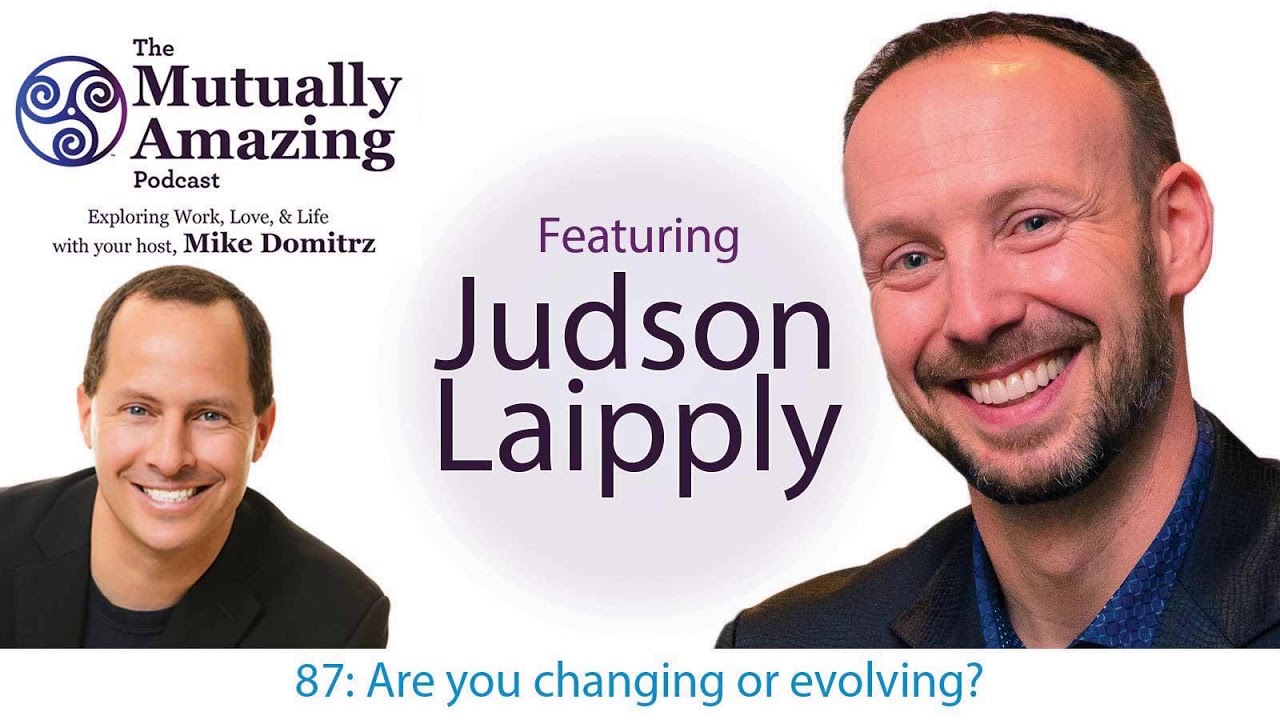
Judson Laipply, who created the "Evolution of Dance" video that got 300 million views on YouTube, talks about the difference between changing and evolving. He says change happens automatically, but evolution takes intentional effort. Respect for yourself first, then others, is what actually moves you forward.
Chapters
Welcome to the Mutually Amazing Podcast. I'm your host, Mike Domitrz, with the Center for Respect. The episode you're about to listen to was recorded when this show used to be called the Respect Podcast, so you might hear that mentioned during this episode. Well, let's get to the show. This week's guest, many of you have seen him In action. He is inspirational comedian Judson Lapley, is the world's first YouTube celebrity. That's right, numero uno celebrity on YouTube. He's been speaking and performing for 20 years, resides in the Cleveland, Ohio area. Thank you, Judson Lapley, so much for joining us.
My pleasure. Thank you so much for having me. It's good to be here.
Absolutely. You and I first met, I believe, at what at the time was called a Bakusen Gamma conference. Whoa.
I think—
wow. Yeah, like 13, 14 years ago, uh, we were both there, which for listeners, that's a conference for, at the time, I think it's changed its names now, uh, for campuses that address alcohol, drugs, sexual assault issues and peer education, uh, and how to do that. And that's where I first saw you do your thing.
That's crazy. I guess I wouldn't have realized. I thought it was, uh, I thought we would've met at one of the NACAs. I didn't realize that we had met at one of the BACAs.
Yeah. First I think it was BACA. We could have again at, at NACA, that's for sure. But yeah. Yeah. Yeah. Now, for our listeners, I hyped it all up there, but they might not understand what I'm referring to. So, let's start off with that first. You are literally YouTube's first celebrity, the very first viral video. So, Judson, for those who don't know you by name, they would know you by the Millennial. So, I'll let you explain further what took you to fame.
It was a video of a dance routine that at the time, and actually still to this day, is kind of the finale of my main keynote. And so, I talk a lot about change and evolving. And so, I created this thing called the Evolution of Dance, which is the last 60 years of dance, popular dance moves all in one. At the time back in 2006 when the video took off, 6-minute routine and currently sits at about 8 minutes depending on the age range of the audience itself. So, I was just lucky at the right place, right time. I actually put up the video on YouTube so I could get an embedding code. to copy and paste it into my MySpace profile so that my dance video would appear on my MySpace homepage because at the time, I wasn't even allowed to be on Facebook because I wasn't in college anymore. Nobody was really doing YouTube as a platform for broadcasting. It was at that time a video-sharing site that allowed you to send a link via email as opposed to sending an entire file of a video. To somebody that you wanted to share a video with.
I love how much we're aging ourselves right now. MySpace and Facebook. That's right. A lot of people don't realize Facebook at first, you had to have a .edu because it was, and it was only on certain campuses. And those of us who were working in the campus world would know of it, but we couldn't use it. So that is—
Yeah, it's like a secret place that everyone was talking about, but we were unable to do. And then you're like, ooh, maybe I can find a school that would just give me an .edu. Yeah.
Well, Judson, you've now— I mean, this thing took off. How many million in the first year and then how many million today?
It was about— in the first year, it was somewhere between 70 and 90 million. Unfortunately, also because YouTube was so small— I wouldn't say small at the time, it was just so new— they didn't have all of the analytics and all the tracking that they have. So, I don't have an accurate exact count, but I do know in the first 6 months, it was about 70 million. And then it now sits at about 305 million views.
Just amazing. And that's just of your version. You know that others have copied you on their pages, right?
Oh yeah, absolutely.
Yeah. And so that doesn't show up in those numbers.
On YouTube, where it was really easy for people to take your video and repost it.
Right. That's what I'm referencing. Exactly.
Yeah. There was one point in time, I mean, I think I went on once and looked and I found over 100 of my actual video on other people's pages. And I think the most views I'd seen, one, some, one was up around the 30 or 40 million view count that somebody else had gotten people to come watch on their page.
And so, when you hit this kind of celebrity, I think what's unique in your story is that it's very much like the Hollywood stereo— stereotyped actor. They're cast typed into this role. People see you as the dance guy. But Judson, you do more than that. You speak about that. And when I first saw you, I thought the same thing. I thought he's the entertaining speaker that can— but you have so much more. You actually grew up in a world of self-help and development for yourself. I wanna dive into that cuz I think it's really cool for people to understand there's so much more here in addition to the evolution of the dance. Not that there needs to be, but there is. You— that was the end of a speech that you were doing because you were really into development and sharing that. So, can you give a little background for our listeners?
Yeah, absolutely. And, it's kind of like you said, it's that you get pigeonholed. So, on one hand, there's a part of you that grows a little frustrated with it, but in that same breath, you realize also how grateful and thankful you are that you had something like that that does propel and get you a lot more exposure than you possibly could.
Oh, my gosh. Yeah. I mean, how many of us would love to say— I mean, outside of you, I have a video with 300 million views. And, what would we What would people pay to get that?
Yeah. Right?
I mean, that's—
And, that's why it'll never be a complaint factor.
Right.
But, there are times where— and, I think sometimes it also from a self-respect standpoint, I sometimes might rely on that too much as well. And, I think I've spoken about this before in other venues. The running joke is there's going to be a day when my doing the dance is going to go from funny to sad. And, I just need to make sure that I'm aware of that and I'm not holding on where the applause are for, oh, that was amazing.
Yeah. And you and I talked about that in Toronto, uh, back in September. We were there for the weekend. We, we briefly discussed that, that you said, hey, I've got to evolve as this happens. But, and, and that's what I don't think people realize. You were never just that. It's just what became known for that. So, I'd love to back up because you've— I've heard you share the story in the past of how you listened to tapes of self-development. When you were like in high school. Can you share with us how that happened?
Yeah, absolutely. My parents were big fans of a gentleman named Zig Ziglar, a woman named Mamie McAuliffe, Norman Vincent Peale, Earl Nightingale. And, my parents kind of got into that world of self-development, personal empowerment. My father was a teacher. My mom was an entrepreneur. She ran her own shop in the small town that we grew up in in Ohio. And so, they surrounded me with some of those messages. And, I think when you're that age, There's a natural tendency to reject things like that that are going on around you. But, I remember my parents would be listening to it in the car or I would see one of their books and I would just pick it up and I started reading some of the books. And, whether it was because of a conscious choice that I made, whether it was just because it happened to be at that time, a lot of that information started soaking in. And, I really felt that I was able to see the world a little clearer than some of my friends were in high school. And, I don't mean that from an, oh, I'm better than you standpoint. I just mean it that sometimes I think as you develop a self-respect for yourself and you start figuring out the path that you want to travel in this world, there are a lot of things that are out there that are very easy to get distracted by. And especially nowadays, there are millions and millions of entities that are trying to take your attention away because they earn their money by getting your attention. And so, when you have that respect for yourself and when you really figure out what it is you want to do, you start to see the world a little clearer in things that are not going to help get you to the next spot. So, I was reading— I was reading Og Mandino, Zig Ziglar, all of those books while I was in high school. And that kind of set me on the path to find more books and teachers and the self-development world that would continue to help me all the way through up until this day even.
And for listeners, please know you can get all those books still today. I mean, those are classics you're naming there. I love Og Mandino. I mean, all 3 of them are powerful. So, you then go to college and you start speaking.
Yeah. I was a good speaker in high school as far as I did not get nervous in front of a group. I'm the prototypical clinical definition of a third child in a family that was fairly normal and middle class. Like, I was seeking attention as a young child all the time. So, I was always hamming things up. I was always in front of the crowd. And so, whenever there would be a group project, I would jump in and be like, I'll present. And, everyone else would be like, fantastic. Here's all the information. You go present it. We'll do the work and then you present it. So, I did that in undergrad and then I got involved in Bacchus and Gamma while I was an undergraduate, which again is a peer education network. I was a peer educator on campus, went to this event in, I think, Orlando, Florida as a sophomore in college. We're sitting in a room for a regional meeting, Ohio, Michigan, Indiana, West Virginia, and Illinois. And, they're like, does anyone want to run for the national board? And, I'm like, what do you have to do? And, they're like, you have to give a 3-minute speech. And then, if you get elected, you have to come to 2 meetings a year where we'll fly you in, we'll pay for your travel and put you up in a hotel, and then we have meetings about helping the organization move forward. And, I was like, I'll do it. So, I went out in the hallway. They gave us what speech we're supposed to do. I walked in, gave a speech, and got elected. And, that really helped propel me because then as a representative of that organization and that national position, I would go to other schools and do presentations. I would do presentations on campus. And while it wasn't necessarily the content that I was creating, it was content that we were researching, and then we were using studies and other people were preparing the content. It really helped give me more experience in front of a crowd.
Yeah. And it's incredible. And today, I mean, you perform and speak all over the world for some of the largest organizations, corporations in the world. What's the message you're sharing today?
So, the main message that I share today is Everything changes, not everything evolves. And, the difference being, are the things that we're doing, are the things that we're paying attention to, are the things that we're allowing to take our time up actually making us, our organization, our family, our community, our world better? Because everything changes. We can just sit there and do nothing and you're going to change. And sometimes, I think we get so wrapped up in thinking about change and all those things that are going on as opposed to saying, okay, are we working towards a better version of what exists now.
Yeah. And I love that because if I do nothing, I will change. I will become unhealthy.
Yeah, you become unhealthy. And I mean, we can, you know, you can, you can get all scientific and break it down to a molecular level that, you know, every moment of every breath that we take, we're inhaling oxygen and carbon dioxide and all those things and our body's changing and things like that. But it's so easy to not move forward and just kind of like, oh, you know, things are going pretty good. And, and then, you know, there's, there's The hard part in the world of self-development is humanity is very rarely an absolute. There's very rarely anything that is 100% true that if you say you can never do this or you have to always do this or the only thing you can do is this, there's always an exception to the rule and we are very defensive by nature. So, we always try to find that little tiny exception so that we can then justify not doing something. You don't have to be reading a self-help book every single day of every single moment. It's okay to take some time to Go on vacation and relax and reenergize and just be. But overall, we really need to maintain focus on moving forward and getting better.
I love it. And we're all about respect here. How does respect integrate into the work you're doing?
Well, I think a big part of it starts with respecting yourself. One of the experiences that I had with the video that it can relate to what a lot of people experience online is when the video was going crazy and it was going up by the thousands every second, I would sit around sometimes because It was such a unique experience and just hit the refresh button on the webpage and watch it jump by 40,000 or 50,000 views. And, the comments were flooding, flooding in. And, 99% of the comments are great. But, if you know anything about psychology, there's this thing called negative bias, which is we tend to focus on the negative. And, there were a lot of comments that were negative that were people making fun of me or what I was wearing or I had highlights at the time, which I kind of make fun of anyways. And so, You go with the idea of what are you focusing on. And, one of the things that I talk about in my shows and I think overall in life is that struggle is not a bad thing in life. Now, if you're struggling and you cannot think of anywhere out and you're really struggling with all of the world around you, then I think there's definitely times where we need to seek help and we need to reach out to people. But sometimes when you're just struggling because something isn't super easy, there's a little bit of work that you got to do into it, that's really a positive thing because that means you're challenging yourself and you're actually growing. We struggle most in the chaos of— we evolve most in the chaos of things. We evolve when we struggle. We don't evolve when things are repetitive and we just do the same thing over and over again. And so, when you have respect for yourself, you can let go of some of those things that we don't have control over. You can let go of some of the negative things that people might say around you. Because we can never control what other people say. And then you maintain that focus on yourself and saying, okay, these are the things that I need to do in order to move myself forward.
I love that. Is it just a let go? Like, hey, I'm gonna let go. That's their thought. That's not mine. I don't have a right to dictate their thoughts. What's the process for you to let that release happen?
That's a part of it. I mean, I think the other thing is too, is finding people who respect you for who you are and to maintain some of those relationships so that if there ever is a time that you really are feeling completely surrounded by negativity and completely surrounded by disrespect that you can go to those people and find some support from them. And, it's kind of going back to that whole thing of what do we have influence over in our life? We have influence over the decisions that we make and the choices that we make. Yes, we can say that our psyche is influenced by the things around us and the things that happened to us when we were younger. And, there is definitely a space for some cognitive work and some help from a professional to help work through some of those things. But, when you've got some of those things taken care of and you're trying to let go of some negativity or trying to do that, the best thing you can do is say, okay, what now? What choices can I make now to continue going after the things that I want at this point in time in my life? And, it sounds really, really simple and it sounds kind of fluff in a way, but neuroscience has proven that the ability to just ask that question aloud starts to change a little bit of your brain chemistry by lighting up your prefrontal cortex and drawing away some of the emotional energy, the electrical energy that's going to a different part of your brain that kind of stays in that emotional realm of, you know, why me? Why me? Why is this happening to me? Why are they saying this about me? Why, why, why? And it's unfortunate because we now live in a world where anyone can say anything to anybody and have it broadcast to a lot of people. You know, it used to be if you felt— if you thought something bad about somebody, you might tell your closest friends and that would be all that know. And maybe it got around through the grapevine. But now somebody can go post something and broadcast it to the entire world, whether it's true or not. And I think that makes things much more difficult for us to be able to navigate through the waters of this world and not let those things affect us.
What are some ways in your work you've experienced that where you've seen Disrespect.
When people have opinions, I think they're less careful to take a pause before saying those things because we've become so accustomed to broadcasting our thoughts via social media almost instantaneously. While there's no definitive reason one way or the other, things like reality TV— love it, hate it, call it a guilty pleasure, whatever you want— But, if you watch the progression of those styles of shows, they're full-on drama shows now. They're not even reality anymore. They call them scripted series within the actual context of the world that they live in. They're not called reality shows, they're called scripted series where they put people in positions that they know are going to be difficult and they're going to get angry and they're going to scream and they're going to yell. And, that behavior becomes somewhat common and that people just think, oh, that's the normal way people react to each other.
Right, right.
I think that's fine for me to do that. And so, I see it a lot because whether it's working with a corporate event, people will say, oh, well, this person just said this out of the blue, or they just— they didn't like my idea and instead of coming up with an alternative idea, they just tell me that I'm stupid or that idea is stupid. We see a lot of people that are that way when it comes to working on teams that are the constant negative Nellies or all the different buzzwords people have for them that they don't ever offer up anything of positivity. They just cut down everybody else's idea.
Yeah.
And, figuring out if you're a leader in an organization of some sort how you can get through to that person to get them to give constructive feedback as opposed to just dismissing things instantaneously or figuring out a way that we can talk about what's wrong with this idea and why do you think this idea won't work, not just call it a stupid idea because it's becoming so much easier for us to just cut things off before we actually get into discussion. In order for me to be right, you have to be wrong.
It's judgment instead of observation, right?
Yeah, absolutely.
Huge, huge difference there and how that works.
Assumptions instead of assessments.
Yeah. Very, very, very true. And so, with that, you have an example of a respect story involving Tiger Woods in makeup. So, you have my curiosity. What is this?
So, I had a very unique event happen to me and I remember at the time just thinking it was really funny. And the more I thought And, the more I thought about it, the more I realized we all have wants in life. There are things that we want. You and I both want more exposure. We're not famous. We're not an A-list celebrity. So, I was on the Ellen DeGeneres Show and this would have been back probably in, I think, 2009 timeframe before Tiger Woods had had any of his issues and had come out or anything like that. And, he was on the same day that I was on. So, they filmed his segments first before they filmed mine even though when you watch the broadcast, I went first at the opening and then I was a closer. But, they filmed his so he could be there for the shortest amount of time possible. They were going to cart him off to another show to film another show and he was doing that. So, he's out there on screen talking with Ellen sitting in the chairs and his face is two-tone because he had just come in off the tour and the lower half of his face was tanner than the upper half of his face. And, it was quite visible on the screen way more so than in life. And, the executive producers are yelling down to the makeup artist, go give Tiger powder. You have to go powder his face. You have to go out there and make it look more uniform. And so, during the break, she goes out there and she kind of approaches him like, hello, excuse me, Mr. Woods. And, she holds out the powder and he just puts up his hand and he's like, no, thank you. I don't want any. And so, she kind of just slunks back to the back of the production stage. And then, the producer comes down and he's like, why didn't you give Tiger any powder? Why did you not give him any powder? And she's like, he didn't want any. I asked— I went to him and he said he didn't want any. And they both kind of looked at each other and they were like, oh, well, all right. And I just remember thinking to myself, like, they could have turned to me before my segment and been like, hey, listen, we're going to put clown makeup on you for this segment because we think that would be funnier. Are you okay with that? And I would have been like, absolutely. Like, do it up. Let's go. Because at that moment, I really wanted to be on The Ellen Show. And sometimes I think we get caught up in life. We want things. from other people, or we believe that being around other people or being loved by a certain other person is going to give us something. And so, we're willing to compromise some of our own self-respect in order to get that.
Oh, I think it's a— I think it's a great story because we do think, right, what do I have to do? Whatever I have to do. Where he's sitting there going, no thanks. Well, it could help you. That's all right. I'm good with who I am. Now, that doesn't mean Tiger Woods didn't have self-esteem or respect issues, but it was just in that, in that moment, no big deal, where we're sitting there going, I'll take the makeup. Like, if, if makeup's gonna make me look better, I'll take the makeup. How we can fall into that.
I would've been afraid that they would not let me go on the show. Right. I want to go on the show so much because I believe it'll help my career and I get to say I was on Ellen and all those things. You know, Tiger was actually on the show. He was on the show to promote a new video game. Which means he probably didn't even want to be there. He is in a way or at the time probably bigger than Ellen. So, Ellen was really happy to have him on the show. And, you ask people a lot of times, I know you see this in your work, why do people stay in bad relationships? If someone's treating them poorly, why do they continue to do it? And, I think sometimes it's because in their mind, they don't have the level of self-respect because they want to be in a relationship so bad that they're willing to change and compromise on some of their own principles. Because they believe that being in a relationship is going to fulfill them or make them complete or some of those types of things. And I'm not saying that's everybody. I just mean sometimes we're willing to compromise on our own self-respect because we think we're gonna get something more out of a situation.
Oh, that can be part of it. I mean, a big part of those situations are so much trauma and harm has been done to the person that they think this is the best it gets, that this is all I have as an opportunity. But you're right, in, in lesser cases, It can be, I'm hanging on because I wanna believe they'll change and I'm not respecting my own values and beliefs cuz I just, like you said, it's the soggy potato chip theory, right? Which is famous in psychology. I'd rather have a soggy potato chip than no potato chip, but no potato chip's actually better. You know, so it's hard for people to understand that concept. When you talk in audiences, you talk about relationships sometimes that can come up. Do you think that love and respect, what role do they play with each other?
I think all of human emotions are intertwined with each other. I think it's possible to have love without respect, but I'm not sure if it's possible to have respect without love.
So, can you think of an example of where you could have love without respect?
I knew you're going to ask me that. And, I'm not sure exactly. I guess maybe you can have respect without love, but when it comes to an actual loving relationship that is mutually beneficial for both people, I started my career working with a gentleman talking about relationships. And, I remember one of the things always is that a healthy relationship elevates both people or everyone involved in that relationship. And sometimes, unhealthy relationships are one or more parties trying to lift up another party the whole time. Right.
They're purely a support role.
Yeah, it's a support thing or there's an unbalance there. And, that doesn't mean that there's times when you're unbalanced in relationships. I mean, that's part of what I think makes relationships great is you can go through periods where the other one is supporting the other one. But, if that's the way it is all the time, Then, that might not be the healthiest of things. You probably actually really do in relationships of closeness and love, I think you have to have respect in order to love somebody else. But again, I guess I'm talking in circles in a way because I think there is times in life when we can love someone and have lost respect for them, but we can still love them as a human being, as a member of our family. There are many people in life who have to cut off someone because that person is in a bad situation or has done something really, really bad or made some decisions that they don't agree with and things like that. And it doesn't necessarily mean we don't love them anymore.
No, I think it's a great example because I may have lost some respect for you, but I still respect you as a human being. And so the level of respect I may have for you can be hurt, can be damaged, but I'm still at a basic level respecting you.
It's kind of sometimes in the ability to separate a person from their decisions and their actions too. Like, you can respect someone as a human being and still have love for their dignity as a human being, but have no respect for the choices that they've made or the actions that they take.
Yeah, that happens. Now, in your own journey along this path, because you've had such a unique path, Can you think of a time where you had a major struggle that taught you about respect? Could be for yourself, could be for others.
There have been some times when people have questioned some of the phrases that I've used or some of the things that I've said. I've changed some of the way that I've said things on stage when my first response was, oh, that's just petty. But then, I thought about it some more. So, for example, when I first used to start introducing the dance in my shows. I would get ready to do a dance and I, I introduce it in my shows to kind of set up low expectations. And I say, oh, I was sitting with some friends and we came up with this idea for a dance. And I was like, oh, that's— there's a problem with that. And they're all like, what? I'm like, well, I can't dance. And what I used to say in the very, very early days was I used to say, oh, well, I'm white.
Oh.
And that got a laugh.
Right.
This is back in 2000. I mean, this is 2000, 2001, before a lot of— and somebody approached me once and it was a person that I knew and respected and they were talking about that. And, initially was like, well, it's blah, blah, blah. And then, the more I thought about it, the more I realized even though I don't think that's a big deal at that point in time in my life because I don't think I had been experienced enough and exposed enough to the rest of the world to understand that whether you call them non-stereotype comments when we think they're not being stereotyped can still reinforce negative— non-negative stereotype comments can still reinforce negative stereotypes.
Absolutely.
And, I think that was something that I really didn't grasp at that age. I was probably 24, 25. I got defensive because somebody came up and told me what I should or shouldn't do. And, I remember that very, very specifically. And, I talked to a couple other people and finally I talked to someone and they were like, well, I understand because yeah, it is funny because you'll hear other people say that a lot. White people can't dance or white men can't dance. And, that's a fairly common— funny thing in Hollywood and stand-up things and things like that. But then, what it also does is it helps create that same divide because there's a separation there that, oh, if you are this, then you must be this. And, the more we can get rid of those types of phrases and those types of comparisons, I think we'll continue to move forward in evolving our own culture so that we don't ever get caught up and just say, oh, because you are blank, then you must be blank or you have to do this type of thing. So, that was definitely one moment where I really had to take a step back and question why was I saying that, why was I getting defensive about it, and then realizing it didn't really even make a difference in the context of the show anyways. Now I can— now I literally can just say, well, I can't dance, and that does the exact same thing.
And that's the beauty in where we started this all today, which is the difference in change and evolution. That change that you made reflected actually an evolution of you. Right? And I know I, I went through the same things. There were times where you get feedback and you come off stage and you're like, how could they possibly take it that way? What? Like, you're like, what are you thinking? But our frame of reference is only ours. And so our privilege and all shows up in that moment and we're not aware of it. And we have to step back and go, oh my gosh, that's what I did? And that, that wasn't my intention. But that doesn't excuse it. It wasn't my intention. I need to evolve that. For the sake of— the whole reason I'm in this room is for the audience. It's not about me, it's about the audience. So I need to evolve for the audience. And I think you gave a beautiful example of us looking in the mirror and going, I gotta evolve.
Yeah, absolutely. And I think you're right. I think the big difference that we have hopefully grown into is the ability to recognize that and to work on changing that versus— I think there's a lot of people in this world who would then refuse to actually do any self-reflection and then do anything to evolve. They'll just say, well, they'll get over it.
Yeah, that's their problem, not mine. Well, you're, you're the one leading the conversation. It should be your problem if that's the case. So now, Judson, you have a few books that you absolutely love. Uh, Illusion of the Reluctant Messiah by Richard Bach, Way of the Peaceful Warrior, Dan Millman, The Spirituality of Imperfection, Ernest Kurtz and Catherine Ketchum. What about these books do you love?
2 of them are very kind of— I don't want to say popular, but they're probably more well-known than the 3rd one. Illusions of the Reluctant Messiah is a book that I read at the right time at my— same thing with Way of the Peaceful Warrior. I read them when I was 19 years old. I was still in the self-discovery phase of who am I, what do I believe, what do I want to do, what do I want to add to the world. And, they're filled with lots of reflective comments. So, for example, and I don't know if you have read those before, have you heard of those before?
Yeah. Well, I've read Way of the Peaceful Warrior. I have not read Illusion of the Elected Messiah. I know of it, have not read it.
So Illusions is great because it's a really, really short book too. And I like, I like storybooks as far as parable form. That's why I liked Og Mandino.
Yeah, that's why I love Og Mandino. Same reason.
That book was really good because within that book, one of the people there receives a handbook for a messiah is what it's called. And whenever he opens it up, a phrase appears. There's nothing in the book, but when he opens it, a phrase appears. And so, there's all these little phrases throughout the book. And, I can still remember to this day that one of the ones that sticks out the most in my mind is, you're never given a dream without also being given the ability to make it come true. However, you might have to work for it. And, that's one of the main focuses of that. I think that helped me at that moment in my life because we have so many things that we want, but a lot of times we're not willing to do the work that might be required to have that. And, that kind of went in line with what Zig Ziglar used to say as a young child. I would hear that was, you can have anything in life you want, but you can't have everything. And, you're going to have to make decisions along the way to figure out what is it you really want. And, those are the things that— we see so many books and so many self-help authors or speakers who say, oh, you can have it all. You can have it all. You can have it all. And, I don't really believe you can have it all. I think you can have a very healthy balanced life full of a lot of amazing things, but realistically speaking, you cannot have it all.
Yeah.
Because there's just too much going on in the world. You know, the world—
yeah, you have to choose.
Yeah. So you really got to choose and then you might have to work for it.
Yeah. No, I love that. Now, The Spirituality of Imperfection sounds a lot like The Gifts of Imperfection, Brené Brown, which— that's a book I do know. What is The Spirituality of Imperfection?
So The Spirituality of Imperfection was a book I stumbled on probably 15, 20 years ago. And it's a parallel book, which means it's kind of 2 books within one. One, it's based around the founding of AA. Now, I am not a member of AA. I've never attended a meeting. Being involved in Bacchus and Gamma back in the day, I always remember that they used to have Friends of Bill W. was always on all of these. They had a meeting every night. And, I literally was like, who's Bill W.? And then, somebody had to explain to me that that is one of the founders of Alcoholics Anonymous. And so, if you are an addict and you want a meeting, there's a meeting every night at this conference. The Friends of Bill W. let you know that that's a meeting you can go to. And, I remember picking up this book and it's a combination of exploration of parable stories through different religions over time along with the founding of AA. So, one of the founding tenets of AA is surrendering yourself to a higher power, not necessarily a specific deity or a specific religion, but surrendering yourself and saying, I cannot go this alone. I need help. And so, what this book did is it explores kind of the founding of AA, but then it also along the same way, it starts exploring all these different religions and some of their different beliefs and some of the stories they use these short little parable stories to help show what some of these things are meaning. You can read great philosophers and you can try to dissect all that information, but I don't know if there's any better way than a parable or a proverb or a short story or something along those lines that conveys that meaning to us. You can pass a lot of wisdom through a short story or a proverb. And so, that book is full of them. So, it's full of nothing but stories and talking about philosophy, but then also talking about the founding of AA itself.
I love it. Thank you so much, Judson, for sharing with us and your own evolution and helping us evolve at the same time.
My pleasure. Thank you so much for having me.
Absolutely. And for our listeners, you know what's coming next. That's Question of the Week. This week's question is, Mike, when you're working with large organizations, whether it be associations or corporations, what's a common mistake you see them make when it comes to respect? And one of the most common ones I see, it's both from leadership and management, is when you ask them, give me some great examples of how you respect people in the workplace, they always tend to tell me about all the different forms of recognitions and acknowledgments they have for people in the workplace. Which, if you're with somebody in that workplace, you might receive an acknowledgment or recognition maybe once a day, maybe once a week, maybe once a month or less. And so, we get caught up in thinking, oh, respect is about acknowledgment versus understanding respect is something I should feel 24/7, not that one moment of the day where you acknowledge good work I did. And so respect is much more about how you feel valued in the workplace, how you see— feel seen in the workplace when you're not being given acknowledgments. In fact, I would argue that in a workplace that is truly built on respect needs way less special acknowledgments and awards because everybody feels valued in what they do every day and every moment. Because you created such a wonderful foundation of respect in the first place. We'd love to hear your questions, your thoughts, and your ideas. And the best place to leave those with us is on our Facebook page at facebook.com/MutuallyAmazingPodcast. Of course, you can always contact us on our website at mutuallyamazingpodcast.com. Remember to subscribe to this show so you automatically get it every week. And if you could take Take one moment to leave a review. That really helps other people find the show, which we are greatly appreciative of. So thank you so much for joining us. May you make today and every day a life full of mutually amazing relationships.








