92: Living a New Life when Yours is Traumatically Changed Forever with best selling author...
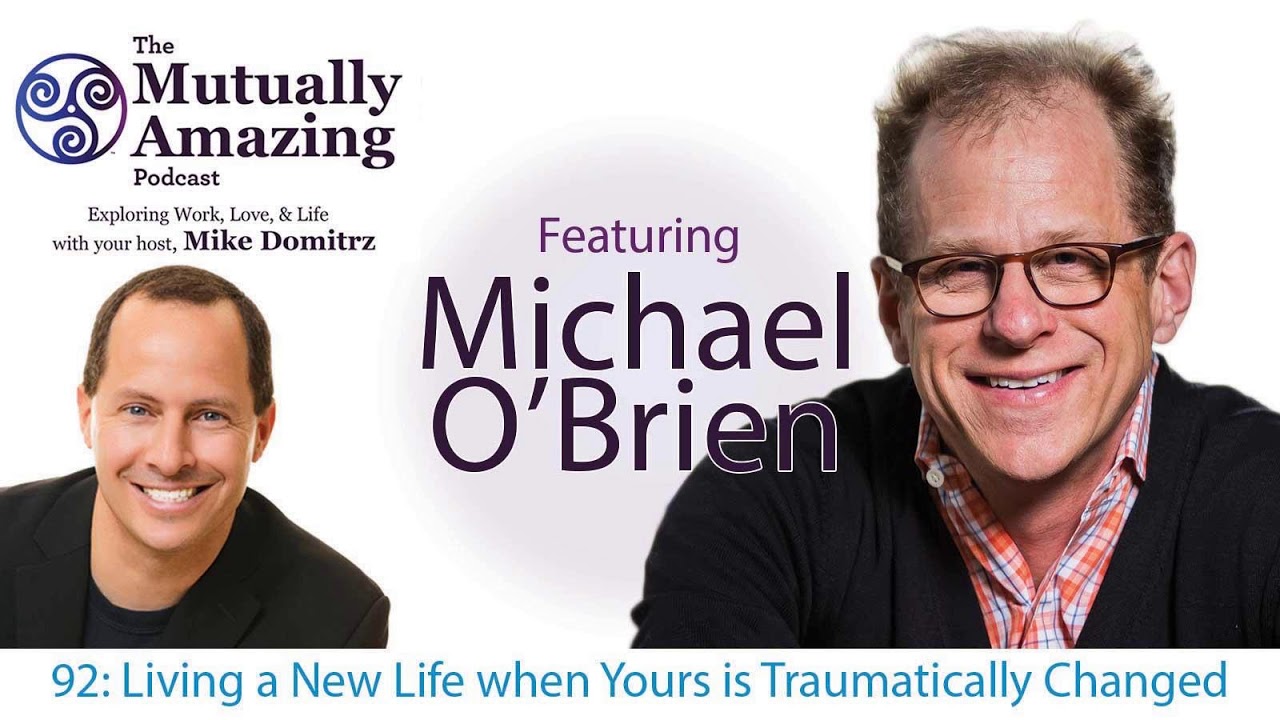
In this episode of the Mutually Amazing Podcast, host Mike Domitrz interviews Michael O'Brien, Chief Shift Officer at Peloton Coaching and Consulting and author of the memoir Shift: Creating Better Tomorrows. The conversation begins with O'Brien recounting his near‑death cycling accident on July 11, 2001, when a Ford Explorer struck him, shattering his left femur and lacerating his femoral artery. He describes the emergency response, the extensive surgeries (about ten) and the emotional fallout – anger, grief, identity crisis – that followed. O'Brien explains how a pivotal moment in rehabilitation sparked a mindset shift: he decided that July 11 would be his “last bad day.” He then outlines three practical daily practices he uses to prevent bad moments from becoming bad days: (1) a five‑minute morning framing ritual to set intentions, (2) “PBR” – pause, breathe, reflect – a brief mindfulness breathing exercise used throughout the day, and (3) a nightly gratitude review. He expands on the broader concepts of awareness, intentionality, kindness, and forgiveness, sharing a story of forgiving his driver after hearing a Holocaust survivor’s perspective. The interview delves into O'Brien’s definition of respect (honoring self and others, listening without judgment) and his LAVA communication flow (Listen, Acknowledge, Validate, Ask) as a tool for constructive dialogue. He discusses his involvement with the Healthcare Business Women’s Association, becoming the first male chapter president, and why men must participate in gender‑parity conversations. O'Brien clarifies that his Peloton Coaching firm is unrelated to the Peloton bike company, using the peloton metaphor to illustrate teamwork and trust in both cycling and corporate settings. Throughout, he emphasizes that his purpose is to help a million people have their “last bad day” by adopting these mindset and communication practices. The episode closes with contact information and a gratitude segment from the host.
Chapters
Welcome to the Mutually Amazing Podcast. I'm your host, Mike Domitrz, with the Center for Respect. The episode you're about to listen to was recorded when this show used to be called the Respect Podcast. So, you might hear that mentioned during this episode. Well, let's get to the show. And today, we have Michael O'Brien with us. He is the Chief Shift Officer at Peloton Coaching and Consulting. He elevates successful corporate leaders by preventing bad moments from turning into bad days. His award-winning bestselling memoir, Shift: Creating Better Tomorrows, chronicles his last bad day and near-death cycling accident recovery journey. Thank you, Michael, so much for joining us.
Thanks, Mike. It's awesome to be with you guys. And I just love the work that you do out there. So, it's my honor to sit down and chat with you today.
Well, thank you. And, and on a personal note, I love to ride. I'm, I'm a big cycler. Now, when I say big cycler, I've only done 2 centuries. So I'm not somebody that's— I'm not somebody that's riding 50 a day. I ride, you know, 20 if I ride, 25.
Hey, like any day on a bike, I believe is a great day. So we need more cyclists out there because we need to share the space. I think cars can exist. I think bikes can exist. We can, coexist together. So I love talking to another cyclist.
Yeah, yeah. Well, that's very cool, and that's part of your journey. So let's kick right into there. Your book's about your last bad day and near-death cycling accident. So can you tell us about that, and then we'll go from there?
Yeah, sure thing. So I'm going to take everyone back to July 11th, 2001. I was a marketing director for my company, just a regular corporate job. On the hamster wheel a little bit, sort of chasing happiness. And we had this offsite, big offsite meeting out in New Mexico. I live in New Jersey. And I decided I was going to be the smart one, Mike. I was going to bring my bike out. I was training for a race. I was going to avoid the hotel gym, all that jazz. And I was going to be like the smug guy in the meeting and say, hey, I went outside to ride my bike as you guys were sleeping. And I brought the bike out. I was going to cross New Mexico off the states I've ridden my bike. That morning, I was doing some laps around the hotel, out the back way, up the main drag, about a 2-mile loop. And on the 4th lap, I came around the bend and an SUV, a Ford Explorer, was fully in my lane going about 40 miles an hour. That's what the police estimate. And he hit me head-on. And I remember everything about that morning, Mike. The sound of me hitting his grill, into the windshield I went. Broke a hole through it, which is really tough. The screech of his brakes and the thud I made as I came to the asphalt below. And obviously, I got knocked unconscious, but when I regained my consciousness, you can appreciate this as another cyclist and your listeners can too if they know people who ride or they ride themselves. I asked the EMTs, how's my bike? And they just looked at me and like, oh, sir. They didn't say anything, but they sort of just did that shake of the head, oh, sir. You— this is going to be a tough morning for you. And it was. It was the toughest morning of my life. And I just remember trying to will myself not to fall asleep because I, I thought if I could stay awake, I could control the situation, as crazy as that sounds.
So there you are, you're, you're going into a bit of shock, obviously, by response you're sharing there. And you now are recovering. So how long was the recovery period? How many broken bones were you talking about?
Well, a lot of broken bones, but there was a major break. So, when I hit that Ford Explorer, my left femur shattered. And, when it shattered, it lacerated the femoral artery.
Oh.
And so, I was in essence bleeding out in the middle of nowhere in New Mexico. We were a 19-minute helicopter ride from the University of New Mexico in Albuquerque, the only trauma 1 center in the state. The doctors later told my wife, had I been 10 years older or not healthy, not in shape, I probably would have died before I got to the hospital because I lost so much blood. And the first surgery took about 12 hours. I spent the next 4 days and change in the ICU. And I remember telling myself, making a commitment to myself as they put me onto the helicopter to take me to the hospital, that if I lived, life was going to be different. I was going to stop chasing happiness. And when I came out of the ICU and they told me about the accident and the driver had a revoked license and he shouldn't have been driving that day, all I saw, Mike, was everything that I lost. Like, life was different, but not in the way that I wanted it to be. I was angry, bitter. I thought life was so unfair. And I went into a deep funk when the— especially when the hotel got dark and the visiting hours were over. I was trying to put on the good face when people were around me. But deep down inside, I was like, who am I going to become if I can't be who I was? Even though I was pouring a lot of stress inside of me back before my accident, trying to be Superman at home and Superman at work, because I was the leader and I was the father and the husband. But I really had an identity crisis. I was like, what? You know, because they painted a picture, a life picture for me of dependencies and limitations and more surgeries. In total, I had about 10 surgeries over the course of Several years to get me back on the bike and really back on my feet and back to life, but back to life with a different script—not following the script that I once was following.
Well, yeah, and you're going through by what you're describing—you're going through the the stages of grief, right? Because there's a loss, and there was a loss. I have another friend who went through a horrific accident, physical accident that would change his life forever. Same thing. There was a major period of loss. And grieving and anger and not fun to be around. Uh, he'll tell you the stories of how he talked to his loved ones because he was angry. Uh, and so you were going through that. So you come out of that. What gets you to the place then of where you are today, which is, I'm, I'm not going to live my life the same way. You did somehow get back to that, that original goal you had.
Yeah. So what happened is they eventually flew me back here to New Jersey and I went to one hospital for some more surgeries and then the Kessler Institute for Rehabilitation where they Took the original Superman, in my opinion, Christopher Reeve, when he had his equestrian accident. And during just a routine physical rehabilitation session, Mike, I just looked around the room and noticed that some people were getting better and some people were plateauing or not getting better. And I was making progress, but not at the rate that I wanted, wanted to. And I knew in that moment I had to shift my mindset if I was going to get my body right. You know, we talk a lot about how we can worry ourselves sick all the time. And I thought, well, In that moment, if you can worry yourself sick, why can't you think yourself well? And I had to get a healthier, more abundant mindset if I was going to fix my body. And I made that determination in that moment that July 11th, 2001 was going to be my last bad day. I had no clue though, Mike, at the time how I was going to do it. I was just going by like total gut. So the next morning I woke up and I started a new morning routine just to get my head right so I could show up. not only for rehab, but the people around me better. And it's been pedal stroke by pedal stroke or drip by drip, day after day, working on trying to get closer to mastery, whether it's, you know, my profession or just really myself. And along the way, there's— it's not— it hasn't been linear and hasn't been— it has not been smooth. There have been days where I've climbed forward and making great progress, and then all of a sudden you have a tough moment. But what I've been able to do over time is learning how not to allow those tough moments to steal a minute longer of my energy and attention than they deserve, so they don't turn into a bad day, which I think happens so often. Well, back then, happens, happens quite often today with so many different people.
So yeah, let's dive right in there. What are specific steps that people can take to have their last bad day, right? To stay— because really what you're talking about is living in a way that You don't see even the bad moments as a bad day, right? Because you do have days that are rougher than other days. That's just human life. So your last bad day is saying to that person, how do you explain that? Like, yes, you're going to have days that are rougher.
Yes. So for me, one of the things I learned through my recovery is that all of our events in our lives are neutral until we label them. We're just really quick with our labels, and sometimes our labels are somewhat binary. It's good or it's bad, and there's no gray space. There's no in-between. So when I talk about having your last bad day, I'm certainly not talking about rainbows and unicorns and butterflies and Skittles and more of the woo-woo stuff of it, because I want to really be practical because many of us are getting up, going to work, want to raise a family. What I'm talking about is not allowing those challenging moments That meeting, that commute, that tough conversation that we have during the course of our days, not letting it hijack us, where all of a sudden, something not so great happens on a Friday at 3:00 PM, and it ruins our whole weekend. We bring it home, and we just fester on it. What I'm looking to help people do is that's a moment, let's let it go, and let's move on to the things that really fuel you up and amp you up so you can do some of your better work, but also that you have the energy for those people around you in your life that you love the most. Because a lot of times when we get short with ourselves, we get short with the people that we care about the most. So, in terms of steps, I'm going to give you guys 3. I'll give your listeners 3, Mike. So, one's in the morning. And I think it's really important just to spend 5 minutes framing out our day. I see this happening so often with a lot of my clients. The first thing they pick up in the morning is their phone, and they immediately get into email or social media, and that frames their day. They're already on the hamster wheel, and they haven't even rubbed the sleep out of their eyes. So I generally love to wake up with a nice glass of water and just 5 minutes or so of really thinking about how do I want to frame the day? How do I want to be? What do I want to do? And what do I want to have more of? And that gives me at least a compass going forward. So that's one step first thing in the morning. Then during the day, this is something I learned through my recovery, is just mindfulness. I know some people do meditation, which is great. It's not necessarily great for everyone, but we can connect with our breath. So I developed something, Mike, that I call grabbing a PBR, which—
What's that?
For— I have a college-age student, so the first— actually, 2 college-age students and children, rather. And when you think of PBR, you think of like Pabst Blue Ribbon. But for me, it's really around pause, breathe, and reflect. So I love just having moments throughout my day or the people around us just to hit the pause button, you know. Pause, connect with your breath. A simple, like, box breathing of just inhale for a count of whatever, hold, exhale. Do that for a minute or 2 in between meetings, or when you feel like you're getting hijacked and the emotions are starting to bubble up to the surface. Grabbing a PBR, maybe even a 6-pack of PBR, maybe sometimes a case depending on the day, just to connect with our breath because our breath does some amazing things, is just slowing everything down so we can be less reactive and a little bit more thoughtful, right? And then we can reframe that, that bad moment and not let it hijack the rest of our day. And the third thing I developed through my recovery is just gratitude. Spending 5 minutes before the head hits the pillow, just thinking about those little things, or maybe even the big things that I'm grateful for. And we can even be grateful for some of our struggle. My last bad day turned really into one of my best ones because it gave me the opportunity to hit a big old pause button and it helped me shift my perspective in so many different aspects of my life. Each night before I hit the pillow, as I'm brushing my teeth, or we call them snags in our household, as we're brushing our snags, I just think about the day and those micro things to major things that I'm grateful for. It's a great way to bookend your day. During the day, I wake up, set my priorities, be, do, have, grab a few PBRs, and then spend a few minutes in gratitude before I go to sleep.
I love it. And now, how has that changed the way you live your life today? So what, since that journey, how do you live your life differently?
I live my life with much more awareness. Before my accident, my last bad day, I didn't know anything about awareness, mindfulness, Thoughtfulness. I was busy living a script that I thought society wanted me to live. Go to college, find a girl, get a job, marry the girl, buy a house, work your way up the corporate ladder. So I was so busy doing— I was on that hamster wheel. I wasn't really aware. I wasn't aware of my emotions. Call it emotional intelligence or anything else. But now I live my life with much more awareness. And intentionality, and I think that's the first start. I also live my life with more kindness and forgiveness. It took me a while to forgive the driver. You know, I I gave forgave him a little bit in the beginning, and each year I let go of it a little bit more. But it wasn't until we took a trip to Europe, we had a private tour. We were part of a private tour of Auschwitz with a woman named Eva Kors, who was a Holocaust survivor, twin. Her whole family lost their lives at the concentration camp, but her and her twin sister lived. And when we were there, someone asked her how she felt about the Germans and the Nazis. And she said, I have forgiven them not because they deserve forgiveness, but because I do. And in that moment, that July summer, you know, out in the middle of, you know, the concentration camp, it was So hot, and I was just shocked by her answer. I learned how to totally forgive the driver, not because maybe he does or does not deserve forgiveness, because I did. Because I was carrying around all that emotion in my backpack. It was impacting how I was showing up for others. So there are a lot of different things I share, 20 ways of being I share in the last chapter of my book that I've learned along the way. But It starts with awareness. And I think right now I just live my life with much more awareness than I did prior to my accident.
Well, and I love that because it's really respecting the holistic view of your life. So this show, we talk about that and respect in work, life, and love. And so what does respect mean to you?
It's honoring the other person and even honoring ourselves, which I think we shortchange a lot. Especially in leadership, and that's the field I work in, there's so many people that talk about servant leadership, but they're not respecting themselves. They're putting their self-worth in how much they can help someone else. And for me, I think respect is about accepting the other person, just a sense of belonging, Mike, of like, I'm accepting you, I'm respecting you for who you are. Because you're another human being on this planet and you have every right to your perspective. And I want to connect with you. I want to be curious with you. I want to listen to understand where you're coming from and not to judge you. And that's what respect means for me as it relates to other people, but also as we look ourselves in the mirror each morning and that self-narrative and having more agency over what we tell ourselves. That we are extraordinary to begin with. We don't have to do extraordinary things to be extraordinary. And I see so many people trying to chase that, trying to chase that big thing in order to, you know, sort of like chasing happiness, that I have to do something big to matter. And I think we are doing amazing things by just showing up each day and connecting with each other and living life with empathy and courage. And if we can do more of that in the world, Then the world becomes, you know, more united. I think it becomes safer, becomes kinder. And we don't necessarily have to agree with everyone's point of view. You know, we can, we can show up disagreeing without being disagreeable and saying, hey, I respect your point of view. I may not share it, but I, but I hope we can have a conversation where you can respect my point of view. And maybe through conversation, we can find a middle ground. That can help us move forward.
And you're talking all right there about communication, and you have what's called the LAVA communication flow. Is that part of that? Can you tell our listeners more about that? It's L-A-V-A, LAVA, like you would hear volcano communication flow.
Yeah, so the LAVA communication flow I learned from one of my great coaches in my life, Tanya Ezekiel. And so LAVA stands for listen, but listen fully. Intuitively listen to what's being said and what's not being said through body language and tone. So that's the first L. The A is acknowledge. So we, we can play back what we've heard the other person say. The V is validate, saying basically you have every right to a point of view. And the A is ask, you know, empowering questions, the journalist, uh, journalist questions of who, what, when, where, and how and why. And even sometimes that question of permission is embedded in that last A, where instead of just offering our point of view to someone, we say, hey, you know what? I have a suggestion or I have an observation. Do you mind if I share it with you now? And that gives some flow to the conversation. But the first A and the V are so important. When we truly listen and we acknowledge what we've heard, other person say. What that does is it builds a wonderful connection. It actually fires up different hormones in our body, oxytocin, which is sort of called the hug hormone, where the other person feels heard. Like, you see me, you hear me, and you're not judging my perspective. You're saying through the validation phase, I have every right to a point of view. Now, with that second A, let's talk about it. Let's get curious with each other and explore where we might have some things in common and where we can agree that we're going to see the world differently because we all do. And I think that's what we need more of because conversation really drives almost everything in our lives. You know, if you want great culture at work, you want great culture in your community, it starts with healthy relationships. And healthy relationships are built through Great conversation, conversations that really connect with each other.
Yeah. And this is an area people ask me in my line of work, I can deal with hecklers because it's such a sensitive topic. People push back and go, whoa, whoa, whoa. You want me to ask someone before I, you know, and you get pushback on that. And people say, you handle those in a way that turns the whole situation around. How do you do it? And I always tell them, it's exactly what we're describing right now. You got to listen. What we tend to do is defend before we listen. We start the next debate while they're talking. We do it to our spouses and our loved ones all the time. Like they're, they're saying, yeah, but, and we're already in our head going, yeah, but, before we even say it out loud, which means you're not listening because you're already coming up with your response before they finish talking.
Absolutely. I love what you just said. It's what I, what I share sometimes with my clients is that we have a great addiction in this country. And a lot of people are like, oh yeah, we have an addiction to pain meds. I'm like, no, That obviously, that is a serious health issue. But one addiction that we don't talk enough about is this addiction to being right. Like, we believe we have the right answer, so then we listen to reply as opposed to listening to connect. And as partners, husbands, sometimes we want to solve our wife's problem, right? So I learned this early on in our marriage. My wife was sharing something with me, and I was like, well, just do this. I had the answer. I was Superman, right? I was the guy. And she gave me a very valuable lesson that sort of falls into this lava concept. She's like, I just want you to listen. You don't need to solve the problem for me. And I learned the value of listening in that moment. And when I do have an idea, I always preface it with that question of permission. Hey, I have some thoughts. I have an idea. Do you, do you wanna hear it? Sometimes she says yes, sometimes she says no, but what it does is it, it allows the conversation to continue to flow as opposed to letting my ego get the best of me and trying to insert myself into the solution when maybe I'm not needed.
Yeah, correct. When they, when they're looking for an ally, right? Not a coach, not a teacher, not a, not a boss, but an ally in that moment. And, and speaking of that, You were very active in the Healthcare Business Women's Association, and people would hear that and go, what? You just said Healthcare Business Women's Association. I can also hear some people thinking, wait, is this a guy taking control in a place where women are built to have power? So can you share about that and that, that question mark of should a man be a contributing factor in an organization such as that?
Yeah, so great question, Mike. And I still get a couple like, what? What's that all about? I've been a member of the HBA, the Healthcare Business Women's Association, since 2003. And this year, they asked me to be the first male president of a chapter, the New York chapter. And the way I look at it, I think when you look at their pillars, their strategic pillars, They're looking for gender parity, pay parity, opportunity for women. I believe that men need to be involved in that conversation because in most corporations, in most industries, the white guy is still— the white male leader is still holding much of the influence. We have to figure out a way to have the conversation where gender parity isn't about someone losing, it's about abundance, it's expanding the tent. Men and women have to be around the table having that conversation. What I've learned a great deal, and I think this is important, I share one experience with the membership, that I went to my very first annual conference. They put on an annual conference each year. It's about 1,000 women in attendance and a few guys. I went to my first one, Mike, in 2006. I felt this weird sensation. What I was feeling was I was in the minority for one of the very first times in my life, you know, as a white guy. Usually, I would find myself in the majority in almost every work situation. And those emotions I felt changed how I showed up and just the whole belief that thoughts drive emotions, emotions drive behavior. And I didn't participate in the meeting like I wanted to. And on the flight back, home back to my corporate life, I wondered about everyone else that are always in the minority. I was going to go back to a majority world, if you will. For me, it was a real spark, a real catalyst in trying to develop more empathy and hopefully evolving how I would lead my teams and having more connection and more belonging within my corporate teams. So I think men can be involved in these organizations, and I take my role in it not that I have all the answers. I use my experience to give back. I believe in the cause. I first joined because of my 2 daughters. I wanted to change the world for them. I wanted a corporate world where they could just show up with all their competence, and they would have as much opportunity as the guy with Equal competence. Unfortunately, we haven't made enough progress. I feel men need to be part of the conversation, especially now when we're living through MeToo and Time's Up, that we need to have a more inclusive conversation about these topics to make the corporate world better because I also believe this, Mike. If we can change how we work together, we can also change how we live together because we spend so much time at work.
Absolutely. That's part of building the tribe, the Peloton. I know when listeners probably heard me say earlier that you're with Peloton Coaching and Consulting, some probably jumped to, wait, Peloton, the bike company? Yes. Right? That's where they jumped to. But actually Peloton is a phrase separate from that company name that if you're not a cyclist, you may be fully unaware of. So they are completely separate, the bike company and your company, correct?
They are completely separate. I'm a big fan of what they're doing. I think anybody riding, you know, getting their spin Yeah. I'm like, hey, amen to that. But we are 2 completely different companies. And for those that don't know, a peloton is a group of cyclists in a bike race. So think the Tour de France, all those cyclists together as a unit, even though they're made up of different teams, they form a peloton and they need each other, right? Even though they're on different teams and they may be competing, they have to work with each other to move down the road as fast as possible. To be productive, to be safe. And I came up with the name of Peloton Coaching and Consulting when I was in the hospital. I had my medical team all around me and I went to my wife. I'm like, they're like my medical Peloton. And I was like, ah, bingo, that's the name of my company. And then Peloton Cycles came to the market with a much bigger advertising budget than my coaching firm and fancier models and certainly fancier places to live. So they've brought the word into the public domain, and for that, I love them. But so they use it as a virtual race, a virtual community.
Right.
And so I use Peloton as an analogy or a metaphor for tribes at work, right? The same things those cyclists in France need to go down the road as fast as possible, the trust and the collaboration, the communication, we need that at work. Heck, we need that in our communities. So I talk about Making sure that you build the right type of peloton, basically paying attention to who you're riding with and being really smart about that because it can serve as your personal board of directors.
Absolutely. And so you've had this journey, the traumatic change that took place and dramatic. If you were to go back and do anything differently, what would it be?
I would do. Nothing different, to be honest, Mike. I, I think that my experience has shaped me into the person I am today. It's put me in this position to share my story. You know, people have told me over the years, hey, Michael, you live for a reason. And yeah, at times I'm like, yes, I understand that. At times I didn't have any idea what the reason was. You know, sometimes I did, sometimes I didn't. Over time, though, that reason becomes clear. I know today it's relaying the story, sharing the story in a relatable way. As someone who had a near-death experience and didn't immediately go off on the speaking circuit, I went back to my corporate job with a different script, and I think it really helped me get to the executive level. Now, I want to help A million-plus people have their last bad day. And again, not the rainbow and unicorn type. It's the day where we decide we're going to live life differently and not allow bad moments to turn into bad days, to live life with intentionality and gratitude and empathy and connection. And I think with that, you can have more success. You can have more wealth, of course, starting from the inside out. So I don't regret or change anything. I think the universe Or whomever was trying to send me a message before July 11th, 2001. I was on my hamster wheel or had my head down pedaling, if you want to play off a cycling analogy, and I needed a bigger pause button. And I got it, and it really became a great gift, and it's put me in this position today. You know, without that accident, we would have never met, and I'm grateful for that.
Well, I appreciate that. And I'm grateful for that. I want everybody else to be able to find you and meet you. The website is michaelobrienshift.com. That'll be in our show notes along with all your social media, Facebook, Instagram, LinkedIn, but michaelobrienshift.com for all of our listeners. Michael, thank you so much for joining us today and sharing an incredible journey and the lessons along the way.
Thanks, Mike. And I hope your listeners got a pearl or two out of it and I also want to thank you again for the work that you do. You're changing lives every day and, uh, it's meaningful work. And I will say to you, keep pedaling with it, man.
Well, absolutely I will. And thank you. And for our listeners, you know what's next. It is question of the week. This week's question is actually a continuation of our previous question. The question was, what am I grateful for? And I ended up talking about gratitude as a whole when I answered that question, but I didn't answer what I was grateful for. And I don't want to Not answer questions that you're asking me. So, I'm going to dive right in. Now, keep in mind, this list I'm about to say is not all-encompassing. We'd be on the show here forever. So, I'm just going to do this top of mind. I don't have anything written out. So, there is going to be way, way more I'm grateful for than just what is on this list. So important to understand. I have to start with family. Absolutely. My wife, spouse, partner for life, Karen, is— I'm so grateful for. Our 4 sons. Every day I think of each of them multiple times a day and how grateful for— I am that they're in my life and getting to watch them live their lives. It's just so wonderful and just filled with gratitude when it comes to my sons and my mom and my dad and my sisters and my brother-in-laws and my nieces and my nephews and my aunts and my uncles and my cousins and my cousins' kids. And it just goes on, my great-aunts and great-uncles. And it goes on and on. Just family, family, family has meant so much to me and has given so much to my life. I'm continually grateful for family. Along with family is friends. Friends, those friends that maybe it's one, maybe some people have many, that friend or friends you can call that even in your darkest hour, you can say to them what you might not want to say to others. And it's safe. And you know that they love you and they're going to be there for you. And they'll also be willing to go down the path with you, you need to go down, whether that's having a wake-up call or just being supported in that moment, that they're there for you and that you're there for them. And to be able to be there for them in those moments and how beautiful that is. And sometimes those friends are family and they merge together and there's alignment there. And that's beautiful. Those are just 2 areas of my life. That bring me so much gratitude. We'd love to hear your questions, your thoughts, and your ideas. And the best place to leave those with us is on our Facebook page at facebook.com/MutuallyAmazingPodcast. Of course, you can always contact us on our website at mutuallyamazingpodcast.com. Remember to subscribe to this show so you automatically get it every week. And if you could take one moment to leave a review, that really helps other people find the show, which we are greatly appreciative of. So thank you so much for joining us. May you make today and every day a life full of mutually amazing relationships.








