94: Shifting the Mindset of Parenting to Prosperity for You and Your Kids with Rachel Marie Martin
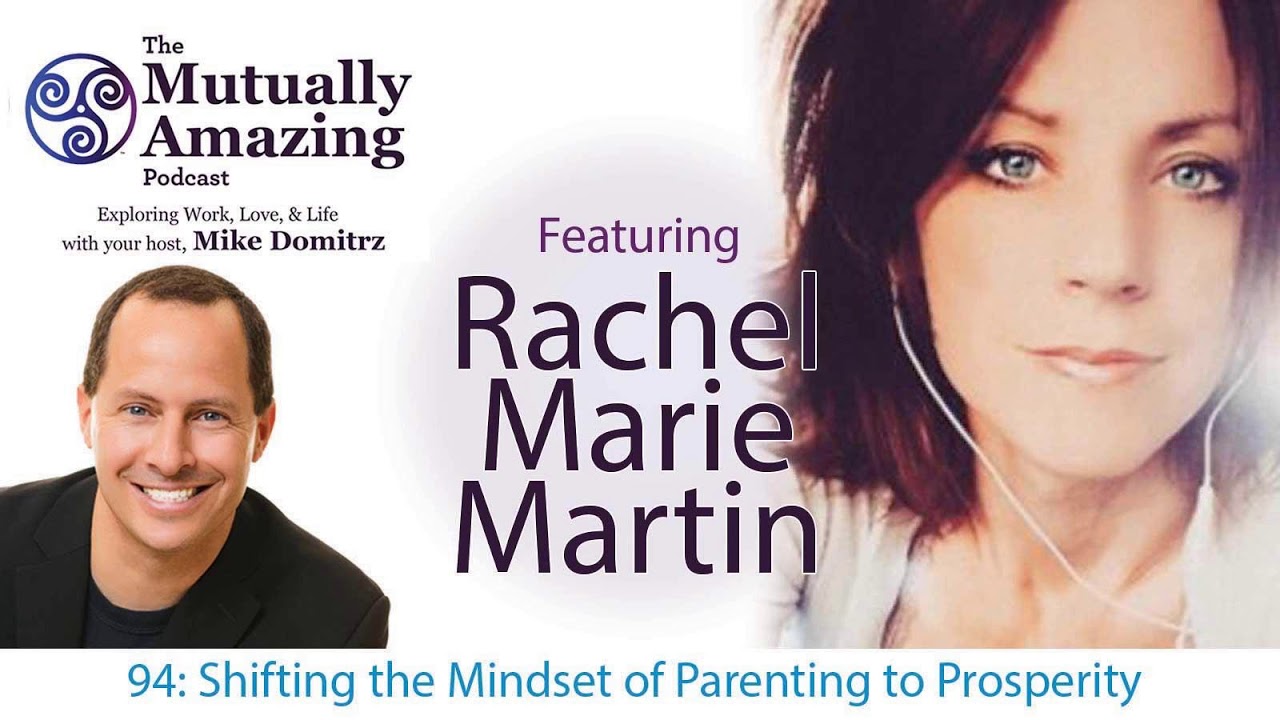
In this episode of the Mutually Amazing Podcast, host Mike Domitrz interviews Rachel Marie Martin, a single mother of seven, author of The Brave Heart of Motherhood, and founder of the Finding Joy blog. Rachel shares her personal journey from living in poverty and a scarcity mindset to building a successful online business and teaching other entrepreneurs. She explains how she transformed her relationship with money by recognizing that wealth is attracted to belief and self‑deservedness. Rachel recounts a formative childhood trauma she calls the “Hey Ugly” incident, linking it to the concept of “dots” – internalized marks of shame or guilt that can be examined and released. She contrasts this with the popular “connect the dots” metaphor, emphasizing the need to discard negative dots rather than connect them. A vivid story from a motorcycle ride in Haiti illustrates how confronting fear can unlock unexpected beauty and courage. Rachel describes practical tools she teaches: creating timelines to spot cycles of being stuck, future‑pacing to envision a confident self at later ages, and the “respect the inches” principle that celebrates incremental progress. Throughout, she stresses that mothers (and anyone) have a 100 % track record of surviving bad days, and encourages them to reclaim identity and bravery without waiting for an empty nest. The conversation concludes with promotion of her book and resources, and a brief plug for the podcast’s respect philosophy.
Chapters
Welcome to the Mutually Amazing Podcast. I'm your host, Mike Domitrz, with the Center for Respect. The episode you're about to listen to was recorded when this show used to be called the Respect Podcast. So, you might hear that mentioned during this episode. Well, let's get to the show. And this week, we have Rachel Marie Martin, author of The Brave Heart of Motherhood and writer at findingjoy.net. Rachel's a single mom of 7 who's gone from poverty to entrepreneurial success. Rachel, thank you so much for joining us.
Well, thank you for having me today.
Absolutely. So let's just dive right in. You said you went from poverty to entrepreneurial success. Can you explain that to our audience?
I would love to. So I lived what I call kind of a masked life of suburbia where it looked like I had it together, but I was actually scraping by every single day and people were helping provide for me. And, uh, There was a moment when I realized I shouldn't live with the gas man coming to my door or wondering how I'm going to put food on the table. I took responsibility for my own life, my own choices, took responsibility for raising those 7 kids and started my own business, started writing online. And gradually, it grew and grew to the point where I can say to you that I have changed the culture and the mindset of money and I've changed not only my story but my children's story.
And so, let's talk about that, the mindset of money. What was the change there?
I lived with a scarcity mindset. I know it's kind of a popular thing that we hear all the time, live with an abundance mindset, but there is actually truth with it. I believed that money was hard to make. I listened. I started paying attention to the thoughts and the mindsets I had about money. I remember once someone saying to me, what do you do to keep the wolf away from the door? And the mindset there is that there's always something coming in to take your money. And I lived so long thinking that I couldn't make money, that it wasn't time to make money. And I had to change it, that really what I think is what I'm attracted to, what attracts itself to me. And part of it was that I was not only able to make money, but that I deserved to be able to make money.
Well, that's powerful. So then how did you— when people hear I write online, How does that mindset shift get you to entrepreneurial success? How does somebody make money doing that?
Well, I've always been kind of a techie person and I started writing online. I started a blog, Finding Joy, years and years ago. So it's about over 10 years now. And I started writing and it started resonating. And one of the things that I did early on was I started using my writing as a way to earn money, whether it was via ads or speaking or Writing an ebook. And it gradually became to this place where what I had built through my voice, through really being real and sharing my own stories, was a way to change the culture of making money in my household. And that pivoted to people asking, well, how did you build this community? And how did you do that? And when people ask you how, that's also an opportunity to earn an income. And I went around and built a company With my partner, Dan Morris, and we started teaching and training entrepreneurs, bloggers, podcasters. How do you go from hobby to career?
Oh, that's powerful. Now, you did come from a background that really instilled with you some tough, tough experiences that also led you to really understanding respect. So, you had an incident called the Hey Ugly incident, and I'm gonna let you share that with our listeners and how that impacted you going forward until today.
All right. Well, I share about this, but when I was in— I think it was 6th grade. Now, I had that moment. I had an experience. I grew up in Minneapolis, the home of Target, and I would always love to go there. And one day, my mom was like, all right, we're going to go here after school. And I had one of those days where, as my 6th grade self, I felt super powerful and confident. I loved what I was wearing. My mom said, go ahead. Go look at the cosmetics by yourself. And as a young adolescent, it was just this moment of freedom. freedom. And I honestly felt on top of the world. And I can remember the moment so clearly looking at these like lip glosses and someone saying and hearing, hey, ugly. And at first, I looked up and I looked over my shoulder because I thought, well, there's someone behind me. And I looked and there was no one behind me. And then I looked up to where the voice was and it was a bunch of preteenage, preteen boys. who were laughing and they were laughing at me. And it really, it really hit me hard in those days because here I was on the top of the world and then all of a sudden, I had this moment where these strangers who were probably just joking around and running around Target decided to shatter kind of my complex of security and self. And it stuck with me for a long time. And I was working with a counselor years ago and we came back to that moment and I realized the power of words. The power of words of somebody that I would never even have give validity to myself today and how they had kind of cloaked who I thought I was about myself. And it came to a place where I knew I deserved to not only change that culture in my own head but to give myself the respect I deserved. And it reme— it meant removing that label of, hey, ugly, from a random stranger as a definer of self.
Well, I think that's so powerful because all— most of us, and if we Dive deep on it. I think everyone can think of a childhood memory of trauma. And it— people, when they think of trauma, they sometimes think, oh, mine wasn't that severe compared to, you know, trauma that leads to long-term PTSD. And they don't realize those little traumatic moments that do stick with us can be incredibly powerful in mindset, how we view ourselves, how we view our bodies, our worth, our value to the world. And being able to look back at them and release is so important. I love what you did there in saying, You didn't make them evil, right? You didn't say these jerks. You said these teens who probably didn't even realize the impact they were doing. It doesn't make what they did okay, but it allows you to also release negative toxic energy related to it, I would assume. Is that correct?
Yeah, absolutely. Because in— when I think about it in my adult self as a 44-year-old, I would— I would believe that those teens have no memory of that moment. They probably did this, whatever, joked around, left, and there's just not this like thought process that it— it created a ripple. And realizing that— that I'm not dictated by my 13-year-old self by that thought process, it shouldn't define who I am now, was part of that releasing of that moment. And, you know, sometimes it— it's— it's important to reexamine those kind of beliefs that we develop as child— as children because they can carry over to us as adults. And then when we can look at them through the adult mind, through who we are now, there's just no way that I would allow somebody of that age to dictate myself now. Just the same way that I would never say that to my children. I would never— if someone said that to my children, I would immediately lead them to truth. And, as adults, I believe we have the same responsibility to lead ourselves to truths regarding thought processes that We might have carried up— carried with us for years.
And you talk about the dots we carry with ourselves, and this is one example of that, the Hey Ugly incident. When you say dots, what do you mean by that?
It comes from a Max Lucado book where he talks about a culture, like a hypothetical one for kids, where they carry dots. And it's this culture where if you're good enough, they give you a star, and if you mess up, they give you dots. And the whole parable of it talks about that we A lot of people go around carrying dots, and we carry dots of shame, we carry dots of guilt, we carry dots of what if. And some of them are given to us by others, and some of them are given to us by ourselves. But I have a responsibility as an adult to not allow it to stick. And I think the deeper part comes in is when we can examine our minds. What are the dots that we're putting on ourselves? I'm failing. I'm not good enough. I'm not worthy. I'm not enough. And when we recognize, you know what, that really shouldn't be allowed to stick on who I am and my identity, then there's this great deal of freedom because we're no longer bound by constraints that really don't define worth.
Well, and I love that. That's such a different look at dots because usually when, when I saw that in you, that you talk about like dots, uh, I, I thought the Steve Jobs version of— and I don't know if you know that one where he spoke I think it was at Stanford's graduation and said, you, you can look back on life and connect the dots. Uh, and so that, that's such a different viewpoint on the dots. So that's why I love that you took us there. So I appreciate that. Thank you. And, and you were in Haiti and had an experience. And if you could share with us about that and how that impacted.
Well, I'm assuming you're talking about my motorcycle experience in Haiti. Um, and so I've been blessed to go to Haiti several times and I've discovered that In Haiti, the people that I've met there are some of the most joyous people around. And, the first time I went to Haiti, I was still in this very transitional place in my life, still coming to grips with self, still deciding— fighting fear was really what it was. But, when I went to Haiti, I decided, I made a decision that I was not going to let fear define who I was on that trip.
Yeah.
So it resulted in a lot of moments of breaking free. And there was a day— on the first day, I think I mentioned to my friend, I want to ride a motorcycle. And in Haiti, that's probably the last thing anybody should do. It's very, very dangerous. There's no rules of the road. People are always swerving in and out. But for some reason, it came in my head that this is something I wanted to do. Well, when you speak something, you put into motion that what you've spoken, which I believe is really powerful to dreams too, and goals, is to speak them. I forgot about it. Close to the end of the trip, my trip leader comes back and he's in this camp with us and all of a sudden, he points and there is a motorcycle. And he says, well, now is your time. Well, I had never ridden a motorcycle before and now I'm in Haiti riding a motorcycle and I'm in a room. I'm in this outside space actually where there's 40 people looking at me and a motorcycle and a Haitian man named Bibi that was ready there to drive me. And, I knew I had a choice in that moment. Either I jump at the opportunity or I don't. So, I went back to that, I'm not going to let fear stop me. And, I remember walking over to the bike and my legs willing me, but my brain was thinking, what are you doing? You're crazy. But, I got on it. I tried to put my arms around Bibi thinking that was the way to hold on. And, I had to hold on behind actually. And, it was even a little bit more scary. But as we pulled away from the camp, I realized that the 40 people there were never going to have that opportunity. So there was this moment of courage that was coming up. And we started driving through these back hills and roads of where we were in Lakai, Haiti, and people started coming out of their houses. And I asked Bibi what they were coming out and saying, and he said, they're saying they're afraid the American's going to fall off. So my fear was tested a little bit there. We kept going, and the more we rode, the freer I became, till the point where he said, do you want to go see the sea? And I said, okay, okay, Bibi. I had no idea. So he turns left through a mango grove, and we hit this beach that's glorious, that's something out of Pinterest and something that you can only imagine. Black sand, and the mountains were just like emerging from the ocean, and the sun was setting, and the Haitian fishermen were coming in. And it was breathtakingly beautiful. And as we were driving and riding this motorcycle, I said to Bibi, I will never forget this moment for the rest of my life. And I knew that the only reason I got that moment was because I didn't let fear stop me. If I had let fear stop me way back in the camp or even stop me from going to Haiti, I never would have gotten to this moment that I would share the rest of my life. In fact, it is one of probably the top 5 stories that I share, and it's a story I hear my children share to their friends. And it's a lesson in— often on the other side of fear is unbelievable beauty, courage, and opportunity.
I love it. That's fantastic. Now, you give people specific skills that they can use, and so I want to talk about that. For instance, we talked about the dots and freeing ourselves. So you have people chart their paths to look for cycles of stuck. What does that mean and how should our listener— how do they do that? If our listeners are thinking, hey, how do I— what does it mean to chart my past for cycles of stuck?
Well, I give an example of if— and I don't know if this is just a Midwest thing, but when I grew up, my mom and dad gave this giant graduation party and as part of it, they had like images of my whole childhood lining the walls of the garage and it was this moment where all of a sudden I could see my whole life. in front of me and you can see your path. And I started thinking about that as I was writing my book. Like, we don't often take a moment to reflect like that again to see the nuances. But when you reflect on your life and when you start to create a timeline, you can start to see spaces or cycles where you're stuck, where things might repeat itself. Where let's say you want to buy a house and it always— you get to a certain point and then it stops. Or you want to start a new career and you get to a certain point and you stop and you loop around.
Or health.
Weight or any of those things. And when you start to create the timeline, you can start to see what happened before, what happened after, what happened before I started, and what made me stop. And you can start to see patterns within it because the only way to break free from a circle or a cycle is to actually figure out a new trajectory, a new decision right before the time when you would normally make the decision that would keep you stuck.
I love it. So somebody sees that, and how do they relieve themselves going forward, right? So now I see the cycle. Hey, I have this cycle of when I get here, I tend to do this. As you and I know, I can know as a person, I'm not going to do that again. But when I get in the situation, how do I free the mentality that happens that let— that caused me to do it in the past?
It's a lot of self-awareness, and it's also creating within your life Knowing that it's gonna— you're gonna get to that point where you're almost like, this is expected, this is what I was going to do, and you create physical reminders, mental reminders of, I'm no longer gonna go that way. If you've ever seen the movie The Matrix, there's a point at the end of this movie where the main character Neo, he lives in this computer-simulated world, recognizes— That it's all a simulation and there's these bullets flying at him and instead of feeling the threat of it, the realness of it, he simply understands this is exactly what's gonna happen and he actually pushes them away. It's the same with us when we change a pattern is when we get to the place where we know this is where I am. I think it's a lot about releasing it, understanding that this is part of the cycle but I no longer have to engage in it. I no longer have to give whatever momentum is going to carry me around that power, but instead, I can dare to choose a step in a different direction. And I think a lot of times, we think, okay, I'm going to change my life in 4 weeks, and we discount the power of a single step. But if every single day, we can create another step, another step, another step, the farther out from that previous cycle we become.
Love it. And you had a friend, Ed, who taught you a lesson about the future. So can you share that lesson with us?
I would love to. So Ed, uh, he taught me about faith and seeing the future. And as we, you know, from the start of this podcast, we were talking about my finances. And one time I was meeting with him and he said, well, hey, do you see yourself stuck in your financial situation when you're 70? And I was like, absolutely not. How about 60? And with confidence, I said the same. Till he got to 40. About that time, I was 30-something and I was like, I don't know. And it was that first moment of confronting what I felt about my future. And he said, I need you— he told me an example about Joseph from the Bible about this time when he was stuck in the dungeons. And he said he had to have this faith in a future that didn't match his present reality. His future that he was supposed to have faith in, that he was going to be second in command, And he said, how did he do that? And I realized, and he taught me, that oftentimes faith in a future means having that bit of spark, that hope that your future doesn't need to match the present reality that you're in. And that involves, for me and for many of us, actually daring to see ourselves in a different situation, responding a different way, and clinging to that image. So for me back then, I created an image of me when I was 40, and when I would get confronted with, Let's say the gas man coming to my door to turn something off or a bill or not knowing what to do, I would constantly ask myself, how would I respond as this person? Because I could tap into those type of resources versus responding the way that I had for so many years. And that kind of future pacing, that seeing a future self, it actually can help motivate us to make better and stronger decisions in the now.
I love that. It's such a simple concept and you have another concept called respect the inches. What is that and how does somebody do that?
Well, respect the inches would be what I was talking about with the cycle is when you break free, it's often inches. It's small incremental changes that add up and up and up. A lot of times we don't give respect to the small changes, to the fact that, you know, we maybe— we tried to work out today or We changed one thing or we paid a bill or whatever the inch may be, we look at the end goal and we think, oh, I'm so far from it, or, oh, I didn't get to it at that point, or, it seems impossible, and we lose that power in the inch. And I always tell people that if you do something for a year, one thing, that's 365 days of progress that you've made. If you want to wake up an hour earlier and you think, I can't do it because it's an hour, if you give yourself You set your alarm 1 minute earlier for 60 days, you're all of a sudden there. But you have to be willing to accept that this day, I woke up 14 minutes earlier, and that's progress. And that's that respect. It's really being willing to see the behind-the-scenes that nobody ever really sees. People see the giant splash moment, the success, but those behind-the-scenes moments are really the moments that lead to the giant breakthrough.
And you, you work a lot with moms. And one of the things you want moms in your audience to do is respect what they can do. And you've referenced that a few times today. You know, what are the small steps? Like we just said, what are the inches? What can I do? Uh, and what they have accomplished, what they could accomplish. And you have a quote that says, your track— save— your track record for surviving bad days is 100%, which I think is beautiful because that's all of us, right? If we're listening to this, that track record's 100%. Why do you think that statement is so important?
Because I think not just moms, but a lot of us have the soundtrack of, I failed, I messed up, I can't get through, or when we have those bad days and we forget that we've gotten through all the bad days. And part of that is the inches. Part of it's seeing that when we were face to face, when we were up to the wall, when we didn't know what to do, we've always made it through. It may not be pretty. It may be messy, it may have been with fight, but we consistently make it through. And it's kind of the seeing the glass half full versus the half empty part. Because when you're in those bad days, there are some times where, you know, even myself, you're like, I just don't know how I can do this. And if we can remind ourselves, you know what, I've gotten through before and I can do it again, there's a lot of power in that, in just the reassurance. That the better days will come again.
And you have a book called The Brave Art of Motherhood. Can you tell our listeners a little bit about the book?
Yeah, I would love to. It's about fighting fear, finding yourself again, kind of regaining the confidence. A lot of times moms will say, I'm a really good mom, but I don't know who I am anymore. Or there's, when the kids are grown, I'm gonna take care of this, I'm gonna follow my dreams. And I really believe in this culture of bravery, and I wanted to change the culture for moms that you don't have to wait until the kids are grown to find yourself again, and that the things that you've always told me— told yourself, I can't really do it right now, you can do it. And that if you're like me and you find yourself in a situation where you're stuck, you're not a victim to the circumstances. There is control and power and beauty and bravery in life.
Yeah, and people who are empty nesters can attest to the fact the longer you wait To try to go through that exploration, the more emotionally difficult it is. If you wait till everybody's out of the house and now you're gonna like, I'm gonna explore now, it can feel overwhelming. Like, where do I start with? Or if you take small steps while that, let's say the youngest child is in high school and each year you do a little bit more, by the time they graduate, you're like, oh, I'm full and running already. Like, this is, it's a freeing experience. It's not a, what do I do next?
Oh, absolutely. I had observed, you know, having 7 kids, I'd observed some of my kids' friends' mothers whose— their friends, their moms, that was their last child— go through this kind of loss of self, not knowing what to do when a child graduated or who I am or marriage is falling apart or whatever it may be. And I thought, if we can change the culture that we don't wait until they're grown and that it's healthy to cultivate and follow your heart, then we can make huge strides and huge differences in those years where a lot of times people say, well, it's a midlife crisis. And I just like to think of it as it's just another season in life. It's another time of exploration. It's not a crisis. It's just kind of that evolving of self. And if we can accept that that's a constant in life, then those years and those, those times can be easier.
Uh, absolutely. So true. Rachel, thank you so much for sharing with us. I want to make sure everybody can find you. The website's findingjoy.net and on Facebook, Finding Joy Blog. Thank you so much.
Thank you.
Absolutely. For our listeners, you know what's next. It is question of the week. This week's question is, hey Mike, we know that when you speak to companies and organizations, you stress that you are not a fan of a belief system that says you have to earn someone's respect. Why not? Why do you think that that belief that you have to earn someone's respect is so dangerous? Well, the whole idea of you have to earn my respect means that I'm in control and it's a power and a hierarchy role instead of I value you. When you ask people what it means to be respected, they say to be seen, to be valued, to be appreciated. What it means to be disrespected, to be degraded, to not be valued, to be ignored, to be invisible. So when you say you have to earn my respect, You're implying that until you do, you are of no value, you are invisible. Why do I want to work with someone? Why do I want to be with someone who views me that way? That I have to do something to be of value to you, to be seen as of value as a fellow human being. And that's why that belief system, when people say you have to earn my respect, is so dangerous. Here's how it should go. You are given respect by me because you're a fellow human being and I give respect to all human beings. Now, you can earn potentially a raise or promotion. You can earn my admiration. But I'm giving you respect as a fellow human being. Huge difference. We'd love to hear your questions, your thoughts, and your ideas. And the best place to leave those with us is on our Facebook page at facebook.com/MutuallyAmazingPodcast. Of course, you can always contact us on our website At mutuallyamazingpodcast.com. Remember to subscribe to this show so you automatically get it every week. And if you could take one moment to leave a review, that really helps other people find the show, which we are greatly appreciative of. So thank you so much for joining us. May you make today and every day a life full of mutually amazing relationships.








