Bitcoin Live with the Power Law & Minotaur Team, #25 11/6/2025
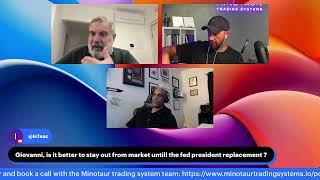
Recorded panel discussion (Nov 6, 2025) where Giovanni, Sebastian, Marcus and Kosta Ouzas analyze Bitcoin price behavior. Key themes: the ‘power law’ as a long-term backbone for Bitcoin price scaling, recent deviations/oscillations from that backbone, institutional trading (basis traders and speculators) damping volatility, and performance of Minotaur’s trading algorithm during major liquidation events. The hosts describe trading tactics (covered calls, using BTC as collateral) and announce invite-only webinars on the algo.
Chapters
Top and so the two things canceled. So in a sense the bubbles never existed because they cancel each other. So they leave the power law. This is why you have a white.
Line in the middle of these bubbles.
Because it's almost like telling you up.
Motion, cancel the down motions and you're left with the power law. The power law is still valid even.
When there are bubbles.
But if there are no bubbles, you.
Have even more of a power law. You are following the power law even more.
In fact, there are all these parameters.
Like this parameter called the correlation parameter R squared.
And that parameter is becoming stronger, not weaker. So I don't get it.
I mean, I think people think that.
This blue line is the power law. The blue line is what they called.
From the beginning the full model.
That means we take the power law, we studied the deviations from the power law and then we make an effort in describing them by using the power law. But they are not belonging to the power law. It's actually when we deviate from the power law. So I don't know why people still confuse this. Now, the only thing you could say if you zoom in, right?
So if we zoom in on the recent.
So first of all, it is clear that what we were expecting, so that we were moving along and these are this shape of a curve is not exactly what we were going to expect.
It was.
It's just a kind of a marker to say if everything happened like it happened in the previous cycles, we should go to 200k. It was never a guarantee. It's a second layer, you understand, there.
Is a backbone that is the power law.
And then we say, well, there are these other regularities and maybe these irregularities will continue to exist. They are at a different level of prediction than the power law. The power law is the backbone. Now you could say that while until recently we were kind of simply oscillating around the power law by small amounts, now we see a relatively big deviation. Now this is still in the realm of what is possible. Because if you see, look at this.
Deviation, when we went back to the.
Power law, we went above, we went below.
So we are not even as strong.
Of a deviation as this one that occurred in August of the last year.
The one that we had around April.
This is when actually things started to seem strange. Because usually see, what should have happened is that we cross the wide line in November. That is actually what I predicted. I say we will, we will have a bull market starting in. It happened, we cross the white line and usually we stay above a white line. It never happened that before in the previous cycle that we actually go back to below the white line once the bull market starts. But we add, we add that. And in fact you could use that as a kind of a measure of us how strong a deviation can be at that time. It went all the way to what, 75 something. But we went back to the power law and then we oscillated and now we see oscillations that are different from the ones that we had from May. So starting May, we Simply went like 5% up, 5% below. We were very, very close to the power law. But now the deviation is bigger. Right now, even just visually you can see that it's bigger, but it's not even in the order of what we experienced when we went to 75 during April of this year. So, you know, what I'm expecting is that we are going back to the power law. We will continue to oscillate and to.
Break the power law, we will have.
To have much bigger deviations. We will continue to be there. We have many different ways. Maybe next episode we can show. I will do some tests. Right now we have this way of looking at just the price, but also the change in price, what are called the returns. We can see if returns are statistically very different from the average, right? It depends, of course, if you choose a very small period, it looks like, oh, they are very different, right. But you choose a bigger period then just as the normal deviations that are expected. So if, you know, to break the power law, we will have to stay. We have deviations from a power law that are big and then consistent in time.
Now remember.
It'S difficult to to say sorry if I take all this time I want to Marcus discussed but you know, it's a long time. We don't talk about these things. One big question is if we didn't have a bull market, right, where we had a big deviation. Because if everything happened like before, we should have added this bull market. You know, we reached 200k simply because there is a decay of these peaks and then we will have gone down and then, you know, experience a bear market. And the bear market bring us all the way to this white curve. That will have been. First of all, it will have taken a year. So it will have to happen sometime November of next year when we reach a bottom. And the bottom will have been around 75, 70, 75, between 75 to 80, something like that. And you will have taken one year to go there. But you know, that will have meaning going down from 200 to 280. So it will have been more than a 50% decay, you know. Now the question is, if we don't have a bull market, do we have a bear market?
Right.
Was it a muted bull market? And then we have a muted bear market. This we don't know because we never had anything like this, you know, we will have to monitor. So right now I will say we are still riding the power law. I'm expecting that we go back to the power law and we are doing oscillations around the power law. We will have to see, you know, it's the only scientific thing to do given that basically we are in uncharted territory. We never added this behavior at this particular point of, you know, of a cycle. But actually, in general, if you're thinking about, you're looking at the data, we didn't spend a lot of time in the white line. Yes, the white line represents the middle, but usually we simply crossed it. And then most of the time we spend it below or above the power law. The middle power law and these are, has been unusual to be so close to it and later around it, you know, so right now the power law is stronger than ever. It's not dead. What is dead? Quote, unquote. And we don't know if it is dead or is sleeping. You know, maybe next, next cycle we have a normal cycle. We don't know. Some people say, I want to make one more comment, but still say, oh, it's an extended cycle. It's a weird concept because cycles means predictability. Okay, don't. I don't. We can have this debate. Like for example, you know, plan C is one of these people say, oh, it doesn't have to be fixed length. It's nonsense. Think about seasons, right? Imagine if you had a summer happening two months later, two months early, and it's not at a particular time, right? It will be a mess. You will not talk about cycles. You will not know the beauty of the seasons that you know exactly when they start within some variability, right? When they start, when they end. If they don't know, then you cannot say, say that we have cyclic seasons. You know, it's nonsense. If a, you know, if I, if a year lasted that two years and then one year and a half and say that. How do you know that you are in a cycle? You know that you're a cycle. Because there is a sequence of events that repeat at precise time, like recycles of Bitcoin. If, if a last, you know, Six years instead of four years. How do you know when the cycle hangs or starts? You know any how you say, oh, because we reach a certain peak and.
Then we get down.
Okay, Bitcoin reaches peaks. Is this a cycle, for example? You know, this was a peak, this was a bottom. Why don't you call this a cycle? You know, it doesn't make any sense. So we need more data, we need to see what is going on right now. If anything, the power law is the only certainty we have because this is something that bitcoin has followed. The cycles in a sense were an illusion because we went up, then we went down and there is this overall trend. If you average over four years, the power law is the only thing you see because the bubbles almost disappear. So that is the only backbone that we still have. And then if, if anything is stronger than ever anyway. So this is all what I have to say, you guys, you know, can ask question in the comments etc. If you have question about these. So I would like to give the microphone to Marcus that will talk about pbt.
All right. All right, ready? Okay. Can you see my screen?
Yep.
All right. I'm glad to be back with the camp. We're back in business here, guys. It's been a while. I think Giovanni was hanging out with the Pope at the Vatican. So he's back.
All right, so that is next. Vet is next.
So the first thing we want to do is take a deep breath and when in doubt, we zoom out. Right? One of the problems that we have as detail and ex retail and small traders is we tend to look too narrowly and we don't look at the big picture. We're swimming in a big ocean and we're just a very tiny piece of plankton. We're not even a shrimp. So we have to understand how big the ocean actually is. So let's zoom out. We're in doubt, let's zoom out. So the first thing we want to do is, we want to take a deep breath. Yes, the market has done a pretty strong correction off the all time high. But that's part of the market behavior and the natural course of action. So the first thing I want to do is we're looking at the, the power law runs on cycles, right? So we're talking about the full bull embarrass cycles. So let's take a step back and let's just look at the cycle for what it is. We're still in this gigantic cycle that we've been in for 360something days now. And here it is right here. There's the big macro cycle. So we recently, in July, we deviated from that cycle and there's the deviation. And we were running in that site, that deviation for 100 days. So a long time we were in this deviation. We had a small deviation for about a month and a few days in February, and it lasted till April of earlier this year. So that was a deviation to the downside. That was the summer, the spring low. So if you, if you take a step back, we've just been operating in the big macro and we had a deviation outside of there. That's all that's happening. Okay, so there's a couple of things that I want to highlight here is there was this gentleman named Wyckoff and he came up with this theory called a composite operator. What that means is the market has lots of commercial or institutional participants. And these participants fall in three major categories. Somebody's got a lot of noise going on and moving furniture or something, so they could kind of mute that mic. I appreciate it. These, these commercial institutions are the ones that have the money that actually moved the market. So these commercial participants fall in three major camps. The commercial participants that actually need to buy futures or derivatives to protect price stability. We're not going to talk about those guys. They're the commercial speculators, the banks that actually buy the asset to earn interest and they profit or get collateral value from its movement. This commercial speculators and then the institutional basis traders. So those are the two we're going to focus on really quick. I'm not going to take all day here. So we're going to talk about the basis traders institutions and the, and the speculator institutions. So having said that, the market loves to do business. You have to be able to identify current markets. The market loves to do business in a range that makes sense. If you were buying derivatives on commodities, you need price stability so you can conduct business. So the business, the market loves ranges. These ranges is where it conducts its business. Institutions don't like volatility or crazy directions. That's what they're trying to hedge against. They are always seeking, especially the, especially the basis trading institutions, which is the majority of them. They're looking to stay delta neutral. They don't want a lot of exposure to direction. So that's why these markets tend to range for long periods of time, because those institutions are keeping it there because they're here to conduct business. They conduct their business off of volume. Retailers and small degenerate traders like ourselves, we're the ones trying to hit home runs. And we're chasing price movement, but that's not what the institutions do. So let's take a look at two things really quick. I want to go over the basis traders first and then we're talking about major institutions. So for example, this was a major short liquidation that occurred in 2024. So if you're a basis trader, you're not trying to get appreciation, you're just trying to keep it in a zone. So you pick up this inventory and you offset that inventory in the same vicinity down the road. These are shorts, you offset it with longs and you keep a balanced basis. The, the basis stays balanced, everything's good. So another aspect of the basis trader, traders or institutions, where do they do it again? So now you're, you're even, your portfolio is even and you're staying in range. You're staying rebalanced or delta neutral. The next opportunity for you to do another basis is here. When we broke out right here, you, you picked up a lot of short inventory in your portfolio. You rebalance that by coming over here at a later date and settling that off those books. And you rebalance and at the derivative of that is keeping a tight range. So now basis traders picked up short inventory, they offset it with long inventory here. And that's where we are currently. So if you really think about it in the eyes of an institution, they're just doing what they do, right? So let's look at another thing. So let's look at the speculating institutions, the banks and the ones that need price direction to move, right? So these guys pick up inventory here on this liquidations and these, this correction that we had this major pullback in the spring and then they offset it here, right? You pick up long contract inventory, you offset it with short contract inventory. So now you're balanced. So what do you do? You pick up short contract inventory and you need to offset it with long inventory. Then you'll do the same thing again. So the point that I'm trying to make is the two biggest pools of institutions, there's hundreds of institutions out there and they become a composite in, they become one composite operator when they act in groups. So the basis traders are doing their thing and the derivative is, is a range. And then the speculating institutions are doing their thing and the basis is also arranged so they become a composite of each other. So the market is doing exactly what it needs to do. So let's look at one last thing. If you are speculating institution and you're Picking up inventory here and you're selling it off here, then you're waiting to pick up fresh inventory to do the same process again. So where are you going to get that inventory to offset these locked in buyers up here? Well, you pick it up right here where we are now. Back to the same old range where you were comfortable doing business. And the problem is us retailers, we start panicking. This is just normal process. So for example, if you look at this major range here, this is the fair value that these institutions want to trade at. So if you, for example, if you, some people I see on YouTube, oh, I'm going to start buying bitcoin here or there. You shouldn't even think about buying bitcoin till you get below fair market value for bitcoin on the spot side. So that's in this area here. This is where the institutions are going to pick it up and that's where you should pick it up because the market has already told you where it trade wants to trade at and what the prices are. We don't set the price, the market sets the price. You just got to learn how to read the sheet music that's in front of you. So I'm not going to get too much in the weeds tonight. I just want to kind of throw. The main point is we need to take a deep breath. If you are an institution and you were a speculating institution, you picked up inventory here and you sold it here, you've only made two major trades in the last year and a year you haven't done anything. You bought here, you sold here and you're starting to accumulate again to sell here. That's all that's happening. We're going through an accumulation phase that should terminate somewhere in this structure right here to take up here. As I've been saying all for the longest time, this is fried chicken. It's in the, it's got batter on it, the grease is hot, it's ready to go. The market's not going to leave all that inventory unmitigated, unsettled. So just sit back, allow the thing to, to run its course and take advantage of it. So that's what I have for today. I try to compress about. I haven't talked to you guys in about, you know, what, four weeks now or more. So try to get a lot in a little bit of time.
So you see a correction upwards in which kind of time scales I think.
It'S going to stay. You know, all the institutions are saying that we don't have the four Year, cycle anymore. I believe that. I'm a believer of that. I think we're right on track. Power law, we're staying close to that power law, which it just proves the institution model is even more correct. Institutions want ranges and the power law is, is the, is the basis for the range. So we're just staying on it. I would expect to mitigate this probably, you know, we're looking at the end of the year to come back up here, so, yeah, we're still fine. The good thing is when the markets move, they move quick. When it does move, and then it'll rediscover a new zone because institutions, when they take it up here, yeah, they're going to want to, they're going to want to settle it down pretty quick and they will. So. Yeah.
Yeah, I like that. I think you're right.
Yeah, I just follow. Hey, I, I, I know what I am. I know that I'm a plankton. I know that I'm not a shark. I'm not a barracuda. I'm not even a barnacle on the belly of a whale. I'm something, something that barnacle eats. I know I'm small and I'm gonna swim with the big boys, you know, whatever the institutions do, I'm just gonna stand there. Little flipper.
And you know that's the pilot of fish, right?
Yeah.
Clean the sharks.
Yeah, the pilot fish swims under the belly, but even the pilot fish would be a pretty sizable institution. I'm that thing that's swimming under the pilot fish's belly.
A little, a little parasite on top of a pilot fish.
I'm a pilot fish's parasite. Exactly.
Yeah. Very good analysis. Okay, that is good. Now, Sebastian, do you want to, or, Costa, do you want to go ahead and discuss the behavior of the algorithm? During in particular, I was very happy because when we had a correction, my algo bought almost perfectly the deep. But let's see some other examples of this.
Can I hear your mic? Is it muted? Maybe he's muted.
Oh, yeah, we are muted.
Can you hear me?
Yes, yes.
Yeah. Yeah.
I wanted to, I did want to go over just one of the, A.
Question for Marcus, actually.
So, yeah.
Are you saying that we can, we've been in this range from 100 to 120.
Are you seeing them? Potentially. So there's one or two scenarios. Right.
The one thing that sticks out to me is the, the power law support, that's something that we really focus on with our risk management.
And, and the power law support says.
That we should come back to around 70, 72k towards the end of next year. Is that right, Giovanni?
That was my big question, right? Do we even go there if we didn't have a put bull market? I mean, that is a valid despotices, right? This is why I don't like speculation. But if you do a scientific hypothesis like okay, usually the bear market, we're associated with the bull, they seem dominant.
Just leave it at the door.
That's all. Right, thank you.
Sorry, I got a postman.
They almost serve a role of compensate the bull market, right. But if you don't have anything to compensate, that is the run. Do we have a bear market? Right. Right now I think nobody can answer that question.
I agree with you too on that, Giovanni. Because sorry, they're. They're running closer to that power low because institutions, they, they damper the volatility. They're the ones that kill the volatility.
Right.
It's a speculating retail that creates all these bubbles.
Yeah, it makes a lot of sense. I. I thought, I was thinking about these exactly last few days like it's possible that simply based institutions simply cannot live with an asset that changes by 80%. You know, like we had in the past and bet in either direction. You know, because the moment that even this two pair, maybe that is all, you know, if we add a two pair almost remember, you know, these are not people that believe in a cause, they believe in money, right? So the manager of a ETFs, etc, if, if a bitcoin went up very quickly by a factor of two, they will sell. They will sell because you know, they think about the bonuses that they will get at the end of the year, you know, so. Yeah, yes. The only thing we can hope is so that it continues to grow because the system grows, adoption grows, all the fundamentals have not changed. But this euphoria that we added during the bubbles is going away. You know, that is actually I, I don't, to be honest, I don't mind because entire point of what we work in art, that is this system, right, that our trading system is all about recreating mini bubbles. Because anytime you have a, a change, any change, it can be a 5% change in either direction. In fact, actually when you have big changes like the one we experienced a few days, that is an opportunity to buy big cheap bitcoin and the price will correct up because this, what is going to do is going to find that equilibrium state and it's oscillates and we take advantage of that. While most People don't, you know, because I never understood the fascination with the buran if you were not going to act on it. Why? The only thing is, because I think there are some people that every time we have a bull run, they think this is it, that we are going to have an exponential behavior and the buran is going to last forever and is never like that. It's actually correcting and don't act on it. It's almost like you didn't have a bull run because it's compensated by the bear run. So really having something. We talk continuously oscillating around the reference value. It's perfect for what we're doing. That's why I was eager for you guys to show. Do we have some charts of.
Yeah, yeah, yeah.
Let me show you something. I've got something really cool to show you, actually. I did a little bit.
In 25 minutes.
Yeah, yeah.
I do want to just share my screen there, Giovanni.
All right.
So I just wanted to bring this chart up because we can see the liquidity here. And what I've done is I've matched it up and I've done a little bit of drawing with what our algo did. So I've added the blue here.
So you can.
I've kind of tried to just replicate it by hand.
So what you can see, we should be able.
Eventually we need to figure out how to superimpose Marcus charts. Because I appreciate your artistic effort.
But.
If we could do it the right way. Way.
Yeah. So, but, but what you can see here is, you know, you know what?
Ask Madis to use his editing skill to do that. It doesn't have to be a live. A live graph, right? It can be.
Yeah. Correct.
Yeah, yeah.
So, yeah. The point, the point we're trying to make here is that if. Well, discretionary trading is. Is almost impossible when the market is moving in this way. Lot of these liquidity pools as well, they're building in live time. Like if we have a look here, what's going on, you know, this, this pool here, we have a look here. This didn't exist a few days ago.
Right.
So, you know, this, this is the, this is there the 6th of November, it's the 7th of November, not even, not even a full 48 hours. Right. And, and, and these pools start to form. So what's going on is that you can, you can start entering trades this and that, and, and very quickly it can move in another direction. So the smartest way to trade in a market that is 99 algorithmically driven is to have your own algorithm.
Right.
And that's what we've developed at Minotaur. And you can see here just how well it tracks the market makers movements. What's particularly interesting is how it survived two of the biggest liquidation events. This one here was 1.1 billion. This one here was 19.9 billion.
And sorry to interrupt because I was actually reading about that and kind of wondered, you know, how we sleep well you know, when there are these crazy liquidation events because we are not going to get liquidated, you know, and not.
Not only, not only survive, actually thrived. Right now it nails those, those incredible.
Yeah.
And what's really nice as well as you can see, this is an example of walking the price down.
So we don't want to short Bitcoin.
It's a very dangerous thing to, to do.
Right.
So we want to make money though when the market goes down and we do that this way. So we entered here, you know, 121, 122. You see here we took profit at 116. So the market's gone down, we're long only and we're actually able to make money. And then we reset the deal. Now we're able to enter at 113. The market's gone down again and we're able to enter, actually take profit at 114. It's almost exactly the same, but our average price down is down at 109. But what's really cool about this is trying to make this point is, you know, where does Giovanni's work comes into this? Well, where it comes into is that we're able to walk this price. Let's just say hypothetically that this is, is going to go all the way down to the power law we use. You know, the week off cycle is going to give us eventually some rallies. And when we get those rallies, we take the opportunity to close the deals, enter new trades. As you can see, simply like this. We walk the price down and then eventually we walk the price back up.
Right.
This is how the algorithm essentially works. We can walk it down to zero and all the way up to a million. And it's just going to be behaving and taking advantage of the volatility. You know, sometimes it can be a bit flat and we have people thinking the bond's broken. You know, here's a good, good example where nothing's really happening. You can see this kind of, this band where the. We're neither taking profit or entering new trades. It's a little bit boring. However, when the volatility and the chaos erupts, look how well we're able to handle it with very, very little margin. You know, people are getting destroyed and blowing up accounts, and this is just like a. A walk in the park.
So, yeah, maybe Sebastian can add a little bit more to that, but that's how it's performed. We're actually extremely happy how it's performed.
You know, the biggest liquidation event in.
In crypto bitcoin history, and I think.
Some of the accounts that I'm running had around a 15% margin utilized. So, you know, it's. It's really safe.
It's crazy because, you know, it just shows really how leveraged the market is. I mean, you know, back in the day when we used to have really massive liquidation events on crypto or on bitcoin, bitcoin would need to drop by 30 to 40 to 50 in value, 60 even to see that. But this time we had the largest liquidation event in history with an only an 18 drop in price, which is really interesting. And it tells us, obviously, we have much more allocation of funds entering the market, but it also tells us that more than ever, the market is highly leveraged. For the, for the single event to happen on an 18 dip, to me, was remarkable. And now I also think we're in this interesting territory where it's hard for me to feel bearish on bitcoin when we're in extreme fear right now. And bitcoin's price is above $100,000, which that's never happened before for.
Right.
Which is another interesting kind of metric to pay attention to. So I think, you know, really, at the end of the day, what we're seeing happen here is the traditional kind of flip. And, and I talk about this often, and it's that the problem with retailers, there's no conviction, and that plays directly into the market maker's hands. And it's very easy for them because they know every time bitcoin's price falls, everyone's scared and everyone's bearish and everyone has fear. And every time bitcoin's price rises, everyone's bullish and everyone feels good again. Right? And there's greed in the market. So if you. If you just zoom out and look at how this psychology plays in, there's a reason the liquidity feels the way it does. And what happens is when the market's down, everyone goes short. And what that means is everyone that's short is eventually going to lose. And Marcus, I mean, can talk on this, but the Point is, most people don't realize that both long and short players lose in this market 99 of the time. And what we're seeing now, and I guess why we have so much conviction that there's still room for bitcoin to go up, is the fact that there's so much open short interest in the market. And when there's a lot of open short interest in the market, it's very, very rare for price to capitulate without that getting taken out first. And Marcus, I know you can touch on that, but you know, if anything, if we're going to go down, it's going to be after all the short liquidity gets taken out. You know what I'm saying?
Yeah.
The market is a, it's a rebalancing engine. It's constantly going to take both sides, it's going to harvest both sides all the time. And it's just like any other business model that feeds off that sports betting, gambling casinos, it's always going to take money from both sides. No directional side wins because the basis of how these markets operate is to continually to wipe out both sides. So you need to have a tool and operate like the institutions that have the game fixed how it operates. So that's what we do. Exactly.
And you know, don't forget guys like Marcus made a really good point on this show. So I see so many people, oh, what's happening? Is the power law dead? Is bitcoin dead? Guys, we just hit all time high. We literally just hit the all time high. So having a correction after price hitting all time high, that's not something that's new or unheard of. This happens all the time.
Right.
And what's interesting, don't forget, I mean, when did we hit all time high? Three or four weeks ago. It wasn't that long ago.
Right.
Maybe four or five weeks when we hit all time high. Remember, what's also happening when you hit all time high is all the short players have lost. Right. Every time when that happens, everyone that was short in the market is now lost. And what do you think happened when we hit all time high? When bitcoin hits all time high, that's when everyone starts going long. So to see a correction after all time high, all that's happened is they just took out all the short players and guess what they've done now? They've just taken out all the long players and there's a lot of open interest in the market now.
Sure.
Which gives us an indication that, you know, it may not happen today. Tomorrow you may not put a time stamp on it, but one way or the other the market doesn't leave that there. That's not how it works. They're coming for it, right? Yeah, we may go down to the low 90s first, but even then I'm not willing to be bearish on Bitcoin until I see that get taken out.
I mean all time high is a retail term, you know, that only matters to retail. There's no, Giovanni said it best. I mean what difference does it make if you're not going to take advantage of it? I mean is there's going to be a million all time highs. It's never going to be the ultimate all time high. It changes all the time that numbers, that term is relative to nothing.
At the same time I would say, you know, we fund them the all time high as the meaning of anyway over time goes up. And in fact, you know one, it's a very interesting thing. It's a graphic. I need to show it. I already did it a few times, but I will do it again because I think I would make a very strong point. You could organize all the prices of the coin from the smallest to the highest. Right. And then in the eyes will be the all time high and it will be today. Right. So I'm going to sort all the data points. When you plot that thing, it's a power law and in fact it's a power law without bubbles. It's a power law without bubbles. Because in the end the bottom line is that is that it's this backbone behavior that follow this long term trajectory that is a reality of Bitcoin. And there is no evidence, it's not guaranteed. You know, there is nothing guaranteed. If it was guaranteed, you will, the potential for investment, potential for growth will be zero. Because that what happens, you know, it's a, it's a balance between risk and reward. But you know, if, you know, it's right now we have an asymmetrical knowledge. You know, the people that follow the show that are still a minority because there are other silly shows that have maybe ten times more viewers. This show is asymmetrical, gives you asymmetrical alpha and on top of that the tools that we have give you asymmetrical alpha. So it's very, it's an elite of people, you know, we don't mind to be elite. It's good. But in the end the knowledge is that, you know, it's a fact. It's all what we have because anybody else, all the other Stuff that people use all the time is meaningless. You know, this, this is true stuff. All these analysis or every tool set we have, it's, they work. You know.
It'S a good point I wanted to add as well is that, you know, there are a lot of people talking about Bitcoin and analyzing Bitcoin, but we've actually built something that trades it based on our philosophy and our understanding of it. And that tool we actually offer to people, if they book a call with us, we can, you know, they can come on board and become part of the program. And, and that's very unique. I don't know anyone, any other analysts out there that actually have a tool that, that can trade their philosophy. You know, we are putting our money where our mouth is and we've all brought something to the table in building that strategy. And the last, you know, the last missing piece was, was Giovanni and the power law.
So you know, I, I, you know.
It is shocking sometimes to say how.
How, how small these shows are when we're not only analysts but we also provide them with a tool that can trade based on that philosophy as well.
Exactly.
I think we just, you know, I.
Do think the show and this team.
Is going to get bigger and bigger.
Because I think we really do have.
That alpha and edge that a lot.
Of people don't have.
You know.
Yeah. So please guys, there is a link here where you can watch a very nice webinar that we put together by the way, talking about webinar. We are going to, we are working now in making at least once a month invite only webinar where we will go more in the details on of the algo works. This will be for people that are really interested in the algo because we want to keep the show anyway about bitcoin behavior. You know, we use all these tools and we show you what the algo does. But you know, we don't want to make it commercial for the algo but you know, for the people that want to learn, want to understand, we will have a webinar. You will still still learn a lot of things because we will go more with technical details. We'll give you examples, we will answer any questions, but they will be invite only. You know, we will advertise it so you will know when it's going to happen. You can send me DM if you want to be invited to this webinar. But for now you can watch this webinar. There is the link that is scrolling right now. Yeah. Bottom and you know, book a Call with the team and try to learn more. You know, start study this thing. Don't trust anybody. Don't trust me. Don't trust the team. Just understand, you know, go deeper and, and see if this is a tool that maybe can help you anyway we can. You guys want to add anything or you want to comment on? Because we can go then questions. Otherwise, let's go some.
Sebastian's going to be off next week. He's getting married. He's going to take a few weeks off. So.
Okay.
It'll be probably the three of us doing the show.
So yes would be great. Everybody was waiting for Marcus. Where is Marcus? What is going on?
What happened to Marcus?
We want Marcus back.
I'm in the house.
I don't want fake Marcus. I want the real Marcus.
So is the power law toast. What is happening? I already commented on this. The power law itself is that white line. And in fact I will say with white line, the support line, that neither of these are violated. We have not been violated. Some people have seen some people showing the graph with gold. You know, bitcoin versus gold. Because everything is a power law. You can use gold, you can use oil, you can use real estate. Power loss, power loss, power loss. The only difference is whenever we talk about that support, we never say that there is an equivalent support for gold. Because gold can change relatively to the dollar, can change. Like we know that what happened, it changed a factor of few. And of course you know, that power, this support, it's about 60% relatively to the center. So if gold goes up factor of 2 by way is nothing. Because Bitcoin in the last 15 years went up 100 million times. Gold in total in the last 15 years went up 3 times. So compare that, right? And he did it. Most of this growth was actually in the last two years or year when he went really crazy and it went up ridiculous stupid amount. That is two pair, you know. So bitcoin has done that, you know, in a year sometime it went up 2, 3, 4, 10 times in a year. So of course in that case the price then if a bitcoin doesn't follow and eventually follows, but right now it doesn't follow. Because you know, for whatever reason, geopolitical reason, etc. These nations are buying gold is already correcting. You will see that the price relatively to gold for bitcoin needs to compensate for that factor too. So it touches that support line. But we never say that support line is also valid for gold. It's just the scaling behavior changes of 10, 10 100,000. We always mention it for the as a useful for the one in dollar simply because it probably has to do. There are very strong indication it has to do with the cost of production of bitcoin and the cost of production. Bitcoin is paid in dollars. It's not paid in gold. People don't pay electricity in gold. They paid in in dollars. Is why it's valid for the model when it's expressing dollars but it's not valid for the gold. We never say I that gold support line is meaningful. It's some interpretation of some people that are coming up with excuses not to understand again how this works. But yeah, so it's not problematic. And even there we barely touched it and we, we are not going below that because you know, I don't see gold gaining factor of 4, 5, 10 relatively to Bitcoin. It's not going to happen. Bitcoin probably is going to catch up anyway very soon. So yeah, it's not good. If anything the power law is stronger than ever. So I don't understand when people say that. Please trying to understand, go back, study more study the power law. Because that is not the case at all. It's the opposite. Okay, yes, we were late and it was my fault. I was talking too much. Let's see, let's see, let's see. Yeah, somebody's asking me to do all these things. These are actually it's an interesting question because I do want to cover some of this topic in, in my ex. Mostly because I think we have very strong connections with bitcoin. You know, like if we can stand lives we can enjoy bitcoin more. AI is very relevant. At a certain point I think AIs.
Will start to trade with each other using bitcoin.
So these are all very interesting topics and we can explore them. So thank you for the suggestion. Yeah. So the. This question is also for me. Yeah, there was.
I like this.
Hendrix Z is actually one of these very honest researchers that always give the right attributions and he actually tries to verify results from the power loss with replicating some of my results. Maybe next time we can discuss these returns. I did all this study focusing on instead of the price on the return. So it is changes in price. So it's another very subtle measure to see if we are still behaving along the power law so far.
Yes.
And he kind of added I wanted to verify what he was saying something about the heavy tails that I think the heavy tails it is what produces these large changes. All of a sudden 5, 10% you are saying vector became smaller but we need to double check that so you get some complicate compliments. Marcus.
Looking for a real question so.
Comment which says movement.
Yeah. So once you start to have tools.
Like these and you know I'm also mentioning how people can use can learn how to do cover calls, you know, because look, we don't care. We will we do this.
Sure.
We are a business, you know, so we are, we develop products, we are proud of our product but at the same time, you know, we are be corners. So we want to see other bitcoiners successful. So my position and I don't know what you guys think, I think we are aligned on this is that we are not anymore in a place where all ordering is enough for the majority of people. You know, maybe if you have 2000 bitcoins, okay, all what you have to do is hodle, you are already set anyway. But you have a, you know, 0.1 Bitcoin. You're not going to retire. You know, I hate these videos we say retire with 0.1 Bitcoin or retire with 0.01 Bitcoin. These people are scamming you. You know, it's a form of scam because they want your attention and they.
Are telling you bs.
So you need to be a little bit more active.
I call it other plus because you.
Auto and plus you do something like we are doing that is basically trading.
Futures using our bitcoin as collateral.
And in that case you can multiply your bitcoin. You can bring bitcoin returns to what.
They were 10 years ago, five years ago. So you can do different things.
You can do cover calls, you can.
Do, you can use our system, you know, but learn how to do these things. Yeah.
And then you know, once you do.
That, you don't care if we are.
Going up, down, we know that we'd go up.
This is what bitcoin has done and it will continue to do.
But and locally if it goes up, if it goes down, I, I'm also almost preferring when it goes down because this is when actually I can buy cheap bitcoin, you know. Awesome. You guys have anything to say about that?
No, I think it's going to be.
An interesting, interesting end to the year.
That's all I can say.
But yeah, I think Giovanni always makes a good point that when you have, when you have the tools that can help you in either direction, you don't have fear of the bitcoin price falling. And I think most people are Scared of bitcoin price falling because they don't plan when it does fall. Really?
That's true.
Yep.
Marcus, you want to answer this question?
Yeah. The time frame that we were looking at is the, the daily so we can get a big picture perspective. And then Costa was using, he drilled down to the 15 minute to show you the algorithm operating inside of that daily time frame. So. Yeah.
Yeah. Okay. And good point on the gold. Yeah, I think so. You know, these are good tools. It's really cool that we see all these power laws. Remember what the power law is about is telling us that as we change the scale of price or factors of 10, so I'm 10 and etc, we need also to change the scale of time. That is really what the power law is all about. Now the additional things like the, you know, these very interesting support that is seems never violated with the dollar or you know, the decay etc, these are important but are additional things are not fundamental. There can still be used like when we trade, for example. Yes. We. You can set your liquidation level of the support line. But it's just a point of reference. Right. If you want it to be even more conservative, you can say I want to be 20% below that, you know, so yeah, it's, it's, it's better than flying dark and not knowing what will happen. Right. If you, if you don't know that, then you think oh, we can go 1 million in a month from now or we can go to zero in three months from now. No, the power law tells you it's impossible. You know that these kind of things happen in these time frames.
Yeah.
Anyway, and then we have this question. No, because we are trading right now. I'm trading now. I'm using the algo, I'm doing cover calls, I'm doing all these things, you know, I will say in general not to worry too much and maybe Marcus can say something much more eloquent about that. The market, I think the market has its own rhythm and there's zone logic. And many people often associate things that happen to the market. They say, oh, this happened because of this event. Right. But usually it's kind of a way around the other way around. And many things happen when nothing happens outside. Right. We don't need some decision from the Fed to change the market. It happens all the time. And maybe sometime happens because we made some decisions, but it maybe doesn't match up sometime up in the office like the cut interest rate and the market goes down anyway, you know, so I, I rather look at the data from the market than outside the market.
What do you.
What do you think, Marcus?
Yeah, I think these are contributory factors. I mean, they. They are. We contribute. They might create tailwinds or headwinds, but like you said, all we can do is look at the evidence of what has happened. We can't really predict what's going to happen and what impacts these things will have. But, yeah, I think it will be a contributory. But it's not something that you should be holding your breath over.
Yeah, yeah. And that is good, because when you don't, you know. You know, basically, look, it's like. I don't know if you like this analogy, Marcus, because you. You make the best analogies in the world, but it's almost like you watch outside and you say, hey, is it raining? Okay, maybe it's a good idea to bring the umbrella. Right? Maybe we should not go out with a sweater, you know? Now, it's possible that you go out without an umbrella and it rains, but, you know, the best you can do is to look at whatever is happening and be aware of your environment, you know?
But to add to what you're saying, the rain, the umbrella can cause the rain. Yes. Yeah, exactly.
Yeah, exactly. All right. I think we cover a lot.
Yeah, I think it's going to be really interesting.
It's a nice comment about the A team. Yes.
The starters are back.
Right. Okay. I think we. It was a nice comeback. And we will be back next time.
We'll do. We'll do.
Same time, Giovanni.
Right?
This worked.
Yeah. Let's do it. Same time. I think it's good time.
Yeah.
Lucky.
Is it good for you, Marcus? You like this time?
Yeah, it's very good. Good.
All right, guys, we will be back next time. We will try to be regular. Okay. Bye, everybody.
Hey, everyone.
See? Yeah.










