Bitcoin Live with the Power Law & Minotaur Team, #11, 6/12/2025
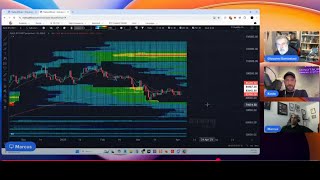
Recording of a live YouTube session (June 12, 2025) where Giovanni, Kosta Ouzas, and Marcus discuss Bitcoin market structure, power-law analysis, and algorithmic trading (Minotaur). Giovanni explains multiple ways to plot the power law, highlights a quantile-regression view (power-law core between lower quantiles and median), and classifies current state as 'turbulent flow' (approx. 0.66 quantile). Marcus emphasizes liquidity and volume-profile analysis of perpetual futures (derivatives drive bubbles; spot follows via arbitrage), identifies key volume nodes and a nearby point-of-control near ~96.5k as likely retest, and argues the market is still in the process of liquidating built-up positions. Kosta and Marcus explain Minotaur/algorithmic strategies: they trade with market-maker flows, exploit liquidation events, and are intended to be cycle-agnostic (generate returns in up/down/sideways markets). Giovanni and team discuss using put options as insurance (discretionary, time-limited) vs. algorithmic trading (continuous, no expiry), position-sizing, and risk (avoid high fixed leverage). They reiterate a full-model view that includes cycle decay and a power-law backbone; Giovanni states a projection (on current model) of ~200k peak by year-end is still possible but contingent on path and volatility.
Questions this video answers
June 12, 2025.
Approximately 0.66.
Around 96.5k (point of control).
Chapters
Hi, everybody. So this is Thursdays, June 12th, and this is a bitcoin live with the Power Law and the Minotaur team. We just came back from the conference. I mean, it was a little bit some time ago. We already had a. A show where we describe it. But, you know, it was quite nice to meet a lot of you at the conference. Anyway. Yeah, let's. Let's start with our usual analysis. So I will share my chart.
The market's having a bit of a dump right now, which is good.
Yeah, so is that in fact, actually, do you want to comment on that? On how we usually think about this kind of stuff during, during a retracement like this?
Yeah, I can bring up some charts while you're getting yours ready. Let's have a look. I just did a post on this, so if you want to.
Yeah, yeah, we can go back to my chart. Just a second. Let me switch it. They change all the time. We set up of a restream. This confusing to me. All right, I'm going to switch off mine and switch on yours.
Great.
Custom.
Yeah, cool. This is pretty cool, this conversation, because it kind of works in fractals as well. So we're looking at what's going on right now in the moment. Marcus is going to tell us what's. What's going to happen in the next sort of few weeks, and Giovanni can tell us what's happening in the broadest perspective. But right now, I don't know, Blinken, you missed it. This was, this was almost a few minutes ago. So the rally that happened a few days ago, we managed to take profit on a bunch of positions. And this is just a really good example of how algorithmic strategies work and how precise they are. I was sitting in my office getting ready, having a coffee, and look at this, look at this dump here. Just look at the size of that and you stretch it right out. And look how that was brought there. So that's all executed completely hands free. These kind of dumps, they're built into the engineering that we do and they pick them up beautifully. So I guess it's just a really nice live example of how algorithms are really going to be superior to any kind of discretionary trade, really. If you have a look at even just the timing of these trades or perhaps together, you know, 11:30 in the morning, 4:30 in the morning, and then midnight. You know, these are trades that are impossible to make discretionary. And, you know, in the next few hours, markets can give a bit insight, but I think we're going to bounce at some point. We might already be up up at this level before you even know it. If we go down we're going to just DCA further using our strategy. So it's just a really good example there. I've also got it on the longer time frame. So this is the more high frequency version that we're using at the moment for these calls. But even on the, on the, on the larger take profit. You can see here we're into the exact same there as well.
Yeah, it was cool because I, I you know I was, I was watching this correction today. I thought okay maybe the market is going down even more. And it you know in the past of course, right. This is what bitcoin does all the time. So there is nothing to worry. But it, you know, you want to see the price going up in particular during the bull market. But now actually almost like it more than it corrects because I know then when it goes up it's a few thousand dollars. I used to buy bitcoin again you know, because that is my goal. I, I don't, I'm not interested in the cash with the IGO produces but I'm interested in converting the cash into further bitcoin. You know, makes me feel good that I'm just by owning bitcoin I get more bitcoin. But you know, it's not what you do if you just auto, you know and I was getting ready for the show, I was doing other things and I he, I keep my headphones and trading view as a bell when there is a trade and I hear the little bell price went down and these are really cool because when I'm working etc I know when the algo is doing something, you know, if I of course if I sleep that is one of the advantages, right? Because it doesn't matter. You can sleep, you can take a walk, you can be in the gym, whatever. The algo is doing what he needs to do. You know when people say buy the deep, you know, if you do it manually it's almost impossible to time it correctly. You know, by the time. There are many times where you would like to buy the deep and by the time you're trying to do that the price already corrected, you know, you, you missed it.
People forget about position sizing when they say I'm going to buy the dip. Yeah, but how much are you going to buy? You know, needs to be worked out mathematically. That's the other. It's not about finding the dip. Well, there's a lot of other factors that come into play when you're going to sell it. Are you going to hold it for.
Yeah. And, and this does it because you know, it has a logic. You know, it, it works down this buying down, you know, these are DCA and, and also it doesn't put in on a bad, bad position. It has a small leverage. So it's, it's, you know, where you can actually take advantage. And, and you really, you know, you can always buy bitcoin on a regular basis without paying attention to where we are. But here we are doing something slightly different, right? We are actually using the volatility of Bitcoin to convert it in, you know, USDT that then you can use to buy bitcoin.
Correct.
It's really amazing. I'm so pleased about this system. Anyway, yeah, let me share my chart. So I have many different ways of plotting the power law and we, we. I have insisted many times that is actually fundamental to be able to show different charts, different ways because there is no one single chart that has all the information. You know, the power law itself is relatively simple when you understand it, but there are a lot of nuances. You know, there are things that particularly if you want to understand the cycles, you know, the deviations from the cycle, there are many different way of representing these every. And you know, and the people that follow me, they know that with some level of debate online with other people that are trying to reproduce a power law. I don't want to dwell in these debates, but the bottom line is that there is not one single method. You know, there are different way of representing the power law. So this is one way that is the quantile model. It's not really a model per se. I'm just saying these things most from educational point of view. There are many different way of doing a regression because basically the idea is this, right? Just to again to explain this number needs to be updated. I need to do it automatically. It updates here, but it doesn't update. By the way, if you're interested in this indicator, a little bit of, you know, hey, I had here you have a, an address where you can find the indicators. But so the idea, right, that is fundamental for understanding the power law is that we have this scaling, right? We have a scaling of a Y axis and the X axis and it's revealed by taking the logs. So if you are using as your input the log of time and the log of price, like in this case, and then you want to find some kind of a pattern that is consistent with this input. And there are many different ways of doing it, different methods. There is a Bayesian regression, there is a quantile regression. The quantile regression, I already discussed it, I have videos about this. But basically it's dividing the data in terms of quantize, right? So you're taking your. Organizing the deviations from a particular trend that you identify, and then you look at the data in terms of this quantile. So the lowest quantile, once you order, you order from lowest values to the highest value of taking, let's say, only 5% of entire data set, starting from the bottom, right? So when we are talking about like here in this table, the 0.05 quantile, that is only 5%. And it's pretty good because that quantile, the lowest quantile give us, it's a relatively few data, but it gives us the support line, the support line that you see here, this darker line. So it corresponds roughly to the support line. And also it's interesting because all the data, all the quantile below 0.5 can be this, you know, are very consistent. So if you calculate, for example, they give you basically power law. The solution is not obvious from this chart because it's not a log log chart. If it was a log log chart, you what you will see that this line, this darker line, and this blue line. The blue line is actually the 0.5 quantile. And this kind of goes in the middle, right? Better. It's not. It's different from the more classical type of regression that is called least square regression. That one gives you an average mathematically. The quantile gives you a median. It has slightly different way of thinking about data, right? How to represent the app, you know, the average data. But the interesting thing that all the quantile in between this bottom and the middle one, up about 0.5, they are all consistent in terms of slope. They're all straight line with very, very similar slope. In fact, me and Steven, that is the other astrophysicist that does a show with me on Wednesday, we call this re. We call this region the power law core, because this is where the real power law behavior is super evident. You could eliminate everything else that is above 0.5, and then it will be super clear how consistent and how narrow even the range of data is, because, you know, it's really in these green areas, right? That is the core power law behavior. And then it's almost like Bitcoin is bimodal when it goes above it. There are other ways of doing it, but don't imply, okay, above or below 0.5 quantile. But it's kind of close to that. You can use, you know, hidden Markov chains and other methods to identify the modes. But there are clear two modes. Now you could even say there is a third mode that is a transition mode between the two modes. But we call it turbulent flow because it's a. There are a lot of fast changes, big deviations. The distribution of the returns is not symmetric like it is in the green area. It tends to be towards larger values. That is good, right? Because it means that we can achieve large deviation. So it's basically bubble territory. And this is where we are right now. Right. So if you are a 0.66 means that we are in the turbulent flow region. Now usually the, the tops corresponds very, very large deviations like, you know, like Top quantiles, like 0.9, for example, is where. And you see also the color coding here, right. So the more red regions in this band and you see all the tops correspond to that even in the past. Now, most extreme values, we go all the way to 0.95 or 0.99 and so on. But for robust statistics, you want to count more on things like 0.9. This really stream. Stream values. Yeah. So this, this is what this chart shows that we are kind of where we are supposed to be. We have these turbulent regions. I added to the chart another model. It is this model where I try, I call it the full model. I try to replicate because. So part of the debate that I had with other analysts, like for example, Plan C, he likes this quantile model mostly because he thinks it can give us an idea of how big the deviations are without counting on a specific temporal discussion. Right. Like, oh, when the peak is going to be. Right. This precise oscillations that we see in Bitcoin. He, he calls it cycle agnostic. I don't think you can do that. It's an illusion because all the information, the way we derive these deviations is based on data that has been very, very cyclic. We have been very, very precise cycles. So if you use this information as a way of projecting in the future, you cannot avoid that you have done it on things that are cyclic. You know, so I, it's still interesting, it's still a way of representing the deviation, but you know, it would be very confused. Just to give you an example, imagine it's almost like this is my. And sorry if I take this few minutes to describe this, but because this model, a lot of people look at it, I want to explain It a little bit better, but you know, like imagine for example, I am here at the pot, right? And are at this very lowest quantiles. Well, this model gives you the illusion that anything is possible. Anything within this range is possible. You know that. Of course, maybe because we go, you know, as you go to higher and higher quantile is less likely, right? Because you only have 10% of entire data set that is in these regions. But what is really the probability? Imagine you are here and ask you this question. In fact, I can ask you guys this question. What do you think is the probability if I am here, that tomorrow we go over there in the right region? How big is that probability?
Very small.
Not even very small. I. I think it's tomorrow.
It's impossible.
Yeah, tomorrow, right? Literally tomorrow.
There's a simple answer. There's actually a simple answer to this. They need to look at how options are priced because you couldn't even give away an option in that quantile for tomorrow.
Yeah, exactly. It's a. It's almost useless information because. Yeah, why do I care if I am at the lowest Quantile? What with 0.9 quantalis, it's completely meaningless to me. It's useless information at that particular time, you know, I don't care. Yeah, I mean, okay, sure, I can calculate it. Maybe it gives me a, an idea of a range. But this is what in fact, you know, we got criticism from people mostly because they don't understand how this works when they say, oh, you know, the power law basically tell us the price can be like when we were here, right? This was 16 000. It can go from 16,000 to 70 000. No, it doesn't. Because the power law is very aware of the cycles and where we are in the cycle, you know, so it doesn't. This model, this what this model does, right? If you take it literally, if you take it at face value, it gives you a possible range of values and it gives you a probability. But the probability doesn't. It's not really a realistic probability, right? If I am at the bottom the possibility I go to the 0.9 quantile, it's absolutely zero. You know, it doesn't happen. It's a very important to understand, right? Because actually even now we structure our holo, we know that it doesn't jump. It's not. In other words, that will be true if it was a completely stochastic process where the coin was a bunch of dots, right? Imagine it was a. And some data is like that, right? If you add A bunch of dots, like a little cluster of dots that can be at any moment, at any time, at any place, right? With a certain dispersion. Bitcoin is nolivet. There is a, it's a, there is a history, right, of how the price evolves. And it doesn't jump all of a sudden like that. That's very important, right? Maybe, maybe it seems a trivial discussion, but there's a very important discussion. In fact, even now that we are at 0.66, it's quite unlikely we jump to 0.9, right? It will take time to go there, but it's a little bit more relevant because we are closer to. So it's, you know, this is why I add other models, like this full model, where I actually tried to say, listen, you know, there is a pattern in how the price evolves. We have a peak. These peaks have been very regular. We have, as we seem to happen every four years, they happen in quarter four of this sequence. I'm trying also to catch the bottom. It, it's one single equation, so it doesn't do a perfect job. I, I can adjust it to actually catch the real bottle. But it's mostly in terms of shape, right, that we have a, A cycle. So there is a top, there is a bottom, and there is a top again and that. And here, you know, trying to reproduce what is going to happen, it's already including a decay of a peak. Because it seems, you know, if you take at face value how these peaks decay over time, because. And that is the other thing I want to explain very quickly. Many people think that the power law says something specific about the cycle. It doesn't say anything specific. The power law says there are no cycles because they average out, right? The fact that we have a power law, in fact, even here. Look at this, right? We go up, we go down. The total result is this blue line. It's like they basically cancel. The bubble cancels. But you can use the power law to calculate the residuals, what are called the residuals. So you measure the difference and then you study how these residuals looks like. And when you look at the residual, it's clear that they decay, but decay actually not randomly, but with a precise equation, it's a few points because we have only three cycles. So you could be dismissive at this about this pattern, but there is a pattern, right? And it's the only thing we have. So if you want to kind of estimate where that next peak is on the basis of this decay is what you get. You get about 200k and it should happen at the end of the year. Now are we on the path for that? Yes. Right. It's still now, even with this correction right now, of course, if we continue to go down, stay there for a long time, stay there for several weeks, reaching this peak, it becomes more and more difficult. Right. But have discussed this in many episodes of our, you know, our analysis. People have dismissed the, the fact that we have a cycle many times already, but I think it's too early to say that, you know, I, I don't think so. So I'm not, I'm not worried. I think we, we can still reach 200k by the end of the year. It will be interesting. But at this point, to be honest, if we continue to move along the power law, we have a bunch of volatility, the algorithm can continue to multiply or bitcoin, I don't even care. You know, I'm not before I think I was attached to the cycles mostly because it gives us such incredible opportunity for volatility. Right. But you have to worry about getting the peak correctly because if you want to, let's say, sell some of your bitcoin and revive them back, etc, and then you have to worry about catching the bottom. I don't have to worry anymore with, with this automated system.
It's funny actually because everyone talks about not selling any of their bitcoin.
And.
And then, so none of these cycles really matter then, do they? It's like if you're not going to sell your bitcoin.
Yeah. Why, why you're even interested in this cycle?
If it goes up or down, it's gonna, we all know that if there's a, if there's a boom, there's going to be a bus.
Right.
This is like the law of gravity. So if the price goes to 300, 400, 500,000, we all know it's going to correct. 50, 60, 70%. And the higher it goes, the more it's going to correct.
So you know what, I have a theory about that. I think some people, they start to see this exponential behavior like we had in the past. I think that is going on forever. Right. So basically, even when they didn't know about the power law, they thought, well, okay, we grow like this. Now there is this crazy behavior. We are going to continue to do this forever. Now that they know that the power law is there, they think, oh, if we have this craziest financial behavior, maybe is breaking the power law. Yeah. Every time we have this crazy exponential behavior, we do break the power law. But notice what happened. The power law gets restored every single time. Right. And so, you know, I think it is what happened. They think that we will continue to go exponential forever. But that is not how things work in the coin, you know.
So.
I think.
I think it still looks on track. And I think there's. Someone just made a. Someone just post a question. He said the power laws crashed 200k is impossible. Maybe if you want to go to that one Giovanni and cover it.
Yeah, let me see.
Two questions at the end. But we're talking.
Yeah, the question I see. Power law crashed Psychopic two Let's be honest. No need now how is crash if we are actually above the power law? How we are crashing? In fact, actually there are tests that you can do like the correlation coefficient. I have a one of my indicator recalculates the correlation coefficient on a continuous basis. That number is going up. It was 0.95 some time ago. Now it's 0.967 or something. It's actually going up again. I think people confuse this full model. Full model is an attempt to. To say okay, the power law. Basically the power law says there are no cycles. So I don't understand when the people think oh, because we don't have cycle. The power law is not there. It's the other way around if there are no cycles. Actually the power law is even more evident, right? The way. The way you will see that the power law is not followed is two ways. One, we go exponential and we never come back. And two, we break the support line and neither of these things are happening. If anything, we are actually offering around the blue line, right? We have notice how we actually are oscillating around the blue line since last year in a very consistent way. Fatwat is kind of almost a problem that we don't have a proper run if we don't break from the power law. Instead we are too close to the power load. So it's actually the opposite. Now if you are talking about the full model. Well, I explained many times there is a hierarchies of prediction here, right? There is a power law that is the backbone and that if anything is becoming stronger and stronger. And then there is the idea of a cycle that has been true up to now. And I think the equal it will continue to be there. Maybe muted cycles not as big as before, but they are going to be there. But you know, if you give to the power law hierarchy of prediction 9 this idea of a cycle is maybe like 6 and then there is the idea that the cycles decay over time, that we are observing that through. But, you know, maybe that is five, you know, or you can interchange. You can say the periodicity is third place, and the fact that it's a decay of the peaks, second place. So these are more, you know, details on top of a main theory that says we are following the power law. We're trying to understand the cycles using the power law. But that is not a component of the power law. It's not part of the power law. It's a. In my. If you read my theory, my article. I don't know many people read it, but entire theories describe it. The understanding of cycle is a corollary. So it's a side discussion. Okay. So I can leave a ground to Marcus so he can actually go and tell us more about.
All right, let me show myself. Okay.
Hello, Moto. I'm getting a lot of spam.
Somebody's got a gong and a phone. All right, all right, let's get down to business. All right, once again, we are looking at a standard daily time frame chart. And we're using the. We are using the futures perpetual derivatives market because bitcoin runs on not only cycles, but they're intermittent bubbles that are formed by high leverage positions. So derivatives are an excellent source for price discovery. Wherever you have high leverage positions, those bubbles will pop, and the price will be. It creates volatility and price discovery, and then the spot market, through arbitrage, catches up as a secondary motion. So, once again, the reason I like to start with this very standard chart that anybody can see, and it goes all the way back to 2024, February 24th. So we have two. Two. Two bull movements here. But the thing that I want to highlight is you can't really make sense of this. This can be. No matter what you're looking at, if you have a bullish bias, that can look bullish, and if you have a bearish bias that can look bearish, and everybody's trying to know, what is it going to do next? The problem is, even if you're looking at this, you should not be paying attention to that noise. That is noise. And that builds positions on both sides until those positions are harvested. So you really shouldn't be looking at that. What you should use as your foundation, stay out of this noise. This is like a static. You know, if this was a. A channel that wasn't on frequency, there's static there. There's a noise there. That's like looking at the weather every day, trying to determine what season are we in, it's almost impossible. So what we need to fall back on is the principles. Right. What are the principles? The power law. What's another principle? Actual liquidity locked in traders that have active positions. That is for. That is real. And then you can fall on volume. So we're going to do a little exercise really quick and try to build a thesis of where the market is going based on hard evidence. Right. So we'll use the volume first. I'll just come in here and pull a little quick volume profile here. Gonna use a fixed range just to get us give ourselves a basis here. Right. So we have a little range here. Just gonna drag up a, a support line really quick. We're gonna do this quickly. We'll clone this. We'll put up so we have a range, a trading range here based on that. And then we broke out. Right. So then we'll do it one more time. We'll make a volume profile here and then we'll extend it all the way through here. And then we'll do the same thing, clone this and then we'll, we'll establish our range. Right. So we're just using past volume to set the range. Right. We're not drawing trend lines or tea leaves or anything like that. We're using hard evidence. This is what actually closed. All right. So we can see now it's starting to make a little bit of sense on where the market's going and how it's shaping up. Right. But we're missing one other ingredient. We need to see the liquidity to see the impacts of why it broke out of these ranges in which direction it went in. So now we're going to put it into liquidity. And just like magic, we have the, the X ray on what's actually happening beneath the scenes. So now when we add the liquidity, we can see that when we got in this range in the last bull run that occurred in March, that consolidation of last year, this consolidation was building this liquidity up, right? Longs and shorts, this is the long side, short side. And all of these traders positions that have built up over time are getting caught up in the turbulence of all this action here. All this action was going up. They're pace, they're placing their bets. You've got shorts that are saying it's going to go down. You've got loans that are saying it's going to go up. And this can, this process continues until the liquidity gets severe sufficient and then boom, it's taken out, right? So my point is don't get caught up looking at the action in the middle. It's a range. The real what's really going on beneath that action is the liquidity. Don't become this liquidity. Don't do that. All right, so now let's look at the more current one here that we had, the one that we're in now. So we're building a basis of historical explanation here. So when we got into this new range that we're in now, we've been in it for a few months now, same process, liquidity is building. So what do they. What gets taken out first? They took out the longs first. All the way to early April, took out all the longs. Then we reversed right here. That was a pivot point. You can actually see the pivot between the volume profile, value area low and this trend line that was formed. That's when it reversed and they started taking out the shorts. And we're still in that process. That's my point. Everybody should calm down. We're still in the process of taking out this massive amount of liquidity. As long as we don't get caught up in all this action by looking using our eyes. We don't want to use our eyes. We want to use math. We want to use sound mathematics of what's actually happening. So what's going on currently is we are consolidating after a massive move up. We're in a consolidation pattern now, which is normal. This is still in play. This hasn't gone anywhere. So everybody's, you know, you got people saying the bull market is over and all this, and that we have a point of control here based on heavy volume. So I would not be surprised if the market comes here, test this and then starts again. Or we may even drop as low as the value area low, which I doubt that, but it is possible. We've already lost the value area high. So we are now in this volume profile. We've been accepted back into this range now. So when you get accepted back in the range, we might get a retest of this. Was support, nice resistance, but this is definitely in play. The point.
Just to jump in there. So it looks like to me that there's not that much liquidity driving this dip down. What's actually just happened is it looks like there's been a attack by Israel, Tehran.
Not exactly. Not exactly, because remember, we're looking at all the liquidity. I'm getting ready to start backing it out. The next thing I was going to say is what is the fuel to bring it down here. Right. So we're looking at three, basically three through a 3x lens. So now I'm going to start to go back to my high leverage positions of 25. And now you can get more clarity on what is actually happening locally. Right. So that's what we're doing. We're getting local now. So now we can see that the market is very. The market does the same thing. It just does it differently. It gives you a lot of head fakes, it gives you a lot of action that pulls your eye in and it fakes you out. That's why you shouldn't look at it. You should just use sound principles. So what happened here? We were already in the process of taking out this pool. What does the market do? It doesn't complete it. It reverses hard in the other direction. And what does that do that sucks in all this new, new intermittent internal liquidity that chase, that move. But really we had unfinished business that we never mitigated. It was never finished. This little move up just pulled in all types of traders looking at that and this still never was mitigated or liquidated. It was still always in play. And now we're more than likely the probabilities are that we will finish what we started. And then that puts you right here to use the point of control of support to get your bounce. Now there's other pools, there's other pools down here, but these are much, much deeper and it's going to take a while to get there if we do get there. So.
So what was missing on the top, it was at that 110k price was a bridge between the liquidity that was much higher. Right. And that's where it sort of tapped out. And now it's gone back down to Chase. What was left.
What happened here is when we were coming up to begin with, we didn't have any liquidity up here. Price stopped, right? The price needs fuel. Remember, 25x is more juicy than 10 and 5 and 3. This is more lucrative. So the 25, we didn't have 25 here at this particular time. So what does the market do? It checks up and starts creating that bridge. So it's building that next layer of 25. However, it's important to understand that this is level liquidity. This stuff in here is internal liquidity. Level is usually last to go. So reason, Reason, I'm just distinguishing the two is because level liquidity, like you had level liquidity here, it lasts a long time before it's mitigated level, liquidity, level, level, level does not get liquidated and mitigated quickly. Internal liquidity. This stuff in here, that's internal, this is noise. All that gets taken out. But that level, those levels last. So here's a level. These are levels. So based on level liquidity lap based on level liquidity lasting a long time. These, these may survive the correction because you know, they, this might get taken out in the bear market. But this one is in play because it's already in play. This one needs to be finished. And if you can tell the market based on level, liquidity lap based on level liquidity lasting a long time, these, these may survive the correction because you know, market is very, very picky about being balanced and finishing what it starts. So it started taking this one out. It gave us a big head fake to suck everybody in. But now it's coming back to finish it and then we have this major support level here. So we just might be done when we get to this point of control, which is that. Yeah, 96, 5. Yep. Because we are in a bull market. Right. So the point of control would be. I had almost a 50 from the, of the move. Oh, just a little bit less than 50 of the movement. So that might be all we need to do to get back on track. Yeah, yeah.
And it's interesting. There's a bit of news. That's what I was saying. There's a bit of news that's kind of created the, a little bit of the stress today. It's gonna, it's gonna be interesting how that might just be the, the, you know, what everyone's distracted by. And the liquidity is what really tells the story. The story was there before the news.
Right.
That's what's so interesting that.
Right. The news always seems to sync up with what's actually happening with the liquidity. You know, the news, the news just, it's kind of like that's what I was warning everybody with to begin with. Don't get caught up in this, this. You can't make the best traders in the world. Can't make sense of that. If you've got a bullish bias, you're looking at bullish news. It looks bullish. If you got a bearish bias, you look at bearish news, it gets bearish. The only thing that you can depend on is the power law, which is math, and the actual liquidity, that's what's going to determine what's going to happen.
So the question, the question is, do we have a bigger chance? Right. Now when we get out of this range to get to 115 or higher or to 90k, looking at this the way we're looking at it, that 90k is the next point.
Yeah. The probabilities are we finished what we started and we come down here to this volume profile because the reason that even though we don't have specific liquidity to take us directly there, there is a gap here. But the market can check, the market can check up and build the liquidity that it needs. This is so close and this is such a high volume node right here. It's like a magnet. So the price, it might not stay there very long, but you might get a little quick wick, you know, it, it, but it's, it's, it's pretty much going to, there's a high probability it's going to tap that level. Just tap it. Maybe it stays there, maybe it doesn't and reverses off of there. But let's, let's, let's, let's look at the big picture again. Once again, we don't want to get too, too fractal or too caught up in the price action, current price action. The point is, no matter what's going on here, which we don't know exactly how it's going to move, we do know that the probabilities are extremely high, that that gets mitigated in the near term. So until that changes, that's still on the table. It can do all types of things that make you think it's not going to do that, but that, you know, that's what happens, that's how this works. And then we can assess what happens once we get up here. Then we can make a determination on where we go next. But this is high probability stuff and you can see a tremendous amount of liquidity here. The market, there's almost, I don't like to say certainty, but there's a high probability. The market is not going to go into a bear market and let all these positions make a, just a mint, a fortune in profit. It's not going to work like that. It's not going to, it's not going to happen. These people are going to get.
Yeah, that's what people forget that this is a business. The price, the price is being controlled by the market makers. And if they let those things sit, you're letting basically 25x leverage positions make millions of dollars. It's just, it doesn't happen. Yeah. Yeah. Giovanni, what do you think?
I think he's on you. Right.
If you're Talking.
But yeah, I think, I think I muted myself.
Yeah.
But I was saying.
Yeah.
So for people who say is it still possible that reach 200k by the end of the year? I mean people forget how explosive bitcoin came super fast.
Yes.
In fact that is more typical than anything else. You have a. It actually doesn't look like from a graph like this. But if I plot, if I zoom in with the power law in this time when it looks flat, it actually follows the power law. It looks flat because the power law looks like a pattern that goes up over relatively long period of time. But you know, to. To follow in average of a power law, bitcoin needs to do a lot of this is what I say. Bitcoin needs to do a lot of power law things. You know, most of the time actually is moving along with power law. Just different layers and then it explodes and it goes to the next level.
So I.
Right now it doesn't look anything impossible.
Right. Just my little crayons here. You know, once we take this level here out, we're going to establish a new price level. Right. A new, new zone, you know. Yeah. It's gonna build up liquidity. You're still on track for first year. November, December, you know. Yeah. Get there and.
And once again it's done the unexpected, right everybody?
Yeah. I mean what do you think these people thought right here? Look at this violent move. Let me get this out of the way. Back this off. I mean what if you were on the wrong side of that? Look how, look how violent that is. That's tremendous. Straight up. So it can move very, very fast after. What did it do? Lull everybody to sleep, made everybody think it wasn't going to happen and boom. It just took everything out.
I remember watching that and people forget. I remember watching that end of last year and it was. It was just like going every day. It was up 1000, 2000 non stop for two weeks.
So. And somebody's commenting, I'm throwing the towel. I will just use 20 pair leverage.
Don't you know.
So instead of using 20 pair use something like our system and that. You know, I know it seems we are pushing this thing but you know, if you had a cl. We actually made a bunch of posts right. On that guy. What is his name? Don't remember. He was using 40 pair leverage. Right. And he lost everything. So that. That is stupid because the difference between using a little bit of a leverage because. Yeah, because it doesn't have a volatility that 10 years ago. So using a Little bit of leverage is clever, but I mean, do you want to be such a way. Where do you want to tap your position, right?
Do you want to be this close to the price of 25x leverage?
Yeah.
You want to be that close? Or I can just come down and take you out or come up and take you out quick. That's how close you're going to be with 20, you're going to use a 25x leverage. You. Right, you're in these two pools. These, these are all the people that are doing that. You want to join those folks. I don't want to be there.
Yeah.
And here's, here's what's so deviant about it, right? This is what's so impressive about it, right? It got all of them. It got all of them. You had these people saying, oh, it's going up, let me jump in here and go long on 25x. Then you had all these people say, oh, it's going down, let me jump in here and go short. And what does it do? It terminates both sides. Got all of them, all of them wiped out. So don't use trading. It's too close.
It's more important. Consistency, right? So if you have a system that consistently makes money and you can use it to buy more bitcoin and it does it when the market goes up. When the market goes down. That is the real approach. And, and trying to do these things manually, you can do it for some time. Like this guy, right? He even built a hundred million dollar position, all right? But it was like winning the lottery, right? I don't think there is a real, real skill there. Kind of almost anybody can do it. If you are on the right side of a trade and then, you know, by selection, you think, oh, this person is the best trader in the world. It will not be. If he was the best trader of the world, he will still have that money. He lost it.
All right?
So it's not.
And I can hear. And I can hear the people saying that, hey, I'll get in here and then I'll sell it here. Or the people saying, I'll short it here and I'll sell it here, right? The problem that they're not understanding is the people that are in these two sides are making bets in here where it's the most choppy. They're taking positions here. Their liquidation levels are on the edges, right? So what happens is when the market makes just a tiny move against them, they're in drawdown. And everybody in this call should understand that. When you're in drawdown, you can't close the position. You're going to stay there. And the more you get in drawdown, the more you don't want to close it, the more you're praying and hoping and staying married to the position. You can close it, but you're going to give the market some money or a lot of money, but you're going to walk away with less money in your account. So it's not like, oh, I'll just buy it here and I'll sell it up there. The minute the mark you buy in and the market moves just a little bit against you, you're already in drawdown. So there's a 90 chance you're not going anywhere. And the more it moves away against you, the deeper and drawdown you get. And you go through this psychological process of just like a moth to the flame, you're going to get liquidated or lose a lot of money. Either way, it doesn't matter. It's going to get you. So just want to make that clear to those thinking, well, I can do it better, I can beat this. Can't beat it. That's why it works. It's what, 97 lose? Yep. Can't beat it. Got to do the same game.
And we saw the algorithm at the start of the call that it's playing the same game.
Yeah. Check this out. You want to see something cool since somebody else has something else they want to share?
No, no, go ahead.
Let me show you. Just based on what Casa was showing, I'm going to pull up the algorithm again myself. Here, let me, let me load it up here. I'm loading it up. Let's go. 0150. All right, so can you see, is that sharing? Yes, it is. Good. So let me put the algo in here really quick. I'm just gonna pull up a different version. I already have it loaded here. All right, so basically the algorithm, just like Costa was saying, it terminated all of this. This, this move down here caught it perfectly.
Right.
Everybody can see that there's a, the reason it did that. There was a liquidity pool here that got terminated. But look how the algorithm trades in concert with the pool. So we're doing the same thing that the market makers algorithms are doing, right? It's waiting until the liquidation event happens and it gets in. Right. So just, just keep that in mind. And we're going to. Now I'm going to drill down to the similar time frame here so you can see it. We're just going to look at the 15 minute. And you're going to see the same type of action. Right. You can see the liquidity right here. It's just a 15 minute. But if the market's fractal, it does the same thing on all time frames. So what does the algorithm do? Just like the market makers, when they take the liquidity, what does the algorithm do? Same thing. It trades with them, not against them. That's the difference. They have algorithms, we have an algorithm. So the algorithm waits until liquidity takes a position.
They're going with the flow, going on.
With it in concert with them. Here they are right here. The algorithm's taking, taking all this liquidity out and we're taking positions with the algorithm with the market makers, not against them. So I just wanted to highlight that.
And that, and that again is almost impossible to do by.
Oh, you do yourself. You, you can't, you, you can't stay awake enough hours in the day and you don't have the psychological fortitude to do that. What people make, the mistake people make is, oh, that's easy. I'll just get in here and sell it over here. It doesn't work that way.
When you. I tried, I tried. It was a period of time where I will wake up every. Because here in California it's actually six in the morning when the market's open, you know, I will wake up six and I am a night person. I spent like three or four months doing that life. You know, every single day I will wake up early and be ready, etc and you know, I did some money, but if, if I went and work at McDonald would have been probably better.
You know, I mean these, these algorithms are 90, they're 95 of all the trading volume. You can't beat them. There's tens of thousands of them. They're trading at all different time frames. We're looking at the 15. They're on the 1 minute, the 5 minute, the 1 hour, the 30 minute, the 5 second, the 1 second, the nanosecond. They're on all the time frames. You're not going to beat this game unless you play like them. That's the only way to, to beat it, you know, so that's all I got for this.
Somebody's saying trade fi, just destroy bitcoin and made it just another volatility out of it. I don't think so. I think actually bitcoin, what is happening is that if anything we don't have maybe these huge big bubbles. But that was kind of a predictable. Right. Remember, there is a Decay. And you could even predict because even if we. Let's say we went to 200k, right? Maybe we don't go to a 200k, but let's say we went to 200k. It's still nothing in comparison with the 1012 pair that we added the first cycles. And that was happening before the institution comes in. And they were institution all the time. They were big fans with bought, you know, Pantera capital for example, but a bunch of bitcoin early on. So this is. Has been always something that is there. What is happening is that now you have in my opinion and let's see what everybody else thinks. You have a best of both world. You have a. The other Bitcoin is following the power law in a very consistent way. Just another volatility out of it. I don't think so. I think actually bitcoin what is happening is that if anything we don't have maybe these huge big bubbles. But that was kind of predictable, right? Remember, there is a decay and you could even predict, you know where it's going. You're seeing that it's like when you drive, right? And you can see the path ahead, you know where you're going. There is a lot, a lot of volatility that it requires more intelligence, right? It requires more tools like our algorithm. But the liquidity volatility is rare if you know how to use it. These corrections, you know, 5, 6, 7, 10%. If you use them consistently, you can. Right now, for example, I calculated without. Without trading system. Bitcoin is about 45%, right? Returns. Well, we do more with double because we get both respons. Because even if we. Let's say we went to 200k, right? Maybe we don't go to advantage to Bitcoin and actually some returns that are actually bigger than what bitcoin does itself. I I say that I was going to calculate, okay, but let's say we went to 200k. It's still nothing in comparison with the typical returns that we get. What that is equivalent 1012 pair that we added the first cycles. And that was happening in terms of bitcoin history, right? Is it what bitcoin was doing two years ago, three years ago? I need to calculate before the institution comes in. And they were institution all the time. They were big funds, basically. It's almost like you're going back in time and if you add some tools to what because. And this is also what many other players are realizing, right? Microstrategy is providing a service to the market. You know, to the stock market to expose basically the regular market, the thread fi markets to bitcoin volatility. There are msty they are using options. You know, there are a lot of people materialize, okay, now the bitcoin is stable in the sense that it's not going to zero. How can we use its volatility that, you know, Pantera Capital, for example, bought a bunch of bitcoin early on. So this is, has been always something that is there. What is happening is that now you have, in my opinion, and let's see what everybody else thinks, you have a best, a lot of, you know, turbulence and energy to actually create some leverage, right. To create some kind of income out of bitcoin volatility.
So there's some other good, there's some other good questions we need to get to.
Yeah.
And just to add to that, you have a. The idea that Bitcoin is following the power law in a very consistent way.
It's like it's a pretty, you know, it's a pretty basic concept. If you have something and then you use a powerful tool, you're going to become more efficient, you're going to do things better, faster, more powerfully, right? If you're just holding a spot position, that's fine, but you're not actually using any tool. We're giving you the equivalent of an electric drill or a supercharged engine. Of course you're going to get better performance, right? You're applying technology to what you're doing. Just like anything in the world, if you use a computer, you go faster. If you use a, you know, engine, it makes you go quicker, right? Why wouldn't using a trading system get you better returns?
We got a question here. Actually, you know where it's going? You're seeing that it's like when you drive, right? And you can see the path ahead, you know where you're going. And there is a lot, a lot of volatility that it requires more intelligence, right.
It requires, see, I'll jump into this.
One and then maybe I'll take a.
Shot at that one too.
So, yeah, there's some good ones here. So firstly, like talking about tools, these are two different things, right? So sometimes you need a hammer, sometimes you need a drill, right? So pick what you need when you need it. Secondly, put options are fantastic, but they are still discretionary trades and they do have time expiries. So you can buy put options, they can expire without you going into the money and they expire worthless.
So more tools like our algorithm but the liquidity.
So firstly, right doesn't mean don't do put options because if you nail them, you will make a lot of money. They're basically like a high leveraged position that has a cap downside. So put options are fantastic but it's a discretionary trade and it can expire worthless. The thing about Minotaur is yes, we have a cycle. We believe there's going to be a cycle that's going to continue. It doesn't matter. Minotaur is going to make money. The system will make money. Whether we have a cycle or not. The market goes up, down, sideways, it's going to keep making money. So what you're getting is you're getting something that has no time expiry. You're having something that has no directional bias either that can make money when it goes up and it can make money that goes down.
And it volatility is real if you know how to use it. This corrections, you know, 5, 6, 7, 10%. If you use them consistently you can. Right now for example a calculator makes money 24 7.
So again two different things. A put option is a fantastic thing to do at the top of the cycle. I'll probably buy some put options. But you have to understand it's still.
A discretionary trade without, with our trading system, bitcoin is about 45. Right.
And you can lose everything you put into it if it doesn't expire in the money. So again different tools for, for different activities, you know.
But I would returns well we do more than double because we get both.
Respons put a lot more money on the Minotaur trading system than I would buying put options.
Yeah. And, and one doesn't exclude the other. Right. So put option is a very, I almost think it as an insurance policy. So when, when we are closed and one of the reasons why we do this every week is because remember my market is dynamic. Right. We are offering a service. We're analyzing the market as we come close to that date. Let's say we do see some explosive move to 130, 140. Then we actually come close to 200. And we see, we use the quantile, all the other indicators, we have like 15 different indicators and everything converges. You will never introduce to Bitcoin and actually some returns that are actually bigger than what Bitcoin does itself. I, I say that I was going to calculate the typical returns that we get. What that is equivalent use only one indicator. We have 15 different indicator, many different. You know, these beautiful Liquidity charts. And we see with the global liquidity too. We see that there are a lot of signs that the market will correct. Then this is when you want to create some insurance policy, right? And I'm so bitcoin history, right? Is it what bitcoin was doing two years ago, three years ago? I need to calculate and buying a put option. It's a good insurance policy. Because if a market maybe put like you invest and we can discuss it, we can go into detail, we can give you some examples. It's premature right now. We are now very close there. Basically, it's almost like you're going back in time. And if you add some when wet will come, we'll give you some. You know, I will discuss for example what they do because we cannot give financial advice. But I will tell you what how I'm thinking about that. I will open some put options. I will put few thousand dollars in it. Because if a market corrects like it has done in the past, then you can recover almost all what he lost. Because tools to what, because. And this is also what many other. You know, if one way of thinking about the market is when the economy players are realizing, right? Microstrategy is providing assist 100k. And there is a correction to 100k. I know that people say one bitcoin is one bitcoin. But this, you know, one bitcoin that is worth 100k is different from a bitcoin that is worth 200k. You. You should admit that also because if you like bitcoin and you do something to protect your Bitcoin. Now you service to the market, you know, to the stock market to expose. Basically you can buy more bitcoin at the bottom, right? So you want to be flexible. These are, these are almost religious statement like oddling at any cost. They never give you, they never bring you too far, right?
So.
But there are two different things. These are like doing this particular the regular market, the thread five markets to be coin productions that we do at the bottom. At the bottom. When we are at the bottom, believe me, we will let you know. And you know, you should really sell all your chairs at home. You know, you should sell everything and buy Bitcoin. You know, that is the right moment to do that. But these are things that you do once in a while and you can do in addition to what the bot is doing. Because the bot is working 24 7.
Let me take a shot at him, Giovanni. Okay, Yeah, I see. Owen, that's a good question. You. You got multiple Sub questions within a question. Let's quickly unpack what you're saying. You're saying what is the upside of doing time trades on the daily time frame versus the monthly? Well, first of all, the daily time frame is fractal to the monthly by a considerable amount. Right.
It's tbt mcy they are using options. You know, there are a lot of people materialize. Okay, now the bitcoin is stable in.
The sense it's multiples of 30, 30 times faster. However, if you're trading on a monthly that's incredibly slow, it's very, very few people have discipline to do that. But the daily is going to give you more action, obviously. So that's that one. You can trade on the monthly. It's probably safer if you have the patience to do it. It's going to take you only going to get 12 candles a year. So you know it's going to take the patience of job to do that. So then the next one you said making a typical trade using Minotaur versus put options. One thing I want to clarify is.
Kind of like CASA was it's not going to zero. How can we use its volatility?
Saying you have to have the right tool to do the job and then you have to have the right confidence to operate the tool. So you got to understand that you're mixing multiple disciplines together. Right.
It is a lot of, you know, turbulence and energy.
You're gonna be an options trader. That's a different type of discipline. And if you're going to be a futures trader or a spot trader, you.
Kind of need to, to actually create some leverage. Right.
To create kind of focus on one primary asset type as your foundation and.
Some kind of income out of bitcoin volatility.
So then you can start to speculate or use other ones. But the big dangers, you're trying to do options and futures and spot and you're mixing all that together, that's a recipe for losing your money. Like Giovanni said, Giovanni said that you can, you, you can think of options as insurance. They're good to think of it that way. But it's very critical that you need to have something to ensure you don't make money with options. Options are a derivative that protects your asset. Right. So the Minotaur trading system is working your asset and working also. There's some other, there's some other good questions we need to get to.
Yeah.
And just to add to that off your assets.
So that's a good foundation system. And then you can take some of the profits from your algorithm trading and buy protective insurance.
Like it's a pretty, you know, it's a pretty basic concept. If you have something and then you use a powerful tool, you're going to become more efficient, you're going to do things better faster.
Insurance put options. So insurance is a derivative of something that it's ensuring. So just use your put options to protect your, your Argo system or whatever it is you're doing. But I definitely wouldn't be trying to use the options as a primary way to make money powerfully.
Right. If you're just holding a spot position, that's fine.
But you're not unless you're very, very experienced. So I just wanted to clarify that.
And then we have these. I think I understand what they are saying, but you guys want to deal with this question.
Just had a call with Minotaur last week. My plan is to sell my ETF BTC once it reaches 200k so I can rebuy actual BTC actually using any tool.
We're giving you the equivalent of an.
Electric drill or get the Minotaur system. Okay. All right. Cost you take a shot at that. He wants to pay for it with that.
All right, nice.
But yeah. So it's up to you, you know, join, join the program when you think it's ready. The good thing about having it now is that you get the upside from now no matter what happens. So again it really comes back to the Minotaur giving you the ability to become cycle agnostic even if you're not like us.
Right.
We believe in the cycles because it just makes sense to us. And cycles will continue at least the next one or two. But my algorithm doesn't care what happens with the cycles or not. It's just gonna, it's just gonna use the volatility to generate returns. Right. So if you want to wait, you want to wait, everyone's in a different position. There's no rush. We're not going anywhere. So you know, that's the question is, you know, when you're ready, we'll be ready for you.
And.
But they want to send general. Right.
Or a supercharged engine. Of course you're going to get better performance. Right. You're applying technology you need.
You know, this system is not for somebody to what you're doing.
Just like anything in the world, if you use a computer, you go faster.
If you use it is starting and it has a relatively, you know, engine.
It makes you go quicker. Right.
Why wouldn't you Little bitcoin. Because it's something for a more mature investor, right. You don't want to do something crazy like selling your car to buy the system or whatever, you know, or sell a bunch of your bitcoin to buy the system. It should be where you are in a comfortable position to do this. You know, in general, investing is like that, right. So that is different from the CNB Coin is what every student, every young people I meet to say using a.
Trading system get you better returns.
We've got a question here. Please put hundred dollars, 100. And I don't get anything out of that. Right. Because I want people to be free and that is different. Right. Maybe it takes you a few years to arrive to a point where see.
I'll jump into this one and then.
Maybe I'll take a shot at that one too.
You want to do something more sophisticated, you know, so don't. Not because we are talking about all these benefits from the system that we created because we think. Yes.
So yeah, there's some good ones here. So firstly, like talking about tools, these are two different things, right? So sometimes you need a hammer, sometimes you need a drill, right.
So it's value behind it. You should do a huge sacrifice to get it right. It's something where you want to do it in a position of strength, you know. Do you agree Costa on this?
Yeah, I agree. I think, I think anything you do in, in, you know, this is at the end of the day, this is still digital currencies, right. Don't put your life savings into something thing that. Yeah, just do the smart thing, you know. I, I agree, I agree. If it's going to cause you any kind of emotional stress, don't do it. But that's like anything in life, you know. Don't date someone that's going to cause you emotional stress. Don't go somewhere if it's going to cause you stress. You can't use Fiat directly, but you can use usdt. That's so pick what you need when you need it. Secondly, put options are fantastic, but they are kind of the same thing or not. I don't know for that last question.
Yeah, yes, yes. In my case I like what really attracted me to this are still discretionary.
Trades and they do have time expiries. So you can buy put options.
It's basically doesn't force me to sell my ptc.
They can expire without you going into the money and they expire worthless. So, so firstly, right. Doesn't mean don't do put options because if you nail them, you will Make a lot of money.
Because my goal, my long term goal is to get more btc. So I hold my btc, I use them as a collateral. I get usdt, I convert it immediately to Bitcoin, I get more Bitcoin. But you know, in theory, it could be used just to have an income if you want. Right. Put fiat in trades and it produces a flow, a steady flow of gains that you can use to pay bills or whatever else, you know. So it's agnostic in that case.
Yeah. Then it makes these boring periods fun because they're not that boring and something's happening.
Right? Exactly, exactly.
Anyway, they're basically like a high leveraged position that has a cap down.
Yeah, I think. Thank you. You know, this is actually side.
So put options are fantastic, but it's a discretionary trade and it can expire worthless.
Be my motto.
Thank you guys for the questions.
What's that mean, a busy mobile?
It means and yet it moves is what. When they force Galileo to basically claim that, you know, he was wrong.
Which the thing about Minotaur is, yes, we have a cycle. We, we believe there's going to be a cycle that's going to continue, Continue. It doesn't matter. Minotaur is going to make money. The system will make money whether we have a cycle.
Church forcing do that, otherwise he will have been killed. I say, okay, okay, yeah, sure, yeah. You know, the Earth is the center of the universe, man. When he came out, he got upset, he said Italian, bad word, you know, and. And yet it moves. You know, the truth is the truth. Math is math. You know, that is what it means.
Nice. She got that.
I will make it. I should make a tattoo.
Awesome. Yeah. Hey, end of the day, I'm rolling with the math. You can speculate, I'll stick. That's right.
Thank you, guys. Thank you, everybody. We will see you next week. See what happens. All right, bye, everybody.
Bye.










