Bitcoin Live with the Power Law & Minotaur Team, #2, 3/20/2025
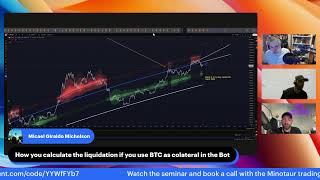
A March 20, 2025 live discussion (YouTube) featuring Giovanni, Kosta Ouzas, and Marcos of the Minotaur/Power Law team about Bitcoin market structure. Speakers demonstrate a liquidity heat map (futures/perpetuals, Bybit) and argue liquidity is the primary driver of price; they link futures liquidations, leverage pools (3x, 5x, 10x, 25x), and institutional flow to price discovery. Giovanni presents a power-law model tying global liquidity (M2) to Bitcoin price with a ~70–80 day lag; the team discusses trading algorithms that combine liquidity, power-law guidance, and risk stacking (discounted BTC collateral, Kelly-like sizing) to manage drawdown and harvest cycles. They present practical bot/system examples, historical anchors (miner cost/support ≈ $40k), and scenario probabilities (high probability of harvesting long-side liquidity down to ~71k; potential upside targets near $130k–$200k depending on timing and global liquidity).
Chapters
Okay. Hi, everybody. We are live. I am here with Marcos and Costa. We are part of a Minotaur team. Well, we are all a team, but I am V Power Law team. We'll try to bring my son next time because he's also good in looking at the market in a slight different way. So it's more like two. Two versus two.
Yeah, that's even it out.
Yeah. To play.
Anyway, so let's. Let's dig in. Do you want me to start? Maybe I can show some.
Yeah, love to see.
Yeah, yeah, yeah. Mostly I'm going to share this chart that I'm working on. Let me see.
Hello, Mr. Modelman.
I'm doing this thing like I never done before that is using different panels. Let me see if this works. Sorry for that. Share screen window doesn't appear. Why don't you start instead? Until I figure out how to do this thing, I created different panels and when it. When they try to share, it doesn't appear, but I will fix it. Marcus, you want to go ahead and show the liquidity charts?
Yeah, sure, I can do that. Do you want me to share my screen? What do I have to do?
Yeah, the way to do that, to do that, Marcus, is if you go down and you look at. You see there is a microphone, a camera, and a bunch of dots. Click on the dots and then say, share screen.
All right, got it.
I will be able to. Yeah, yeah. Okay.
Okay. Can you see that?
Yes, but wait a second. Yes, I see it. Okay. And everybody now should be able to see it. All right, great. This is.
This is a. An example of a liquidity heat map. First, I would like to thank Giovanni for having us again this week. And I'd also like to thank the people at Trading Differently. They're really smart guys. They built this algorithm and what it does, it focuses on the liquidity of the market. And as professional traders, liquidity is the main thing that we want to track. The institutions and larger traders use liquidity as their fuel. Liquidity attracts price action and price action attracts liquidity, creates liquidity. They're one of the same. So this map is. This heat map is very good at showing you where existing liquidity is in the market. It's overlaid over a trading view chart, and it's one of my primary tools. I don't particularly watch trading view indicators without this because it puts the context behind where the liquidity actually is. This map shows you the existing positions. There's different types of heat maps. Some heat maps focus on limit orders and orders that have not yet been executed. This heat map focuses on orders that are already executed. These trade, these positions are already in drawdown or in slight profit or neutral, but they're in the market. So it's very, very accurate in determining where the price may go because liquidity is a magnet for price. So what you see here on this particular screen here is the daily time frame. You have a volume profile in the middle and you have the liquidity above is the short side liquidity and the liquidity below is the long side liquidity. We can see that the price currently on Bitcoin is 84. And the reason we use Bitcoin is the primary crypto obviously, and we use liquidity to track its movements. Because if you look at Bitcoin as the primary spot asset, if you were buying the coin straight up in the spot market, the derivatives market, which is the futures, exactly what we're looking at here, the futures coming from BYBIT right now. But the futures market is where price discovery happens for the assets. So price discovery initiates first in the futures market or the derivatives market, because that's where the leverage is at and leverage is a magnet or it moves price first. So this heat map that you see is looking at the futures, perpetual futures market from buybit. So it's where price discovery occurs first. The price action happens from liquidations and closed orders and it gets reflected first here, then the spot market catches up to it later. So we're looking here also we're looking at, on this particular screen here, we're looking at 25x, 10x, 5x and 3x leverage positions. So right now we're looking at the entire up to 3x. If you go lower than that, that's almost spot. But this is 3x. So we have a upper range coming in at about 137 of existing liquidity right now. And our lower range that we're looking at here is about 60k. And as you can see here, the market, which is a combination of everything in the market, big institutions, everyone has already started taking this, this long side liquidity right now all the way down here, currently at about 76,000. And if I back out the 3x, you can see that the 5x liquidity pool, we call them liquidity pools, goes primarily down to where this go line is at 71K. Another thing that typically happens in the markets is once one particular side of the liquidity starts to be liquidated, it usually finishes. So even though we've had a little rally here, we are probably in position to Finish the rest of this liquidity down to 71K. And then it's, it's a simple premise. The market is fractal. All time frames behave like this. This is the day. You see the same type of price action on the 1 hour, 4 hour, 15 minute, 5 minute, it's all the same. Just takes longer for the longer timeframes to play out. But the ideology is very simple. These, these orders here, these positions are already being liquidated. They' in the market, they're stuck. So these people here, as they're being liquidated, they're forced to sell low. And then the market as a whole, all of the aggregated market makers and institutions, this liquidity has to be harvested, then sold right, then sold off. So they take it up here to this pool and this is these, these are shorts. And when they get liquidated, they're forced to buy it back high. So you know, 101 is buy low, sell high. But the way the markets, these institutions, when they take the liquidity, they're going to force retail traders and aggregated traders to sell low and buy high. So they'll harvest this liquidity here. The market moves it up here and then it sells it off at the higher point. But it becomes an incredibly accurate tool to analyze where the market is going to go. So we know that we have this much captured liquidity here. Let me put the 3X back in here. So it actually goes to about 136. So we know we have a large amount of captured liquidity on the short side waiting to be harvested as soon as this long side is finished. Typically in a bull market we don't take much 3x. We just, it takes out the 5x which, which would terminate at about 70k, 71 to 70k. And it may take, you know, we might have another week, two weeks before we finish this off. And then we start the process of going to take this short side, which could take. Overall, I think when we use the power law as a, in confluence with this, it's very, very accurate, very, very highly informational. So the power law suggests about 80 days before we harvest this short side. And the liquidity heat map also agrees with that. I can show you really quickly here. We can go back to a previous time really quick. I'm going to turn it back over to Giovanni. When we went back to the summer of last year where we harvested the 5x right here, we terminated it right there. And that was on August 5, 2024, right here. We completed that, as you can see. I can put the 3x back. We did not harvest the 3x. Then just took out the 5x. And then that started the process of the market beginning to position itself higher lows and to start taking out the short side liquidity of that particular time. That was in October. And we finished, finished liquidating it at about mid November. So from the time period of when it harvested the long side, that was 80 days. This was 80 days of time. So we're still on that same time horizon. And Giovanni can show you in the power law that it matches that same time period. So give it one more week here to finish this. So 80 days out puts us at about. Move it over just a little bit more here. That'll put us in.
So Marcos, a question. First of all, I love these because see, these are. There are teachable things here, right? So many people, people that may follow. I think we learn a lot of things on this. When you show me these things first time, I was really fascinating. So the main. I really like this idea that if you think logically, right, to do these moves, the market needs liquidity. It needs to find the liquidity to go up. Right. What that means, I'm giving you my interpretation when you tell me if I am correct or not. You know, feel free to add or subtract. But the way I understand it is these are people that really are not necessarily, you know, they, they do want to. For the market to go up, but they need to have. They need to buy first bitcoin and they want to buy it at a relatively low price. Right. So they are basically causing. They are causing these people to be forced, the people that are putting all these very high leverage shorts there, buy there, to actually sell them.
Right.
Because they go there and they start to buy all these liquidity available. And then now they can go higher and they start to push the market up. Right. And if there is a gap, it means that the market really can go just up. Now, how do you know? My question is, how do you know when we are done with the move down? In terms of what you're looking in the chart, do you use a particular level of liquidity, you know, particular color in this chart? You know, do we need to, for example, do we need to get all that liquidity there, you know, at the 70k? Yeah, yeah, yeah.
Great question, Giovanni. What we typically do is we analyze that. You can, obviously it's very visible. We can see that there's a large accumulation of liquidity here. Yeah. And the composition of this liquidity is 5x10x and 25. Right. So when we put it all, when we put it all together, this pool comprises them. 25x leverage traders, 10x leverage, 5x. We're not looking at 50x and 100x because they're really close to the price. So these are, that's what's in the composition of this pool. And typically what happens is when the market starts to liquidate one pool, it doesn't take it all at one time because that would be an enormous move and an enormous amount of single side order book liquidity. So they break it down into digestible pieces. And there appears to be about. And it's highly accurate. It's about 70,000. Is the level lower level? 71. 70,000 left to go. They don't always take it all, but it's a probability of about 90% that they get it all when they go for it. As I showed you earlier in the previous pool, they took all of the 5x before they reversed it. So yeah, it's very, very.
So you're saying we are going to 70 something. But this.
Case, in this particular move, because, you know, here's your higher highs, higher lows.
Okay.
And we haven't changed our bullet structure. I mean our bearish structure. We still have a bearish structure until we break this. We haven't done that yet. So yeah, if we, if we were to break this structure and go this direction here, then this, this, this might invalidate that lower level. But right now we haven't invalidated that. So we're still, this is still right now.
Okay. Yeah, that is probably the best way to think because one on one end. I never like when people say, oh, you know, it could happen in this way. Oh well, it can happen only in two ways, you know, but in the same time, at the same time, the way you describe it makes sense because you still leave room for something else. But you are telling us what is the most likely scenario, which is all what matter in science is all Probability, confidence. If you. I know it's difficult to assign probability, but if you had to assign probably. Will you say 70%? We need a more of a leg down then. Yeah, continuing to go up. Right? Something like that. 78.
Yeah. Don't get me wrong, I'm a perma bull. I'm not in here.
Yeah, yeah, yeah, no, of course. But I like, I like what you say that it's kind of like going one time you made this analogy says like going to a field trip or something. Right. And before you do that, you need to Load fuel and snacks and all kind of stuff. Right? Yeah. Can you tell us again about that analogy? I like to do explain it better.
Think of it as harvesting. Right. The liquidity was not very thick here. So the price goes this way and it brings liquidity in down here, then it goes that way, brings in liquidity up there. So that's why it moves in this condition here. It's just increasing the size of the pool. Right. So just like when you get ready to take a road trip, you don't want to gas up with a little bit of gas. You let it build up, get really fat. That's what the market does. The market makers, institutions, they're going to fatten it up. And these are all algorithms. There's not like a Wizard of Oz, one person diabolically doing this. This is thousands of algorithms controlled by hundreds of institutional size companies all running similar programs. So all these algorithms are running together, aggregating all this liquidity, getting all this fuel get ready. So they force all of these retail and smaller traders and smaller positions that are highly leveraged, they force them to sell it low. And then they get on their road trip, they gas up, get all this, harvest all this inventory and they take it up here where all these people are already forced, they can't get out. If they get out, they're going to draw down, they're going to. They're stuck.
They have to buy.
Yeah, it's perfect.
I love it. I love it.
Yeah, yeah.
So I think this is like a really good way to understand why discretionary trading in this kind of market, the odds are stacked against you. Like Marcus said, you know, these are algorithms executing. If you're sitting there at your computer and you think for a couple hours a day, you're going to be able to outplay these giant algorithms. It's, it's impossible. It's very, very difficult. Maybe, Maybe the top 1% max of discretionary traders can do that. And, and this is another reason why you've got to fight fire with fire. If you're going to trade the market, if you're going to do anything apart from hoddle, hodling is just fine. If you're going to play in the market with the big boys, you need to have an edge. You need to have something that's going to be able to react 24 hours a day, seven days a week, 365 days a year. And you also have to have something, and this is what we try and do with our system that's price agnostic. In other Words. It doesn't matter if it's going up or down. The algorithm is going to react in a way to protect you. Right. We're not biased towards a bull scenario or bear scenario. It doesn't matter. We're just going to react with what we're given. It's a much, much more intelligent way to approach a market that when you actually put this heat map on, you know, paint such a different story. When most people are thinking it's being driven by the news, you know, like it is a little bit. But. But this is billions of dollars just sitting there waiting to be sucked up.
Right. And you can tell that. Great, great analogy. Great observation, Costa. You know, it's almost like the movie the Terminator, right? If you, you know, if you don't have your own and your own algorithms or your own robots to fight those robots that are competing against you, you don't have, you don't stand a chance. You better, you better hot wire your own or get your own. That's the only way. It's just too, it's too much. Yeah. There's no way.
I think another thing to, to like, I know a lot of, you know, when I listen to these things, I always want someone to say, like, what's the price condition? To do what's. And, and you know, we've got the power law and Giovanni is going to go through his analysis of, of where he thinks that, you know, according to the power law, where we should be, what times he is. But looking at this map right now, you can, you can, you can say with a high degree of probability that there's a high. Likely, there's a high likelihood that it could get to 70k. It also might not. Let's just say this. There is news can drive things in the opposite direction. Doesn't always take that liquidity at the bottom. It's always going to take that top. So we could say that the minimum base case for this bull run is 130k. Looking at this, because that liquidity pull up the. Up the top there, Marcus, that's going to get taken no matter what, right?
Yeah, it's. It's an extra extremely high probability that they take this. It wouldn't make sense from a business standpoint or a mathematical standpoint to harvest all this liquidity and keep going lower. Where. What are you going to do with it? If you're going to harvest.
Yeah, you're gon. You got to sell it.
So that is also what they say all the time, right? They say, remember, every time that somebody sells somebody's buy and vice versa. Right?
Yeah.
That is how markets work, right?
Yeah.
There are a lot of people that invested in bitcoin and want. And these are not, you know, some random dudes. These are like you said, this is huge, big quantity of bitcoin that was bought. And these people want to see a return. So. And they have enough ability and enough capital to move things around. So it's just that they do it at their own pace, they do it with their own principles. And most of us are baffled by this because we are not part of a club. But these are some of the tools that we can use as a small investor to try to make sense of the market.
Just to add to what you're saying, Giovanni, if you're an institution and you're trading hundreds of millions of dollars or billions of dollars, you're not going to put a limit order in the market and say, hey, I want to go long with a billion dollar market order. No, you have to break that order up into tens of thousands or millions of individual smaller orders. And that's why it takes this long to set that up. You know, they don't trade retail discretionary traders, we're thinking day trade, intraday scalping, all that kind of craziness. Well, they, the big institutions like this time period here is, you know, that's a, that's 150 days, you know, so it takes time for them to set that up and we, you can't lose sight of it. But it's the same principle though.
And this also backs up a lot of the discussions that we were having. Well, you were having publicly Giovanni, like about six months ago about the whole supply, supply shock coming. Supply shock coming. You know, people are going to hold all their big. If everyone's holding their bitcoin, the price doesn't do anything. The fact is, is that it's the, it's the futures market that that like Mark is saying, is where the price is discovered and this is how the price is discovered. And this is the reason why the price moves, especially on the daily. When you're looking at it like this. So you know, that's. That this kind of supports a lot of those arguments you're making, Giovanni. You know, six months ago when everyone was saying that, you know, supply shock incoming and you know there's all the bitcoins off the exchanges is just.
It'S a ridiculous thing, right? It's all about liquidity level.
These are all sellers above there. That's their buyers and sellers, you Know.
In the same, in the same conversation, you know, Giovanni was highlighting that it's the liquidity, the ability to buy and sell is what makes it valuable. If everybody just held their Bitcoin, it would have no value.
The reason anybody will be a stupid market and nobody would want to play with it, you know.
Right.
It's exactly the opposite. You know, it's good, there are some long term investors. But that is one component. But it's not it. Right. It doesn't explain why Bitcoinia, it continues to go up. It doesn't explain why there are certain moves. It's a silly thing. You want a balance of both. He's sure. You want people that consider Bitcoin a long term investor. All of us. Right. All of us are the cornerstone. We are focused on Bitcoin. But at the same time you want to have people using the liquidity of Bitcoin because it's one of his main features. And this is what actually long term, you know, like a institutional investor, they are interested in, in the fact that it's a 2 trillion asset and it's very liquid etc. If it was not, it will be a bad thing. So you know, when sailors say oh, the selling makes the network weaker. It's.
He's telling you that, but he's not doing.
Yeah, exactly. You know, when you have a. People like Marcus with all these. Marcus has work in the institutional field. Right. What is your background Marcus on that? If you want to share.
I'm an old school trader. I, I used to be a stock broker way back in 1998, 99, 2000. Then I moved to private equity after that. So. Yep. I've seen, I remember the days where you had 20 second quotes you call the floor and you had to write the tickets and all that. So we've come a long way from that.
Yeah. And I think it gives you a lot of insight. Right. Because you look at the transformation. You saw how computers add an impact on the market. It's a very valuable information. I, I didn't see that. You know, I don't have that kind of experience. So it's very, very grateful that you're part of our team, Marcus. Thank you.
So this is a great, this is a great time for retail people like us because the technology is here for us. It was out of reach. The institutions have had this technology for 30 years. It's been around a long time. Ever since the NASDAQ automated quotations and electronic trading that's been around. It's just been out of the reach of retail people. But we have it now. It's in reach, and it's an unprecedented time for us to be able to take advantage of it.
I like it.
Yeah. Sorry, Giovanni, I was just gonna.
Was going to ask you casa to show us maybe some of the trades.
Yeah, I will. I will in a second. And I just want people to watch this, to understand is that what we have here is, is we have liquidity and volatility. When you have liquidity and volatility, it means there's opportunity. Right. When you add the power law to that, you have certainty, you have more confidence. Right. That's what gives you the edge. So it's really the combination of what we're given, what every single person in the world is given, the volatility and the liquidity of bitcoin. And then all you need to do is add, I guess, the. The science of the power law, the understanding of the power law, of that growth trajectory of bitcoin, and then if you can set up your own system, which is what we try and help people with, to actually trade on that, you can have a lot of success. And it's a lot simpler, a lot easier to do than most people imagine. You know, we're just, you know, we spent years thinking about this. But. But at the end of the day, you don't have to be a gigantic institution to be able to get the returns that historically have only been allowed for these kind of big institutional traders. It's a unique opportunity, and it's probably going to have diminishing returns. That's another thing Giovanni always talks about is the fact that the opportunity is now we get a lot of, you know, our returns are pretty damn good, but they probably won't last for 20 years. You know, bitcoin is a unique opportunity right now. So, you know, people will kind of say to us, you know, how can you get as good a returns as Jim Simons or Warren Buffett? Well, they weren't trading bitcoin. I probably couldn't. If I was trading what they were trading, right? If I was trading the stocks, if I was trading Coca Cola stocks, like. Like Warren Buffett, he'll be making more money than us, right? Yeah, but we're trying to make bitcoin.
Let me add to that, Costa, that you bring up a good point. We do. With crypto being a total of less than 3 trillion for all of the tokens, bitcoin being the majority of it, because it's an emerging asset class or technology, because it's both things. You have A window. Like you were saying, probably it may be five, 10 years. But what happens to markets is they become more efficient. Right now bitcoin is not incredibly efficient yet. But let it get past $10 trillion or let it get to where gold is at, at least in that area. Bitcoin could go much larger. However, it's not, it's going to be incredibly efficient, more efficient than it is now, orders of magnitude more efficient. So right now you probably have a three year, five year window where you can kind of clean up on it, because it's not so efficient yet. And since you're a retail trader using your own algorithm, you actually have an advantage over larger institutions because you can get in and out of the order book seamlessly efficient.
You mean less volatility. Right is what you mean.
It'll be, it'll be less volatility and the algorithms will soak up all of the edge. There'll be less edge to go around because there'll be so many more algorithms. We can see it now, just a little bit now, but it's going to be like for example, if you try to run algorithms in Forex, it'd be much, much harder or equities or something like that. Yep.
I, I was explaining today, I made a post, I say I we added this bot that was buying and selling sheep coins. I made literally six pair and this was relatively to bitcoin while bitcoin was going up in one month. Okay, but when was that? It was during one of the craziest bull run ever, in 2017. In fact in the month of December. And you know, in January the market crash, you know, so it was. No, I know I brought record, I tested it, you know, I have some credit, but it was mostly lack of making it work during that crazy time, you know. And so it was. If you went earlier and earlier, you could make a lot, a lot of money with bots. You know, the first people that started to use bots in the crypto market, they make a killing, you know, because it was less and less efficient. So. And that edge was going to go away in time. You want me first to grow and Costa, maybe then we can conclude with some of the trades with the algorithm because that is the other part of what we do here. We have an algorithm, you know, from the Manotor company that actually tries to put together all these principles from liquidity, from the power law. And we always continuously try to improve it. I'm part of a team, I help them and people can access the algorithm, you know, we we have a link. You can watch the seminar or you can also DM me if you like to talk to me about it. You can DM me anytime on X for example. But we want to show you how the algorithm makes its choices. You can see how consistent it is and some of the details, but we leave it as the final part. So let me share my chart. I was able to solve whatever problem I had and it is here. Okay, so this is the chart. So basically what I'm showing you here, I was able to take M2, but I also tried with more sophisticated forms of liquidity by adding them together. I still have work to do because I'm always digging and trying to improve the analysis, but was not much different by adding banks. Adding other form of liquidity is possible though. But I can improve a model by giving different weights, you know, to different contributions. But right now I'm mostly using M2. But like I said, there is no much difference by adding other parameter, at least so far. And what I'm trying to do, I First of all, I made a graph I posted in on my X where I showed if you plot global liquidity and it looks much better if you start from 2014 because if you go earlier than that, the curve, the relationship between liquidity and the price of the coin is more complicated. Doesn't look like a power law. You know, when you do a plot in the log log chart, it should look like a straight line. It looks, if you go early on, it starts to bend. That means there are higher terms. It's not just the power law. It's more complicated, but it approximates a power law. If you stick with data from 2014. So about 10 years, you know, 10 years of data suggests there is a very strong correlation. It's. It was something on the order of the r square is 0.9. That kind of crazy correlations are things that you find in physics. You know, like I work in neuroscience, we never saw anything any correlation between any data with kind of R square. It's very unusual. So it's very, very powerful. And it suggests there is some kind of relationship. Now you. One of the issues that we are debating is it looks like there is some kind of a delay between the global liquidity and the price of the Bitcoin. And there is some debate what it is. I think it's actually there is not one single number. It's more like an average because it flat weights. There are times where regions where 80 days will look better in terms of aligning them. Other ones that are 90. So it changes, it changes with time. And I don't know if one can do anything mathematically to try to fit everything. Probably want to take an average, an average value and right now anything between, let's say 70 days, 200 days seems to work. And this is what you see here in the lower panel. So basically the blue line is the M2, the yellow one is the shifted M2. And they shifted here by about 70 days, something like that. And and then in the upper panel, what do you do? So I, I as the usual thing that I do when I do the power law, right? I look at the relationship between whatever, you know, Ashray and time or Bitcoin and Ashrae. Then I calculate the relationship. Then I use it to make a model out of it, right? So for example, in this case the power law between M2 and the price was a power law with a power of nine. That is crazy because nine is a very high number for these things, right? It means so for example, to give you an example, so if liquidity goes by 10%, but you can write 1.1, that means, right, you look at the liquidity at one point, then another point and their ratio of the value is 1.1, right? It went up about 10%. When you take the power of 9 of that, it gives you 2.4. So it means that a little change in liquidity gives you an enormous change in price. So it's almost like a liquidity multiplier, you know, like crazy non linear multipliers. It's very interesting way of thinking I that it takes this liquidity and responds so strongly. Remember though, every time you have a power law the response becomes diminishing returns. It's part of our power law works I in time this response will looks smaller and smaller. It's diminishing right now. It's very, very powerful. So then I take that relationship and I say okay, give me liquidity, take the power of 9.3, whatever it is. And that is my price, that is my evaluation of the price. And this is what the kind of reddish curve looks in the eight. So it's basically and calculating the supposed price of bitcoin based on this relationship between the liquidity and the power and the, and the price of bitcoin. So it's supposed to be a more a fair value of a price based on this relationship. And so this is what the red curve is. And you see, it's not perfect, but it kind of tracks some of the major move I can show you.
It's getting you to 130 as well. That's what's interesting, isn't it?
Yeah. So this is here, for example, you see how it kind of got this lower bottom, right. So the, the model was bottoming here. And also this, you know, it's not perfect but you can see it's a clear one to one relationship, right. This was a bottom and we could have detected this bottom by looking at the liquidity. And remember, we are shifting it, right? I'm shifting, you see, because you notice how here it continues, right. It means it's trying to predict what happens next. So these, these will have been a prediction. We will have known in advance when the price was noveer. We will have known in advance that we were bottoming. So it's really cool if this holds. Now here you knew that we were going up and it looked like, you know, this one. When I tell you that the delay is not always 100 days, sometimes small, sometimes longer. So we are taking an average. So in this case we kind of, you know, we will. I would, we would have said that we were coming to a peak, but we not have got it precisely right. The peak actually started to happen earlier a little bit. But in general, right, with move is the same. We are going up, the liquidity is going up, the price of the coin is going up. So they. And you can continue in the chart. I will make it an indicator. You know people, we have right now 13 indicators and this is going to be another one. And people can look at my patreon and find the indicators there. I will have a link in the, in the comments after we're finished with the video. So yeah, there is, I'm convinced, right. I spent a lot of time looking at this thing. I actually subtracted the power law and the publish. I will make also that an indicator, almost like an oscillator, right? You can subtract the overall power law and then you can superimpose them and you can see you with your naked eye that they track each other pretty well and there is some predictive power to it, right. We have to take it with a grain of salt, but there is a pretty power. And then today I made a post and they say, I don't get it. Why, why this delay? What is going on? Why there is a delay? And you know, if, if there is a delay, you know, given that everything. Right. Like we just discussed right now, it's a digital and it's based on the computers. I will not expect a delay of 70 days. Right. Looks like something that will happen if you were sending pigeons, you know, not. Not if it was all. Everything is computerized, right. You will expect much shorter delays. And you know, there are a lot of clever people on X and it's always a good question, good approach to ask question. I should ask more question myself. And people started to respond and kind of educate me on this thing. And it made sense. They started to say, oh, it takes time before these liquidity find risky assets. So they go through kind of almost like a cascade. So gold, for example, will be one of the first things that traditionally this liquidity will go into. You know, they will start to. It will start to affect gold first and then everything else. And bitcoin is still considered a pretty risky assets when it actually is not. And we explained that in our show that bitcoin of physics, the. The physics of bitcoin, the coin of the physics of Bitcoin, we Stephen yesterday explained why not. But for many people that is true. It's a risky asset. So you will expect a less delay for gold. And then finally bitcoin reacts later. It is actually good because that means we can make some predictions, right? It's actually a good thing that bitcoin reacts later. And I need to explore this and I will have better graphs. In fact, probably I can make even a model of gold based on liquidity like I did for bitcoin. But look at this. You see how the gold is responding? So the gold is yellow here, right? Is responding early on. So for example, supposedly if this shift is correct and we do follow liquidity, liquidity is going up right now. Liquidity is going up, right. You see, this is a non delayed M2, the blue one. So the blue one is going up. If you put the delay, we are supposed to go up in about 70 days from now like we are we discussed before, like, and it is more or less what Marcus also sees in these charts. So we are supposed to go up in a delayed fashion like here, right? But gold is already acting. In fact, you can see when, you know, there is almost no delay at all. Because here, you know, the M2 was going up, right? And gold started to go up more or less at the same time. In fact, actually seems that kind of almost anticipated that move. Because maybe, you know, it takes time for the news to, you know, for every information to be gathered, right? It takes time for. This is kind of a microeconomics index, right. So we need to collect the information that remove money is moving and maybe it was already moving and finding is way into gold. So gold seems to react. And you can see any other places where gold was anticipating either. You see here, for example, there is a bottom, the bottom for bitcoin apple later while it happened early for gold. So maybe we can use gold actually as a way of anticipating some move, not all of them. Like for example these peaks here. They don't seem to be appearing in gold mostly because I think these peaks were mostly formal. Right. It is like an upward movement in the. In the liquidity. It affected gold early on, then coin acted. But a lot of it, I think it's almost like starting a fire. Like you. You have a fuel there. But then the fire can continue to run by itself. And the form was that far. Right. So when it's kind of decouples from the liquidity. But so everybody's wants to know what is the next move, right. Because we are sitting here at 84 and it seems nothing is happening. Right. We would like to continue the bull run if this is correct. Right. That we're going to. This is going to happen. This is the next move. Right. So this is going to be the next move. But yeah, let's see if that happens in these. If it is just fantasies or true in general. I'm now convinced that as liquidity goes up and it's almost unavoidable because global liquidity, you know, right. As more money is printed, etc, it will continue to go up. Bitcoin goes up. The correlation is so strong that that is the general direction. We are more about worry about the, you know, what happens in the next few months and how we can act on it. Right. But this, this seems. Let's see what happens. But I will be kind of surprised if we don't follow this move. And it will be exciting because it looks pretty nicely up. Gold reacted strongly here, right? It is another confirmation. But actually look at this. Gold actually follow the liquidity very strongly. So it's time for bitcoin to do the same. So that is where I am right now. But yeah, let's see if that is true.
I mean this is a really good indicator as well. Be good to have this one.
Yeah, yeah, yeah, we'll work on it. And they do want to look at gold and see if it is a power law with the liquidity or not or you know, what is the relationship. And because I think I'm putting it together and looking at this cascade, maybe other things that are in between, it will be like a way of confirming, okay, gold is up, you know, liquidity is up. Okay. It's with the coin term, and I'm measuring these delays. It seems about few months or a couple of months. It's the two or three months that is the scale. And it's good because that makes us prepare for these moves. We can do different things.
Yeah.
What do you think, Marcos? What is your feedback about this?
I think you also have to take into the. I mean, I think it's an excellent observation showing them side by side like that. Giovanni. I see that in the previous two peaks there, that was a lot of easy monetary policy right there. You had a lot of easy money. And there was. That was after Covid right there. So there was so much easy money hitting the city system that it shows you that people elected when they have a lot of easy money, they buy because extremely. They buy assets that have more upside. So, yeah, they. They flooded into bitcoin because it has more upside than gold. It wasn't. Gold wasn't attractive. If I got a lot of easy money, I want big returns.
Yeah.
So now, in the scenario that we're in, currently, their easy money is not there.
Yeah.
It's kind of like when you get sick, you eat your vegetables. So now I can't have what I want. So I'll buy gold just to play it safe, even though I want bitcoin. Yeah. So that's another way.
You're so good with these analogies. Exactly, Exactly. Exactly. Yes. And, you know, I have. I have said that for months and months and months, and it was getting a lot of heat because I didn't play with the delay until recently. I was skeptical about it, but I was seeing, you know, bitcoin going up, liquidity going down. And I was saying, ah, you know, I don't know, because it looks weird, Right. And it never happened like that before. We always add up more liquidity than, you know, it was kind of overvalued. And. And this is the first time it happens, and I have the big question mark in my charts. And then when we had a bull run, you know, in the end of the year, people were tell me, oh, you know, you see, you were wrong, etc. But it seems that I was right all the way along to be. I. I always say, I don't think ETFs or sailor have enough fuel, you know, to push this thing out. It needs to be something much more global. And I think that I was right.
So I think you bring up another good point, that the catalyst of the last banana zone was Covid money. Easy money, crazy money. The catalyst this time since we don't have all that easy money in the system is going to be your institutions and ETFs and all that. So they're the next driver because now the retailer fomo, they don't have the money for. To spark it. So it's going to come from the institutions now. Yeah, we saw their game. We, we just took a look at their playbook.
Correct.
So, you know.
Yeah, very good. Costa, what you want to show? Share your screen.
Yeah, I'll share my screen. We can have a look at what we've been doing. And, and I wanted to add something just about the narratives there and the global liquidity. It seems that there's a. The narrative drivers and then the liquidity drivers. And, and like Giovanni said, we had ETFs plus and, and looking at how much time is actually left now to get to, well, how much, like Marcus said, fuel is in the engine to get us to a top, it seems that those narratives are going to be the only narratives left for the cycle.
That.
The strategic reserve, I think that's a narrative for the next cycle. I, I just don't think anything. Like everyone thought that was going to happen.
Bang.
But you know, it's just on the table and it's not even at the front of the table, it's just in a pile at the back of the table. Right.
So, yeah, right.
You know, that's going to happen when, when the governments. There needs to be more stress on the governments. It's just not there at the moment and it's not going to be a priority. So I think the narratives are already in place and we've seen the price action that they've created. Now we need the global liquidity to push us to the top. And then like it always happens, there's going to be a crash. And I think the higher it gets, the more brutal that crash is going to be. And I do see the price returning to that 70k power loss support that we, we treat so seriously. And then, you know, the strategic Bitcoin reserve is going to be a big player in next cycle's narrative because it already exists. There's going to be another one as well. And then we're going to have the same global liquidity pushes. It's going to be telling the same story. This is, this is like a really logical way to think about it. And it, and it really removes hopium and, and gold candles and, and supply shops and he really looks at things that are real and that are in front of us and how are they going to Affect the price, you know, in, in the short term, six to 12 months, beyond that, who knows. But we have to look at the cycles. But regardless, we can have a look at how the algorithm performs under these market conditions. Hopefully you guys can see my screen. Just to cover a few points that, you know, what we really do is we focus on being price reactive, not price predictive. So it doesn't really matter what happens after we enter a base order. If the price goes up, we take a profit. I can show you example of that here. We can see a couple orders here, here, base order profit. If Bitcoin is going up, it's very easy to make money, right? It's very simple. You make an order, you take a profit, you make an order, take a profit. But we'll come back down to where we are today and we can see we've had these pullbacks here from 95k around March the second second. We're all the way down here at 85, but you can see, and again, Marcus is good at these analogies. But what we're doing is we're walking the price down. You know, we enter here 92, we've made these safety orders, we've gotten out on the suburb on a small rally here at 89. We've got some really cool take profits here. Trailing take profits. As you can see, our profit lines are the green, but we're able to get a little bit more juice out of it using some of our advanced features. Gives us an extra 1.89 on that one there. But yeah, we had the mark. We had 1, 2, 3, 4 safety orders and we took profit on the 19th, which was two days ago. So this is a really nice trade. And again, we had that trailing order, which was nice, that gave us around 4.58% profit, it looks like around 4%. And now we're back here. We've entered at 85, we've made our first safety order here at 83. So, you know, it doesn't matter what the price does. We're in a position to take advantage of it. Just so people can understand exactly how this works, if the price rallies from here, we're going to hit our take profit, fantastic, very easy. But if the price goes the other way, we're going to basically be executing safety orders all the way down. At some point the market's going to rally, we're going to take a profit. And again, knowing everything that we know about the power law is that we always have our support or most of our risk management playing down you can see at around this level here, kind of around 40. So if we zoom out on that, if we go to maybe like a four hour, you can see how far down our risk management really is and how good, you know, what is a.
Liquidation level to reach for.
Yeah, so it'll get down all the way down to around 35. That would be the minimum that we'd be giving our clients on, as you can see.
Yeah, but you can set it up where you have a even lower.
You can even remove it completely. But. Yeah, yeah, you can even completely.
Like for example, I am in a trade where my liquidation level is all the way down to 10K.
Yeah. So you're so, so with, with a two or three orders, your liquidation is going to be around that 10K price point. As you execute orders, obviously you're, you're deploying more capital. The liquidation level will slowly rise as well. But with the setup that we've got, there'll be a full cap at that.
And one of the way we integrate, one of the way that we integrate the power law, basically we are looking at that very hard support level that we always discuss. Right. It seems that you take basically 60% from the general trend. Historically we never went below that. Never. We even during COVID we barely wicked down. And so of course we always add a little bit, you know, like a little safety gap between that level and you know, the liquidation possible liquidation level. But also you have to understand, right, if we are 84, it's almost impossible that we go to that level. Right. We will have to be in an extended bear market. We usually go to that level when we have an extended bear market. Right. So it's not doesn't happen. And by the time that happens, there are other measures that we can take to avoid liquidation.
Yeah, correct. I was going to say, Marcus, could you talk about the Kelly criterion for risk management and deploying capital at this zone here and how that's part of what we show people to do.
Like plus just from a liquidity standpoint, when we look at all the way down at 3x that level is at 60k. And then we also add in there, if you want to mention the ETFs, their aggregate cost basis is 68 to 70K. Now they're, they're because they're consuming, they're aggregating more. So their basis is now at 70k 68k. So it would stand to reason since their funds that they will defend that price. So they don't want to see it the market dropping too much lower than 68, 70k themselves because then they would be in drawdown on their fund. That's going to mess up their fund reports. So there's that protection plus the existing liquidity that I showed earlier goes to 60k if all the 3x is taken. And in bull markets that is almost that doesn't happen. So we have all those. What we like to do in our company, we incorporate the power law, our own metrics, so we create margins of safety that are stacked on top of each other. So we like to run three or four individual margins of safety. And when they're compiled together, it makes it fairly bulletproof. Unless there was some catastrophic thing happened to the world, but then we'd be in another shit sandwich before, excuse my French. You won't be worried about Bitcoin if the world's coming to an end. So. Yeah, yeah.
And I think another point is to make is that, you know these liquidation levels, places where you start defending the position. So if bitcoin is going to drop to the 40, 30K zone, really, you always want to have some kind of dry powder aside so you can buy at that point by buying it that correct. And then like trading the way Giovanni and us do, we for most of the cycle, we're using bitcoin as collateral to do this. 40k is a really big buying signal for us. We might deploy an extra 25%, you know, into that at that time, which would literally bring that down to around these levels here. So, you know, having, having the power law there, it's. It's not like a fixed point where if it goes below that, everything blows up. That's a dumb way to look at it. The way to look at it is that if you're, if you're at a chart. Right this.
Right.
What else do you have to tell you? Do I start protecting here? Do I start protecting here? If you're using moving averages and all that is that those things tend to break. They're not traders use them for a certain period of time, then they don't work anymore. But what we do have is the power law and it only applies to this asset. That's what makes us so unique. Having that gives us the edge to make decisions like what I'm talking about now and the confidence to go, this is the point where I need to deploy. This is the point where I need to protect. Doing so here or here is just going to create more risk. Right. Because it's the wrong time. We need to focus down here. That's where all Our energy goes. That's what makes our system so unique. Because then when the price goes up, it's very like we said, come back to the strategy itself. The price is going up. It's very easy to make money. Very easy to make money. So when the price goes down, it's the risk management that's the most important thing.
And you know, just to remind to people why that level is so fundamental, right Is because, and I can share again my chart to show you is because that. So this is the white line, right? So first of all historical, you can see we basically never cross that five never cross that value, right? So it's a white line. And we have a lot of evidence, something that we are still exploring. But we think, we believe that that wide line comes from ashrate. It comes from the cost of production. Basically that level is how much it costs to produce one bitcoin. So right now that level is close to $40,000, right? So this is how much it costs to actually make one bitcoin. That's exactly 38, 99. So if, if we arrive here the miners are going to stop to buy, to sell. And you and we mentioned that very that many times that the amount of coins that the miners are producing is small relatively to the big huge flow of money in markets and so on. But imagine we usually don't go there, you know, by chance. We. It takes a long time. It's usually a prolonged bear market historically took one year to go down. So you know, it's, it's a process. By the time you go there, like Marcus show, all the liquidity dried up. There is no more liquidity. You go up. In fact we are even look at chart at certain point maybe you can do a systematic study to put like the support level on your liquidity chart markets and then we can look at how liquidity look like there, there is no liquidity because by the time we go there and it takes one year and we continue to go down, the market is exhausted. And on top of that the only other source of liquidity that are the miners, they refuse to sell because they say I'm going to sell it at the loss. And many of them, I talk actually with them because I wanted to understand this topic so I started to have discussion. Some of them contact me for consultation and what they tell me is exactly that, that they stop selling. Some of them take loan against their machines and things like that. So they can pay the bill, they can pay the electricity and they wait until the market recovers and usually it doesn't take much to recover because you know, if nobody's selling, etc, the market can go only up, right? It can go up, it can, it will go up. And, and this is when you start to have more liquidity and everything else. So you know, it's such a unique system. Gold doesn't have that. Stocks don't have that. So that support level changes completely the way you're doing this trading. This is why this bot is so unique. It doesn't, it's not forex, it's nothing. It's something, it's nothing that you have seen before. It's something completely different. It's like we only trade bitcoin, we don't trade anything else.
And I actually think we're discussing this the other day. I think calling this a bot is a bit of a misnomer. What we have is like a comprehensive trading system. The bot just executes orders. That's all it does. The bots just execute orders, right? It's a system, it's a integrated system.
Yeah.
And the system has, has all the thinking and the intelligence that comes from the technical indicators. The team, the developers, the people that write the code. That's what you're getting in the algorithm.
It's an advanced algorithm. Very advanced algorithm.
Yeah.
Bot is a nickname. That's just normal. Yeah, it's a nickname.
Yeah, exactly.
Correct.
So it's, it's chain up and there are many different tools and this is one of the tool later, you know, we can look at options, etc. Because there is a lot of interest. But it's a tool that people can use and you know, try to get more bitcoins. That that is the goal for all of us. Because you understand, right, we are not external from this world. We understand bitcoinness very well because we are ourselves and we are oddler. So the people that don't like trading, putting down trading, they don't know what they're talking about. You can always take a small portion of your investment or your assets and play with it, with the idea. Right. In a known degen way. Because that is something that I would never endorse. Right. You know, buying meme coins, I mean you can even spend few thousand dollars on that, a few hundred dollars to have fun. But in general it's something that I will never endorse. But being a little bit more, it's not even aggressive etc or taking too much risk. It's a question of, you know, risk and reward. You know, you, you want to manage the risk and the rewards. And if you do it correctly, you get more risk than the rewards. Right? That. That is the idea. And then, you know, if you are sitting on a thousand Bitcoin, maybe you don't want to do anything. There are people that even they are not, you know, they still do something with a thousand bitcoin, but, you know, maybe you don't need to do anything, but if you don't, you know, the idea that there be a God can, to me that is more degenerate than actually trying to think rationally and say, what can I do to actually try to get some of the gains that I was going to get from Bitcoin 10 years ago? Because that is kind of idea, right? Is there a way to reproduce some of these gains that just by sitting there I was getting from bitcoin by sitting there and waiting for gold candles or, you know, the strategy reserve. This is what makes me crazy. This is why sometimes people understand, oh, you're trying to get all this BS Guitar projection. I care about bitcoin and I care about bitcoiners. You know, this way, not a towel. I'm against the gold candle because I think it's. It's. If you are waiting for something that is not going to happen and you are putting all your hope on that, when maybe you could take a little bit of time taking very. A little bit of risk. Risk in this case means, you know, actively getting involved in something. And because it takes some responsibility, takes some learning, it takes some studying, you want to go a little bit deeper. Sitting there waiting for good candles is stupid, you know, I'm sorry for that. And it's. It's a bad decision, you know, and this is why I'm so against it, because I. I feel sorry for the people that are looking for this FOMO as a way of, you know, kind of calming themselves down or having some delusional thoughts, you know, it's delusional. So my invitation for you is learn to do some of these other things, like maybe options or, you know, looking into a trading system like the one we offer. But, you know, it requires some level of involvement, even with an algorithm like that, because you would have to make some decisions when you want to use it, how you want to use it. You know, it's a. It requires some level of participation.
Yeah. And. And like anyone who's listening is just. We actually do free consultation calls. So if anything that we talk about interests, you just go and book a call. One of the things Giovanni always says, it's like just Just if you're interested, ask, ask whatever questions you want. And then at the end you decide, is this for me? Is this, is it not for me? And that's fine. If it's not for you, that's great. If it's for you, that's great too. All things are meant for all people. So doing this kind of trading is not for everyone. You know, sitting at home and hoping for God candles is for some people. They prefer that. But I'm the type of person. And Marcus and Giovanni as well, like Giovanni I know personally has hoddled most of his bitcoin life and he's come to the point where he's starting to make decisions on potentially. And you can speak for yourself about this. Taking more advantage of the cycles and also using systems like ours in order to generate more cash flows. Because holding bitcoin forever does not generate you any kind of cash flows. And we all live in a real world where we all have to pay bills and we have to pay taxes, but we all truly love this asset and we don't want to sell it. So what's your solution? Your solution is you can hope that you make enough money on a God candle to sell it all, which again means you don't have any left. Or you got to be smart and you got to figure out a way, how can I generate something from this? And like we said earlier in the conversation, we have volatility and liquidity. That equals opportunity, right?
Yeah.
Anyone right now is in a position because of technology to take of advantage, advantage of it, right? You don't have to go invent this stuff yourself. You can find people like Giovanni who've spent their, the last five, seven years studying this stuff. They're willing to help you, right? Join discord.
I joined Bitcoin in 2012.
There you go. And like you spend hours talking to people and sharing this stuff and they can get up to speed with your thinking in a couple of months. And the same with us. If they join our program, we can plug, we can plug and play our system in under two hours, right? You get all that alpha and like two hours that people have spent years and years. And it's funny because a lot of the time we get a lot of criticism. Why aren't you doing this for free? Or why are you doing that? It's like, man, we've spent so much time and hours, like, you know, you get to, you get to, you get the shortcut if you deal with these things. So I don't know, that's my perspective. But everyone's different.
Yeah, yeah.
Anyway, you guys are into answering some questions? Let's see if we have some questions and then. Okay, here, let me see. Okay. Whatever this is. Thank you. Mick should be gone. Okay, let me check the question. Okay.
No, there's no question. If anyone's got questions, now is a good time to.
Yeah. Please ask some question. If you have any questions.
There's one, there's one that says what price should bitcoin be in June? Yeah. So that we have a chance for 200k.
Yeah. So June, you know, like we are Talking about maybe 70 days from some kind of a big move happen. So we are talking about two months. Right. But that will be March, April, May. So we are maybe early end of May, early June. Right. When hopefully we are above the bitcoin price line. Right. This blue line. Because in general, you see in the past, if that is one of the things that, you know, I. Some people, maybe they think that it's a waste of time. But it's always the time, you know, to compare what happened before and what is happening right now. There was only one time where we went to below the blue line. Once we cross this blue line during a bull market. Right. Usually it cannot. It can happen. If we like here, for example, right. There was a kind of a fake out and usually it's always associated with some kind of event. So for example here there are reason. Reason I studied this seems to be associated with this event. This was called the plus talking affair. There was some kind of scam and it created. In that case, yes, it created some kind of a shock in the system. You know, we're less bitcoin in circulation and that push the price up. But it's only temporarily and. And here very likely this one is due to the FOMO associated with the atf. Once we are in this region, we stay in this region. Once we are in this region, we stay in that region. And usually it's two years in three years, at least that is what happened in the past. We started perfectly okay. Exactly like it was supposed. In fact, I even predicted. I say people don't remember these, but they predicted 93k and it at the end of the year. And you know, this actually was a public bet that a lot of us did, Fred, you know, bitcoin beagle. And I was the one winning it because within few hundred dollars, literally the end of the year was 93K. And I did it because I look at the power law, I knew where the price was of it. End of the year we were going to go up, because it was the beginning of a bull market and the rest was luck. Right? Because when you get so close, I kind of added a little bit, right. 18. They have a logic of it to follow. But, you know, the fact that they got it so precise, it's luck, you know, and anybody claim is not. It's, you know, it's not good because you are fooling people. I could have fooled people to say I'm this magician or this, you know, alien from another dimension. It was a mixture of having a good understanding of things and also, you know, luck. But the idea was in general that, yes, we were going to start the bull market in November because this is usually what happens after two years spending in this region. We have a bull market. The bull market's another year. It takes one year. This is why I was projecting all this time that we were going to reach the peak in the end of this year. You know, this is where I put it. And I was putting that peak at 200k. Now, because I'm guessing, because I'm not guessing. Anything I'm trying to calculate is based on how the peak have been decaying. That seem at least up to now, Medicaid in a very precise fashion, mathematical fashion, and extrapolated with value and bet value is 200k. So it's all based on that. You know, what is different this time is one, we kind of stay. People talk. Oh, then the power law is broken. No, it's the other way around. We follow too much with power law. Right now we are following too closely the power law. When usually during a bull market we are supposed to go away from the power law. I'm again, I'm completely okay going away from the power law. If we come back to it after one year, that was an entire point. I like crazy bull runs. Okay? And in that year is the opportunity. This when Bitcoin. You know, I made always this joke, right, that it was almost like going to Cancun, kind of almost a Marcus type of analogy. Coin goes to Cancun, it has fun, and then it comes back home, right? That is what happened. Usually during these bull runs, we leave a power law. We are too close to the power law.
Right?
We have been a little bit above then. Now we are a little bit below. So in average, we are following the power law too closely. That is a problem. No, in fact, it's stronger than ever. And. And so this is what is different from previous now. One reason we were discussing this and by the way, Guys, if you talk, I cannot hear it. So at certain point I will switch headphones because these ones are dead. I'm going to listen you from the phone, but I will finish my little rant and then you guys can maybe we can conclude the show. But you know, you guys can also make some concluding remarks. Of course. But you know what I'm trying to saved, you know, to answer like I always do. I take too long to answer questions. The idea is that we never had anything like this. Where see here for example, we violated this rule that once we go in these second regime, it's almost like Bitcoin has two regime, one green and one red, right? Is why I created this, this indicator that I call bimodal. Like if we have two modes. So once we enter this mode, very rarely we go below it, right? We leave it. In fact, if it happened like here, it was like a little spike and then we went back to it and we had nothing out. Nothing like this before, where we stay there for this extend amount of time. It will even be okay to, you know, to have a little spike down and then back up, but kind of look like, like that initially and then no, you know, like. And mostly I think this because of the tariffs. All this craziness due to the tariffs, it kind of stunted the market and now it's doing something that maybe will not have done if a tariff were aware. But you know, it. Whatever happen happens, right? Whatever bitcoin does, whatever Bitcoin dose. Now dsds, are we going back to continue this bull market and reach this one? The K is not excluded yet, but it be a point where if we don't see some very strong moves upwards, maybe we don't have a cycle anymore, right? People say oh, but it's an extended cycle. To me, a cycle so far means this very periodic pattern. Maybe coin it has, if it's. If a peak, if we have a peak in two years from now, that is not a cycle, it's just a peak two years from now, then maybe we go down. Do we go back to the floor? I don't know. We will see it. You know, we will have to see what happens. It'll be in a different type of regime. But so far, you know, I don't. It's too early to say it will have been, you know, it will be different from everything else. It will be a first, but it's possible that it's still temporary. We correct, we go back to this red region, right? That means above the power law. And we can Kind of estimate what that value will be if it happens in few months from now. So I don't extend it, but we can kind of extend it roughly by high like this, right? Then we can say, okay, what will be that price in June? Let's say one of four. So if we take time, we spend some time here, maybe we even revisit 70 something 80, low, late 80, you know, like Marco suggest. And then we started to recover, you know, we respond to that liquidity delay and then we cross the line here we go back into the red region. It will have been unique because we never done anything like that before. But the cycle is still restored and very be time to go to 200k. Now if it is June, it's only six months. And I tell you all the time how to calculate what is needed. Because let's say we are at 100, right? To round it up and we want to go to 200. The way to do it. I can put it in the chat if anybody's interested. You will. It's basically two, right? A factor of two. We need to go a factor of two up in six months. So you take six multiplied by 30, then basically take the root of that crazy number. You take the root of six times 30. Okay, I will show you in a formula in a second that gives us 1.0038. Okay, so this is how you calculate. I will, I will put it in the chart. This is a way to do it. And why I calculate this number. I calculate this number because I want to have a ceiling of what it takes Bitcoin, right. And people gave me some criticism, say, well, but bitcoin doesn't do like that. It doesn't go steadily out. Well, most of the time, actually it does. When we have this run, kind of almost moves in an exponential fashion. Yes, it has corrections, but it's still an average. It's an average. It gives me a feeling. Is that a reasonable number to ask in average? Right. Even if we have fast moment where we could go, there are days where we got 2% right. But I'm talking about the average. The average will be needed in June. It's 0.0038. Just to give you a feeling right now, if we started the bull back went back to the bull, it will take 0.3 and from a lower position, in that case, it will take about close to 0.4% a day. Just as a reference, last bull run, we were going up 0.45 in average. So it's doable. It's doable. We will need to see something very bullish to make it happen. By the time, you know, you are talking about 1% per day. Oh, we need 1% per day every day in average. That means someday we need much more than that for two, three months. That I think is almost impossible to obtain. Right? But right now, even if so, I will say maybe, maybe June is the decisive point. If by June we are now back to the power law, if we don't see very aggressive move up, then maybe the cycle doesn't happen this time. I don't know. It's still a possibility. I always say it's a possibility. And the only way to know is this why these models are still good. You know the power law is going to be there, right? You know, of course even that can be broken, right? Even that can be broken. But right now we have no if anything is becoming stronger and stronger. So we will still move along with power law. But now we don't have this very nice regular cycles, right? There be oscillations around it. Etc. That is also something that happened. I always say in analyzing the cycle until we have evidence that the cycle are broken, let's stick with it. Because bitcoin as, as added is very, very regular cycle. So let's take it seriously. When the scientific evidence is there that something else is happening and this. And you know, it doesn't mean the cycle will not repeat. It's possible that we miss this cycle. It's kind of weird. Etc. We have maybe a major correction. Maybe we still go back because markets will correct the fantasy. People that think, oh, you know, we are not never going to have this huge correction, very big. Because I take some, you know, some bad news and then there are cycles we are observing the liquidity, the liquidity cycle money moves around, you know. So I think the power law is still there no matter what. Because it's basically how bitcoin grows. It's supposed to be something fundamental. I could be wrong. But we will see. Recycles. I always say it's a little bit weaker. It's like a component, it's at home, right? And that component can disappear without doing anything to the power law. If anything, it became stronger because now you don't have these crazy oscillations where you're almost required to go back to the support level to average out, right? To be going up. You know, I always see this is what we do here. We leave a bottom, we got something crazy and then we go to the bottom. This is why you keep away our lobby. Because in average this bubble is almost like it didn't exist. It cancel out. You know, if you don't have bubble maybe the power law becomes even stronger. So you know, this is what is going on. These were just a long way to answer the question. But it's people what people are asking all the time. So I wanted to go through this analysis to explain where we are basically right now. I will say it's different. It. It looks more bearish when it's supposed to be. But it's possible simply because you know we. We are too far away from where we were supposed to be if we didn't have ETFs. So maybe I included this other analysis. What you want to say? See here we. We left this region. We are supposed to be close to the this green region. We left it and then we had a correction. But maybe the correction was not strong enough. Last. Last cycle we had something similar. Where we left this region, we fade out. You know, we. We faked out. We went above. It was a correction. But notice here the Kovid was almost like a reset bottle. It will e reset us so hard that we went all the way to a support level them. And then all these stimuli came out, came about like Marcos say before and people decided, you know, I have extra money, let me buy some Bitcoin. So they actually anticipated the bull run. And this is why we had a double top. You know, see it if you go here. It's not that I'm making up story. I'm not. I'm trying to make story that are consistent with the chart, you know, that are supportive with the stuff in the chart. I am. Stories are okay if you try to back it up with at least some level of evidence. Right. And I think something similar happened here where we got a lot of FOMO and also injection. Right. Due to the ETFs. We arrived here. We were not supposed to be there. We corrected, but we didn't correct strong enough within our is set all the way down to the support. And this why we kind of are there are early too early. This why we don't go down, but we also don't go up. At least this it's an. A possible interpretation of what is happening right now. You know that it's okay. It's okay. Because if the price continues to go up in June, we can still make it to 200. So I will not exclude it. I will say as time comes closer and closer to June, then even after it's going to be less and Less likely that we go there, buy Power law alone. Remember, we are supposed to be around 130. So even if we fall a little bit with Power Law and we don't have a crazy burn, it will be much higher now. It will be at least 135.
Right.
Or maybe a little bit more. So doubling is not impossible at all, you know, and double is not too bad. Right. So anyway, this is where I am. I still cannot hear you guys. So maybe if you want to conclude some remark, Marcos or Costa, I can turn on my phone.
That's a good question for Marcus. Actually.
It just came out, just died. I'm sorry, my headphones. That just. Costa, do you want to do some final remarks?
Yeah, well, actually there's a question that just came up if you want to pass on to that one. I think it's a good question from Michael. Geraldo, Marcus can answer that.
And also I think there is a good question here. Maybe you can ask this question and then maybe we can end the show. I'm going to turn on my phone so I can hear the discussion.
Michael asks, how can you calculate the liquidation if you use Bitcoin as collateral in the bot? Well, even before we use it in the algorithm, we use a discount rate on Bitcoin because it's a fluctuating value asset. So we typically do not use Bitcoin at its stated market price. Like say, for example, it's trading for about 84,500. So we would use a discount of maybe 50% depending on the market levels of the market. And then we trade with the value of the discounted amount. So we would just, just give you a rough example. If it's 85,000, we would consider that 50% off of that 42 to 40K support.
That's the parallel support.
And then, and then we use the power, then we marry that value up to stay below the power law support level. And then we stay below the liquidation level at 3x and beyond and then we stay below the ETF so we stack all those margins of sector together so we can sleep at night.
Yeah, so the trick is to use the power Law support as much as we can or all the time risk management. And yeah, discounting the Bitcoin based on those levels is the best way to be able to trade with it. Yeah, I think that's. That's it for the questions.
I think that's it. I guess we'll wrap it up for him, right? If he can. Yeah.
And if anyone's got any questions they can follow us on X on YouTube. We're taking consultation calls at the moment.
Okay, good. There is a little delay with the phone, but I think you guys are. Can you know that if you're wrap.
It up for him, right?
Yeah.
If anyone's got any questions, they can follow us on X on YouTube. We're taking consultation calls at the moment.
I think you guys have. Can you now? Yeah, I think. All right. Are you guys okay with ending the show? My phones are all charged. I, I, I figure too much. Someone's coming to my door.
Any questions? Yeah, we can continue on on hdmi.
I don't see any new ones.
Okay, thank you, everybody. To follow the show. We will be here next week, too. Sorry, sorry for these technical problems. Next time I will make sure my phone are fully charged. All right, thank you so much, Marcos. Thank you so much, Costa. And let's come back next Tuesday, next Thursday. We are going to do this on regular basis at this time. Thank you, everybody. Guys, bye.










