Live with Minotaur Trading Systems, May 7th 2026
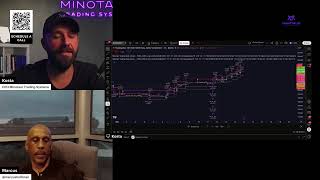
Kosta Ouzas and Marcus review Minotaur's trading tools, including a Power-Law model tracking Bitcoin at a score of 30.45 and a new Accumulator strategy that runs long and short bots together to cap drawdown at around 5%. The system adapts to different assets: mean-reversion for consolidating ones like Bitcoin and Solana, trend-following for movers like Nvidia and gold.
Chapters
All right, how you doing, Marcus?
All right, how's it going, Kosta?
Good, good. Been a, been a big week, uh, for the business actually with Minotaur. We've been making a lot of progress with the release of our new software, getting a lot of new clients onboarded, which has been great. And today what we're going to do is we're going to discuss the markets. We're going to see, uh, what Bitcoin's been doing, uh, what are algorithm looks like on it, and we're going to have a look at some of the other strategies that, that we're deploying at the moment. So let's dive into it. First chart I want to bring up is one of Giovanni's, actually, and let's just have a look, uh, where we're at relative to the power law. So as you can see here, we've got, uh, these are basically the 3 versions of the chart that I like to look at. This one here, it corresponds to what we call the power law score. So right now it's around 30.45. You can have a top score of about 100, obviously a bottom score of around 0. 0 corresponds down here to the power law support. So anything below 0 effectively means we've breached power law support, and anything above 100 would be breaching these, this sort of red band over here. So This bottom one as well tells us— this is more like a visual representation of where we should be in the cycle. So, you know, really we've, we've passed the top of the cycle. This is the one that really hasn't, hasn't corresponded. The cycle has changed this year. So instead of being at the top and coming down, we seem to have really been, uh, we sort of missed that top. And in a way, we could be catching up to the line. I think this is one of the things that we're seeing potentially. And let me know what your thoughts are on this, Marcus, because I've been sort of thinking about this later, is that this white line is a kind of sine wave. It's basically like a clap from the Genesis block, and it's showing us— it was always like that, the cycles were following this, and it was slowly, slowly, uh, decorrelating over time. But here we've really, really broken it. Now, I think there could be a few scenarios here. A lot of people thinking that we're going into a bear market here, which would bring us somewhere down like that, and, and then potentially, you know, back up, you know, following it like that. That would be one scenario playing out. Another scenario is that we actually catch back up to this line. That would look something like, you know, maybe we go like this, we overshoot it, break all-time high, and then come back down to it. Now this path here would get us from where we are right now potentially back up to $150, which would be a new all-time high, let's just say, or at least above $125. and then we could still come back down, uh, to follow it to that 87 mark, maybe even hitting cowhole support back at 66K in the future. So, you know, looking at this, I think that they're— that, you know, the two paths, they're gonna go up until they're gonna go down. But what I'm, what I'm thinking is that eventually we will recalibrate. Um, you know, all these models are— they're non-predictive, they're models that enable us to to, you know, understand the past. Um, that don't mean they're going to follow them, uh, directly. However, we could snap back to that white line. What are your thoughts on that, Marcus?
Well, I remember discussing that recently with Giovanni, um, and he was saying that— and I agree— he says that the center is the power law. He said everything else is just a deviation from it, right? So yeah, You know, yeah, so he just said he seems to think that that trajectory is still very much intact, and that's the one that keep your eye on, is that center line. So everything else is above or below. He even says that even if we don't reach the top of the previous deviations according to the model, he says it's still on, um, still, it's still intact, still healthy. and I tend to understand that.
Yeah, I agree. And you can kind of see, as long as, you know, from a, from a, you know, trading perspective and, you know, really a fundamentals perspective, that as long as we're trading within these bands, right, it is intact. Because all we're dealing with then is a deviation from the mean. The mean right now, it's actually that green line, I think, because I heard him on a podcast the other day, it should be around $137. So that's the mean there. And you can see the price oscillated around that mean for quite a while from November 2024 almost till October '25. There was nearly a full year oscillating around that mean, and then we sort of broke away from it. So yeah, people love us making predictions on this show, um, and when they see us, I'm, I'm of, of the belief that, that this was a really steep correction, and, and I think that it's more likely that we're going to see some kind of, you know, push back up to this mean and and maybe we come back down again. I truly believe that that's more the outcome, more likely the outcome, than coming back down, perhaps sweeping those lows one last time, and then slowly— that would probably put us in a crypto winter for 2 years. I just don't, I just don't see that where we are right now, that scenario playing out. I don't know, what are your thoughts, Marcus? I know we've all got different opinions about this.
Oh, there's two lines. There's the extreme line. I don't necessarily. I'm not in that camp, but I am in the camp of the lower, uh, retest.
We don't have to go much—
yeah, that's 60. We don't have to go lower than that, but I think that that is a more healthy bottom. And then that could link up with— how far is it, um, the lower part of the, um, the, uh, dotted line, the dashed line? Where's that? Where's that in time?
December.
Okay, but so you can actually come back maybe a month off of that, right, and still be in the lower part of that, right, right in there. So if we come back and retest the low, which still doesn't violate the power law, that's, that should be enough, and that puts you right there for the bull, bull, uh, run time-wise.
Yeah, so, so again, one thing that's pretty clear is, you know, even with these, these severe corrections, we didn't really even get close to the power support. You know, we still had quite a while to go, almost another 20%. So from a health perspective, it is within, you know, a healthy correction kind of area, which is good to see. So again, I guess we're gonna have to wait and see. I think, I think that there's, there's a lot of macro wins that could push this up. I think that there is also the opportunity of— we're not going to take a look at the liquidity now. Marcus can bring that up and we can see, um, what's forming above and below. Might give us a bit of a clear insight into the to that as well. But before I do, I just want to bring up the Power Law Algo. So one of the, the things that the Minotaur trading system has developed alongside Giovanni is our own version of trading the Power Law Algo. Uh, what's really cool about this, this is particularly good at trading, um, inverse perpetuals. Uh, what I mean by that is we use Bitcoin as collateral to trade an inverse perp, which realizes the profit in Bitcoin. So we like to say it's like mining with Bitcoin. And the way we've done this, we've integrated the power law into the actual algorithm itself. So you can see that that power law support there is at 57. So what we're able to do is dynamically adjust, uh, the settings depending on where we are according to the power law. So what that means is that as we stretch away from the power law to the upside, we're able to increase our deviations, uh, lessen position size, basically make things safer preparing for a crash. And when we're down the bottom, we're able to tighten things up and make it much more, uh, offensive to take advantage of the fact that we're, uh, close to the power law. So right now we just moved out of the, the bottom regime into the second, 25 to 50, uh, because that corresponds with the value of 30. So basically when this took profit here and reset, uh, these settings probably different to these, these settings here um, these settings here automatically adjusted. They're probably different to these settings here because we broke probably through that 25 power law score mark. So we're in a new regime now according to the power law and the way that we, um, set things up. And now we adjust the cloud. So that's a really interesting way that Minotaur has used the power law in order to develop our strategy. So again, it's working particularly well trading the inverse perpetual futures. Uh, Marcus, you got your equity map up there. You want to bring them up? Do you want to say anything about that Powell or algo?
Yeah, uh, definitely. Um, that gives us a, a great, uh, risk management basis. What's important is you, you always need to know your levels, your key levels, right? So For us, without having that power law, we, we'd have to defend all the way to zero. We wouldn't have a basis to, uh, frame up the universal structure of Bitcoin, right? So that power law, uh, bottom is extremely helpful for us because it gives us a very, very, uh, clear level to set our risk management from without having to have a lot of underutilized capital tied up at the same time. So it's very, very important for us to use in Bitcoin. So, um, it's very effective for us.
So yeah, yeah, uh, great. Well, let's take a look at where Bitcoin's at with regards to the liquidity.
Share my screen here. Yeah, let me know when you see it. I only have one screen.
Yeah, there you go, we got it.
All right, so we've seen what the power law has to say. See what the liquidity has to say. And, um, I am a big, big supporter of the auction market theory, Wyckoff, and liquidity. So price action creates liquidity, and liquidity creates or is a magnet for the price. So they're one and the same. One is a derivative of the other, and we like to use these derivative markets because that's where the leverage is at. If you think about it, Bitcoin has 21 million coins. It has a finite number of asset tokens directly. However, the derivatives market is many, many times bigger and will continue to grow. You could have trillions of dollars of secondary derivative assets that trade on these spot assets. So the derivatives markets are gonna become more and more of an influence on price because you have orders of magnitude more capital there. And once all these coins are, are, uh, absorbed from all these institutions and ETFs and all the spot whale investors that are buying the actual asset, it's gonna increase the, uh, perpetuation of all these derivatives. So derivatives are very, very important. And as such, when you have large amounts of leverage, then you have bubbles, and bubbles, uh, it— the, the market becomes a leveraging, deleveraging engine, right? Leverage builds up and it deleverages. So, um, what I want to focus on here is let's, let's kind of zoom in on what's currently going on. We are in this area. I think the power law is somewhere around in here. This area down here, and that's exactly where the liquidity is kind of void, or it's dissipated. So that's in confluence, uh, right now. Currently we have been trading sideways in the zone for a couple months, and we've been on this nice, uh, manipulated move up to the upside. This is extremely manipulated right here because of the uniform Uh, higher highs, higher lows, and there's a tremendous amount of liquidity building up below here that the market makers or the composite market makers will obviously come back for at some point. We don't know exactly when. Uh, currently this price action has generated two brand new levels of liquidity. That's what the price action is creating, and the market could have Uh, my theory is, um, there's the accuracy of levels and time, right? So after about 2 months, these levels break. So we're in that window. However, at this point, the market was extremely bearish, right in this regime, this area right here. Uh, and the market is a deleveraging engine. It's going to be pulled in the direction that wrecks the most accounts or where the most liquidity is built up. So all everybody was anticipating that at this point. And what does the market do? It reverses in the other direction because there was a tremendous amount of over, uh, leveraged shorts, too much short pessimism. So that's what this move is doing. It's squeezing all of those shorts out. And at the same time, when we somewhere reach this about 85 level, that's what I'm looking for. When we reach this level, that also completes the bull trap. So it's simultaneously squeezing the bears the shorts and setting the bull trap at the same time for the, uh, sweep of this low right here and probably liquidation of this liquidity. And that's probably what would occur in a couple of months, 3 months or so. That puts us in line with the, uh, catching the power law on the way back up. So that's what the liquidity is saying currently. You know, this is an extremely manipulated move here. It's too uniform. So Typically, that just traps a lot of people on the wrong side of the market. Also in this area here, as the market began to get in this area, the pessimism, pessimism started to swing from extremely bearish to moderately bullish right in here. And now it's becoming more and more bullish here. People are beginning to think it's a bottom is in, the future is bright, and And that's how it catches everybody. Yeah, so that's what the liquidity says.
Interesting, interesting. A lot of, a lot of talk online. I, I guess it's real, real bears versus bulls right now. It's going to be interesting how it plays out. Still though, you know, there's still that, that chance that it rallies further, maybe breaks out and then comes back down later. We really don't know. It really is a knife's edge.
Because prices— price and liquidity are magnets. So if it gets up there and sentiment changes, some type of Black Swan to the upside can happen, uh, anything can change that can delay that price. As long as the price hangs out up there, then it generates new liquidity, late, late longs, late shorts, and it could change its trajectory. Yeah, it's kind of like a— the market moves kind of like a Ouija board. Where you can kind of sense where it's going, but you don't know where it's going to actually end up till it gets there.
Yeah, yeah. And that's kind of why we argue that you need to have an algorithm in order to, to capture this kind of— it doesn't matter what analysis you're doing, it's very difficult to predict the direction. So you need to be in a position where you can capitalize no matter what happens, really.
That's the, that's the, that's the whole game is You don't want to predict, you want to react, and you want to set your levels and set your machines to harvest. We don't, we don't need to know that. We just need to know the longer term trajectory. We don't have to know how each candle is going to work, each candle is going to do. We don't, we don't need that to be successful.
Yeah, that's right. Marcus has actually developed a new strategy that, that is a really true almost delta-neutral volatility harvester, and it's a version of the Minotaur Accumulator. Now we've done a, uh, we've got a relationship with some exchanges now. We're able to trade different assets, um, and we're able to do this with our software. And I wanted to just bring up our software quickly. Anyone who's joining, um, Minotaur at the moment will have access to this software, but they better connect their exchanges through here. Uh, one of the cool things that we've done with our signal bot is we're able to connect with the, the— I'll come back here— the Blowfin exchange. When that comes up, you should be able to see it here. And we're able to, to basically deploy the algorithm itself on tokenized equities and commodities. And, you know, we all know that these tokenized equities and commodities don't have power laws, right? They don't follow— they don't have the same, you know, mathematical underlying structure that Bitcoin does and which we understand through the work of Giovanni. So we need to come up with another strategy, and it's more of a traditional trading strategy where we have max drawdowns and stop losses. What we're actually doing is we're, we're taking a, a kind of multi-pronged approach where we're running a long and a short bot simultaneously, but then we're also hedging the long and short bot simultaneously. So it's really almost like having 4 positions open at once, and this is working tremendously well. And I just want to do a— maybe Marcus can talk you through it, but it's doing really well on a lot of different assets. So this is Nvidia, for example, and again, another really interesting one because just had a really big rally today, uh, from $215 to $237 because, um, the talks in China went really, really well. So 10% increase on a gigantic company, uh, in, in almost 2 days, which is really insane. So, um, let me reset this because the algorithm's disappeared. Oh, here they are. All right, so you can see here we have the short positions, and you can see how they're entering, taking profit, entering, take a profit. But what I'm going to do, I'm going to switch here, and now you can see the longs on top of that. So effectively what we're doing is the short position is protecting the long position, the long is protecting the short position, and they're both harvesting volatility, the volatility on both sides. Um, this is really phenomenal the way that we've been running it, and the results have been really good. Do you want to discuss Marcus, what's going on here? People that are seeing it for the first time.
Yeah, it does a number of different things. Number of, uh, stacked benefits are occurring here. Uh, you're harvesting volatility, and ultimately that's how institutions and commercial operations trade. They try to be as delta neutral or, uh, marginally skewed as possible. So that's what you're doing. Um, so the way, way it works, what makes it effective, is markets are going to take liquidity on both sides. So if we understand that, then even at a foundational level, it makes sense to, uh, go long and short at the same time. Also, by going long and short at the same time, you're able to fold the margin requirements in half. So you can go long and short at the same time in the same account.
Yeah, and you can see here, I'm going to just flick to the short, and you can see it actually playing out. Yes, look at that, we can switch between them.
So they're able to share the margin, reducing margin requirements, because the longest side is, is adding as the short side takes, and then vice versa. So it is extremely powerful in that regard. So actually you're able to do more with less capital, which is lower risk. It may not seem that way, but it actually is because it's counterintuitive. And at the same time, uh, by having a tight margin, by folding our margin, we're able to also limit our risk, our downside and upside risk to 5% or less capped because we have the ability to, uh, obviously we'll run a stop loss with this. And you will not be stopped out on both sides, so you can only be stopped out on one side. So we're able to limit our, um, our drawdown to 5% or less. And with the benefit of the hedge, because you're hedging, it also protects you in a— the worst event would be, uh, the 5%, but the hedge subsidizes some of the cost of the stop loss, which now our net losses, 3% on one side only. So this thing is really, really a chainsaw as far as how it's generating, uh, harvesting that.
Yep, definitely. We got a question from Richard, one of our clients. He wants to know how it's running on Solana. I think you've been running some test markets on Solana.
I have a forward. I don't have it with me, but I have a forward, uh, test running on Solana. It's, it's running quite well. Uh, one of the things we like about Solana is that it is semi-correlated to Bitcoin, where it moves similarly but not exactly. So, um, and Solana respects its volume profile quite well, and it, it, uh, moves very uniformly between liquidity pools, the short to the long and long to the short. So it performs a lot like Bitcoin, just probably a half, uh, 50 basis points higher in volatility. So about half is half more volatile.
And the volatility is great. That's really what we're looking for, you know, the more volatile the better. So this strategy is really good because it's, it's basically allowing us to now trade any asset that we want. If the volatility is there, we're able to harvest it, right? Um, obviously, uh, the volume profile, there are certain, there are certain characteristics that help But again, it really comes down to how you set it up, because you only need to be studying those characteristics if you set it in a way where you're going to be actively managing it. Where we've also developing settings where you can be quite, um, hands-off.
But again, every asset has a different, um, I can speak to those two variables. Uh, mainly it comes down to two types of, uh, price action, because there's predominantly two types of price action. You have consolidation and you have breakout or discovery. So the standard way we run the, uh, hedge feature is we run it in a, uh, consolidation. I mean, consolidation is our bread and butter. That's where we make 80% of our returns, are on consolidation. We're consolidation harvesters. So we love those conditions. Like Solana, Bitcoin tend to consolidate a lot. 80, 90— Bitcoin's like even 85, 90% of the time. It's a lot. So that's money printing for us. However, the risk that you have to understand, the Achilles heel of any strategy that you're doing, if you're looking for consolidation and you have a breakout risk, uh, so some assets like Nvidia, gold, or some assets trend, they don't consolidate a lot. They're always moving in trends. And Nvidia is one of these. So we have to adjust. The beauty of our algorithm is it's a Swiss Army knife. It can be adjusted to just about any type of strategy or condition that you want to adjust it to. So what we do is on a trending asset like a NVIDIA, we will adjust the settings to follow the trend. And that setting, we use the mean reversion as our entry and exit feature because what the Achilles heel of a trend, of a trend, of a consolidation is getting caught on the wrong side of the market. So when we activate the mean reversion, what that does, that allows us to, to be able to follow the asset as it trends without being captured on the wrong side of a move that might occur.
Yeah, and these are all inputs that we've slowly added to the accumulator. So, uh, this is why when a client signs up with us, they have updates forever. The licensing fee comes with perpetual updates because the strategy is always getting better and better, and we want to make sure that everyone has the best version of the software and the strategies that we're using. So yeah, that kind of, um, brings us to what we wanted to show today. Anything, uh, you wanted to add, Marcus?
Yeah, as you were talking about how we update the algorithm and how we keep developing it, well, we're in the hurricane business, so we develop based on what we learned, what the market throws at us. Every time we get a black swan event or major bear market or correction, we get the invaluable data that we're able to feed into our models. So we actually gain from all this chaos because we're able to, uh, adjust the features to withstand the next time. So it's good information for us.
Yeah, absolutely. All right, well, that's what we wanted to cover today. Thanks for, uh, joining the show. We don't have too many questions, just Richard had a few, so, uh, we'll, we'll leave it at that. Again, we'll be doing this, uh, live show and, you know, inside our software we do promote this show. Usually Giovanni Uh, well, it'll either be on our channel or Giovanni's channel, but we're definitely going to be doing it, doing the live stream Status of the Market Thursdays, 5:30, either on this channel or Giovanni's channel, but it'll show up on both of our YouTube accounts, uh, our live accounts anyway. So great. All right, Marcus, well, thank you for your time today. All right, and we'll see you in the next one.
See you soon.










