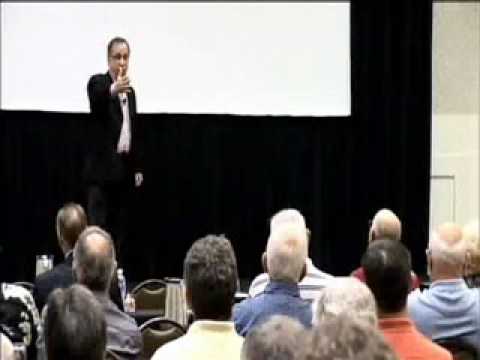
Mitch Gooze argues companies must abandon traditional planning for disciplined execution: declare a goal, craft strategy, identify critical success factors, define key activities, measure results. He distinguishes price from value, shows how companies command higher prices through unique propositions, and treats marketing and sales as a manufacturable process using lean methods and constraint theory.
Chapters
Are we having a good afternoon so far? I mean, the only thing that's happened is lunch. I'm gonna try not to screw it up from here on. So, why was I invited to speak to you today? And I think the answer is what we learned this morning from the economists. The economy's not gonna help us grow. So, if we wanna grow, we're gonna have to do it on our own. And that's what I'm here to talk to you about. Hello. Why would you want to grow? I mean, if the economy stays flat, you don't have to grow. You know, you can just maintain your same market share. You can continue to do things the way you've been doing them. The problem is, what I've discovered in most industries is that everybody doesn't agree to cooperate. And if the market's not growing and somebody else wants to, then you have to agree to shrink. And that's probably not on your agenda. So if you're not growing, somebody else is probably gonna grow you into nonexistence. So you're gonna need to bucket your— buckle your seatbelt. If you don't know what that was, you either don't have kids or you don't treat them well. That's the beginning of Space Mountain. 'Cause this is gonna be an e-ticket ride. If you don't know what an e-ticket ride is, find a more older person and ask them. But like many e-ticket rides that upset you or shake you up, I may do the same thing. Because I need to challenge your thinking, and I need to get you to think differently. Because if you want to grow, you can't keep plodding along. The world is changing. The world is getting more dynamic across all industries. And if you try to do things the same way you did yesterday in tomorrow's market, it's probably not gonna work for you. We saw just before lunch what's going on in the consumer electronics industry. That was my very first ever trade show, was a consumer electronics show. It was in Chicago in winter. I'm from California. I don't even own a coat. And they sent me off to get some stuff, 'cause I was also the junior engineer. And so I'm walking along the streets of Chicago, and I stop at the street corner, and I notice that everybody on the street corner is not standing on the street corner except me. And I realized I better back up, 'cause I don't know why. And that's when a car went by, and the water and the mud went everywhere, and then I knew why. So— But we saw even in consumer electronics that they're gonna be struggling to find ways to grow. Everybody's gotta find ways to grow. If you don't, your competitors will, and they'll grow at your expense because we already see that the economy's not gonna help. Your customer base is demanding. I don't have to tell you that. They're getting more demanding every day. Expectations of customers just keep rising. Business would be so much easier if it weren't for the demands of customers. Or you could just operate like the airline industry, which really doesn't care about customers all that much, as far as I can tell. In fact, I've decided that passengers are an inconvenience to the efficient movement of airplanes, which they don't do anyway other than Southwest. Anyway, your competitors are not going to sit still. They're not going to worry about what might happen to your business if they do what they're going to do. They don't really care. Small differences. Make a big difference. Michael Phelps won the gold medal by 0.23 seconds. And as they have said for a long time, since Satchel Paige at least, don't look back because you never know what's going to be gaining on you. I'll have another one. $1.24 million for coming from behind and winning that race. The horse that came in second Won $400,000. Now $400,000 is nothing to sneeze at till you understand what it costs to raise and train a thoroughbred. But look at how— look, the winner earned 3 times as much money as second place. That's true in business as well. That's true in business as well. The only constant in the world is that things are going to keep changing. If you like the way things used to be, and you wish they would go back to that, you need to hope you're approaching retirement age because it's not going to happen. We're under tremendous pressure from all these changes, all these demands, and the gosh darn competitors that won't leave us alone. And of course, there are lots of people out there to help you waste a lot of money on the latest marketing fad to help you. There's no shortage of marketing gurus who will tell you I'm from California. Gold was discovered in California in 1849. You probably can't name a single gold miner who made money in the Gold Rush, and there weren't very many. But lots of suppliers made lots of money selling the secrets and supplies to gold miners. I'm from Texas. Biggest one you know very well, Levi Strauss. Made a fortune selling supplies to gold miners. If those marketing gurus actually knew the secrets to success, they would use it themselves rather than try to sell it to you. I use the horse race clip for lots of reasons, including that my mom loved the horse races. Now I'm not telling you she was an addict, she just liked to go to the horse races. And we still ate. Come on. But when I was a little kid, I probably went to the horse races more often than most little kids. And I remember one of the first times that she took me that I was old enough to recognize what was going on, we're walking into the racetrack and the touts are outside selling the tips. And I said to my mom, I said, Mom, shouldn't we buy that so we'll know what to bet on? And she looked at me and she said something I have never forgotten. What did she say? Do you think if they knew who was going to win, they would be outside here telling you? They'd be inside betting on the horse. There's lots of ways to waste money, but that doesn't mean everything is a waste of money. You either move forward, or you're going to get pushed backwards. You can't tread water. It's not working anymore. So, what do you want to do about this? Because it's up to you. What do you want to do about this? That's my question. I think we need to get out of the way. For the day. What do you want to do about this? Because to survive and thrive, you have to have a profitable strategy. So I want to take just a minute and give you some thinking about creating strategies and executing strategies. I'm not about strategic planning. Strategic plans impress the bank. Somebody who's in the business told me once that They're pretty sure that more than 80% of all strategic plans are in a drawer someplace. I'm about getting you to think about strategic execution. So what is a strategy? When we say you have to have a strategy, what do we mean by that? I'm gonna show you a very simple framework. If you like the framework and you want a little bit more about it, if you see me in the hall later, just hand me your business card. I'll send it to you. No salesman's gonna call you. Okay? But it's very simple. You start with a goal. The goal is declared by the owner of the company. If you are the company's owner and you haven't declared a goal, what do you think your people are working on? If you work in a large company, the board of directors is the proxy for the owner. They have to declare a goal. In my opinion, employees don't vote on the goal. They should know what the goal is, and if you can't support the goal, don't take a paycheck. Go someplace else. Once you know what the goal is, then the question is, what's your strategy to achieve the goal? That strategy is impacted by environmental influences. We had some great speakers this morning talking about the external influences that they see that could impact your business. Some of those could Could be very positive for you. Others could be negative for you. The strategy you create is designed to take advantage of what your company internally is great at, take advantage of those external factors that are in your favor, and mitigate the ones that are operating against you. Once you have a strategy, Then you have to identify what are those few things, and I mean few, could be 10, 20 at the most, critical success factors. What are those critical success factors that must happen for the strategy to be executed? Because if the strategy is executed, the goal will be achieved. So what are those few things that must happen? They are necessary. They are critical. And sufficient, such that if you do them, you know the strategy will be executed. What are they? You have to identify them. They could include hiring a key talent. They could include expanding your facility. They could include developing or acquiring a new technology. What are they? Then what are the key activities that you have to make sure happen so the critical success factors will be executed? So the strategy is executed, so the goal is achieved. And then how are you going to measure the performance to make sure those activities are actually happening, so that you're not just getting closer— excuse me, so that you're not just getting further from the beginning, you're getting closer to the goal. The cool thing about this hierarchy is everybody knows how they're contributing to the success of the company. And it's very easy for you to recognize Things you're being asked to do that don't contribute to the strategy. The bottom line is if you have an activity that isn't required by the government, that doesn't support a critical success factor, why are you doing it? Why are you doing it? And if the answer is because you're having fun, okay, but don't confuse that with a legitimate business expense. So to create an effective strategy, you have to have a goal. What's your goal? Is your goal to sell the company in 5 years? Is your goal to hit a certain number in 5 years? What is your goal? Because if you don't care where you're going, any road's gonna get you there, and you still won't know where you are when you get there. So step 1, declare a goal. If you are the owner of the firm, it is your required job, says me, to declare a goal and make sure everybody in your company Knows what the goal is. Now, sometimes if the goal is to sell the company, you're gonna package it differently because it does make people nervous to realize that you're gonna sell out from underneath them. I get that. All right? And then you follow the strategic execution process. Set a goal, build a strategy that will achieve that goal, align your resources to those things which will cause the goal To be achieved because the strategy's executed. No more and no less. And again, if you want some more information about this, just hand me your card if you see me in the hallway. I'll be happy to send you some more stuff on it. OK, next step. What do these 3 words mean to you? Price, cost, value. Price. Your customer has to differentiate between the cost of your products and services to them, the value they receive, and the price they pay. One of my good friends, Ted Steinberg, used to say when people would ask him, how much does this cost? In many cases, he'd look the customer straight in the eye and say, you mean if you buy it? Or if you don't buy it. Value in all cases is measured by the receiver. The person acquiring the value is the decider and definer of the value. And customers don't care about the following things, at least. They don't care what it costs you to do it. Especially in the automobile industry. They don't care how hard it was. That's why they're paying you. They don't care what it took to do it. Stop whining about it. They don't care about your systems, and they don't care about your rules. All they really care about is everybody's favorite radio station, WIIFM— what's in it for me? What's in it for me? Here's a question. What is the customer buying from you they don't believe they can buy from anybody else? I want to take a minute and I just want you to think about that for a second. And I want you to write down a couple of keywords, a sentence, a paragraph. I want you to write down how you would answer that question if I asked you one-on-one. What it— what can customers buy from your company they don't think they can buy from anybody else? Now, here are the caveats. You cannot use the words quality or service in your answer. You know why? I've asked thousands of CEOs this question. None of them ever said, we sell crap but it's cheap. Everybody claims quality and service. I even had a junk dealer. In one of my audiences, and he didn't claim it was junk. Nobody claims poor quality, and nobody, even your worst competitor, can't get out of their own way, claims that they give bad service. The airlines tout their customer service. I'm not sure what planet they live on. I don't get it. So I want you to think about that. What can customers buy from you they don't think they can buy from anybody else? I think that's a great question. Now, let me give you some examples to show you how this works. I want to start by looking at what you drive. Now, I'm assuming most of you flew here or took a train or something. You didn't drive your car here. I'm sure some local people did, but most people didn't. So I have no idea what you drive. I have no clue. However, I have discovered that senior executives in most companies drive a Mercedes. Drive cars. Come on, that's pretty smart for a guy from California. You gotta admit that. But I've also discovered that senior executives in many companies don't drive cars. So if they don't drive a car, what do they drive? Well, it depends. I'd have to see it. But if what you're driving costs more than $80,000 and you think you're driving a car, Could you put a little star on your business card when you give it to me so I can call you later and sell you some stuff? Am I saying that if you drive something that costs over $80,000 that you wasted your money? No. But it can't possibly be a car, because then you'd be a fool. Come on, you can buy a car for $30,000. You can buy a car for $20,000. Come on, why would you spend $80,000 on a car? That doesn't make any sense. So if it's not a car, what is it? I don't have to see it. But if I see it, I can tell you in a heartbeat what it is. Might be the ultimate driving machine. That's the only thing those folks make. It says so. It's all they make. Could be a prestigious automobile. Might be a toy. Might be a Tesla. I wanted to get a Tesla. Especially when the SUV comes out. My dog's too big for the car, but the SUV looks really good. But my wife said we can't have one. And I said, why not? It's good for the environment. She said, I know, but we can't have one. I said, why not? She says, because apparently if you own one, you have to wash it every Saturday. At least that's what our neighbor does all day long. So it's not a question of right or wrong. It's not a question of anything other than what are you buying? The holidays are coming up. If you brought your significant other with you, this won't help you. But if you didn't, I'm going to save you some money by teaching you something most people don't know. Rubies are 45 times rarer than are diamonds, and most people do not know that. Rubies, when converted into jewelry, generally results in less expensive jewelry than diamond jewelry. Why? So now that you understand this price-value mismatch, you can leverage it. What you do holiday season, Valentine's Day, anniversary, any event where it's jewelry is the right thing to do. You buy ruby jewelry, gift wrap it really nice, give it to that special person in your life. When they open the box and they are surprised to see that it's rubies, that is when you explain to them that rubies are 45 times rarer than our diamonds. And when that doesn't work out for you, don't blame Knox for inviting me to come here. Because it's not gonna work. And it's not gonna work for a very simple reason. About 80 years ago, the diamond marketing cartel created a what for diamonds that everybody in the room knows. Diamonds are forever. And if diamonds are forever and you give that special person rubies, how long is that for? Forever. Less than forever. Less than forever, apparently. You don't think rubies wear out, do you? Of course not. But once the diamond industry took the position that diamonds are forever, what was left for the ruby industry to say besides, us too? Now, you're thinking, OK, great. High-end cars, high-end jewelry. Come on. We're in much more of a commodity business than that. So are you in more of a commodity business than dirt? 'Cause I'm gonna give you my dirt example, 'cause it's the best commodity example I've come up with, and so far in all my audiences, nobody claims being more of a commodity business than dirt. The largest aggregate supplier in Northern California is a company called Granite Rock. Granite Rock's been digging aggregate up out of the ground for over 100 years. I met the CEO in the late 1980s. He had apparently sat in on one too many value-added marketing presentations, and he came up to me, he says, I am sick and tired of being in the commodity dirt business. We're getting in the value-added dirt business. I said, that is really cool. I said, will you be getting new quarries? He said, are you nuts? I said, well, where are you going to get value-added dirt from? He said, you'll have to watch. Took him 10 years to do what I'm going to describe to you. It has now been 25. When he started this process, they were the number one aggregate supplier in Northern California, and their business strategy was low price leader and low-cost producers. They'd make a profit. Today, they are the number one aggregate supplier in Northern California, and their prices on average are 6% higher than everybody else's, and everybody knows it. Who'd like to raise their prices by 6% and not lose any business? Yeah, come on. What did he do? Well, he looked at what the customer was buying. Turns out when you buy aggregate back in the '80s, you had to buy whole truckloads, and you could have it delivered any day you wanted during the delivery window, which was noon plus or minus 6 hours. And if you needed a fractional truckload, like 14.5 truckloads, forget it, you got 15. Which meant when the job was over, you had to pay to haul all that aggregate away. Today, Granite Rock will sell you however much aggregate you want in whatever quantity you want, and they will deliver it plus or minus an hour if that's what you want them to do. They're still the number one supplier. Their prices are higher because the cost to the customer is actually lower. What is your customer buying from you? Here's an exercise I encourage you to do when you get back home or to your office. Ask everybody in your company who has a customer-facing job— that would be salespeople, marketing people, customer service people— ask every single one of them to answer that question: what can customers buy from us? What can customers buy from us? They don't think they can buy from anybody else. And tell them they can't use the words quality or service. Here's what will be unfortunately true. You will not get consistent answers from the people in your company, which means depending upon who I talk to, I will get a different story, and none of them have the right answer. When salespeople don't know how to answer this question, what do you think they do? They make it up. They make stuff up. What would you do? Come on. If nobody's a low-price leader, that means I've got to go out and justify a higher price. And when the customer says, well, what makes you different? Nothing. Doesn't go over very well. So salespeople have to make something up if you don't teach them what it is, which means they make stuff up. And when you don't win the job, what is the reason why you didn't win the job or the project? Your price was too high. No. No? There was no value I could perceive. And you can't be all things to all people. Don't even try. So, before coming to speak to you, I talked to a few people to get some ideas, and then we sent out a couple of emails asking you to ask me any questions you wanted to. Many of the questions I got were in alignment with things I already talked about, but I did get a few questions that weren't already going to be included in the content. And my promise was, if you asked me a question, I'd answer it. So I'm now going to answer them. So a question I got was, as a general rule, is it better to have 12 smaller customers or 1 bigger one? My opinion, 12 smaller ones. There are people who like having 1 big customer because it's a whole lot less hassle. The problem with most companies that have one big customer, 80%, 90%, or even 100% of the business is you begin to price that customer's business as if it were a marginal contribution business. And you erode your margins because they keep asking you for price reductions. And you're afraid of losing them as a customer, so you cut your price. And pretty soon you have no money to invest in R&D, you have no money to invest in marketing, you have no money to invest in sales. All you have left is the pay you now get from your employer and a hope that they won't cut you off until you've paid off all the equipment you bought for your new job. So I'm a big fan of spreading the customer base out and trying not to have too much concentration in one customer. If you were put in charge of a newly acquired company in a geography or market that is new to you, What would be the highest priority in trying to grow your business and revenue in a market with several well-entrenched competitors? Well, let's not talk about what caused us to acquire that company. Let's just take the question on its face. The best thing the CEOs in this room can do is stay out of the office. You are legends in your own mind about how helpful you are operating your company. Today and tomorrow will be 2 of the best operating days in October in your company because you're not there helping. The truth of the matter is the best skills most CEOs have is understanding the customers and where the customer's going. You are the chief marketing officer of your company unless you're over $100 million in revenue. In all likelihood. So what would I make my highest priority? Get out of the office and spend time with the customers in that territory, both the ones I already had and the ones I'd like to have. Not to try to sell them anything, but to understand what it is they're trying to buy. What are they willing to pay for they're not getting, or what would they pay less for if they could do without it? Get out of the office and spend time with customers. Most CEOs don't do that anymore. Most CEOs, the only time they're out of the office is to come to a conference— good thing to do— close a big deal, or apologize for something you screwed up. I want you out of the office to understand the customers, because your job is to think like a customer, not hope the customer thinks like you. We have done some basic marketing. We participate in some trade shows, do some advertising, have a decent website, do selective mailings. What's the best way to start to formalize our marketing effort with a strategic approach? We have somewhat limited resources and want to maximize the value for what we spend. Well, let's talk about the first thing, which is trade shows. How many of you exhibited at IMTS? Good. Excellent. How many of you have a plan That you know what it is and will know if it's executed to convert the leads you got at IMTS into revenue? A lot fewer of you, and probably several of you raised your hands aren't 100% sure you actually know what's gonna happen because the vast majority of you, if you do anything at all, you give the leads to the sales force. It is a proven fact that the best thing for a salesperson to do with those leads is throw them away. That doesn't mean none of them are good. It means most of them are a waste of time, and that's what most of them are going to do with. Well, they'll hold some of them up to the light to see if they can figure out which one the good ones are, or they'll use it to get into a company they already wanted to get into, or to have an excuse to call somebody that they've been calling on already. You need a plan and a strategy to qualify those leads and to know what's happening with them and to close the loop to see whether or not. it worked. Because most people, when I ask them about trade show participation, they can tell me about the order they got. Trade shows are great, but work them correctly. So the rest of the question had to do with formalizing marketing. So let's talk a little bit about marketing. Our definition of marketing is very simple. It's marketing's job to align the capabilities of your company With the current and future needs of your customers. It's an alignment function. It's figuring out what your customers are going to need tomorrow. The 2 quick examples, many years ago the Oakland Athletics baseball company called us to see if we could help them sell more season tickets. My initial response was, could we get a good baseball team? Their response was, could we go with Plan B? We helped them a little bit, but they never really sold the stadium out until they got a good baseball team. If you get a great product, you don't have to promote it so much. In the middle of the biggest downturn most of us have ever seen or heard, Apple's got people wrapped around the block to buy their next $400 product, which is twice as expensive as everybody else's. They don't promote it. They make great stuff. Marketing's job is to figure out what the customer's going to need tomorrow. It's the Wayne Gretzky analogy. They asked Wayne Gretzky many years ago what made him a great hockey player. He said, I skate where the puck is going to be. Everybody else is skating where the puck is. Marketing's job is to figure out where the puck is going to be in your business, in your industry, for your customers. There are 4 overarching roles to marketing. I will go through them quickly. This is another thing, if you want it, I've got a paper. I'll be happy to send it to you. Just hand me your card in the hallway and I'll get it for you. Strategic marketing, that is the job of the CMO, which is to create— oh, you remember who I told you the CMO was, right? The CMO's job is to create a marketing strategy. A marketing strategy is about how to grow the business aligning with the company's overall strategy. Product management is about what are the new products or services or new markets you're going to go after. It's about stuff you don't do today. What new products should you come out with? What new services should you come out with? What new vertical markets should you go out with? What new geographic markets should you go out with? It's all about new. If you abdicate that to R&D or engineering, you get things unlike this. This remote control is perfect for me. It has 2 buttons, forward and backwards. Do you know how hard it is to find a remote control with only 2 buttons? Because nerdy engineers think more buttons are better. The AV experts in the back know. People like me— Can't do it. They can't handle more than 2 buttons without screwing up their whole life. And you saw early on, I almost screwed it up anyway. Product marketing, those are the people responsible for your current products and services. Their job is to make sure that your current offerings are competitive, that they're positioned correctly against the competition, and to know when to phase them out. If you abdicate that to sales, which is what most companies do, you'll never phase out anything because I might sell one. And you suck your salespeople into spending a third of their time doing that job, which takes away a third of their selling time. They don't do it as well and they're not selling. So if you have at least 3 salespeople, you can afford a product marketing person. Whether you've got enough work for them to do is a different conversation. Role number 4 is the one most of us think of as marketing, and that is marketing communications or marketing services, sales support, or in modern companies we call it sales enablement. Like salespeople are disabled for some reason or other. I don't get that. It's where you spend all the money. Website, collateral material, brochures, trade shows, advertising of one form or another. It's where you write all the checks. That's what most people think marketing is. It is a function within marketing. It's where most of the money gets spent and it's when small companies first hire their first marketing person, they generally are hiring a marketing communications person. The problem is the CEO thinks they hired a marketing person because they don't realize of all the other roles. So they hire a marketing manager who studied journalism or communications in school. Isn't going to say, well, look, I didn't really study marketing in school. You shouldn't call me a marketing manager. They go and tell mom, what do you hear about the hot title I've got now? They come on board, and the first thing they do is change your website, change your logo, change your brochures, change your collateral material, update your trade show booth, and. You spend twice as much money as you were spending before they came on board, plus you got to pay them. I'm not dissing marketing communications. It's a very important function. But if you don't have product marketing people to tell marketing communications people what's important and what to talk about, they'll do whatever is interesting. And if you don't have product management people focusing on what the next generation of product, service, or markets are for you, you're going to be trying to promote the wrong stuff in the marketplace. You may remember a number of years ago the so-called friends and family pricing program that the automobile industry was running. Everybody called that brilliant marketing. That wasn't brilliant marketing. It was brilliant promotion to cover for a lack of marketing. What was the lack of marketing? None of them had any cars anybody wanted to buy. We were working with Chrysler at the time. They said, we don't want to talk about the PT Cruiser. We can sell them out. I said, well, then why don't you just develop some more cool cars people want to buy instead of trying to discount and promote the ones nobody wants? That's marketing's job. Skate where the puck is going to be. Otherwise, you gotta hire salespeople that are better than average to make up for the fact that you didn't do a good job in marketing. Last question. How does a technically focused company which is managed and owned by engineers— I are one, so I sympathize with you— use marketing to achieve growth goals of 10% a year? Well, we saw from the economists, they're not gonna help. Which means we gotta do something different. So what will it take to grow? What will it take to grow faster than the economy? The answer to that question is, you're gonna have to take market share from somebody else. But in order to figure out what to do, says me, it's time to think differently. You have to stop using the try something loop. You're all familiar with the try something loop. Nobody's ever called you on it. You know what the try something loop is? That's when sales are down and you bring all your sales and marketing people together in the room with flip charts and you brainstorm what to do to grow revenue. And you have a flip chart full of ideas and then you use a sophisticated mathematical technique to pick one. Everybody votes for 3 and the one with the most votes wins, or we just short-circuit the whole thing and do what the CEO wants to do. And when it doesn't work, you have the meeting again. And that continues until the economy improves or you fire the sales manager. Now, this seems silly when I point it out, but you've been doing this all along. And here's what really is funny. If your VP of manufacturing was having a production problem and you went to him or her and you said, what are you going to do about that? And they said to you, no problem, boss. I'm bringing all the production people in and the production engineers. We're going to have a brainstorming meeting this afternoon. And we're going to list out all the possible ways to fix this. We're going to vote on the one we like best, and we're going to try it. They wouldn't have finished the sentence before you fired them because you don't think that marketing and sales is a process to produce something, and you don't manage it that way. If you did, you would never use the try something loop because you don't use it anyplace else. You use constraint analysis or bottleneck theory. If you have a lack of throughput in your revenue, where's the bottleneck? Unless you have 50% market share or 40% market share, the market is not your bottleneck. I will concede in 2008 and 2009 it might have been, but today it's not. If you have 3% of the market, 97% of the market's available to you. Go get 3 more percent, you doubled. So don't tell me it's the market that's the constraint. Something that you're doing or not doing is the constraint. So why not apply constraint theory to marketing and sales? Then you don't have to use the try something loop. Constraint theory can be applied to marketing and sales. Again, if you hand me your card, I'll send you a paper on it that we wrote. We believe that if you start— I'm sorry. Thinking about marketing and sales as a manufacturing-like process, it becomes very interesting. Today, this is how most marketing and sales processes work. It starts with marketing. There's this big black hole in the middle, and hopefully it— something happens in sales. The disconnect between marketing and sales is well recognized. People have been trying for years to resolve it. They think that if they find the handoff point that is correct, they'll solve it. Or if we can just get the people to get along together, it would just be so much better. But let's compare that to the manufacturing process around 1970. Looked pretty much the same. What did engineering used to say? We give it to manufacturing to build. What did manufacturing say, or production say? They throw it over the wall to us, and it's unbuildable. Problems in production in the 1970s were assumed to be production problems, just like Lack of revenue today is considered to be a sales problem. Well, Deming taught us that the problem in production wasn't necessarily a production problem. It could have been designed to be unproducible. So you're all familiar today with design for manufacturability or design for producibility. That same construct. can be applied to marketing and sales. If you think of marketing and sales as a customer manufacturing process, what are you trying to produce? Loyal, profitable customers. It's a business process. And this— the cool thing is that the analogy works. We've spent 14, 15 years now Yeah. We're looking at this and understanding it. The relationship between marketing and sales is scarily identical to the relationship between design and production. And the cool thing is all the stuff y'all spent 50 years trying to solve in the manufacturing arena, we just steal it all and apply it to the customer manufacturing arena. It's very simple. If you want to grow revenue faster than the market, Figure out what the bottleneck is. Apply lean thinking principles. We just finished working with a manufacturing company, took their time to market from concept to market from 18 months to 90 days by applying lean thinking to the process. And then of course continuous improvement, which we're all aware of. They can all be absolutely applied to marketing and sales if you think of marketing and sales as a business process. So what are you going to do with what I've talked about today? What are you going to actually do? There's 5 possible outcomes I can think of. One is you can reject it altogether, which you're entitled to do. You can say yes but never do anything about it. That's pretty common. How will you know when it's time to do something about it? You'll know when you're not making money. You can make an attempt but not commit, which unfortunately happens in a lot of companies. You can do it but not implement it correctly, or you can implement it and enjoy the benefits, which makes it transformative. Think about marketing and sales as a business process. The marketing people have escaped business process scrutiny forever. The time has come when they can't anymore. Thank you. My dad was a rocket scientist for 45 years. He has looked at this presentation, and I am here to tell you, he assures me this is not rocket science. So, again I ask, what are you going to do about this? If you work in a company and your answer is, I'm going to wait and see if the CEO or owner wants to do anything about it, that's not very productive. You came to this conference to learn something. Take it back and push on it. As the great Jedi Master said, do or do not, there is no try. So I want to leave you with a story. As I told you several times, I live in California. We don't have very many or any old-fashioned merry-go-rounds, Ferris wheels. I mean, Merry-go-rounds. Merry-go-rounds, yeah, carousels. So several years ago, took the family to Cape Cod for vacation. Fortunately, we went before the season. I had no idea there was a season. But we went before the season, because when we left, it was the first day of the season, and the traffic was backed up from Cape Cod to Maine, I think. So as part of our trip to Cape Cod, we took the ferry over to Martha's Vineyard. And if you take the ferry over to Martha's Vineyard, you will find when you get off the ferry, there's a very old carousel there. And I love carousels. And I'm watching this carousel go around. And little kids are on it. And I'm noticing they're doing something I've never seen before, which is they're reaching up and grabbing stuff. And I'm not sure what they're grabbing. And I'm paying attention. And I finally figure out they're grabbing rings. And if they grab the brass ring, They win a prize. And all the kids are doing this except one little kid. One little kid is not doing it because he's probably 2 and a half or 3, and he's holding onto that pole for all his— I mean, I think his knuckles are white. Now his mother is standing right next to him. Nothing bad is going to happen to him. He's just scared. But he's watching all the older kids. Grab the ring. And I don't know how long this ride's gonna last, but I'm watching this kid. His mother's oblivious. She doesn't know what's going on because she's just there to make sure he doesn't fall off the horse, right? And I'm watching this kid, and I'm watching his upper hand begin to loosen up a little bit. And I'm wondering, you know, are you gonna get enough guts to grab that before the ride finishes? And I'm watching him, and I'm watching him think about it really hard and screw up his courage. And he's gonna do it. And I would love to tell you that he got the brass ring, but he didn't. But what he did do is he grabbed the ring, and that was a win for him, 'cause he had no idea he could win a prize anyway. In order to get different results, you're going to have to do things differently. Every process is perfectly constructed to produce the results it's producing. If you don't have the guts to change, Don't expect different results. Thanks for listening to me. Thank you.