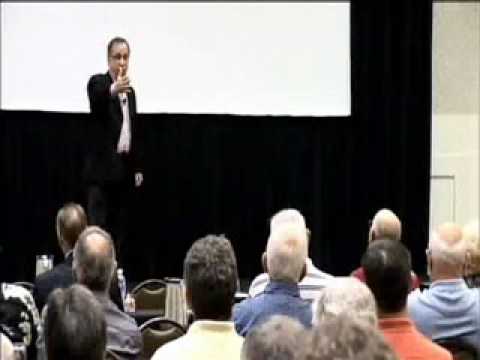
Mitch Gooze argues that associations confuse marketing with advertising. Real marketing starts by defining what members can get nowhere else, then reaching them where they already are. Engaged members who see ongoing value are more likely to stay.
Chapters
Hi everybody, I'm Keri Fearneck with CNTV. We're glad you're joining us online. Joined now by Mitch Gooze, who is an author, and we are here to talk about marketing, but maybe in a different way than we've been talking about marketing so far, right?
I hope so.
We're glad you're here, Mitch. So we've been talking about marketing and communications, but you say really there's more to it than just that, right? Tell us what you mean.
Most people, and literally I really mean most people, academics, Senior executives in big companies and small companies and human beings have a perception of marketing primarily as the communications things that they see. The ads they see on TV, the viral videos, the print ads, etc. And those things attempt to communicate a message to an audience.
Right.
The question is, what message are you trying to communicate and to what audience? Well, somebody has to figure that out before you can communicate, right?
So how do we do that? I mean, I guess all the association folks watching might say, okay, wait a minute, I've got to communicate, but how do I determine what it is that I'm saying?
Yes, so the key question is, what can I get by being a member of your association I can't get any other way? Or what can I get by attending your event or getting your certification or otherwise engaging with your association? association that I can't get any other way? And then, who wants that? Now, clearly, I met a gentleman yesterday who's the president of the Chest Physicians Association, which I thought was a pretty interesting thing. And it's pretty clear that if you're not a chest physician, you can't be a member of this association. So the who is pretty clear. But then the question becomes, what do I get by belonging to that association? Then you can figure out how to communicate it.
So let me ask you this in terms of, let's say that I've determined my message now, and I So we need to communicate. We've had a lot of discussion on the how do you communicate. Do you have thoughts on that? Any specific ways that work better than others?
Well, it really depends upon your audience. So people ask me all the time, should I be on LinkedIn? Should I be on Facebook? Do I need a webpage? What about social media? And, you know, as one of your guests talked about earlier, you can spend a lot of time doing that, or you can spend a little bit of time doing that. But the real question is, Nobody has enough time, so what should I spend my time on?
Right.
And so the answer I always give is, what is your audience already doing? If you and I were sitting here— kind of funny— over 100 years ago and you said, well, what do you think about this newfangled thing called the telephone? Should people get involved with that? I would say, well, if your customers or prospective members are using the telephone, you want to consider it. If your customers are using a media, you should consider that media. But if they're not, then not.
And once you've figured out how you communicate with them, you have to constantly get feedback, I'm guessing, to make sure your message is relevant to them, right?
Which really, it's all about measurement. Okay, so that's another thing that I talk about is how do you measure how you're doing? Now again, people in measurement, they tend to focus on did my media work? And there's a whole technique called marketing mix modeling that helps you figure that out. But when the iPhone came out, it was the middle of the worst recession most living people have ever seen.
Wow, that's true, isn't it? I'd forgotten about that.
I'm pretty sure that the iPhone is not the least expensive smartphone on the market.
Yeah, no.
And yet people were wrapped around the block 4 times to buy the most expensive phone with no L on it.
In a recession.
Why? Because Steve Jobs was a genius at figuring out what his customer wanted. If you don't do that well, all the advertising in the world won't work. It's kinda like a number of years ago when they couldn't sell cars, they had the friends and family pricing program, which was— people called it brilliant marketing. I called it brilliant promotion to make up for bad marketing. Because if you had cars people wanted to buy, you wouldn't need the promotion.
That's true, that's so true. So what's one of your main takeaways for associations as we wrap up? You know, when somebody listens to your session, when someone reads your book, what's your main advice to an association?
Well, for an association, I really think it's about increasing engagement with your members and between your members, because the more they're engaged with the association, the more likely they are to continue to find value in the association. If there's— if the only thing I belong to an association for is credentialing, well, that's not really an association. That's sort of holding me captive.
Right, right.
But if there's engagement, and so the real question is what new services, what new offerings should you consider to increase engagement with your members?
Interesting. Good question, and one that I know a lot of folks are gonna be asking themselves after this. Mitch, thank you so much for being with us.
Thank you, Kari.
That's another one of our great interviews right here at Forum Forward TV.