Career Design: Taking Ownership of Your Path (feat. feat: Mollie Amkraut Mueller) | Ep. 145
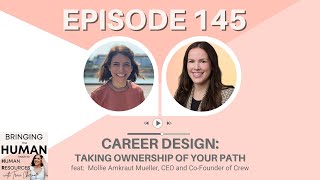
Podcast episode (YouTube) where host Tracy Chernoff interviews Mollie Amkraut Mueller, CEO/co-founder of CREW, about career design for "squiggly" careers. CREW is described as a career design platform combining digital tools, content, and group coaching. They explain applying design thinking to careers through stages: "me search" (self-reflection), synthesis, ideation, prototyping/experimentation, and storytelling. Key claims: careers are increasingly non-linear; lack of career development is a top reason employees leave; individuals should take ownership of their careers while organizations should provide scalable supports and equip managers. Practical prompts include the "work view" question (work as means to an end / work enables success / work is purpose). Closing includes call-to-action to visit joinacrew.com and connect on LinkedIn.
Questions this video answers
joinacrew.com
Chapters
Are you tired of your valuable ideas and suggestions getting lost in the shuffle? Well, that is why I'm introducing Direct Suggest, the revolutionary digital suggestion box that.
Puts your voice front and center.
With Direct Suggest, you have the power to make a difference in your organization. Direct Suggest provides value to organizations in various industries worldwide, including notable brands like Comcast, TD bank and Nokia. And here's the best part. Direct suggest only costs $0.50 per employee per month, making it an affordable solution.
For businesses of all sizes.
Plus, they have an incredibly high ROI and savings potential with an average 33 times return on investment. The implementation process is also a breeze. Once committed, setting up Direct Suggest from start to finish can be completed in as quickly as a week or less. Don't let your ideas or your team's ideas go unnoticed. Visit directsuggest.com today and start by making a difference with With Direct Suggest. Use the promo code HUMANHR for your extended 60 day free trial. Again, visit directsuggest.com to learn more. And remember to use promo code HUMANHR for an extended free trial. Direct Suggest where your voice matters welcome.
To the Bringing the Human Back to Human Resources Podcast.
I'm Tracy Chernoff and I've spent my entire professional career in hr. Each week we'll explore the delicate balance between people and business with the aim.
To reconnect the two and create meaningful outcomes. Listen in as I share my own experiences, challenge the status quo, and chat.
With guests from various industries about our.
Mission to bring the human back to human resources. Hi everyone. Welcome back to the Bringing the Human Back to Human Resources podcast. Thank you so much for being here for another week. Don't forget to rate, review, subscribe and subscribe to my newsletter on my website hrtracy.com this week we're talking all about careers and career design. We with a very special expert guest, Molly Mueller, who is the CEO and co founder of crew, the career design platform. CREW helps people navigate increasingly fluid careers through digital tools, online content and coaching workshops and programs. Molly's interests in careers dates back to college when she worked as a student career coach and wrote her senior thesis on employee engagement. After getting her CPA and MA in accounting, she pivoted hard into the creative side of business and spending four years at IDO innovating new products and ventures. She founded CREW based on her own experience of working with a coach and finding her own crew of professional peers. When not nerding out on careers, Molly can be found doing anything outdoors, training her incredibly naughty goldendoodle or drinking tea while reading A great book, which I love. I love all of those things, including the career stuff, but especially the personal stuff. So, Molly, welcome to the podcast.
Thank you, Tracy. It's so great to be here. Yes.
I'm so glad that you're finally here. We've spoken a number of times over the last few months and what you're doing at CREW is super, super exceptional. I think when we think about HR leaders and career design and talent development in general, we seldom find tools that are really kind of paving the way for the future of career design or even challenging the status quo. So for those who might not be familiar with crew, can you give us like a little bit more of a deep dive into what CREW is really solving for, what problems CREW is solving for?
Absolutely. So CREW is based a lot on my own experience and really the experience of my friends, my classmates, my peers all around me. And you know, I've had a really squiggly career and that is now the norm. Right. We squiggle maybe even more than we go up the ladder's steps. And at various points in my career, I have felt a lot of ambiguity and have often felt stuck or confused about which direction I wanted to go in and needed some help getting clarity and also confidence on my direction of travel. And I also saw that, as I said, amongst my peers, you know, my colleagues at ideo, my business school classmates, my friends, as you said, I've been been interested in careers for a while, so I liked to ad hoc career coach friends and colleagues and just had so many people come to me over the years with asking those same questions, right? What is my purpose? What do I want from work? What role should work play in my life? What's a good next step for me? And people really don't know where to turn with those questions. We don't have a lot of existing support structures beyond the campus career center to help us, you know, mid career professionals navigate lifelong career decisions. And so CRU came out of this need that I was seeing for myself, for my friends, for my peers. I started researching it. It turns out that all of the trends around careers backed that up. You know, we change jobs so much more frequently now. Our skills get outdated more frequently. We've shifted to remote work. Our jobs change all the time. So all of this created this huge need. And so crew, to answer your question, is we call it a career design platform and it's a collection, as you said, of digital tools, online content and education and then live coaching, you know, workshops or group coaching programs, all using what we call career design as our methodology, and its whole point is to help people gain structure and support and tools and community as they navigate squiggly careers.
I love that. Squiggly careers. And you're right, it is the norm. I mean, I was just speaking with an old colleague about this over the phone, that people now more than ever, are navigating their careers in a nonlinear way, and that recruiters and headhunters and hiring managers are much more inclined to still look at those resumes, to still look at those candidates as strong candidates. Whereas in the past, a squiggly career, as he put it, might have not looked as appealing to a hiring manager. And now, really, since COVID I think we've seen all of these shifts in the market, shifts in people's interests and where they value work versus their personal lives. And so it's interesting to see, and I think, if I'm recalling correctly, one of the things that we had spoken about a number of months ago was this idea of applying design thinking to careers, and that through that application, we can look at careers kind of to your point that you've just made a little bit differently, so that there is a different approach to not only bringing someone into a new role, but also how they develop within that role and as they continue to grow. So when you think about or when you say design thinking and that application, what does that really mean? And how do we apply design thinking to careers?
So we believe that design thinking is a great process for careers for a couple reasons. One, I should say, you know, I spent four years working at Ideo, which is the company that pioneered design thinking. And I didn't know much about design thinking when I joined Ideo, but while I was there, I saw how powerful of a process it was, both for solving a wide variety of challenges, you know, anything from product design to big, systemic corporate questions. And the other thing is, I saw that not only did it help solve these big, gnarly problems, but it brought joy to the people who were doing that process. You know, we'd come into clients and take them through the design thinking process, and they would say things like, I love my job, again, because it's such a fun, creative, collaborative process. And so.
The other thing I'll say about design thinking is it lends itself particularly well to problems that have high ambiguity and multiple right answers. So, for example, let me sort of illustrate that with a couple examples. One of the projects that I did while I was at Ideo was for a retailer who wanted to reduce work waste in their packaging. And they came to us and said, how might we reduce waste in our packaging? And when you hear that question, you don't know the one answer right away. There's multiple ways that you could do that, and you're going to need to use a process that lets you do research and brainstorm and ideate and prototype to get to the answer. You know, as an alternative, there's questions like, how do we optimize an airplane engine for that kind of question? Of course, there's some creativity involved, but you can use more of an analytical optimization process, because you already know what you're trying to get to. If I extrapolate that to careers, as we've just said, careers today are squiggly, and there are multiple right answers and very high ambiguity. This design thinking process lends itself really well to helping people figure out their careers, whether that's figuring out a really big change or just figuring out a small change to bring more joy or, you know, less of something into their career. So what does that look like? We follow a process that looks a lot like the design thinking process. It has a few stages. It starts with a stage that we call me Search, which is a bundle of activities that help you to reflect and better understand who you are and what matters to you. And then we move into a synthesis stage, where we take everything you've learned about yourself, and we boil that down into a question or a problem or something that we can ideate around. And typically that looks like, I want more of this thing in my career, or I want less of this thing in my career. And then we move into an ideation phase where we're coming up with lots and lots of ways that you could answer that question.
And.
And then we move into an experimentation and prototyping phase. So we get you to test those new ideas in small, scrappy ways. And then the final stage is telling your story. Storytelling. And how do you communicate your story and who you are and what you're looking for to your colleagues and your company and whoever you want to. So that's the process in a nutshell.
Thank you very much. I mean, I think it's so interesting to hear how something that often is overlooked, you know, this idea of creating a career path, whether it's internal, within an organization, or just on our own, how there is a clear process or can be a clear process, even when our careers are squiggly. And, you know, I think most often what I hear as far as, you know, comments or dms from HR people is this like lack of resourcing, that there are all of these amazing things that they want to do, HR leaders and other business leaders alike, and that talent development and career pathing is often the first thing to get crossed off the list. That and like learning and development, those two things are arguably some of the most important parts of an organization's ethos. And so often cut first, whether it's because of budget or because of time constraints or bandwidth, what have you. But you know, given that this is your bread and butter, arguably we can say this should be the last thing to be cut. And we have to find places for career design, career design thinking, and just career pathing in general to live and breathe, regardless of resource constraints. So what would your advice or response be to someone who says, hey, I have all of this passion. I want to create and apply design thinking to careers. Our people need it. We have to do talent development, but we don't have the bandwidth. What is your advice to them?
Well, certainly talk to us, but.
Step one, go to crew.
Step one. Yep.
So I think what you're describing is, yeah, I'm very familiar with the problem and you're probably familiar with that matrix that's like urgent and important.
Yes.
And this is one of those things that's really important, but never urgent. But the problem is that the number one reason people leave careers is a lack of career development or they don't see the career development or opportunities that maybe do exist for them at that company, but they don't see them and so they leave. So this is attraction, but really it's a retention play. And we know that companies really care about retention and that's a very costly problem. So as I said, it's important, I would even say mission critical that companies really invest in this if they want their talent to stick around and to thrive and grow and find new opportunities to grow internally. So first and foremost, it's worth the investment. But second, there are really cost effective ways to do this. I think, you know, of course, happy to share more about how we work with companies. We have software that we help with and we run group coaching programs. And I think the benefit of this is again, when I think of retention, retention is costly. And one way to retain people is to pay them more or to, you know, increase some of the more expensive benefits. And this is a much more cost effective way to increase retention that not only enables individuals to see these opportunities, but also helps managers to add tools to their own toolkit when they have career development conversations and feel better about their own career development and opportunities. So the whole process is designed to be scalable. Right? It's a. As you said, it's a structure that gives people a lot of confidence and guidance and frameworks and structures and tools like these enable people to do a lot more of this career design on their own instead of needing a really heavy lift from an HR team.
I'm glad you mentioned that. As far as our own individual involvement in our own careers and our own development, when I, in my past, when I worked at Target, I know you and I have spoken about this a little bit. There was a mentor of mine who I think he might have been a district manager at the time. And he said, listen, like, development is 80% yours and 20% hours. That 20% is just creating the opportunity for you to, whether it's exposure to move into a new role. And he was like, sometimes it's not even 20%, sometimes it's 5%. But really the majority of someone's development is owned by the individual and not the manager. And I've really always carried this with me because, you know, when. When I think about my own experience and my career, whether squiggly or not, I didn't wait to rely on someone else to create opportunity for me. And I know many, many people would agree that they've done the same. There are also many, many people who are like, why isn't my manager thinking of me? Why isn't my manager putting me up for this promotion or this new job? And I get messages like this all the time. And I always say, well, you know, you have to be your best. Your. Your first advocate and your own best advocate. You know, no one is really going to advocate for you the way you will advocate for yourself. And people, managers, HR people, whomever we're talking about in this instance, as far as where the burden is, it's true that the burden shouldn't actually sit with them. There, of course, has to be this balance between how positions or roles or opportunities are created and what that coaching looks like for managers. But then there also has to be this emphasis on the individual that if that there has to be some, you know, action taken first by them. And I think it's a hard pill to swallow for many people because there's, you know, it's not to say, I'm not going to go ahead and say it's a sense of entitlement, but I think everyone does at some point have a feeling in their careers that they've worked really hard and they want someone to notice. And I can understand that. But then also it's like, well, maybe they do notice, but they. You just have to give them exactly what you need. Like ask for exactly what you want. The title you want, the pay, you want everything to actually design it for them. So I don't know if you have thoughts on that, especially considering the philosophy that CREW has around, you know, individual involvement in career pathing.
So many thoughts. I see this all the time.
I think it's the most common mistake that people make in their careers is assuming that they can outsource it to their manager or their employer and someone else will take care of it for them. And I've done it myself. Right, we're all guilty of it. To your point, you know, I think whether it's entitlement or for me, it was okay, I put my head down and I worked really hard, so now I get the thing right? Like, now I get the promotion. And being a little blind to the fact that you putting your head down and working hard is maybe only 50% of what it's going to take to get that promotion or that new job or whatever that thing you want is. And, you know, first of all, there's external factors that are out of our control, but there's also, you know, for better or for worse, there's the politics. And to your point, there's the stuff that is in our control that is, besides just the work. It's telling the story, right? It's coming forward to our manager with the case or, you know, helping them to make that case for us. There's so much in there. And so, again, I think the power of career design is it's all about helping individuals take ownership and giving them the tools and the guidance and the confidence that people need to take that ownership and be their own best advocate. And as we say it, Crew, the designer of their career.
Love it. I love it. Thinking about this, just one point that you had made around why we kind of unload that burden onto our managers and things like that. There is also, of course, I'd be remiss not to say that there is ownership on behalf of the company to create space, which is why CREW is doing an amazing job in helping teams to understand what design thinking for careers looks like and the coaching around that and the digital tools and all that. And, you know, I tend to think very idealistically about things. I'm like, oh, you know, if everyone just like, does what they need to do for themselves, it's going to be amazing. But obviously that is not always the case, to your point. And so I counteract that idealism by saying that of course there are moments where someone is not getting what they need from their company, but there's another company out there willing to offer that thing to them, whether it's a different role, more money, more opportunity, a team, so that they go from individual contributor to manager, whatever that looks like. And then companies tend to scramble to figure out how did we lose this person, why did we like, what can we do to retain them. And so I like that what you all are doing at Crew is actually getting ahead of that, being proactive about design thinking with careers so that there is this emphasis on retaining talent by creating those opportunities and taking that 5 to 20% of responsibility and doing a really good job of it, so that the, the majority of the responsibility that sits with the individual actually has an opportunity to live and breathe. And so that leads me to my next question, which is obviously in the title of your company crew. It's in the name crew. You mentioned it. Actually we mentioned in your bio that this like, you know, having your own crew of professional peers and the power of a career crew. So what does that word crew really mean when it comes to careers? And I know we've talked about careers as being a team sport. So how does that all, how does that all connect and where does that all live?
If your company is remote or hybrid, then you know just how difficult it can be to grow your company's culture beyond a pre scheduled zoom happy hour or occasional lunch and learn. Well, this week's sponsor is here to solve that. They're called Culturebot. Culturebot has devised what will likely become the gold standard for growing and blossoming a company culture inside of Slack. The app is like a sidekick for any HR or people professional automating a lot of the mundane tasks you probably are forgetting to do on a daily basis. Things like birthday and work, anniversary celebrations, team shout outs and kudos, employee introductions and remote games. It even has health and wellness tips and conversation starters. If that piques your interest, this will get you even more excited. Today I'm able to share a special promotion for listeners of the podcast. You can get your first six months of Culture Bot for 50% off. Plus if your team is under 25 employees, CultureBot is free forever. So if you're looking for a way to create a culture of appreciation and drive increased engagement and togetherness across across your team, I definitely recommend checking out Culture bot. Go to getculturebot.com humanhr that's getculturebot.com humanhr to get the offer. Plus, I've added the link in the show notes, so you can just click right there. Now let's get back to the podcast.
Yeah, well, you've summed it up. Careers are a team sport, right? We don't get anywhere these days on our own. And so the title of the name of our company is speaking to that in its broadest sense, in that whatever you're doing, you know, whatever goal you have in work or really in life, you're going to need the support of others. And so the way that manifests in our company is in a few ways. One, you know, we're building out this sort of all in one career management platform, and all of the tools within that platform are connected. They make it really easy for you to connect with people that you already know. So, you know, that could be former mentors, former colleagues, current colleagues, current managers, and manage those relationships in really healthy, nurturing ways. So again, that could be things like requesting feedback on your strengths from certain people. It could be tagging people in a milestone that you've achieved and sending them a really nice green gratitude note for the impact that they had on you and helping you to achieve that. It could be nominating them to your personal board of advisors, which is a tool that we also have. You know, that one is both current focused and also future focused. Who are the people that have already supported you, but who are the people who are going to help you to achieve your next goal or your next milestone? And are you really being conscious, you know, conscientious about building those relationships, nurturing those relationships, and enabling those people to help you by telling them what your goals are and how they can help? So what I'm getting at is, you know, even just through those digital tools, everything is collaborative, and we're always making it. We're always encouraging you and making it easy for you to foster those relationships. And then in addition to that, we run these, you know, group coaching programs and workshops. And those, you know, appear in a variety of ways. But one of the things that we've done is, is match you into a small group of peers that could be people outside your company or people within your company. And we take you through our career design process with the same group. And so you're on the same journey with peers who are going through the same thought process that you are, and you're finding a real sense of connection and belonging with those people in your group, and you're learning from them. And you're feeling seen. And what I always say about those groups is we tend to forget that all of our. We think that all of our problems are unique to us. And it's not until we get into a group environment and we talk to our peers that we realize that we're all experiencing the same things here. We're. We're all going through the same journey.
That's really important, a very important distinction, actually, because through this remote movement, people have felt a little bit more disconnected, I think, because they are sitting with their own issues, so to speak, and their own, you know, challenges. And, you know, when you go from being in an office to being remote, where you once maybe grabbed coffee or lunch with someone and maybe you did commiserate a little bit, which I think is totally fine and absolutely normal. And there are probably HR people who disagree with me, but that's okay. That is like a really healthy and important part of the. The job. And actually, I would be a total hypocrite if I didn't say that I loved those moments, too, with my own, like, h. Our peers, you know, going around the block in soho and maybe letting out a quick scream or something if you needed to, like, let out some energy, you know. That's New York for you, though. No. No one even bats an eye if you scream on the street. But, you know, all of that to say is that when you are remote these in, even if you're not remote, you have to put in the. The work and the intention and the focus into creating those moments. And I really like coming back to what you had said in the beginning that, you know, one of the. Really, the main reason why people are prompted to leave their organization is because of a lack of career development. When you have the opportunity to connect with people in your organization, outside of your organization, when your company invests in tools like crew to give back to the employees saying, hey, this is actually so important to us that we're, you know, we're putting our money where our mouth is, so to speak, like, that does send a very specific message. And certainly not every company is necessarily finding the budget for that these days. But there has to be some sort of focus on careers and saying, okay, well, you know, especially in the sense of crew and all the clients that you have and the customers that you have that they have put in the work, they're saying that this is important and they understand how impactful career development is on retention of the team. And, you know, it kind of brings me to one other thing that I had Wanted to ask you about. And you kind of touched on some of these things when you talked about belonging and, and purpose and all of these things. Those are really values based verbs and, or I should say terms. And when we think about having purpose behind what we do and being values driven, it's, it kind of brings me back to something that you had said a number of months ago around career mindfulness. So is there a way for people to start their career mindfulness journey, so to speak, so that they are thinking more along the lines of what they want and need out of their careers, who's going to help them get there or take them to the next level and how they can stay connected to their mission and their purpose and their values.
Yeah, you're so right. I think, you know, if I boil all of this down right, we have, we talk a lot about the specifics of career design as a methodology, but if I boil it down to one word, I'd say it's intention. It's about being intentional. Because when we're intentional, we work in ways that are aligned with our values and our goals and our strengths. And this has been proven to increase our happiness and our confidence and our fulfillment. Right. So as you said, you know, CREW is a career development platform, but sometimes I say it's a bit of a Trojan horse into mental health and well being because these things really do, you know, improve mental health and well being. And to answer your question, you know, how do people get started? I'll give you one really simple way. It's a question that we ask at the beginning of our onboarding experience and we ask it in our group coaching programs as well. And the question is, what is your work view? And we usually give three choices and those choices are, I'm going to paraphrase, but you know, work is a means to an end for me. It's how I enable the life I want to live. Choice two is work enables success. You know, I work for achievement and for success. And three is work is my purpose or a big part of my purpose. And just knowing your answer to that question will unlock a lot of understanding about who you are and what role you want work to play with you. And that's why we like to start with that question. It kind of sets you up for a lot of the following me search activities that we're going to do.
Oh, I love that. I'm thinking myself right now about what I would respond. I think I feel pretty confident in my response, but I'll probably still noodle on it. But I love that and thank you for sharing that. That's a fun fact that we otherwise wouldn't necessarily know unless we were working with crew. And so I really love that you just shared that with all of us. And it's giving everyone the opportunity to have an approach to their careers in a way that's mindful and action based and. Or I should even say active, not passive, because so often our careers do take a bit of a passive approach if we are not invested or involved with a career design platform or way of thinking. And so I think that's really awesome. And you know, one other thought that I had on this that I'd love to get your perspective on is how managers kind of play a role, at least with your customers. And the me search that's done, and the coaching and the tools, are managers given? I guess the question is really, are managers as important in the next steps in someone's career? Meaning, you know, even from an operational perspective, like if a role, let's say someone says, okay, my career is my passion. I've done this in my me search and this is what I want out of it. I want this role. I want to get there in the next two years. Is the manager even, let's say the company and the operations there impactful on that person's experience? Or is it really more about the journey to get them ready for that next step in their careers? Or is it both.
Or not?
I think, well, the answer is it depends, right? It depends on who that manager is and who that person is and what that company's philosophy is. There's a few variables in there, but let me try and generalize.
I think for most of us, the answer is yes, right? Our managers play an incredibly important role in our own career development and our career satisfaction. And so I think managers in so many ways are the linchpins of this. And that's why it's really important to invest in them and first and foremost to help them design careers that they love. Right? Managers are often overlooked. They're under trained and overburdened and, you know, they bore the brunt of the remote work and trying to take on all this extra load from leadership, et cetera. So first of all, I have the most empathy ever for managers, especially right now. And I think a lot of managers want to make sure that they're designing careers that they love and, you know, doing this work for themselves. Then there's this ripple effect where if they are doing this work for themselves and designing careers they love, they're going to feel more fulfilled. They're going to have, you know, better and richer relationships with their colleagues, including their reportees. And they're going to be better coaches themselves because they'll know what kinds of questions to ask. So this enables better transparent conversations between managers and employees.
And yeah, I guess the last thing I'll say is, I think we can probably all relate to this. You and I have both been managers, and I know that as a manager, if an employee, if one of my reportees comes to me and they are clear on their goals, my job just got so much easier. Right. Because I really want to help them and I want to retain them. And if they tell me what their goals are, what their vision is or their dreams or any aspect of that, then I'm like, great, let me help you. Like, I can run with this, but what's harder is if they don't have that clarity because then I have to kind of get in there and try and help them and get that clarity. And that's a huge job. And so, you know, I felt that pain as a manager. And then as an employee, we've already talked about this, but we assume that our manager knows what our goals are and that they can help us. And if they don't, we're like, why didn't that person advocate for me? Why didn't they give me that promotion? And there's, there's just this, you know, lack of transparency there. And so if we're all more clear on what a meaningful career means to us and what we want to do in the next two years, then we really unlock individuals, managers, teams, companies to become better places for career development and for people to work.
I think that's amazing. And it just kind of reiterates how important it is to be able to articulate what it is that we as individuals want and need or have experience with. Like I often hear, and I've even experienced this myself, that if there's manager transition and someone leaves and then you have a new manager, that there's this feeling of overwhelm, that all of that historical knowledge is now lost. And you have to be able to. And it kind of is. You have to be able to articulate what you've done, what you do, what you're capable of, to demonstrate your skills. And I also, I agree with you. I empathize with managers too. It is, it's a job on top of the job that they actually do other than managing people. And I love what you said, that they are under trained and overburdened essentially. It's really an accurate description of what managers experience day in and day out. But I find that the best managers are the ones that are like, yeah, this is my job, this is what I asked for. But how can I get my team to the next level? What can I do to enable them and empower them? Because actually, those are probably the smartest managers in the room because it's less work for them when their people are enabled and empowered, to your point. Um, so I really encourage any listener who maybe is thinking about a particular leader that is overburdened and under trained and maybe doesn't really see how they can kind of get air out of that, that it's all about empowering and enabling the team. And one of the best ways that we can do that is to help them, to your point, Molly, have meaningful design thinking around their careers. So with that, I'd love for you to kind of close. Close us out with a. Maybe even like a call to action for our HR leaders who are listening in or maybe even if they're not in HR and they're really passionate about being able to bring some change to their organizations or even have a little bit of an introspective moment with themselves. What is the first thing or the most important thing that HR leaders can do today to create and establish this type of methodology and ethos within their organizations?
Well, I think the call to action is things that we've touched on, right? There's careers today are squiggly. Retention has always been a problem and it's only going to get worse. The number one reason that people leave is a lack of career development.
So I think the call to action for individuals is take ownership. You are the designer of your career. The call to action for managers, and I would extend that to mentors, coaches, anyone who feels some sense of responsibility for someone else is equip yourself with tools to have great development conversations around careers. You know, be that coach, cheerleader, design champion. And then for companies, it's, you know, find a scalable way to do this because it's mission critical. And if you don't do this, you are going to lose your best people. So, you know, whether that's using cruise tools and platform, whether that's finding other ways to do career design, you know, today is the day, the chance is now. And as you've said before, this is the future of careers, this is the future of work. So you are the designer of your career.
Thank you so much, Molly. I know that everyone listening is going to want to learn more about carew, more about you. Where can they connect? And of course it goes without saying that everything will be linked in the show notes.
Well, they can check out our website which is joinacrew.com I'm very active on LinkedIn. People can find me there and message me and I'm always happy to have a call with anyone who's interested in career design.
Thank you so much Molly. Really appreciate your expertise and your passion around career design and how this all drives a more engaged and more retained workforce.
Thank you Tracey. This was so fun.
It was.
Hey, just before you go, don't forget to subscribe to the show so that you are the first to hear when.
An episode drops each week and maybe.
Leave a five star review and a.
Comment about how much you loved this episode. Plus, if you have someone in mind who would really enjoy this episode, make sure you share it with them.
Thank you so much for tuning in and I will see you next week.
More from Mollie


Sora Ai is the most fun I've had in a while! I've got invites. Comment AI Magic if you want on...



Feel confident going into every meeting with just 5 minutes of prep with ChatGPT