Should Leaders Actually Use AI—or Just Understand It?
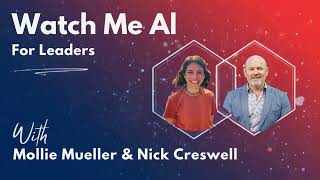
Mollie Amkraut Mueller and Nick Creswell debate whether leaders should use AI themselves or just understand it. Nick argues hands-on experience makes leaders more credible and effective. Mollie shows how AI saves time on meeting prep and communication. Both offer low-friction starting points to experiment.
Chapters
Foreign.
Hi everyone, I'm Molly Mueller, founder of Watch Me AI where I explore how AI can make us better leaders.
And I'm Nick Creswell. I'm a longtime people and culture leaders who spent years working in organizations like Thomson Reuters, Orsted and Google, working with leaders and with talent going through intense transformation. And I'm now fascinated by how AI is changing the way that we lead.
And this is our first episode of Watch Me AI for Leaders, where we explore how leadership coaching and technology intersect in ways that are practical, human, and maybe a little provocative.
So basically, we're two curious people trying to figure out what leadership looks like in the age of AI. We're learning a lot from each other as we go through this and we wanted to share some of that learning with you through these discussions.
So today we're starting with a simple but surprisingly divisive question. Should leaders actually be using AI themselves.
Or is it enough as a senior leader just to set an AI strategy, delegate the tools and the objectives to others, and then to make sure that they stay on track with those, but not get too directly caught up with AI yourself?
It feels like a very foundational question. And Nick, you and I have both discussed this with a range of leaders at a variety of companies and it keeps coming up again and again. So it seemed like the right conversation for today. I know we've both got strong and maybe slightly different views. So let's get into it. What are your thoughts? Do leaders need to use AI?
Personally, I think a key point here is that a leader needs credibility. Can you, credibly, as a leader, lead AI initiatives in your organization if you don't have direct experience of it yourself? And for me, the answer to that is no. And so therefore, for me, it's a clear cut yes, that you really do need to have hands on experience of using AI in order to be able to lead your team as they deploy any kind of AI strategic work. And the story I'll tell here is during my time at Austin, a global renewable energy developer, we were going through a very significant transformation of our talent acquisition processes. And as leader of the culture and talent function, I was sponsoring this work and I would have regular meetings with the, with the team that were actually responsible for making the work happen. And it was my responsibility to set direction to impact and then to empower them to get on as the experts with this piece of work. And I was learning through this that AI was being used, for instance, to help us develop a whole question set that would be as effective as possible in a whole range of interview situations. And this is quite a complex question set and I knew at a high level it was being used for that, but I had no understanding, really hands on, of how that would be happening. As I've learned more about AI over the last few months, I started to realize just how useful AI would have been in such a situation. And of course, for me as a talent, this starts to open up all sorts of other possibilities about how else AI can help with talent assessment. And if I'd understood that better at the time when I was hearing about this in Steer co meetings and so on, I could have asked all the more intelligent questions about it. I could have potentially connected the dots more effectively. So now I've been more hands on with it, I think I'll be able to be a more effective leader in that space. Molly, what's your take on it?
Well, I agree with you there and I might add.
I see AI as really the most powerful.
Growth tech tool that we have as leaders. So for me, AI has helped me across all facets of leadership. It's helped me make better decisions, it's helped me communicate better, it's helped me show up in the way that I want to show up, it's helped me save hours of time every week and it's helped me to grow. And so I think, you know, to the extent that it's any leader's responsibility to continuously grow as a leader across all of the facets of leadership, then leaders need to be using AI to do all of those things and to coach themselves and save themselves time and be more strategic and really using it as that thought partner that can accelerate all of those great leadership qualities. So yeah, I think leaders really need to be using it for their own personal growth. And I agree with you Nick, that you have to have an awareness of what it can do to enable your organization to leverage it best.
So let's get a bit more hands on now and think about, well, what practical examples do we have about how AI can help busy senior leaders? And I'm going to take a couple of different perspectives on this and think first off about having to make a hard business decision when you might be looking to accelerate and make sure that your thinking is as effective as possible about making a certain business decision. Well, I've learned through experimentation that AI and particularly an engine like ChatGPT can be really good at taking unstructured information that you have, putting some structure around that and giving you a decision making format to help you drive a decision on that now that doesn't mean that AI is going to make the decision for you. Absolutely not. You as a human need to add your value to that. It won't give you the answer, but it can really accelerate your thinking that maybe you are taking a loan or more likely that you're then using with others as well. So I've really seen situations where it can sort of make you, where it can accelerate the hard business decisions and, and also make them more effective as well. And I've also, I can see how it can be applied in much more of a talent situation. So when you're thinking about the people that you as a people leader are leading, when you're thinking about maybe a feedback conversation you need to have could be as simple but also as important as a one to one that you have with people in your team. That's a few minutes spent with AI before that meeting just to help you think about how to set the right mindset for the meeting, the questions that you might ask, the objectives you're looking to have, various things that Molly was just mentioning actually could be super, super powerful. So I can certainly see it being helpful for people related discussions and decisions as much as it is for making the sort of the harder edge business decisions as well. Molly, I know you've got something you want to share as well, which you've converted me on, so I'll leave it with you. That's about.
Yeah, I am shouting from the rooftops about one of my favorite AI use cases for busy people, which is meeting record. So I started recording basically all of my meetings many months ago and it has been the single biggest efficiency booster for me. So you know, most leaders were in back to back meetings all day. It's hard to context switch. It's really hard to remember what you did at 8am that day after a day full of meetings. So I record all of my meetings and I use those recordings for a variety of things including a one click follow up email or an end of the day, you know, quick ask to the AI, what are all of the action items that were listed in today's meetings? Or even take this meeting transcript and turn it into a deck that I can send to my team that summarizes everything we talked about. You know, that's as simple as one or two clicks. Now you can do it in a matter of minutes and it saves me so many hours. So I think everyone should be recording their meetings.
And I know you've been talking to for weeks to me about this and finally I got into doing it last week. And I emailed you straight afterwards with this email that Fathom had sent me, which is the recorder I've chosen to use. And I was like, it's a miracle. It appears instantly and it is so, so helpful. So, yeah, if you haven't tried that, I can, I can highly recommend it.
So why don't we switch, Nick, to what's getting in the way of leaders using AI themselves and maybe some ideas for how leaders can overcome the obstacles. And I can start. I think one of the things that I see is as a mindset, a mindset thing where a lot of leaders think that AI is this technical, big, a little bit scary and intimidating thing that's going to take a really long time to learn. It's going to be really hard to learn. And. And maybe it's just not for me. You know, I'll let other people learn that because I'm not sure that I can or that I'd be very good at it. And I think a lot about growth mindset when it comes to AI, because learning AI is about curiosity and bringing in that mindset of, I might not know anything about this today, but I know I am capable of learning. And especially with, you know, the tools we have, like asking a chatgpt to help you learn, learning's never been easier. So I think mindset is such an important piece of learning AI, especially for busy leaders. What would you say?
Well, that's perfect segue. You may have known I was going to say this anyway, because after all, we did prepare this in advance. But for me, it's all about time. And I say this as someone who I work so hard on trying to be less busy. I'm naturally, I'm a curious person who likes to get my finger into lots of pies. And then when I'm in a business context where I'm working in senior leadership roles, I'm in a busy organization where there are so many pressures on my time. And much as I know that it's important to learn how to focus and to slow down the pace and to lead by example on this, I also know from experience it is really difficult to find the time.
To practice AI, particularly when you think it's going to be.
When it's going to be a big activity in the way that Molly was just describing. So that takes us into our next question, which is for leaders who feel too busy. And believe me, I know all too well how that feels. What is the first step that you can do to start using AI in daily work that is really just taking one step forward and really importantly is not too hard or too time consuming. What's your take on that, Molly?
Well, I'll give you one though. I've got a long list, but I'd say using AI for meeting prep is a really small, easy way to get started. So for me, I never used to use AI before a meeting and I started doing this a few months ago. And what I realized was that I was showing up to most of my meetings unclear on what my goal was for the meeting or the goal was for the meeting. I hadn't done just a few seconds even of planning to make sure that I was going to get what I needed from that meeting and that we were all going to have a productive meeting. Now, before every meeting I go into ChatGPT and I spend really no more than three minutes giving it a lot of context. So I'll say I have a meeting with Nick coming up. We're going to discuss if we're going to do a podcast. Last time we talked about this, I might copy in the transcript from last time and then I'll say help me figure out my goal for this meeting or help me figure out like what do I do to run a great meeting here? And just within a a couple of minutes and a little bit of a back and forth with the AI, I come into that meeting so much clearer on what my objectives are, what other people's objectives are, where we might have potential sticking points and how I'm going to get through them. And my meetings have gotten so much more productive. How about you? You must have one that you want to share.
I think my one is less action oriented and more about sort of what's going on up here. As you're thinking about this and it's to have the mindset to integrate this into your daily work. And I think about the many conversations I've had with leaders over the years about how to focus on talent, how to focus on diversity, how to shape the culture in your team, and something I repeat over and over for those kind of activities. They can feel like an extra thing on your to do list, when actually they should be integrated into your whole to do list or into many parts of it. And it's the same with AI. AI isn't something else on top, it's something that just becomes part of your operating rhythm. And the more that it can just be that as you sort of are going into meeting just three minutes before that meeting, you're having a quick AI chat about what you're looking to get from it and maybe a minute afterwards to reflect on that meeting with the AI can make a huge difference and there are many contexts you can have. So really try to integrate it into everything that you're doing rather than seeing it as something on top of everything else.
So now it's time for takeaways and we wanted to make this as synthesis, we wanted to synthesize this discussion into something, something that is as actionable as possible. So going to talk about, I'm going to talk about what we should know and do and then over to Molly to wrap up on that. So my thing that I encourage you to feel that you should, to encourage you to know as a result of today's discussion is that you do need to lead by example as a leader here. You need to understand AI, you need to apply it. And then what I encourage you to do is then experiment with it and share what you learn with those that you lead. So know that you need to load by example and then in terms of what you do, please experiment.
Molly, I think the one thing I want people to walk away with from today is understanding that AI is for everyone and it's not that hard to learn. I think a lot of people still think that AI is highly technical and you need to have some base technical expertise to be able to learn AI. And it's the opposite. AI from what I've seen, is more impactful for non technical people and so impactful and necessary for leaders. So it's really not this big scary thing. There are a lot of small ways that you can get started. The key thing is to get started.
Nice. Well, thank you all for paying attention in this, in this first one of our series. Please do make some comments below, give us some likes, share this with people that you know and if you see fit, then subscribe of course, as well. And of course please do let us know if you have questions that you'd like us to be discussing in the future. So on that note, over to you, Molly, to close the show.
Well, this was really fun, Nick. I'm so glad that we got our first one in the books and looking forward to future episodes.
Okay, see you soon. Cheers. Bye.
More from Mollie


Sora Ai is the most fun I've had in a while! I've got invites. Comment AI Magic if you want on...

Feel confident going into every meeting with just 5 minutes of prep with ChatGPT