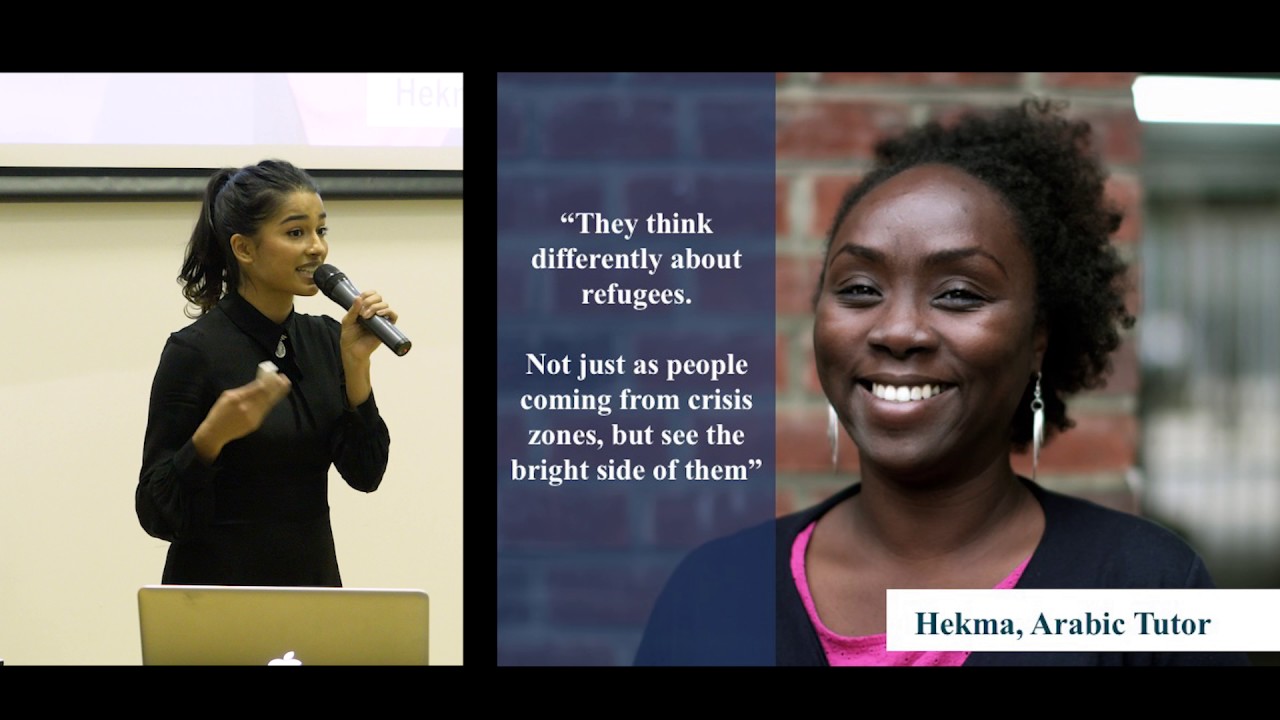
In a Bloomberg Surveillance Early Edition interview, host Francine Lacqua speaks with Mursal Hedayat, CEO of Chatterbox, an AI‑powered language learning platform. Hedayat explains how Chatterbox uses generative AI to let native speakers teach online, creating employment for refugees, women returning to work, and other marginalized groups. She argues that AI augments rather than replaces human work, freeing teachers to focus on motivation and real‑world practice. The conversation covers Chatterbox’s view of the edtech landscape: a $300 billion language learning market with only a $5‑6 billion AI‑enabled segment, indicating large growth potential. Hedayat outlines the company’s “double bottom line” model—profitability combined with social impact—and notes backing from both traditional venture capital and impact investors. She discusses funding challenges amid broader tech market volatility, the need for thoughtful regulation, and the role of markets versus government in shaping AI’s societal effects. Finally, she calls for stronger government partnerships to address structural unemployment caused by displacement and to scale AI‑driven upskilling worldwide.
Chapters
TranscriptAuto-generated · 7 min
Economics, finance, politics. This is Bloomberg Surveillance Early Edition. Francine Lacqua here in London. Now, a new study by Stanford University and MIT researchers showed that AI tools boosted worker productivity at a Fortune 500 software firm by 14%. Now, the research found that the lowest-skilled customer service workers reaped the greatest benefits when AI was rolled out. Well, joining us now is Chatterbox Chief Executive Officer Mursal Hedayat, chief executive of an AI-powered language learning platform that especially helps refugees. So thank you, Mursal, for joining us. Now, I feel like there's a lot of ethical debate on whether AI is a force for good or bad, but 100% in your case, you're using it for good. This is to give language skills for people that need it most.
Definitely. I mean, I think a lot of people are worried about technology and AI in particular taking over jobs. And I think we know from history that's not always the case. At Chatterbox, we've built technology that uses AI to allow anyone to teach their native languages online. And the power of that is that we can use this technology to employ refugees, women returning to work after a career break. So the social impact is even greater.
So I guess the concern is that it's the first time— and we were in Ireland together at the New Economy Forum— is actually this is the first time when you see a big disruptor. And I keep on hearing like this is the first time where we had the car disrupted of course, the horses, and a lot of people think, well, what do we do with the horses and what does it mean going forward? But AI doesn't really put the human at the center of it, or does it?
I mean, I think humans are so adaptable, and I think if anything, if some of the more rote parts of work are taken over by technology, that can only be a good thing. I think lots of things that we do today are not fulfilling for human beings. Take language technology, language learning like we do at Chatterbox. So much of the education in teaching grammar and vocabulary is way better suited to multimedia, AI, you know, spaced repetition, not with a teacher standing in front of a chalkboard. What the teacher needs to do is to engage the learner, keep them motivated, and to help them practice and to give them a real-world practice setting. This is exactly what we do. Now, that wouldn't have been possible if technology hadn't advanced to the level that it has now.
What's the next, I guess, like for some of the things that you use? Are you looking for processors? When you look at research and development, how much better will your product be in 2 years?
Well, we, you know, we started off as an AI company and of course we welcome the revolution that's been advanced. I think the case to, you know, encourage more and more companies and people to adopt language learning and technology and AI in particular in their workflows, the case has been made almost, I think, by, by recent advancements. But I think where we need to go next is to be creative about what parts of the economy are truly better off delivered by human beings and which parts are better off delivered by machines to upskill and and to make sure that these opportunities are spread far and wide. I did mention at Chatterbox, our recruitment program specifically hires refugees and those who are most marginalized in the labor market. These are not communities that are traditionally engaged in technology or AI. So I think that having foresight into the potential inequalities that may be reproduced and also thinking about how we can use AI to boost the quality of work overall.
This is so difficult because I don't know whether it's the government or it's private entrepreneurship. If you look at the regulators, a lot are saying, well, they're still on the back foot because they haven't really— I mean, we haven't really figured out what AI becomes and what it morphs into. So who's the right person to look into these big questions that you're asking?
I think, you know, I'm a believer in markets. I, you know, I think that a bunch of driven people like our team at Chatterbox and other places solving small problems, genuine real-life problems for consumers, that is where the real test of this technology and where its impact will be felt. And I really believe in the organic creation of the new paradigm through the markets, but also, of course, carefully guided by policymakers, because we do know there's a dark side to AI surveillance, you know, biased algorithms that do need to be carefully watched. But overall, I believe in the power of human ingenuity to, to take this technology to make it truly impactful.
How big are you expecting Chatterbox to be? So if you look at the next 2 years, 4 years, 5 years, how are you expecting it to develop?
Well, edtech has been one of the earliest adopters of AI and technology in general. So I think we're quite far ahead compared to other industries. The language learning industry is over $300 billion in size. The technology segment of it is only $5 or $6 billion. So there's a huge amount of growth. You've seen so many of our language technology companies being listed, being sold, being resold. So I think there are plenty, plenty of space for, for more giants like Duolingo. And I think Chatterbox will be one in the next, next few years.
Are you getting enough funding? And one of the things that we were also trying to explore is when you look at, you know, 2 years ago it was all about the metaverse. Now it's all about AI. You started the company, or certainly you were looking at Chatterbox before this kind of, you know, general freakout or interest in AI. But has it helped with funding?
We're extremely fortunate to have what's called a double bottom line business model. We are profit making. We have some of the most influential VC backers from the UK. And Silicon Valley as our investors, but we also have some of the most influential social impact investors in our, in our cap table. So, you know, funding is always a challenge, but I wouldn't say it's been easier for Charterbox compared to some other social impact organizations. Of course, looking at SVB, looking at, you know, recent returns and reports from some of the bigger technology companies, I think the next year is going to be difficult for us. But actually, yeah, if you're, if you're a a company has strong fundamentals like ours, I think it's a good time to be alive.
So do you need— I mean, is there something that you would need more from governments maybe? I mean, you're already having a big impact. This is about, you know, training and hiring people that maybe the government may have not thought about. What could you— you know, what could they do to make your life easier?
Absolutely. I mean, I think, you know, being an entrepreneur, you try to predict what the problems will be in 5 or 10 years' time, not the problem that's a problem now. And, you know, 6 years ago when I started Chatterbox, the biggest problem in the horizon were escalating global force displacement, escalating and accelerating technological displacement from work, and also the opportunities inherent in AI. These are the insights that led to the initial development of the Chatterbox technology platform. Today, I think we're uniquely positioned to help governments solve some of the early frictional and actually structural unemployment that can result that takes extremely talented people out of work. And we're a great example of how technology can be used intelligently to solve unemployment rather than create it. So in terms of the— we work quite closely with the government in the UK. It would be great to partner with governments elsewhere to see how we can, how we can support more people worldwide.
Thank you so much for joining us. Thank you for having me. Caterboxx Chief Executive Officer Mursal Hedayat. Coming up, as we get a slew of European bank earnings this week, we'll discuss what investors will be watching out for. That's next.