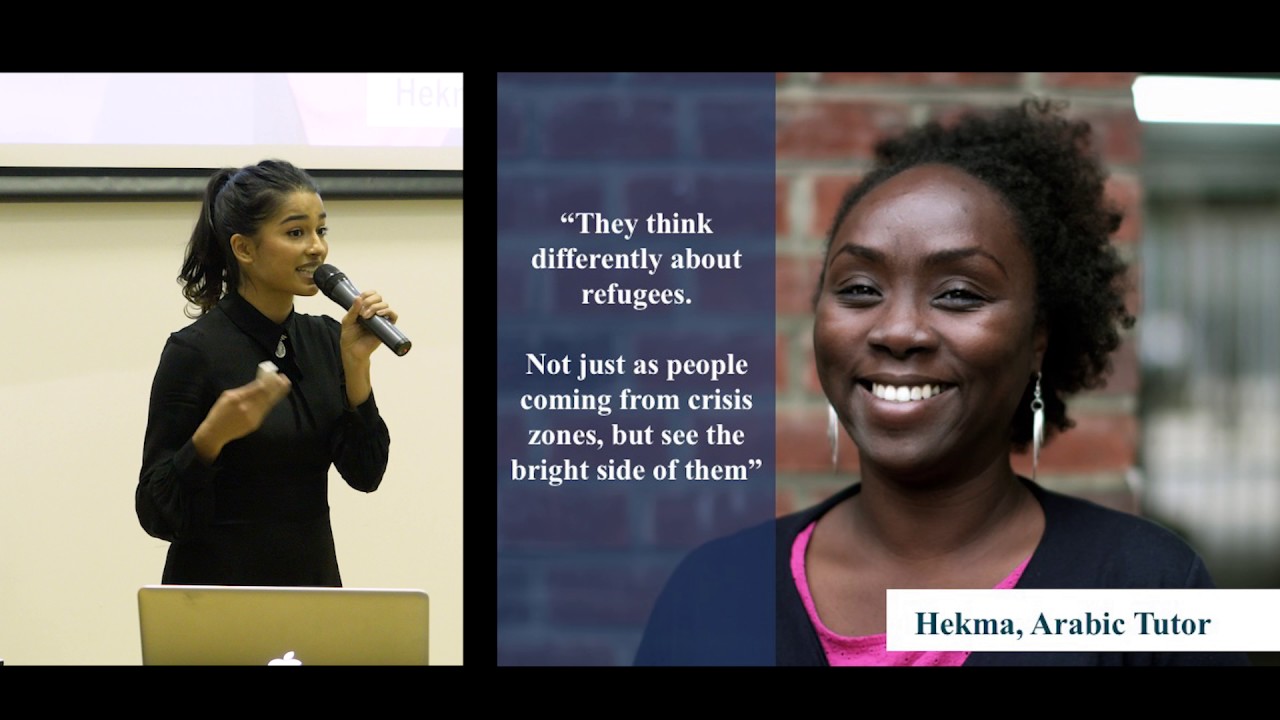
In this Bloomberg TV interview, host SPEAKER A speaks with Mursal Hedayat, co‑founder and CEO of Chatterbox, the award‑winning digital platform that trains and employs refugees as language teachers. Hedayat explains how Chatterbox reimagines the traditional job centre by using AI‑driven matching to pair language learners with refugee coaches, thereby boosting integrative motivation. She outlines the platform’s current scale – about 300 refugee job‑seekers and a team of roughly 20 staff – and notes the recent seed‑round funding that fuels ambitious growth plans. The conversation details corporate partnerships with Unilever, McKinsey, BNP Paribas and others, describing how companies use Chatterbox both for employee language training and direct hiring from the talent pool. Hedayat also discusses the broader vision of expanding beyond language learning to become the world’s largest community for “career relaunchers” – refugees, women, and older workers – matching them to high‑demand online roles such as Salesforce analysts. Throughout, she stresses that profit and social impact can be pursued together, positioning Chatterbox as a scalable, technology‑enabled solution to the UK’s skills‑job mismatch.
Chapters
TranscriptAuto-generated · 5 min
The Women of the Year Awards were held this week, and the winner of Barclays Women in the Community title is Mursal Hedayat, the chief executive of Chatterbox. It's a digital platform that trains and employs refugees as language teachers and is used by businesses including BNP Paribas. Well, Chatterbox is meant to close the gap between refugees with qualifications and the labor market, creating pathways into professional careers and displaced professionals. Mursal Hedayat joins us now. Mursal, first of all, congratulations on the award and on a wonderful business that also bridges these 2 things that are so important to society. How big can Chatterbox be? What kind of uptake and support have you been getting from companies and businesses?
Well, at Chatterbox, we're reimagining what the job center should look like and be for, particularly people from marginalized communities. When I arrived in the UK at just a few years old, my mum was a civil engineer having graduated from Kabul University. And in the world's, you know, one of the world's largest economies, the UK, she struggled to find any work through the traditional job center. So really what Chatterbox is doing is reimagining that state function using the power of AI and technology. And indeed, we did start out as an organization geared towards supporting refugees into work via language learning. But the vision is much larger and the need amongst talented people for work is also much more significant.
So, Mursal, I don't know whether you actually have employees or whether they're considered freelancers, but how big is Chatterbox right now and how big can it be in 2, 3 years?
We have about 300 job seekers currently on the platform. Our team is approaching 20 people. We've just closed our seed round of investment actually backed by venture capitalists across Europe. So we do have significant ambitions. I don't think that leveraging the power of business to achieve social impact goals is antithetical. I think we can both be super ambitious as a business for both profit and impact.
So, Mursal, give me a sense of, for example, some of the companies I think BNP Paribas uses your— so how do they use your services exactly? Is it to try and train some of their employees to learn another language? Is it support and services? How does that play out?
Companies like Unilever, McKinsey, BNP Paribas, as you mentioned, are very keen on expanding their workforce, particularly towards talented people who are often overlooked from the refugee community and beyond, and trying Chatterbox helps them do that in 2 ways. First, they can purchase our services, for example, a language learning service, which is an online learning software used by employees at these corporates. And second, they can actually hire directly through our talent pool. This is a new angle for Chatterbox, and it's one that I think is going to be much needed.
So, Mursal, give me an idea of how, you know, you say AI enabled? How do— how is the use of AI actually transformative in language learning for Chatterbox?
Within language learning, I think the time when we've all felt the most enthusiastic to learn a language has been sitting around a dinner table where every other person is speaking Italian and you've never wanted to speak a language more than at that moment. Well, we're building technology to enhance that feeling of integrative motivation. So the feeling that you get that you want to learn a language to become closer to other people. So the matching algorithm, for example, that we have at Chatterbox, pairing language learners with their ideal coach from our community, really helps to build and sustain motivation. We have, for example, the chief scientists of the UK Department for International Development learning French from a Congolese medical doctor on Chatterbox. And these are the kind of pairings and the usage of AI and matching algorithms that Chatterbox deploys currently. In the future, we'd also like to deploy this algorithm to help job seekers find better-suited jobs and training relevant to their interests, but staying squarely within the focus of online work. Because, you know, the pandemic has had many negative impacts on society, particularly on marginalized groups and the unemployed. But it's created a wealth of opportunities online, not just in online language learning, but also in many different careers.
So, I mean, there's a massive, I guess, mismatch here in the UK about employment or job seekers and some of the skills that they have. Could Chatterbox or similar online platforms also help to retrain to make a society that matches the skills with the jobs actually required?
Exactly. I mean, some companies like Salesforce need 3.5 to 4 million Salesforce-qualified analysts, salespeople, solutions engineers in the next few years. Where is this talent going to come from? They're not all going to be graduates. Some of them will be adults returning to work, mothers returning to work, refugees returning to work. And Chatterbox wants to be the world's largest community for what we call career relaunchers— refugees, women, older workers returning to work after career breaks. And we want to direct them toward these very high-demand jobs in the online economy, from language learning and beyond.
All right, Marcel, thanks so much. Marcel Hedayat there, co-founder and chief executive of Chatterbox. Now, we'll have plenty more, of course, on