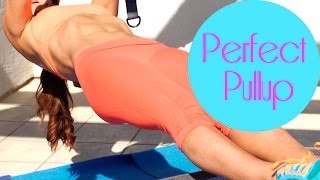
Natalie Jill breaks down pull-ups and chin-ups, which differ only in grip width. Skip assisted machines and build up with bodyweight progressions: hang from rings or a table, do partial lifts, nail one unassisted rep, then add more. Do them fresh at the start of your workout.
Chapters
Hi, I'm Natalie. Jill. Let's talk about how to do a pull up or how to do a chin up because they're very similar. It's just a difference of your hand grip and they are the best upper body weight exercise. They change your upper body, they change your strength, they change the way you look and they are the ultimate test of being physically fit and being functionally fit. I love pull ups and chin ups. So first the differences. A pull up just means your palms are faced away. So when you're pulling up, your palms are faced that way. A chin up means your hands are faced the other way, so your palms are faced towards you. So it's just a difference in grip, but the technique to learn them is the same. Now, I'm a huge fan of getting rid of that assisted machine, so you heard me, no assisted machine. With these, I'm going to have you using your own body weight because that's how we're going to develop the strength the best way and that's how we're going to be functionally fit with these and learn how to do them. So the first thing I want you to do is you can do this at a gym, you could do this with monkey bars, at a park, whatever.
You can find, wherever you can find a bar or even rings.
I'm going to use rings for this. We're going to start with our own body weight. We want something low to the ground. So you could use a table to help lift you up, where you'll put your feet on a table. But what you're going to do is.
You'Re going to grab either with your hands forward or back, feet on the ground and you're going to pull up this way. This is the first step in developing that strength. Now, whether you can do one or 20, that's not the point. It's, can you do that first?
How many can you do? And are you starting to develop those muscles? The next step is to work on just hanging with your own body weight. So what I mean is literally just hanging here. Can you hold that? Can you hold it?
And can you lift up slightly? Even if it's just a little movement, no assistance, but just developing that strength.
In your back and those arms so you can start to do a full pull up. The more you practice that, the stronger you're going to get. Once you've got that down, it's time to take it to that first full pull up.
Just pushing it up now here, I'm not cheating, I'm not doing any kind of swing forward. I'm just working to get one, one solid one in. Everything on the rest of my body is straight.
I don't have any assistance here. Working on that. And doing one of those is better than doing a lot of them assisted. Because you're working to develop your own full body strength. Once you've mastered that, it's working on how many can you do, how many can you do at a given time? What I like to advise and what I personally do is I begin all of my workouts with pull ups or chin ups before I'm tired from everything else. That way I'm able to progress with full energy and really get my practice in. So once you've knocked them out, once.
You'Re able to do lots of them, the next step would be advancing to moves like an L sit.
When you do that, not only are.
You really challenging those muscles, you start to work your core and it starts to be more of a full body exercise. So there you have it. Everyone can learn a pull up or a chin up. It's just taking patience, working with your own body weight, keeping it consistent. So you're practicing all the time and progressing through it. Starting with your feet on the ground, then a table, then your own body weight, holding it, and then moving it on to more of them.