Is Slow Fat Loss or Fast Fat Loss Better?
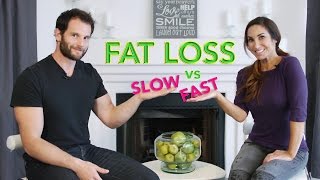
Natalie Jill and Ari Witton break down a study comparing fast and slow calorie restriction. Both groups lost 15% of body weight but regained most of it within three years. They argue the real problem is forced restriction itself, not the pace, and push whole foods and sustainable habits instead.
Questions this video answers
November 4, 2015.
15% of body weight.
12 weeks.
36 weeks.
Up to three years.
Chapters
Hi, guys. Natalie, Jill. Welcome back to Happy, Healthy and Fit. I'm here with my favorite health guru, Ari Witton, and today we're answering what is better, slow fat loss or quick fat loss? Because the answer is not what you think.
Basically, you've probably all heard the advice. In fact, you know, probably you and I have both given this advice many times in the past to lose weight slow and steady rather than lose it fast. Right. You know, don't go on crash diets. You know, don't try to drop £30 in three weeks or four weeks or something. Instead, you know, lose weight slow and steady, and that's more likely to result in you sustaining it. The idea is if you go on a crash diet, you know, it's going to not just crash your weight, but also crash your metabolism, and then it's going to predispose to weight regain, right? Correct. Okay. So as much as that advice has been around for a very long time, for years, for decades, pretty much everybody in the fitness industry, nutrition, health industries, we've all been saying that.
Despite the fact that it's been around for a very long time, there's very little actual evidence that it's based on one of the main studies that's actually tested. This just came out. Okay. And basically what they did is they took two groups of obese people and they put one group of obese people on a fast weight loss diet and one group on a slow weight loss diet. Okay? So they used the same basic methodology for losing weight, which is just forced calorie restriction. Okay. So just counting calories and establishing that caloric deficit at a certain level. Obviously, the fast group did more of a caloric deficit so they could lose the weight faster. Slow group did less extreme of a caloric deficit. The way that they did it was just replacing one of their normal meals with a Optifast meal replacement shake. Okay. So one group replaced three of their regular meals with these meal replacement shakes. So they established a very extreme caloric deficit. The other group replaced only two, so just a less extreme caloric deficit. You with me so far? Yes, I'm with you. Okay. So basically from there, the fast weight loss group lost 15% of their body weight over the course of 12 weeks. The other group, the slow weight loss group, lost the same amount of weight loss, 15% of their body weight over the course of 36 weeks. Okay. After that happened, basically, they then put these people on professionally designed weight loss maintenance protocols. Okay? So they said, we're gonna. Once you reach that 15% weight loss mark, we're then gonna put you on these professionally designed weight loss maintenance protocols for the next few years, okay. And during that time, they basically monitored.
Body mass, body weight, body fat percentage, the rate of weight regain, and all of those numbers. So it was an extremely well designed experiment and very long term, much longer term than most studies. So they monitored these people all the way out to three years. And what did they find at the end of three years? Basically, they found that there were no significant differences between the fast weight loss group and the slow weight loss group.
So basically, it gets rid of the entire conversation about one being better than the other or it having to be this slow.
Exactly. So, you know, the reality is that there just isn't a solid scientific body of evidence saying that slow and steady wins the race. Okay? Fast seems to work just as well.
But there's commonalities, there's things that went wrong in both methods. And that's for sure what I want to talk about. Because it's really not what people think. It's not about just the fast or the slow. It's really these other big factors and variables.
Exactly. So here's the big thing that people leave out. After this study came out, there were all sorts of articles online of people basically saying, slow and steady doesn't win the race. Fast fat loss, crash diets work just as well. So there's no point in trying to lose it slow and steady. And if anything, this study actually showed a slight edge to the fast weight loss group in the sense that more of them were actually able to find through and complete the initial weight loss phase just because it was shorter.
And they decided. And they're ready to do it.
Probably, yeah. They didn't have to suffer through hunger pangs for 36 weeks. It was only 12 weeks. Right. So there's a slight edge, if anything, to the fast weight loss group. Now, in all those articles of people saying fast weight loss works just as well or better, here's what everyone seems to be leaving out. Both groups, when they actually looked at them three years later, both groups regained almost all of the fat. Okay? So they worked very, very hard for 12 weeks or 36 weeks to lose about. They lost 15% of their weight. So they lost about 40 pounds of body fat. Okay. And three years later, they had regained over 30 pounds of body fat. And if they tracked them out to five years, they probably would have found that they regained all of it. Okay. I would wager a large sum of money that they would have regained everything. Okay? So keep in mind Also that this is a professionally designed weight loss protocol and weight loss maintenance protocol that's monitored by professionals, by diet professionals. They're watching these people the whole time and keeping them accountable. Okay? So in the real world, most people trying to lose weight on their own wouldn't even do as well as those people. People, this was professionally designed stuff. So the thing that everyone's not taking into account in this whole fast versus slow discussion is really the fact that regardless of whether you lose it fast or slow, you're probably going to regain all the weight. If your approach to losing fat is simply forced calorie restriction, okay? You count the calories, you establish a caloric deficit of 500 or thousand calories or 3000 calories or whatever it is per week, and you try to just lose weight by starving yourself and forcing yourself to suffer through hunger by the.
Whole 3500 calories loses a pound and thinking that way.
Exactly. Okay, so calories do matter. And you can very predictably create fat loss by establishing a certain caloric deficit just through counting calories. But what also very predictively happens is that you regain. You eventually, over the coming months and years, you regain almost all of the fat that you initially worked so hard to lose.
Well, that's because you never really learned to eat. Right?
Right. Yeah. So, and this is the big difference. There's a fundamental distinction between losing fat through calorie counting and just simple forced calorie restriction. Suffering through hunger pangs versus sustainable lifestyle modification versus in terms of nutrition, focusing on food quality rather than food quantity, rather than trying to count calories and force yourself to eat a certain amount, focus on the quality of the foods you eat, and that will impact the quantity. In fact, it's the best way to impact the quantity of calories that you consume. And here's the big difference. It will do so without causing you to suffer through hunger pangs, without the metabolic slowdown and without the eventual fat regain. And we know this is true from a huge body of evidence.
In rodents as well as in humans, where when we give animals access to a particular kind of food supply without restricting their total calorie intake, when you give them low food quality, and specifically that means very high palatability, high reward, processed foods dense with a combination of fats and sugars, they eat more overall calories and they reliably get obese. When you then take those obese animals and you give them a food supply of very high quality whole foods, even without asking them to change their calories, without restricting their food Intake in any way. They eat to fullness, they eat however much they want. Those obese animals reliably become lean. And the difference here is that they do so sustainably and it lasts permanently. In contrast to simple calories deprivation, forced calorie deprivation, you know, going on these thousand calorie a day diets or 500 calorie a day diets and just forcing yourself to suffer through hunger pangs. It just doesn't work.
So what I think is always so funny is I think everybody, because this is a big topic right now, everyone says, wow, everybody always said slow and steady. Now it's fast. Everyone's looking for that black and white, quick, like, this is what to do, this is what not to do. And it's so funny to me because it really is never about that one thing. It always goes back to the basics that you and I have always talked about. Eating an unprocessed food diet and listening to your body. I mean, really, that's what so much of this goes back to?
Yeah, absolutely. And the truth is that some people in the scientific fitness community, nutrition community, actually attack people who focus on food quality as orthorexics, or, you know, the clean eaters. And they say, you know, you're an orthorexic and you're giving people eating disorders because you're telling them to restrict, you know, focus on food quality and restrict certain kinds of foods. And we're superior to you because we're, we know that it's just calories. And so we allow people to eat junk food while focusing on overall calorie amounts. And while what they're saying actually makes sense in terms of short term fat loss, it doesn't make sense. When we look at things in the long term, it doesn't make sense for health.
Really.
It doesn't. It doesn't. I mean, everybody, we're all human, we need to indulge sometimes. But.
It'S very clear that in the real world setting.
Focus on food quality trumps a focus on calories.
I 100% agree, and I love this. Now, what I will say about Ari, if you don't know him, is we have a lot of the same way of thinking as far as the eating the unprocessed food. But what I will tell you is I get down to the black and white of what I know from you, and he is the scientific guru. In fact, he'll tell me something and I'll look at him with crossed eyes and then sure enough, two years later, that's what everyone's talking about. So this guy knows his stuff. Now you have a test on your website now that people can take, right? Tell us about that. Because it's free. This test?
Yeah, it's a free test on my website. And basically it's designed to tell you which of the six major factors are holding back your fat loss efforts.
How cool is that? And it's free. All they have to do is go to your website.
It's free. And then you get personalized test results, basically breaking down which of the factors are problematic for you, as well as a free ebook that elaborates on all the six different factors.
We love the word free and they get to know you better. So I'm gonna have all of Ari's information down below so you can learn more about him. And Ari is awesome. So if you're not already following him, please make sure you're doing so on social media. He loves to post controversial things and get people going in discussion, but it's all good information. Thanks so much for being here, Ari.
My pleasure. Thanks for having me. Bye.
More from Natalie









How Natalie Jill Fitness Was Born - The Journey From Corporate To Fitness To Midlife Conversations

