
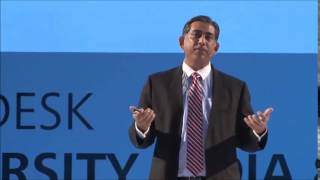
In this keynote, Amit Sharma, senior leader of TC, reflects on the company's 53‑year legacy and its ongoing transformation under his dynamic leadership. He outlines five macro‑trends reshaping construction, engineering and design – the collaboration of minds, global economic rebalancing, cultural and workforce shifts, integrated value chains, and shortened product lifecycles. Sharma explains how TC leverages partnerships with Autodesk and other technology leaders to adopt 3D/4D modeling, engineering analysis, safety‑by‑design, and digital delivery across sectors such as power, steel, mining, infrastructure, and smart cities. He highlights TC’s contributions to national initiatives (Smart Cities, Swachh Bharat, Make in India, Digital India), large‑scale projects (sewage networks, power plants, industrial complexes), and sustainability efforts (green footprints, renewable energy). The talk also covers TC’s focus on workforce development – training 500 graduates annually on digital tools – and corporate social responsibility programs that expose under‑privileged youth to engineering technology. Throughout, Sharma emphasizes the need for collaborative ecosystems, rapid learning, and innovative tools to create a better tomorrow.
Chapters
So TC, some awesome accomplishments there. Many firsts, a whole bunch of things that they've done which are really first time that anybody has done those things here in India. Before I bring up on stage Amit Sharma, let me talk to you briefly about Amit. Amit, we've been working with Amit for now over 3 years and we've seen the journey that TC has been under his dynamic leadership. I mean, he's transforming the firm as we speak, you know, not just in terms of the work that he do, but in terms of the DNA of the firm itself, in terms of the culture of the firm itself. Fantastic guy to know. And you know, for the last 3 years I've been trying to get him to come up on stage and share what he does with us, and every time he says, "No, no, no, not yet, not, you know, we're not yet there, we're doing some good work, but I'll be, I'll come up on stage when I'm ready." And you know, this year as is usual, we made our usual pilgrimage to TC and said, "Amit, can you come up on stage and share what you do with us?" And this time Amit said, "Yeah, I think we're ready now." So without any further delay, the— my— one of my favorite people, Amit Sharma. Thank you, it's all yours.
Thank you, Pradeep. Morning everyone, ladies and gentlemen. It's a privilege to be here amongst all of you. We started this journey 53 years back, being the engineers to the nation, and I think we've done a lot of the firsts in India. Over the last couple of years, we looked at what our customers were demanding, how India was reshaping itself, and we looked at partners around that can best get us the best technology, that can get us the best ideas, the way we collaborate with our customers, with industry peers. And with that, can we create a better tomorrow? Collaborating with this ecosystem, understanding the markets, understanding the way India is changing, understanding our peers elsewhere brings the best to the market. Creating a better tomorrow is also about understanding the trends. Amar talked about that, Pradeep talked about that, Honorable Chief Minister talked about how India is transforming itself. And we classified this in terms of what are the 5 trends that relate to us in this industry. And when I talk about my industry, it's about plants, projects, new products that we get to our clients. And we classify as the 5 key trends that relate to construction, engineering, and design to create a better tomorrow. And most of our efforts in the direction of transforming our firm as well as bringing innovative solutions to our clients is based on the trends we studied together. And we started this journey with Autodesk. The first one was what's happening today, the collaboration of mind that's driving innovation. 300 years back when the Industrial Revolution started, it took about 100 years. In the last 100 years, we saw mass production. The assembly line concept, and it was all about collaboration of hands, machine, the change of fuel from burning wood to biofuels. It was about people coming together and creating products that were affordable. What we achieved in these 300 years with internet and the digital aspects of technology We have achieved that in last 25 years purely because of the collaboration of minds across nations, across small cities in India, across firms that compete and collaborate that are driving innovation. And we thought about how should we be part of this to get better products, projects, and plants to our ecosystem. The second trend we understood was around the big global rebalance. It's the first time in the history 80% of the world population is contributing a huge amount of GDP growth. The emerging economies today are a great asset to look at projects, products, demands. With West experience and East opportunities, how do you leverage the collaboration of minds, that drive innovation to bring prosperity and distribute and redistribute wealth across the globe. And it's a great opportunity to also work in a collaborative ecosystem where projects worldwide— we work in India, Middle East, Africa, Western economies, Southeast Asia— and we come across lenders, decision makers that are not part of that world. They look at world in a very macro view. The visions and plans of most of the country— companies today are global, and it's all because of this global aspect of the economy we are part of. The third one, because of minds that are collaborating, the global rebalancing act that's taking place, we are seeing big work cultural shifts. We have a global workforce. 25 years back, most companies probably had 99% of their folks that represented a part of their nation or country. Today, most of the firms have global workforce. It is no longer about competency or loyalty. It's about competent loyalty. Knowledge management, being an intangible asset, is more important than ever before because With people having choices, attrition is a big issue. So for us to continuously produce predictable outcomes, projects that are successful, we must capture this knowledge, iterate on it, innovate on it. And tools for design today are working along with human beings to create a better tomorrow. But we are amidst a big change. As one of the futurists, Alvin Toffler, has talked about, this century is not about what you know, but how fast can you adopt yourself, about how fast can you learn, unlearn, and relearn. And we are trying to use technology to rapidly change our offerings in the market, to train our people. Some of the technology from Autodesk that we use allow our people to innovate faster, to create new ideas into reality faster, to visualize it, to sit with stakeholders, show the knowledge and experience of the last 53 years and create a better output. We're also seeing the fourth trend on integrated players and value chain. Today when we run workshops to create a concept, a master plan for a plant like a steel plant, a power plant, or even to create a building or build new cities, we find the workshops run into value chains that were never interconnected. Today, whether you are a lender, developer, contractor, design engineer, or from the public, the government side, the value chains are so integrated that designs are complex, funding is complex, and because of this complexity, you need to manage risk better in your projects. And if you can visualize, predict, forecast some of these challenges, you can make a better project come alive. And of course, the fifth one, for an engineer like me and many in this room, what does it mean to the lifecycle of the products, of the projects, and the plant we create? We are not designing any more products or projects or plant that will last for 50 years. The life cycle is so short that the ROI being demanded is much stringent. The entire— whether you are in a product business, we are in plants and project business, and our clients are asking us to make sure that they can make it faster, and the focus is shifting from execution to concept phase. To the design phase so that you can iterate upon as many things, visualize it, and create something that has a higher level of success rate. Also, there's a disruption. If you look at our industry all the way from finance lenders to contractors to design engineers to operators, developers, it's going through a disruption. We will either collaborate and redefine or integrate, or the market will consolidate. Lot of the players today are overlapping their offerings, and it's a great opportunity to collaborate. But at the same time, if you do not, as Amar talked about, the disruptions will basically consolidate the industry and you would have less space to work on. So with these 5 trends, we looked at what we could do. But as Tata's being in India and TC being here for last 53 years, we also studied the Indian context. Lot of the things that we are doing today are part of our service to the nation of ensuring poverty is removed, ensuring wealth distribution across India, of enabling tier 2 and tier 4 cities to be part of the India growth story to provide water, to provide energy and power to the furthest part in India. And we are part of Smart City, Digital India, Swachh Bharat, in policymaking, working with policymakers at the center, and of course, Make in India. And I'll just share a few snapshots of how we are doing. Basically, there are 6 areas we work on that leverages technology. From infrastructure buildings to nuclear power, chemicals, steel, metal, mining, and transportation metros. And our services are on design engineering, construction supervision, advanced technology, EPCM services, and we work with many of you in this room. Of course, the way— looking at these trends and the growth in India, the whole transformation of India, We classified our strategy into the differentiators that were external. For example, how will we treat the market? Who will we collaborate with? And the enablers. And the enabling architecture was around people working with best-in-class solutions, enabling innovation to come out and hence creating a better tomorrow with projects that we run from concept to commissioning. The entire architecture here has many aspects of what you would see in a corporate architecture, but let me touch base upon the enablers where we have partnered with Autodesk and few other leading firms in the space. Each have their own sweet spot. With Autodesk, we're working on the engineering analysis tools, 3D and 4D platforms, safer construction techniques, integrating safety in our design, in the way we manage changes on a project. A large infrastructure project has multiple players. How do they collaborate efficiently? Can we work on a project in Africa sitting in India but understand the GIS and the landscape and create something better? Can we train the operators? All of this is part of this business architecture. So, under the Swachh Bharat, we're working in 5 states in India and bringing water and removing waste in these states. In Gujarat, we work in almost 250 towns, 400,000 kilometers of sewage lines, lot of pipeline and sewage treatment plants that are done. All of this is not sitting there, in our center of excellence in Bangalore, in Mumbai, or distant locations. We have 200 engineers working on this and understanding the landscape, putting all this in 3D, simulating the work, and of course, then our colleagues in the industry, the various construction firms that execute these projects, we supervise them. In terms of smart cities, we are part of DMIC, doing projects across that corridor. Gift project in Gujarat was architected and created with us as key partners. And again, all of this about smart cities, about waste management, about living, breathing cities that talk to human beings. How do we change age-old practices of doing something and creating a better grid, a better utility management corridor, a better infrastructure, better mobility is all today done using these tools. Of course, we've been powering the nation. 35% of power that touches the lives of every individual in India has been engineered or designed by TCE. And we are constantly iterating and innovating to get better technology, renewables, hydro, power plants run by coal, how can they be more efficient, less polluting. How can we have a greener footprint is again visualized, engineered, and designed in these tools. So before someone sees a power plant in the physical form, 10 years or 7 years before, we have a virtual plant. We have a plant where you can simulate all these aspects of green footprints to make it much sustainable. Under the Make in India, We are part of projects, we're building multiple industrial complex in Chakan in Maharashtra, in Chennai. We leverage these tools to design the next efficient steel plants, the next efficient cold rolling mills, material management, handling mines. Again, all of this happens on these tools. As I talked about mines, being a nation that needs a lot of resources, you have to create a plan before you start digging these resources out. So a lot of the mine planning and the material handling is also done leveraging these tools. And of course, we collaborate with people across the globe. So all these trends— collaboration of mind, collaboration with the various firms across the globe in terms of IP and knowledge management. We use these tools to enable that. We are also watching the 3D printing space. We have invested in our own 3D printer and we're looking at how can we work with policymakers to create smarter cities. How can you visualize a better master plan in a congested city? Can we sit down and look at options on the way a certain transportation corridor can be created? Can we work with the poorest and the underprivileged to see how they are impacted with this master plan? And if all of these people can visualize the possibilities, the output would be much better. And that's some of the stuff we are trying to do. So not only can you look and feel, but you can leave a model behind. It does not require you to read and write, but you can— because you can visualize that model, probably you'll create a better master plan and make smart cities a reality. Our focus on safety for our employees, for our customers, is a big aspect of the way we deliver our projects. If you can simulate the working condition, the construction conditions, if you can embed safety in your design and ensure that when you are building tall buildings, big power plants, Can you ensure that the operator is safe when the plant is commissioned, that the contractor and the person working, putting bricks on that dream of yours, is he safe? So we use a lot of these technology with aspects of safety embedded in it. We're also migrating to 100% digital delivery. We take about 500 graduates every year. They go through a digital training. A lot of this change is being driven from the bottom. The youth of India is much more tech savvy. They're much more excited. They want to automate things, play around, experiment, and we must leverage this immense advantage we have with the youth. And they go through this training, which also I must thank Autodesk. We allowed this platform to be created to train all of our lateral and graduate engineers who go through almost 6 months of training on these platforms. As part of our commitment to the society at large, we are also looking at, under Digital India, of what we can do as our corporate social responsibility, touching the lives of people who are underprivileged and from the lowest strata of society. We, we Welcome some of these folks who spend few days and weeks in our offices playing with digital technology, dreaming what is possible, and then aspiring towards becoming engineers, architects, and future leaders who will reshape this nation and others across. So a lot of the skill building, we are part of this today. And as you can see, this is a program that's run across all our offices in India. Last but not the least, I think with help from technology leaders like Autodesk, the entire ecosystem of policymakers, our clients, customers, and peers, I think together with you, for all of us, we surely can create a better tomorrow. Thank you very much.
More from Nathan



Can AI Read Your Heart? Unboxing DeepVessel with Nathan Qin from Keya Medical | #52







