Tata Consulting Engineers built a mathematical model that predicts hard-to-measure boiler temperatures and conditions by solving energy and heat-transfer equations. It works across 80 to 1,000 MW boilers and different coal types, helping operators prevent damage and maintain efficiency during load changes without sacrificing safety.
Chapters
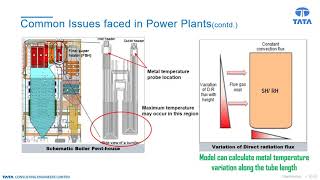
Mathematical modeling of boilers for performance evaluation. Boiler is one of the critical equipment in a power plant. A well-designed and operated boiler is important for its performance and reliability. In this video, I would be explaining the details of the boiler model developed by Tata Consulting Engineers (TCE). Indian power sector is going through transformation phase with focus on green power generation. Coal power plants originally designed for baseload are forced to operate under partial loads to take care of the variable nature of renewables. Dealing with variation on coal quality and flexible operation of coal power plants without compromising on safety, performance, and reliability are the present challenges. Mathematical models can be used to evaluate and predict boiler performance under variable operating conditions. TCE has developed a steady-state mathematical model from first principles for pulverized coal-fired boilers. Boiler model has the following capabilities: design validation during bidding stage, performance evaluation of operating boilers, performance prediction for firing another coal different from design coal. Online performance tools with built-in integrated thermodynamic models can be used for real-time evaluation of various components and overall plant performance. The model uses available operating data and derives intermediate parameters along the flue gas path that are not available through direct measurement but essential for analyzing boiler performance and its health. The model would help plant operators to overcome the difficulties that arise due to change in load and fuel. Continued operation of boilers by firing coals different from that of designed quality may lead to reduction in boiler efficiency, excessive so preheater or reheater tube metal temperatures, increased erosion of heat transfer tubes. All these parameters ultimately affects the performance and reliability of the Boiler. Metal temperatures of heating elements are measured in a boiler penthouse at the inlet and outlet tubes. These measurements do not represent the maximum temperature location of a heating element, particularly for those subjected to direct radiation from the furnace. If tube metal temperatures are calculated along the tube length considering heat flux variation, it would represent maximum temperature location that enables boiler reliability. Usually boiler operator has few input controls such as coal quantity, excess air, and burner tilt to maintain output parameters such as steam flow, superheater and reheater steam temperatures, boiler exit gas temperature. To achieve the required output parameter, control logics are focused on input control, but this may not ensure boiler reliability. For example, high main steam temperature initiates attemperation to reduce steam temperature to protect steam turbine components. Overheating damage, however, may have occurred in the boiler tubes upstream of the attemperation point. The better way to maintain the desired output parameter is by controlling input parameter and also maintain in-process parameter within the design range, as shown in the figure. As such, number of in-process parameters are limited in the boiler design Hence, additional in-process parameters would be helpful to achieve boiler safety and reliability. In boiler, after combustion of the fuel in the burner zone, the next monitoring parameter in the flue gas path is the economizer outlet temperature. Furnace exit gas temperature (FeGT) is one of the most important parameters in boiler design which separates both radiation and convection zones. If Efficiency is maintained within the recommended range, problems associated with slagging and fouling can be controlled. Hence, utilizing Efficiency as an additional monitoring parameter will enhance boiler performance and reliability. Some of the in-process parameters in the boiler are furnace exit gas temperature, intermediate flue gas temperatures, intermediate steam temperatures, attemperation flow, slagging and fouling coefficients. Boiler model can derive all the above in-process parameters which would enhance boiler reliability. To understand the heat transfer mechanisms across the boiler, furnace, radiation and convection sections are studied separately. Calculations are performed by solving energy balance and heat transfer equations simultaneously. Best model is then created utilizing boiler design data. The model then validated using data for other load conditions. The model is applicable for both supercritical and subcritical boilers and is agnostic to coal quality and boiler manufacturer. The model is validated on many pulverized coal-fired boilers of varying capacities ranging from 80 MW to 1,000 MW. All the boilers which include subcritical and supercritical types are validated successfully. A close match between design and calculated parameters are observed in flue gas temperatures, water and steam temperatures, heat absorption by each of the heating elements. The validated model is now available to apply on any boiler. These are the few snapshots from the output page of the Boiler Model Tool. On water stream temperature profile, flue gas temperature profile, flue gas velocity profile. Validated mathematical boiler model developed by Tata Consulting Engineers is now available to apply on any pulverized coal-fired boiler. The model assists in arriving at a root cause analysis and in troubleshooting to resolve operational issues. Proactive operation, root cause analysis, and in-time corrective measures can improve performance and reliability of the boiler. The developed boiler model would help plant operators to overcome the difficulties that arise due to varying loads and coal quality.