
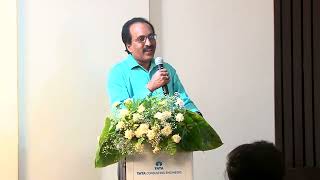
The YouTube video records the inauguration ceremony of a Chandrayaan‑3 mission exhibit at the Nehru Planetarium in Mumbai. The event, hosted by a master of ceremonies, brings together senior officials from ISRO (Chairman Shri S. Somnath), the Nehru Planetarium (Director Shri Arvind Paranjpe), Tata Consulting Engineers (MD/CEO Amit Sharma), and the NMMC Education Officer Srimati Arunayadav, along with students and teachers who have participated in a three‑month STEM outreach program. Key points include: - A celebration of Chandrayaan‑3’s successful lunar landing and its role in inspiring national pride. - Presentation of the collaborative Project Vikyaan between ISRO, TCE, and the planetarium, aimed at providing accessible STEM education to students from socially‑challenged backgrounds. - Detailed overview of ISRO’s future mission roadmap: Aditya‑L1 (solar study), XPoSat (X‑ray polarimetry), Chandrayaan‑4/LUPEX (Moon‑South‑Pole landing with JAXA), Venus probe, Exoworlds exoplanet studies, Dishaa aeronomy satellites, and a planned Indian space station (Bharatiya Andhra Pradesh station) by 2035. - Emphasis on building an ecosystem that opens the space sector to private entrepreneurs, startups, and industry, linking space capabilities to applications in agriculture, industry 4.0, drug discovery, and climate monitoring. - Vision for India’s space economy over the next 25 years, including human spaceflight goals (target 2025) and the need for systematic, inclusive education. - Testimonials from the education officer and students highlighting how the exhibit and the partnership have empowered children from middle‑class and under‑privileged families, fostering curiosity and future career aspirations. - CSR perspective from TCE, describing its role as a thought leader in promoting space research, translating engineering concepts into tangible experiences for the public. Overall, the ceremony serves both as a public celebration of a historic mission and as a platform to announce ongoing and future collaborations that aim to broaden India’s scientific talent pool, stimulate the space economy, and ensure equitable access to space education.
Chapters
It is with great pleasure that we welcome you all to the inauguration of Chandrayaan-3 exhibit. Let us all give a huge round of applause for all our pioneers whose relentless efforts have brought us together for this momentous occasion today. I would like to welcome Shri S. Somnath, Chairman ISRO, on the dais. I now request Shri Arvind Paranjpe sir, Director, Nehru Planetarium, to join us on the stage. I request Mr. Amit Sharma, Managing Director Founder and CEO, TCE, to join us on the dais. I now request Srimati Arunayadav, Education Officer, NMMC, to join us on the stage. So before we proceed further into the heart of our event, it is my pleasure to invite a distinguished figure whose vision and leadership has been instrumental in shaping the course of today's proceedings. Please join me in welcoming Shri Arvind Paranjpe Sir, the esteemed director of Nehru Planetarium. Sir, we would be honored to hear your insights on this remarkable collaboration with, uh, Nehru Planetarium and We kindly invite you to share your words.
Good afternoon, friends. Respected Somaji, Amit Sharma Ji, Shrimati Aruna Ji, esteemed guests, ladies and gentlemen, my colleagues, and last but not the least, the students who have participated in this program for last 3 months or so. Since its inception back in 1977— actually, Nehru Planetarium celebrated its 47th anniversary, anniversary just a few days ago on 3rd of March— the planetarium has been inspiration of knowledge and curiosity. Now, over 47 years, this institution has become immensely cherished among astronomers, basically amateur astronomers, but also professional astronomers, space enthusiasts, general public, and of course children. The planetarium has not only been the place of edutainment, but it has also been a hub of intellectual discourses. We conduct public lectures, a special year-long astronomy course which is conducted in association with Mumbai University, in the city. It is called the Extramural Course in Astronomy and Astrophysics, where at the end of the year certificates are given. And, uh, we have a lot of activities for the school children. And this is the laboratory next door. Many of you must have visited by now. So this is the laboratory where we interact with school children. We teach them laboratory exercises and so on. We are here today for the momentous occasion as a remarkable addition to unveil our facility that symbolizes the power and collaboration, education and innovation with the Tatas. I'm honored to stand here, stand here before you on behalf of Planetarium and our esteemed partners Tata Consulting Engineers as we celebrate the inauguration of the remarkable Chandrayaan-3 mission exhibit. The creation is not just a feat of engineering by TCE, but it's also testament to our shared commitment to inspire and educate the next generation of scientists, engineers, innovators, not only from India, from every— all around the world. Those people visit us. Today's unveiling of Chandrayaan-3 mission exhibit marks another milestone in our planetarium's journey to reveal the cosmic world to our visitors and curious young minds. About 7 and a half months ago, on 23rd of August, when C3 landed successfully on the moon, I was at Chad, Pennsylvania, attending a conference of planetariums, and when it was evening here, it was early morning morning, and we knew what time it was expected to land. We had no doubt that it would land successfully and— excuse me— successfully. And we had gathered around the television screens, all our international planetarian participants there. And when it was landed, it was a big roar in the premises there. We were all sitting and clapping and— thank you. And then I took pride because people, myself and of course we were other couple of other Indians there, we took pride because they came and congratulated us. And so on behalf of ISRO and India, we received their good wishes. And a little bit of my outreach came out. Many of them actually came to the camera and recorded their best wishes, which I immediately transmitted to my friends in the media here, and it was aired. So it was a very great occasion for us. What a day it was! Our association with TCE began with the Project Vikyaan. This is one of its own kind, uh, kind of platform provide kind, a platform which provides accessible and engaging STEM education opportunities to the students, and students particularly from socially challenging background, and empowering them to shape the future of our world. Before I leave, I would like to extend my gratitude to PCE for their passion and generous partnership in the— in bringing the STEM education same education to our youth of this nation, uh, through this project. I must also thank Nidhi here for initiating this program with Nehru Planetarium. And I would like to thank her. I would like to talk about her a little bit. That is that she has such a clear thinking and a good team that we saw this thing going and also her team members, Paromita, Anindya, Biren, Mandak, and others. So we are so grateful for— grateful to you for bringing this together, this model, etc. Our thanks— I would also like to thank at this juncture that the Nehru Center, Nehru Center staff, and the people of Nehru Centre had worked very hard in association with them that we could see this day. And lastly, children, you are sitting there. When the Chairman ISRO came and asked you questions, I think some of the questions you should have asked our— your teachers in the classroom. I will— sir, I will just change into Marathi for a second. And we will do this activity. I mean, we'll induce them to ask more questions. With this, I would like to thank all of you and hand over mic to— Thank you very much.
Thank you so much, sir. So ladies and gentlemen, please join us in extending our sincere gratitude to Shri Arvind Ranjpe sir for his enlightening insights. May I now request our Managing Director and CEO, Mr. Amit Sharma, to please share his perspective on TCE as a thought leader in promoting space research through close collaboration with ISRO and Mission Chandrayaan-3, and also throw a light on TCE's CSR initiatives.
Good afternoon everyone, welcome to Sri Somnath Ji. Thank you for being here with us. Thank you, uh, Mr. Pranjpe, for giving us this opportunity to be part of Naruk Grand Curriculum. Thank you ma'am as well, Aruna ma'am, for giving us an opportunity to associate with schools around our area. And thanks to all our colleagues and leadership to be and your team to making this happen. You know, Tala Consulting Engineers started in '62, and at that time Dr. Homi Bhabha and Shri JRD Tata spoke about India's energy security. They said we should have somebody do this. At the same time, all these institutions that we hear today, whether it's ISRO, whether it is Bhabha Atomic Research Center, they all came during that time, Vikrasarabhai Center. And it's so amazing that the foundational elements of these institutions are so strong. The kind of benchmark they've created makes India proud and every citizen proud. And there's so many benchmarks that will happen. It's really a privilege and honor to have Shri Somnath Ji amongst us. And he's put India firmly onto the journey of Vikasit Bharat. And as we embark onto 2047 as a developed nation, thank you, sir, for your leadership and making sure that every Indian is proud of the accomplishments we've done. While PC has been part of a lot of iconic projects And we thank our clients and customers who put faith in us. Whether our work in the '70s, it started in a lot of radio telescope designs, a lot of work with ISRO on various equipments, components, and I'm sure many other things. We also equally worked on the nuclear part of India's journey, and nuclear is also, you know, coming back in a big way. So when we were doing all of this, There is one aspect of making curious minds of future, the innovators, the scientists, the people who can think of ideas, and in this lies the whole essence of asking difficult questions. It's not the solution that one must search for, as they say, it is the questions that drive the human growth into new areas. You know, in our discussions during our focus on giving back to society, while we do work with research institutions of repute across India, we said the best way is to inspire young minds, to make them live and feel some of the proud moments of the country. And amongst many things, this is one of the proudest moments. We thought, how could how do we make it look real and you could look and feel? Because in today's age of virtual mobile phones and televisions, if you don't see, you really don't understand. And so we thought we should partner with somebody that can help us give back to society and create the future scientist innovator. And I really want to thank the Nehru Planetarium as well as Education Department in Maharashtra for giving us an opportunity to work and translate our initial ideas into something tangible. We hope to do more of this. I wouldn't take much time. I would actually have Shri Somnathji, uh, share his vision and thoughts with all of us, but I am immensely thankful and grateful for him to be here amongst us as we inaugurate this small contribution of ours towards science and its expansion.
Thank you very much.
Ladies and gentlemen, let's all thank Mr. Ramesh Sharma for his invaluable contribution to today's proceedings. Sir, your words have truly enriched our understanding on this remarkable collaboration. So now, ladies and gentlemen, I request our chief guest, Shri S. Omanath, Chairman ISRO, to share his thoughts on Indian space research and how programs like Vignyan help build India's future planet.
Good afternoon, all of you. And thanks so much for having me here amongst you, especially at the planetarium where everybody comes for getting inspired, because space always inspires young and the old. Whatever may be the generation, we always look up at space as an inspirational element associated with this modern technology. And that's the way that the Chandrayaan-3 captured everybody's mind. So thanks to his— he associated with the Nehru Planetarium to create an inspirational element in it for the young people. I want to thank you for inviting me to be part of this event and also to interact with the boys and girls. And if my interaction helps them in any way, I am really blessed. To speak about the space program that we are on, I think all of you know better than me, it has been coming in press and media in a big manner, especially after the Chandrayaan-3. The hype is very high and the expectations also is very high. It's good in a way that the nation knows about our capability and being proud about what we accomplished. And this is something that will help us to drive a point to the society that, that it is possible for us to do things which you thought that impossible. And with our mind, our capability, our brilliance, it is possible to create a different type of story that has not been created elsewhere. So this is something narrative that we would like to tell everybody in this country, be the one which are in the, in the elite or the people who are in the villages, both takes the story in their ability to absorb because it gives confidence to everybody to show that it is possible for us to do something spectacular, not only in space but in many other sectors in this country. So we believe that the next 25 years, which is going to be a very defining period in the history of our nation, where we'll slowly progress from a nation which has been deprived of many capabilities to one which will stand as one iconic nation where everybody can look upon us as a capable nation who is able to deliver things very first of its kind in this world. We hope that space will always become one day in that— with that capability. The last 60 years we have been working in space sector. I think all of you are aware we have rocket We have satellites, we have applications, and we are doing certain things but not in scales that are sufficient enough for the nation today. I think this is well understood now. After making, uh, events like Chandrayaan-3 landing, the nation is more and more aware of our capability and the need to scale up to bring in certain amount of, uh, economy into it. That, that is very, very— our business into it. And this is well understood by the government, but it takes time to transition from a national program of creating capability within the, within the country to one which will, will be more, more like a business-like activity in space sector. That transition will take over a period of time, but it's very important for us to do that. But equally important is to work on the scientific goals of space technology. Unless you have that side, the application side and the business side will not grow. So it's a combination of these two things we must create in this nation, and this vision is very clear in our new space policy. So that's why we are looking at how government agency like ISRO, while we are working on space sector, creating capacity, capability in various technical domains, we equally want to create the capability in manufacturing, want to create capability in delivering systems at speeds much higher, and also utilizing the capability that we are realizing into applications that will drive business and economy in a big manner. So unless this whole ecosystem is created, it's not going to grow beyond a point. It will become— no, it will be a stagnating thing, which has been the case for the last many years. So it is high time that we open up the whole space sector and then make it accessible for private entrepreneurs, startups, etc., to come in and create innovative ideas. That's why we have to send this message very well, how to incubate new ideas, support them, industrialize them, create applications out of space sector, reach it out to various sectors of wherever it is possible, like agriculture, industry, IoT, the Industry 4.0, manufacturing, drug discovery, or whatever. In many areas we can— weather and climate, a lot of domains that we can really bring in a business-like application of space, space capability into this country. And this has to be done not by government, it has to be done through an enabling ecosystem that need to be created. I think we are on it. In the next few years, I will believe that transition will take place. While we do all of that, we have to continue to do the inspirational part of our work, like the going to moon, landing on the moon has been very important, but repeating it on a different scale and different goals to keep engaging our scientific pool of talent in ISRO is very important. It's not only ISRO, but many institutions in this country are partners in with us. For example, we are working on the human spaceflight now, and it is, it's not an easy task at all for a country like India to work on human spaceflight and make it succeed. We, we understand it very well because in the West it has been achieved with great investment of money and effort last many— last, last of 50 years or so. But for us, this is just started. Last 10 years we started, and it has been projectized in many last few years. But reaching the state of having capacity to launch human beings to space and bring them back safely— this is the fourth nation to do that, and it's not an easy task, but we are on it, and we are sure that we will do one day. Though we have put set a schedule or a target of 2025 to achieve very, uh, high target, but it is important that we approach that and go in a very calculated manner to reach that target. And I'm sure, uh, while we launch our first Indian to space and bring them back, our confidence on the whole of this will go to another level of, you know, accomplishment. I am very sure about it. And it's not only going to end with that, we are going to continue our missions to other planets and explore as, as exploiting scientific goals in Moon, Mars, Venus, and etc. And we are working on various projects. For example, I think you would have all read about Chandrayaan-4 ideas. We are leaking out little bit here and there for people to create a discussion point so that everybody is aware of it. It's not something that we need to contain in the organization. We want to tell stories to the outside world that we are working on such ideas. Creates inspirational story everywhere, create discussions. Now even discussions on why human beings should go, why not robot go, you know, it happens. And these discussions are good in a society where we debate on various possibilities. It's— somebody comes out with better ideas. Ideas are not confined to only organizations. It is possible to come from outside. So we leak out little bit here and there to create the discussion topic so that we get inputs from people's thought, and then we reshape our ideas. For example, recently our honorable Prime Minister has announced a vision for 2025, you know, sorry, 25 years in the Amrit Kaal. You know about such a vision. He says that we must land on the moon in 2040. Human being, Indian should go land, not only land and leave it him, leave him there and not come back. We have to bring him back also. So we have to safely land and bring him back, and it's a different thing, you know. Landing there is easy, but bringing back is much more difficult. Now, to lead up to that, we have to do many things, uh, on the way. We must continue our exploratory missions like the going to Moon, Mars, etc., in a continuous manner. We should also work on human spaceflight program on a continuous manner. And if you have to— if you have to continue this, there must be a purpose of it. Otherwise, it doesn't— it doesn't mean anything just to showcase our strength, we can't do it. It must create a technical reason or business reason or national reason for it. And this is something that's very important. That's why there is a space station element that has come in between. By 2035, we must launch our Bharatiya Andhra Pradesh station. And a space station is an important item in the whole of this, uh, the, the vision. Because once you have a space station, we can do microgravity-related activities in a big manner. Which we have not been doing in this country. If you look at Europe and America, there is huge amount of research happening in microgravity-linked activity in many scientific domains, and we must bring those type of research in this country. And that is possible only we have such capabilities. You know, there is, there is a microgravity drop tower in Germany, and, and when I went there, I found that that whole facility is being booked every, every half an hour. It is booked for one experiment or the other. So, so much of work happening in, in in Europe and America on microgravity experiments, but that much of activity is not happening in this country. If you really talk about a nation to grow to technical supremacy, and if you do not work on many domains like that, we are not going to be. So at least let us say that we will work on microgravity and we will create that ecosystem in this country and use the space station as a tool for deriving some, you know, benefit data for our industries. It will be drug discovery, let it be material science, let it be on genomics, or let it be on additive manufacturing or organs. All of this should happen, and, and that will become a next station for us to enable travel to Moon and Mars and beyond. So this is a vision that has been created. So we must continue scientific explorations of various kinds. We must create a continued human space flight capability including space stations, ultimately leading to human landing on moon. And is it going to be the ultimate, uh, accomplishment of space? I do not think so. I think this is only a journey for next 25 years, and our life in this Earth is not going to be limited by few hundreds of years. It's for thousands of years. And for us, for a culture who wants to create an impact in this world, I think we cannot be left behind like, like with the other nations. We must contribute in some manner to this endeavor called space, because space is always the next frontier. And unless we invest and create the capacity to handle this technical domain, and we will be left behind and somebody else will take over. So as a nation, I believe that we must invest. I think we— you all of you know that space has been a, in a domain where we have been investing very less and getting a lot of returns. So we'll continue that manner. I think all our engineering approaches have been such a manner that we do not put too much of money into it, but we will expect more to come out of it. Hopefully we will be able to do that. The same approach will be able to continue in the coming days. So for this another narrative, I think all of you know that we have been drawing people from communities, not from the IITs. I think this is also a discussion topic which has been happening, but this is an equally important topic. No, various people understand that it's not, not belonging to any elite group of people. It is all for people with capability that can be drawn from this nation. It gives a different message. It's not to say that IIT people are not joining because the salaries are less. Notice, that is not the narrative that we want to say, but we want to say that it is possible for us to do with people who have been drawn from other background to create a high-tech domain. And this is very important for the nation because our nation still consists of crowds of people who are from that type of background who need to be enabled. I think today what you are doing today is to bring these children here and showcase this shows there are potential in every human being here. It is very, very important to realize it. It's only because they are not exposed to the possibilities in life that they are left behind. That should not happen. And that if you are able to bring up at least 5-10 of them, I think it's a great service. And the message will go down into the history in their society, their community, to create a change. I think this is very important for a nation with the 140 crore people who is going to be 160+ in the next, and getting stabilized, I hope. At that time, I think we need to be, to to be a real strong nation, all of these 160 crore people should be empowered. We cannot have a large amount of disparity, at least in the level of access to knowledge and capability. This must be allowed to everybody, and that capability should be developed by systematic intervention. I think that is the role of the government, and that's the role of each one of us. I am very happy that you are doing it, and I'm really happy to join you today when at least some capability of us is showcased with the help of PCE in planetarium. Yeah, in the astronomy side, I think all of you know Chandrayaan-3 has been a planetary mission, but we did the Aditya-L1 mission. It is only one of the many missions that are going to happen. Aditya-L1 has been working, we have been working for the last 10 years on this mission to understand Sun, and this mission specifically looks at Sun with 7 different instruments. The coronagraph is the primary instrument, and there are many instruments to look at the mass ejection happening in Sun and its secondary impact. For example, the particle emissions, the, the emission of the X-rays soft and hard, the magnetic field that will happen between Earth and the Sun space— these are measured using 7 different instruments. And the mission is also very complex one. The travel from Earth to that Lagrangian point is not just like a National Highway that has been built here from that point. It has been a very, very circuitous path, which we call it as a certain track that we designed, which is a lowest energy transfer path, which is the very first time nobody else has done like that. We have traveled from that Earth to that Lagrangian point in a very unique path with very less fuel that has been used. We reached perfectly on the date of arrival and has been captured in that Lagrangian point. And this point is not one point, this point is a so big a circle or a space where the satellite is moving around but continuously looking at Earth, Sun, and it started working. All instruments are working beautifully. Immediately after that, we launched one satellite called XPOSAT. I think that all you also know. We wanted to study polarimetrically, look at black holes where black holes, when they are adjacent stars, when they come, will start pulling the material into it. And when they pull the material, the material moves at very, very high speed, very close to the speed of light. And when then they start emitting X-rays, and this X-rays are studied in a polarimetric manner, then you can understand how much mass is being pulled out and etc. So this is binary stars study. We are going to launch many more such missions in the future. We are working on a mission to study, uh, Chandrayaan-4. Of course, you know that to go there and bring back samples. And we have already a project finalized to go to Moon again, use with the help of JAXA. So we are together working. It's called the LUPEX mission, where the lander will be built by ISRO, designed and built. Rover will be built by Japan, and the launch will happen on a Japanese rocket. So this is another project which is going on, and this is to explore some of the very shadowed region of the moon where we land very near to the South Pole. Then we are working on a Venus mission. Venus is another interesting mission where the pressure in the atmosphere is very, very high, and we want to put a probe that will go deeper into the atmosphere and go to the surface, still transmit data. It's an acidic atmosphere, sulfuric acid, full of sulfuric acid. Vapers as huge wind is blowing around. I think as we know, photographed from outside. So this is another mission we want to do. We are also looking at exoplanet study. We call it Exoworlds, where we want to look at planets which are there in other stars and then understand their atmosphere through spectroscopy. So currently the design work is going on. And there are another satellite pair which we are looking at, how to look at aeronomy. That means the effect of external influences on our the space weather, and using two different satellites which will be placed orthogonally apart, which is called Dishaa. This is another mission which is going on, and there are many such in the series. Okay, thank you.
So let's give a big round of applause to Dr. Mr. Sonak for sharing your valuable insights with us, sir. So ladies and gentlemen, uh, get ready to be moved by the stories of triumph and transformation. We have a special segment dedicated to the voices that matters the most— the beneficiary, our teachers and students, and our support at NMMC. I would like to invite Srimati Arunayadav to share a few thoughts with us. Also, I would like to welcome on stage our teachers and students representative who have been an integral part of the program and request them to share their experience with the gathering.
Respected dignitaries on the dais, and you all lovely people. I'm very thankful to everybody because Sir said thank you to me, but actually I should say thank you because it's a great moment and you have given very great moment to my students also. I think when you see this building from outside, you say wow. I remember my My father and I came here when I was in 7th standard. So it's a great moment for me to stand here with my students. I want to tell you that this team, Tata team, worked a lot for our students. They talk very politely with our students. So my students are very happy and they also want to work in in the next year. So I have told them that you must work for our children. I thank all this team, and I, I think so, so not sir is here. Everyone said thank you, but now thank you, we will say thank you to him, and this thank you will go in his office and everywhere. And also I thank all this team and America Planetarium team because it's my duty to thank all of you. Really, my students are very, very happy, and I can see that happiness in their eyes. So there are tears in my eyes also because it's a happy moment for me because my students come from very, uh, middle class or poor families. So I think that's the greatest moment, and they will always remember whenever they will come here, or they will come with their parents. When they will come as a parent, they will tell that, see, this is the place where I had got a great chance. So I thank all of you. Namaskar. Thank you, thank you so much.
With that, I would like to request the dignitaries to proceed to the level 2 for the inauguration ceremony. And before doing that, we would like to capture this moment for our memories through a group picture. I would request everyone to please stand.
More from Nathan



Can AI Read Your Heart? Unboxing DeepVessel with Nathan Qin from Keya Medical | #52







