
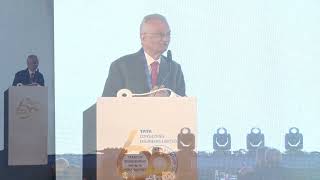
Dr. Anil Kakodkar lays out India's path to net-zero by 2070, projecting energy demand of 28,000 TWh annually. Renewables can cover only 8-10 kTWh; he argues nuclear power must fill the 19-20 kTWh gap, with hydrogen production scaled to 15 kTWh through non-electrical routes to avoid inefficiency.
Chapters
May I now request Dr. Anil Kakodkar, globally renowned nuclear scientist, former chairman Atomic Energy Commission, former director Bhabha Atomic Research Center, and former secretary Government of India, to come to the dais and share his thoughts on energy security of India.
Good evening. Let me extend my greetings to Tata Consulting Engineers. I have had the opportunity to work with engineers of Tata Consulting Engineers Way back, maybe 1964 or '65, I had joined atomic energy just then, maybe a year or so earlier, and the Calandria from Larsen Toubro was to move, and the constraint was whether the Mahim Creek Bridge, which is a very old bridge, would be able to take that load. So there are so few people I remember. Mr. Ranga Rao, I'm sure Mr. Manohar might remember him, recall him. And so I thought on this day when TCE completes 60 years, I would recall an incident almost 60 years ago. And congratulations to all of you for this tremendous journey contributing to building the nation, engineering the nation. I have been asked to talk on energy security. After the panel, I'm not too sure whether there is much for me to add. So what I'll do is, rather than talk about what should happen or what would happen in coming decades or 20 years or 30 years, you know, we're talking about 2050 or when India completes 100 years, let me take you straight to 2070, which is the day We have declared that we will become net zero, which is 50 years away from now. Surely by 50 years from now, one could expect India to be a developed country. Kalam used to say India should become developed country by 2020, which is 2 years behind us. Now, But even if you work out with very simple compound annual growth rates, I think India— and I'm talking about, I calculate everything in the context of individuals, so per capita— so I would expect the Human Development Index, which is in some way related to per capita uh, earning or per capita energy consumption and such factors. But I would want to see the human development in India comparable to the best so-called advanced countries, which would mean a minimum threshold Per capita energy input, uh, and today's scale may be around 2,400 kilogram oil equivalent. Uh, let's assume that there will be a lot of electrification as we go to net zero or as we decarbonize our system. And so I bring that down from 2,400 kilogram oil equivalent to 2,000— sorry, 1,400 kilogram oil equivalent, which is, which is a substantial improvement. But I do believe that as a result of the, the electrification particularly, one do— one does expect that kind of gain. Multiply that with the expected population, you would get something like 28,000 terawatt hours of energy for this country per every year. Now, if you want to realize that dream, or I come back to the topic given to me, if you want to ensure energy security for India by 2070, as a citizen I'm sure I won't be there, but as a citizen of India, one would expect that we would have an energy system which delivers 28,000 terawatt hours— terawatt hours every year. The question is from where this energy would come, and my simple calculation text tells me that renewable energy cannot deliver that energy. We can look at it all, database and all, but you don't have so much— you have enough solar, enough wind to meet present energy requirements. But these augmented energy requirements, at best, the assessment I have is that you would get something like 8,000, 8,500, maybe 9,000 terawatt-hours of energy. That leaves something like 20,000 or 19,000 terawatt-hours gap to be bridged. And at today's sort of situation, nuclear is the only mode which can bridge that. And if that doesn't happen, it would mean we'll have to necessarily depend on fossil energy. And of course back it up with carbon capture utilization and sequestration. So that's broadly the picture as far as energy security of this country is concerned. Don't ask me how we'll reach there. I'll talk about it a minute, but that's a difficult question to answer. Now out of this 28,000, if you want to break it up in terms of the sources as well as in terms of the needs of the demand segment, the biomass— I told you renewable energy may be around between 8,000, 9,000, maybe 10,000 at best terawatt-hours. But of that, the biomass component, including the non-commercial energy, would work out to roughly around 2,500 terawatt-hours. And so my first suggestion would be that we actually reserve biomass to produce gas. For use in our kitchens, because the other alternative of hydrogen or hydrogen-based substitutes going into the kitchen, at least I can't visualize it today. Maybe 20, 30 years down the line, safety would improve. So I think we should reserve bioenergy, in my assessment, to our kitchens, both in rural areas as well as in urban areas. And if there is some surplus, which is unlikely, use it for agriculture— energy required for agriculture. So that is as far as the bioenergy is concerned in my assessment in the final equilibrium. You know, you may go through different pathways, but in the ultimate analysis, electricity, which is around 18-20% of the total energy system now, would certainly go up. And assuming that we would produce hydrogen without too much of dependence on electricity, one would need to scale up the electricity production to around 10,000 terawatt-hours, up from 1,600 terawatt-hours today. So that's the jump you need in electricity. And I said hydrogen would be maybe another 15,000 terawatt-hours, because that will be the energy required for industry, transportation, and such other segments. Now, today all we talk, all we know is that if you want to produce hydrogen, you need electricity. Particularly green hydrogen. Now, if that electricity is to be added to this 10,000 terawatt hours of electricity, then India's electricity generating system would need to be something like 25,000 terawatt hours. These are mind-boggling numbers. You are all captains of this power industry, you know what it means. So I think that's the challenge that we need to do. And so what is the answer? I think we must quickly find an answer to produce hydrogen without producing the electricity. It also contributes to better efficiency because you cut down one step. So whether it is thermochemical or whether it is photochemical or such means. And I think these things are possible. Uh, proof of concept experiments are existing right in Indian labs. Uh, we need to scale it up. And of course, the world cannot wait, India cannot wait. So till that time, we may have to depend on electrolyzers. So that is the broad picture. And now, to answer that question, how this will come I myself doubt whether all these things can be delivered. So sometimes I get a doubt whether India will ever be an advanced country. And I think it is for us, the planners and the engineers of this country, to prove this hypothesis wrong. With determination, I think we should become a developed country and meet the challenge. To be able to do that, number one, I do believe that fossil energy would stay. Let's be realistic. Fossil energy staying, we have to meet the net zero target. Obviously carbon capture utilization— utilization can be only a small part because we're talking about very large number. So essentially sequestration, and to be done in a manner which is economically viable. That's to me the number one challenge. Number two challenge is to very quickly develop ability to produce hydrogen directly from solar thermal, from nuclear thermal, or from other means, but without going through electricity, because that is where the gain in efficiency lies. And of course, the consequence if that doesn't happen, I already said, then you will have. Now, I don't want to go into details of these, but the question is one big thing. This requires technology, doing it fast. It's okay to ask IIT, IISC, no, no, you do it quickly and all, but I think policy plays a very important role here. The so-called triple helix architecture for development of technologies is a must, and we are far, far away from that triple helix architecture. I think the policy making Government investments, private investment, and R&D institutions have to work in sync. You can't be expecting— you know, energy infrastructure is a capital-intensive infrastructure, is an infrastructure which takes long gestation period. So you can't expect industry to invest money unless they know for sure a precise direction in which things will go. For next 15 years, 20 years, because with an assurance of a couple of years, I don't think that investment will come in at all. So I think we need to back it up properly with a good policy framework. And if we all— one thing Dr. Baba used to tell us, and that is the problem is we don't put enough challenge. In front of our young people. You put challenge in front of young people, they will deliver. And I think history has shown that that has actually happened. The startup moment, the innovation kind of thrust— and I'm talking about high-tech, deep-tech, such kind of innovation— I think it's all possible We have the right infrastructure, but we need to create a right ecosystem, a policy ecosystem, and put our act together. I think India would become developed country. But so much for the energy security of the country. Thank you very much for inviting me and tolerating me. Thank you.
More from Nathan



Can AI Read Your Heart? Unboxing DeepVessel with Nathan Qin from Keya Medical | #52







