
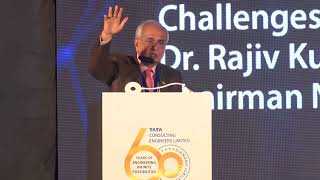
Former NITI Aayog Vice-Chairman Dr. Rajiv Kumar argues India must reach $34 trillion GDP by 2047, a tenfold increase, while cutting carbon emissions across energy, agriculture, construction, and mobility. He says the country needs to create 400 million jobs and shift from profit maximization to profit satisfaction within ESG limits.
Chapters
Ladies and gentlemen, we now move to an interesting, insightful, and inspiring session by Dr. Rajiv Kumar, renowned economist and former Vice Chairman of NITI Aayog of India. Dr. Kumar has spearheaded the foundational pillars of India's growth aspirations for 2047 and its related opportunities Challenges and Pathways. May I request Dr. Rajiv Kumar to share his thoughts on Bharat at 100: Aspirations, Challenges, and the Way Forward. We welcome you, sir.
Mr. Shankar, Mr. Anil Sethi, my friend Amit, Dr. Saraswat, Dr. Kakodkar, all the eminences here. I feel very honored as an economist to be brought in to speak here in a gathering full of such high-level professionals, engineers, and technologists and scientists. Thank you very much for this invitation, Amit, and I hope— and I congratulate the TCE for completing 60 years of amazing contribution to building the country. And I'm sure that your next 60 years will be even better and brighter, and you will contribute to making the 21st century India's century, because that's what I'm sure will happen in this year. Ladies and gentlemen, I know that given the session, I should be focusing on science and technology and innovations and allied themes, but please do allow a mere economist to crystal gaze a little bit in the future. But if you want to crystal gaze in the future, you want to actually look back, because that's the best way to look at the future. And I want to bring to your notice, 326 BC, Alexander, young Alexander, crossed the Oxus and the Caucasus and the Hindu Kush to come here. He must have had a reason for this. And the reason, ladies and gentlemen, was that the Gupta dynasty at that time had reached the zenith of its glory and was contributing, according to all records, more than 32% of the global output. Angus Maddison has actually authenticated it and said that in the first century AD recorded— nobody has ever questioned it— India's share in the world output was 32%, China's was 25%, and our share of the population was about 30% also. Since then it has declined, and it did decline after that, and it went on a bit, but even in 1850, according to Angus Madison, India's share in the world population was 17%, and India's share in the population was 16.9%. Friends, what I want to say, what I want to crystal gaze about is the time has come now to set our targets. On regaining India's share in the world output commensurate to its population. Because in 1947, when the British left us, it had dropped to a mere 3.1%. And the jewel in the British crown had been left a pauper, a poor country, having suffered the Bengal famine of 1942, which was probably the world's worst famine ever. So in 2050, 25 years, 2047, when India is celebrating its 100th year of independence, the world GDP according to the UN and World Bank projections will be $200 trillion. And for that, for us and our population at 1.64 or 1.66 billion, would still be about 17% of the world, 9.7 billion. So if you want to maintain, get that share which is commensurate to our population, Our GDP should be about $34 trillion in nominal— in real terms in 2047. Today we are at $3.1 trillion. 10x. Can we do it? Seems huge. Seems almost impossible. But you know, it's been done. China has done it. 1990, that's— Chinese economy was $380 billion. We were $320 billion. Our per capita incomes were actually higher. But today, the Chinese economy is $18.6 trillion, equal to their share in the world population. 30 years, they grew at 10% plus. If you do a little bit of maths now, you will see that from $3 trillion to $34 trillion requires you to grow at about 10.3%. The question is that given the sweet spot that India is in today, in the world situation, in the transition that Chandra talked about, in this massive technological turbulence that is happening, can we seize this opportunity to grow at double-digit growth? How some of our states have done it— Gujarat, Madhya Pradesh, Bihar— they've done it but not for a sustained 3 decades. So I think As an economist, as an optimist, as incorrigible economist, I think we should set our targets for that. And I think we can do it with a little bit of effort and that, but at the same time, we have massive challenges facing us. But, you know, theoretically, it's easy for me to say how can we do it. You know, labour growth in India, easily 2.5%, especially if you include If you increase the participation rate, which is at 43%— female participation rate is about 24%. Worldwide, labour participation rates are more than 55%. Female participation rates are— they are high. If you increase that rate and let the labour grow at 2.5%, capital stock can grow at 5%. We have got the savings in our country at 37, 39, 40%. And the total factor productivity, which is a project called CLEMS, which I started when I was in ICREA, when I was CEO of ICREA. Now the RBI is doing this. This is capital, labor, energy, materials, and services. Together, the total factor productivity can easily— which is technological progress. And in these days of huge technological change, total factor productivity can easily grow at 2.5 to 3%. You add them up and you get 10%. And that's what we can get, that's what we can do. But of course, the conversation would be, the remark would be, but this is typical economist assumption and theoretical theory. The real world is not like that, and therefore it's difficult. But I appeal to you, ladies and gentlemen here, the gathering here, if it makes up its mind, this can be done. And but even if we want to, as you sort of say, that's not too much, You know, 1990 to now, our average rate of growth has been 6.7%. 2003 to 2011, we grew at 8.4% at that time, but the world conditions were very much positive at that time. They're not the same now. We're faced with a lot of uncertainty. But, you know, even if we agree that we can grow at 7% and then sustain it over 3 decades, which means that in some years you'll have to grow at 10, 11, etc., percentage. At 7%, our economy would be $17 trillion in 2047, and at that time— and at that will yield you a per capita income of about $10,000, and which would mean that you are an upper-middle-income economy, not a developed economy. The problem is that at that time you will be aging already in 2047. Your demographic dividend would have been exhausted by that time and we would face the risk of being caught in a middle-income trap that a lot of Latin American countries have seen. We have to break out of that and this is the time, ladies and gentlemen, to develop that momentum with our technology and economy and institutions to break through that trap and become and rise towards a developed economy status. No, it's easier said than done, I know, but the fact also is that we face, as I said, some massive challenges. Let me give you one example for you. The first one is, you know, that we will be the only country in human history— we will be the only country in human history to grow exponentially and also to reduce our carbon footprint exponentially. We have to do this. The planet can't afford it otherwise, we can't afford it otherwise, and the question is that once you think about this, just go into a little bit of detail, the 4 sectors which contribute most to the carbon footprint are energy, as has been mentioned already, surprisingly agriculture—27% of greenhouse gases come out of there—construction, with all its related sectors of cement and steel and others and so on, the hard-to-abate sectors, as you said, and mobility. If you look at each one of them, we can have a vision because technologies are already available here. We can have an image, we can have a vision of our desalination plants powered by solar energy along our coastline, producing enough sweet water, desalinated water, because we are a water-scarce economy. We are facing a water scarcity. Desalination plants along the coast producing the water for electrolysis to convert it into hydrogen. And hydrogen can then fuel our energy along with the solar, the wind, the geothermal, and as Sandra said, many others which will come. And we can do it and we can make energy. And as the NTPC chairman once said that hydrogen plus solar plus wind can make energy pretty much a free good in India, if you like, from the cost we have. That vision is possible for us to see. In agriculture, we know now that precision agriculture with optical sensors, with nutrigation, with very controlled dosage of chemistry, etc., etc., can reduce your use of chemicals. And also now you have grown smart proteins which can be grown— now there's a material science revolution. Going on where you can get super proteins grown in labs which are better than the meat-based proteins and so that the methane, you know, thing can— methane, you know, sort of generation can also come down and we can have a vegetarian society which is not deficient in proteins. All of that is possible. But ladies and gentlemen, I think the most important thing that I have pushed in Niti Aayog when I was there for 3 years is zero chemical farming, is what is known as— now has come to be known as zero budget natural farming. And I assure you that Sri Lanka is just a, you know, sort of a, you know, it's just nonsense if you like, but that's not natural farming. I've seen 30 lakh farmers now registered not using chemicals, zero chemicals along 11 states, and the Prime Minister has endorsed it publicly. Including in his 15th August address, you know, in the last 15th August address. What does it do, the Zero Nitrogen Farming? It takes care of everything, including sequestering large amounts of carbon into the land, because what it does is it raises the carbon, organic carbon content into the soil. And there are the benefits of health, there are benefits of environment, there are benefits of water conservation, and there are benefits of The fact that cancer trains that run today from Bhatinda to Bikaner would stop running, because that's— we'll stop consuming all the chemicals that we've got. Similarly, if you go for construction, I don't want to belabor the point, but the fact today is that when we tested that and we asked from NITI Aayog, IIT Roorkee, to test it, you got concrete which is 10x the tensile strength of present-day concrete. And they didn't give a negative report, that that's available. And can we use that? Because that will mean that your steel, that your cement, all of that will be lesser used. And also the fact that the hard-to-abate sectors are already beginning to use blue or green hydrogen for iron ore reduction or for converting cement, limestone into cement, etc. Construction can be made a carbon— the footprint of the construction sector can be brought down You know, but, you know, very much so. And mobility— Tata's other leaders, of course, I don't want to repeat it. The fact here is that I believe, and I've checked, that the life cycle price of electric vehicles today is unfortunately more than the ICE vehicles. And this has to change, and this will change with new battery technology. This will change when we find solutions to lithium and we go to sodium and we go to whatever. But this has to be done because otherwise it's fiscally unsustainable. Ladies and gentlemen, I just wanted to relate this to you, that all of this is possible today with what we've got. But there is one more challenge that I wanted to point you out today, and which is employment generation. We have to generate huge amount of employment in a time when artificial intelligence, deep machine learning, foundational algorithms are actually for the first time threatening to kill employment. Kai-Fuk Lee in his book has talked about the fact that this is probably the only technological revolution where more employment may not be generated than what is destroyed along the spectrum. But in this climate and in the 10 deep— in the 10 threats that Nouriel Roubini talks about in his latest book, frightening absolutely, we have to generate masses, 400 million I think, of employment from here to 2047. And not only that, But we have to probably generate it where the people are, because we can't afford mass migration across our states given our massive diversity that you've got. It's a huge challenge. Can we face it? I think we can. We've got terrific strengths. We've got the greatest talent in the world, we've got the best human capital in the world, we've got scientists, etc. And the fact that these things are already known and they need to be just scaled up and replicate it. So for that, I have two conditions, ladies and gentlemen, for you to happen. Otherwise, it's possible, it's feasible, technologically, scientifically, it's feasible. You need institutional change, and the one big institutional change that we need at the moment is that the government and the industry has to start working seamlessly, have to start working on the base— on the basis of trust, on the basis where every— they all work in the in other countries and here I think the big thing here is that we need to create a climate where we think all of us are on the same page and working for the national interest. Now this is a big challenge in our country but has to be done and I think what you need to do is to get a platform where all the stakeholders can talk to each other about this. Precondition that I think is that we now— it's time to completely junk the Adam Smithian notion of profit maximization, because I think profit maximization for individual firms or corporates will not produce the social welfare that he talked about, the Pareto optimum. No, because what we now have to do is to switch to a model of profit satisfaction, or profit satisfaction, which is a part of managerial economics. Profits, reach a threshold of profits subject to certain societal and environmental constraints. And this is what now is a huge pressure under the rubric of the ESG. So this is where we— this is what— these are the two challenges that we can think about, that we need to face. And these are not small challenges. We in, um, Pehle India Foundation, which I chair now, have started therefore a big project called Bharat at 100, where we are going to have more than 35, 40 workshops, stakeholder meetings across all stakeholders across the country to try and get a vision of India which is ground up, and then also to tell— ask them the challenge that they are facing in their part, in their region. And we have decided that all of these will be with youth between 20 to 30 years of age. 'Cause that's when they will come of age, at the age of 50, where the world will be expecting the world of them. And they will have the leadership, they'll have to have the leadership of these challenges. We are doing that, and we will not produce just a report and be done with it. No, it'll be a live project where we would want to do longitudinal tracking. And what we cleverly sort of optically we're doing is to select 20, 47 young people across the country. In a very well-selected sample and track them every 6 months to see where they would go after 10 years and how their expectations met, and have a progress report for ourselves as to what we set out to do and how that's been done. I think my own optimism is that if we get these two things together— the second, by the way, is a part of the Prime Minister's call for making development a janandolan. Because you see, Gandhiji made independence movement into a janandolan, and since then we achieved our independence very quickly. Today we have to have a situation where our youngsters, our people, all our stakeholders are imbued with the idea of India's development and regaining its share in the global economy that it had already in 1857. If all of us can work towards that, to imbue every Indian that, look, that's your destiny, that's your right, and that you achieve that already, I think 10%+ is not something that we can't aim for. Thank you very much. Jai Hind!
More from Nathan



Can AI Read Your Heart? Unboxing DeepVessel with Nathan Qin from Keya Medical | #52







