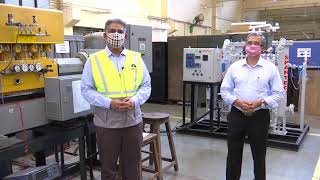
The video presents a demonstration at IIT Bombay's Refrigeration and Cryogenics Laboratory, where a conventional liquid‑nitrogen plant equipped with a Pressure Swing Adsorption (PSA) unit is rapidly re‑engineered to produce medical‑grade oxygen instead of nitrogen. Professor Milind Dutray explains the existing air‑compression, drying, and PSA workflow that normally separates nitrogen for liquefaction, and describes the simple modification: replacing the molecular sieves in the PSA column with zeolite sieves that preferentially adsorb nitrogen, allowing oxygen to pass through. In partnership with Tata Consulting Engineers (TCE) and Spantec Technologies, the team swapped the sieves, connected the PSA to the existing compressor and buffer, and achieved an oxygen purity of 93‑96%, suitable for hospital ventilators. Amit Sharma of TCE outlines the broader strategy—identifying idle nitrogen PSA plants across industry, obtaining statutory approvals, and deploying modular, skid‑mounted oxygen units to address the COVID‑19 oxygen shortage. The presentation emphasizes the speed of the collaboration (MOU signed in one day, conversion demonstrated within a week), the need for compliance and quality checks, and the potential for scaling the solution nationwide.
Chapters
So, welcome to Refrigeration and Cryogenics Laboratory of IIT Bombay. This is Department of Mechanical Engineering. My name is Milind Dutray. I am the Professor of Mechanical Engineering and also Dean Research and Development at IIT Bombay. So, what you see behind me is basically a liquid nitrogen plant wherein we take air from atmosphere using this compressor. And this compressed air goes to the pressure swing adsorption unit, or the PSA unit, wherein nitrogen goes further for liquefaction and oxygen goes to the atmosphere. Now, in view of the pandemic that we have, what we want to do is now we want to reject nitrogen to atmosphere and take oxygen further so that we can fill our cylinders with oxygen gas. We don't want to liquefy oxygen here. So this laboratory now would like to demonstrate conversion of nitrogen producer or a nitrogen generator to oxygen generator, which— where the oxygen can directly be fed to the patients who are sitting on ventilator or who need oxygen in the hospitals. So before I go ahead, I would like to show a small schematic of how this process happens, and then I can show you unit by unit the operation that happens here on nitrogen generator. So here is a liquid nitrogen facility in mechanical department at IIT Bombay. This is a central facility of IIT Bombay and we supply liquid nitrogen to all the departments of IIT Bombay. So here you can see a small schematic. Uh, here you got a compressor and air from atmosphere is taken to the compressor and we compress this air to around 8 bar. And in this container we store air at 8 atmosphere. Now this air has oxygen and nitrogen and other gases like carbon dioxide, water vapor, etc. We take care of all those components, and after that, after separating carbon dioxide and water vapor, this air comes to Pressure Swing Adsorption Unit. Now, this unit is called as Pressure Swing Adsorption Unit, wherein in the existing facility that is meant for nitrogen, we let only nitrogen go outside and get into buffer vessel. However, what we are now doing is instead of letting nitrogen to go ahead, we wanted to go— wanted to have oxygen to go ahead. And nitrogen to be rejected to atmosphere. So this unit is called as pressure swing adsorption unit. This is what we want to change. This unit we want to change in such a way, it's like a filter unit. The molecular sieves now allow only nitrogen to pass through, but we will change this molecular sieves which will allow only oxygen to pass through instead of nitrogen. So we are going to change only this right now, and in all existing nitrogen plants, if we could change the filter or the molecular sieves of this PSA unit These nitrogen plants can therefore be converted into oxygen plants, and that is what need of the hour is. On my left side now, you see, is the air compressor which I just showed you here. This air compressor takes air from atmosphere and compresses it to around 8 to 9 bar. Okay, so what I told you earlier, that the air storage vessel is here where air at 8 bar is stored in this buffer vessel. And the major unit is this PAC unit, Pressure Swing Adsorption. So after the air gets compressed, all the water vapor, carbon dioxide, hydrocarbons, etc., will get removed here. All the oil components also will get released here, and it will enter the PSA system. Now, as I told you, this is a nitrogen plant, and therefore this PAC unit allows only nitrogen to go ahead, but it doesn't allow oxygen to go ahead. So you want to modify this PSA system, and after removing nitrogen, it will get stored— after allowing nitrogen to go through this, it will store nitrogen here for further liquefaction or for further usage. So basically, you've got one more buffer stock of air on the left side of this PSA unit and buffer stock of nitrogen on the right side of this unit, but in between, we separate oxygen and nitrogen. The whole motive or the whole idea of this change is to change the PSA. So PSA has got molecular sieves which allow nitrogen to go through. What we should do and what we want to do is basically change these molecular sieves depending on the size of oxygen molecule. So we will allow only oxygen to go through it and will not allow nitrogen to go through it. And that is the basic motive of this small change that should— that could be done on every nitrogen plant. So in order to do this change, the Tata Consulting Engineers and Spantec, all of us came together because everybody has different contributions to offer in such changeover from PSA nitrogen to PSA oxygen. We understood that Spantec company has got expertise in PSA and they could change the PSA nitrogen to PSA oxygen. So instead of changing our PSA unit, so in order to this conversion of PSA nitrogen to PSA oxygen, Tata Consulting Engineers and Spantec. These are the two companies who came forward, and IIT Bombay, we formed a collaboration. We in fact signed an MOU within, within literally one, within one day and came forward in, and three and a half days we could see that Spantec are in the business of making this PSA, and with our request, they actually converted PSA nitrogen to PSA oxygen. So instead of touching our PSA nitrogen plant, and halting our nitrogen facility, what we did was we connected our compressor and the buffer volume and the purifier to the PSA unit that was supplied by Spantec. So we're very happy that Spantec actually changed their nitrogen PSA for oxygen PSA for evaluation. And we yesterday, we actually coupled this PSA unit to our compressor and we found the results are very, very promising. We got around 93 to 96 purity of this oxygen. Which is absolutely acceptable according to me for our patients who are waiting for oxygen as of now in the hospital. So this unit is basically what we call as pressure swing adsorption, wherein in these two quantities the filtration happens. After some time, because of this, for some time this cylinder used, for some other time this unit is used, so that continuous oxygen supply is monitored. I will not go in the details of this technology, but the filters are basically housed in this PSA unit. So whatever modest success that we have got in terms of the purity and having this unique at IIT Bombay, the credit goes to the collaborative success that we had, the collaboration that we had between IIT Bombay, Tata Consultancy Engineers, and Spantech Technologies. All these three companies could come together, and this actually happened, started happening on Sunday, and now you can see the result on Thursday here. So I'm very much thankful to the MD of Tata Consultancy Engineers, Mr. Mr. Amit Sharma. So I would like to give this credit of taking this technology further for deployment and to see that every hospital gets benefit from such a unit. And I'm very thankful to Mr. Amit Sharma for taking part in this collaboration and seeing the modest success that we have got here. So I would request Mr. Amit Sharma to talk about it.
Thank you, Professor Atre, and to our partners with Spantec. PSA technology has been there since 1970, and I'm sure we will get new PSA oxygen plants. But amidst the current crisis, our teams came up with an innovative idea which we quickly partnered with Professor Athre and Spentec to convert existing PSA nitrogen plants to oxygen plant. It's a very simple technology. In the adsorption process, there are certain sieves called molecular sieves that take oxygen or nitrogen depending on the type of material. What we have demonstrated here jointly with IIT Bombay, Spantec, and engineers of Tata Consulting Engineers is by looking at existing nitrogen PSA plants and converting them to oxygen PSA plants With zeolite molecular sleeve, the output is medical grade. I want to also carefully mention that all such conversions should be done with proper compliance, statutory approvals, and with proper quality check of the oxygen coming out, such that it benefits and does not have any safety incidents, which we must be careful about. At Tata Consulting Engineers, we've been in touch with multiple suppliers of the PSA oxygen and nitrogen plants which are used in industrial complexes. Exxis, because we've been designing plants across various sectors for last 60 years. Our plan is to work very closely with such companies, government authorities across states and center, and to help them explore the feasibility of identifying such nitrogen plants of a certain volume and flow rate and help them to be converted. Our teams of technical experts will be available. We are only already in touch with few states as well as private sector, and we hope that by using this in a short term, we will be able to convert nitrogen to oxygen. And wherever there is time and resources available, new PSA oxygen plants must be quickly adopted. Also, I would highly encourage the various stakeholders at municipality, government authority and private sector to come and visit IIT Bombay and look at the lab and how easy it is to do this conversion. At the same time, how easy it is to look at these modular oxygen plants which are skid-mounted and can be comfortably transported from one place to another to provide continuous stream of oxygen supply in hospitals, or even makeshift COVID hospitals across the country. I hope we are able to save citizens and provide urgent and emergency level oxygen to the various patients across the country. Thanks to IIT Bombay and our partners in Spantek and our team of passionate engineers, I'm happy to say this successful demo has demonstrated that industry-academia partnership can truly yield innovative results in a short span of time.