
Energy Diversification as a Bridging to a Sustainable and Affordable Future Leadership Panel
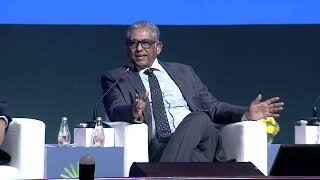
Indian officials and industry leaders discuss how renewables, nuclear power, and storage can deliver affordable energy. Solar tariffs have plummeted from ₹15/kWh in 2009 to ₹2.5-3/kWh today. Gujarat already has 46% renewable capacity and aims for net-zero by 2070.
Chapters
Good afternoon, ladies and gentlemen. We'll try to keep it very interesting, and we have an esteemed panel today where we'll be discussing energy diversification as a bridge to sustainable and affordable future. Of course, um, any energy transition journey has to be a sustainable one, an affordable one, and we have to make sure that energy is available for all. And I think India is one of the few states that's taking a very pragmatic approach towards the energy transition, realizing that all forms of energy are are needed, and indeed all these forms of energy will be discussed with our panel today. I'm delighted to be joined by Mr. Sanjit Kumar, the Principal Secretary for Forest and Environment at the Department of Climate Change, the government of Jhudrat. Welcome, sir. And I'll start off by asking you, could you give us a quick overview of what is happening in Jhudrat in terms of the energy mix your targets for the next years and just the development overall in reaching your net-zero targets?
Yeah, thank you, Amina. First of all, let me start with Sustainable Development Goal 7, which mentions like ensure sustainable energy for humanity, nurturing the quality of life from all aspects known to human. Which covers basically energy access, energy efficiency, clean and affordable energy. So the important components of it are energy security, energy equity, and environment sustainability. So as we all know, during COP26, Honorable Prime Minister, he mentioned about the Panch Tantra, the 5 goals to be achieved. That is 50% of the installed capacity to be from non-fossil fuels, then reduction of carbon emission intensity by 45%, and finally all these 5 targets leading towards achieving net zero by 2070. So when we talk in context of Gujarat, presently the contribution of renewable energy in terms of installed capacity is around 46%, and we are very confident we'll be able to achieve the target of 50% much before 2030. And recently, in the month of October, government of Gujarat We came out with our new renewable energy policy, which will be in place till October 28th, which is a very progressive policy, and lot many incentives have been provided in this policy, particularly for solar, wind, solar-wind hybrid, and others.
I want to bring Mr. Deepak here into the conversation. Mr. Deepak Agarwal is the EVP of Equity Investor Relations and Strategy at Avada Group. When we talk about energy transition, a big part of it is affordability and how commercial some solutions are. Could you just run us through what makes sense in India in terms of commercial solutions?
India, we clearly see that India has shown to the world and demonstrated that India is certainly one of the lowest cost producers of renewable energy. We started way back in 2009-10 when the tariffs were in excess of more than ₹15, and today we are down to the tariffs of anywhere between ₹2.5 to ₹3. So that is a reduction of almost more than 80%. In just a 12-year history. So I think India is one of the best places in terms of the scale at which you can build renewable energy. And this, this is not just solar, but it includes wind. And now I think this will also get extended to long-duration storage solutions like pumped storage hydro. So one is the scale, and second is the sheer potential that exists in India. In terms of taking the renewable energy in the overall mix from currently just around 40% non-fossil-based to close to 50% target that we have set, that the Government of India has set for itself by 2030. So, and at Avada, we are right at the heart of making this happen as one of the main IPPs, uh, who has fully integrated business model in all forms of renewable energy. So, uh, so it's clearly, uh, one of the very good places. And thanks to the, uh, the combined effort of all the stakeholders, India is already the fourth largest market in the world in the renewable energy. And in just a matter of a few years, there where India will notch up to possibly number 2 or number 3 renewable energy market. Thank you.
Thank you for that. Mr. Rakula Kashyapa, from the COO of the ACME Group, we spoke a little bit in the room before coming on stage about offsetting some of these carbon emissions, and you were telling me that there's a lot of potential for India to become a hub to offset all the emissions. Could you tell us how that would work?
Sure. So thanks. Thanks for that question. And it's actually pretty relevant and pertinent because we are talking about the decarbonization of the economy at large. So what we have also seen here in India is that many large organizations who are setting up, say, shops in Singapore and some of the other locations are looking forward to India to set up, say, renewable energy projects here and use the carbon credits generated out of those projects to offset their global greenhouse gas emissions. It actually ties up into the India stories as well because of the fact that we have a pretty large, I would say, the power exchange market wherein you set up a project, you actually take out the green attributes to be used by you, by the organization in this case in India or outside India as well, and you sell the power on the exchange. So if you see the kind of downstream impact that some of these things will have, is that you are actually injecting the renewable power into the grid, although you might have stripped that of the green attributes, but then it's just still at the end of the day, it's a renewable project. So in some way or sense, it's not only offsetting the GHG emissions of the organizations who are setting up projects here in India, but in, in other ways also helping the Indian grid kind of, you know, obviate the requirement of setting up new fossil fuel plants. So those— the advantage of this kind of a situation is two-pronged. One is for the industry which is actually using those attributes and also for the, you know, Indian economy wherein the dependence on the fossil fuel over a period of time is expected to reduce because of some of these, you know, initiatives.
Mr. Amit Sharma, I didn't skip you but you asked me to always come to you last because you are going to talk about a topic that comes up a lot and perhaps is a little bit controversial because it's not renewable energy. Just to emphasize, Mr. Sharma is the MD and CEO of Tata Consulting Engineering. Let's talk about nuclear power. How does that fit into the energy mix and how could India tap into more nuclear power?
Well, you know, I'm definitely a supporter of renewable, of all the work that's happening in that area, the green molecules. But India is a country that will need energy and the peaking of this will take a couple of more years. We are a nation that will continue to use energy and since the topic is about diversification, you know, it goes without saying that clean, continuous, and cheap energy— nuclear plays a big role. We've had a very successful past, about 45 years of nuclear, but the story never really went to the next level. Now is the time for India to really look at nuclear for a couple of reasons. If you look at the Indian energy consumption, it's about 7,000 terawatt-hours. By 2030, it'll be 10,000 terawatt-hours, and it's predicted to be touching 30,000 terawatt-hours in the next 30 years. Now, to meet that kind of energy demand, we need diverse sets of portfolio, and nuclear has to figure in that. Plus, nuclear is a continuous baseload option, unlike the intermittency that solar, wind, and other sources provide. But more importantly, why nuclear has to be a real story for India is our industry. The economics for India will come out either of internal infrastructure growth or exports. We'll grow from half a trillion, uh, to $2 trillion and for exports to grow, our goods have to be competitive. We have to avoid the cross-border adjustment mechanisms like carbon penalties that may come on various products— steel, aluminum, copper, food, etc. So not only our energy has to be cheap, the goods that use the energy have to be competitive and avoid the cross-border adjustments or cross-border penalties. Industry uses 40% of the whole energy, and it's slated to grow from 3,000 terawatt-hours to more than 10,000 terawatt-hours by 2047. Nuclear can provide not only a baseload but also work alongside, respectfully, with the green molecules, with the renewables, other forms of energy— coal to gas, coal to liquid. But also be meaningfully viable considering our thorium reserves, which can add on to our energy security and also provide an outlet for the collaboration that has been discussed under the 123 Agreement, wherein the enriched uranium can be used for the reactors in India. And the small reactors that the world is talking over, India already has these small reactors. Erstwhile 220-megawatt PHWRs are a perfect example why India can take a lead to provide not just clean energy, but energy in the private sector for private industrial energy needs.
And I think there was a recent announcement by India as well earlier this year for private companies in principle to start looking at going into the nuclear sector. Do you think that's a game changer Mr.
Sharma, if you're looking at green steel, aluminum, copper, even silica, our semiconductor value chain requires silica and it's a big guzzler for energy to produce silica out of sand or to produce hydrogen DRI-based steel. And so the private sector has to get continuous baseload, which nuclear is a game changer. And if this can be done within the boundary wall of the plant as in captive, I think it'll really change the game. And the small reactors do provide the right strategy to embrace nuclear in a very big way. We've done about 6 gigawatts, and I think the portfolio should be of at least 100 gigawatts in the next 15 years coming out of nuclear, which would still be less than 10% of our energy needs.
Absolutely a game changer in terms of loading cleaner capacity online. Mr. Kumar, there's always the question of who leads the energy transition, the private sector or policy? And I want to focus on the policy part since you're in government. How could policy help pave the way or ease the way for a smoother transition?
It's, it's important for both private sector as well as government policy. Both have a very important role to play in this energy transition, particularly when we talk about the renewable energy. The initial capital investment is slightly high, but recurring cost is quite low. So here The private sector, if conducive government policy is there, the private sector, because of its mere competitiveness, there will be always a scope of bringing in more competition, reducing the price, getting in modern upgradation of technology and all that. So, and on the other hand, there will be less burden on the government budget. Government, with the right kind of policies, can focus more on building up the energy infrastructure, particularly in terms of upgradation of the transmission lines and all that. So certainly, government policy, the right government policy, will help and invite more private investment in renewable sector and will help in this, the whole pathway of transition to cleaner energy.
Do you receive feedback from the private sector in just your, you know, normal mode of doing business? Do you hear from the private sector their concerns and so on, or is this interaction doesn't happen?
In fact, recently when the state government came out with Renewable Energy Policy last year in the month of September. So in fact, there was a stakeholders meetings where the remarks, the comments of the private sectors, they were taken into and addressed. One of the issue which was raised by the private sector, particularly in Gujarat, was the ITMS. So that was very well taken care of in the new policy. And I would just like to I would like to add, it is slightly out of what you have asked about the— about the nuclear thing which Mr. Sharma spoke about, the small modular nuclear reactors. If you see over the last 5 decades, because of this nuclear modular reactors, we have avoided carbon emissions, greenhouse carbon emissions, to the tune of almost 70 gigatons, metric tons of carbon dioxide equivalent. So it's a huge— I mean, so there's a, there's a great scope of having a diversified mix of renewables: solar, wind, solar-wind hybrid, biomass, pumped storage, and along with nuclear, which can provide the base load here.
Absolutely, and this is the multi-pronged approach that India is taking, which honestly I found very, very pragmatic. And in fact, at COP28 this year in the UAE, it was said that all countries must look after their national interest and take the path that makes sense for them. And this is the path that makes sense for India. Mr. Agarwal— Mr. Sharma had mentioned something about nuclear. That it could withstand baseload. And when we're talking about renewable energy, we have to talk about storage. So could you run us through some of the storage options that are, again, commercially in the works and make sense in terms of storing renewable power?
[FOREIGN LANGUAGE] storage, whether it's in the form of a battery energy storage or there are some compressed air kind of technology. But however, when it comes to a large gigawatt scale kind of solutions, I think the traditional old methodology of pumped storage hydro still offers a long-term sustainable solution, uh, because for the obvious reasons, like a pumped storage hydro is 100% sustainable. Hydro can be a closed-loop system, so there is hardly any loss of water, and the same water can be continuously recirculated day after day, month after month, year after year. The sheer life of the pumped storage hydro can be more than easily 50, 60 years versus a battery storage plant, you know, which can't be more than like 8 to 10 years. And also, they are a very, very high-cost So, so one of the important way and the transition pathway for India in this entire energy diversification is we clearly see the role of pumped storage hydro assuming a center stage. So while nuclear offers a very long-term baseload power and can continuously run at 90% plus utilization factors to ensure that renewable energy moves from an intermittency you know, toward 24-hour round-the-clock solution, the solar and the wind has to be complemented with pumped storage hydro capacities. And that is what even we have embarked at Avada Group to ensure that we move to this RTC solutions. Now another benefit of moving to RTC solutions along with other forms of energy which will also grow the way because given our very large requirements of energy, RTC renewable energy solutions can also help a lot in full industrial decarbonization because there are hundreds of multinational corporations and even large and mid-sized industrial Indian companies who are committed to RE100 kind of solutions, or they have themselves want to move to 100% renewable energy. So one, RTC solution can help them decarbonize their business, and B, India can actually use this RTC affordable and a large-scale RE solution for the production of green hydrogen and further downstream all the green molecules. We can actually be not just used in India, but India will actually can aspire to become a global export hub. Given the cost competitiveness of the Indian industry.
Thank you.
If you allow me a follow-up on that, I mean, when we're talking about storage solutions, we have to talk about critical minerals that are needed for these storage solutions. And we know that the leading country in that field happens to be China. So would that add more reliance on China, or do you think that India currently has access to the critical minerals needed for, for storage?
So yes, critical minerals are a requirement, but they are more needed for a battery energy storage solution. And battery energy storage solutions will also develop in India, but they would be at a much smaller scale, maybe let's say a 5-10 megawatt or maybe maximum 50 megawatt kind of solutions. But when it comes to a 500 megawatt or a gigawatt scale, solutions, we can't have too much dependency on this critical materials. And that's where the pumped storage hydro offers a solution. To just to give you a statistic, India currently has— though installed is around 4.8, but actual operating is just 3.3 gigawatt pumped storage hydro. But if you have a potential of more than 100 gigawatt, and we clearly see the pathway of almost between 20 to 25 gigawatts anywhere in the next 8 to 10 years. So that can be easily complemented with the existing renewable energy solutions. And that also completely takes away the dependency on the critical minerals that is needed for much smaller storage solutions and not for pumped storage hydro.
Sir Kashyapa, we mentioned that nuclear could be used to decarbonize heavy industries. But when it comes to decarbonizing these industries, is there another alternative to that? Could we use renewable powers to decarbonize heavy industries? Sorry, Sir Kishore.
Thanks for that. And yeah, I mean, I am just taking a leaf out of what, you know, my fellow panelists just said. It's actually, you know, written on the face, on the wall itself. So yeah, decarbonization of larger industries, leveraging renewables for that is something which is already happening in India. So there are large, you know, industries which are looking at a very innovative solution, which could be a high CUF, which could be, you know, a mix of both solar, wind, storage, and also to a certain extent dependent on the market. As I talked about, you know, India having a pretty, I would say, robust power markets also. So you can actually also procure green power from the markets at some point in time. So the dependence on renewables, as far as these large industries are concerned, is something which is, you know, happening for sure. We are in discussion as an organization, we are in discussion with a lot of consumers who want us to help them transition to green and clean energy. This is not only going to help them with their, you know, bottom line improvement, movement. But over a period of time, it is also becoming really important because their own consumers or customers are asking to clean up their own operations. So for example, there are a lot many manufacturing organizations who would want to export to, say, you know, say someone in Europe. But the requirements are such that over a period of time, you need to clean up the operations. So if the dependence on, say, fossil fuel has to be reduced, these are ways and means of, you know, transitioning to renewables, leveraging innovative solutions as I just talked about. And obviously storage is going to play a very important role. And that's where we see this transition happening. This is something which was really, you know, far and few in between a couple of years back, but it's expected to become quite, you know, commonplace as we move forward.
Mr. Sharma, you mentioned small modular reactors, and worldwide it's known that perhaps they haven't been as successful as larger ones. How could they be a success story here in India? But— and I also want to ask you about the prospects of pink hydrogen. Could that be possibly a byproduct of having more nuclear power in India?
Yeah, that's a good question. You know, traditionally the West has invested in larger size nuclear reactors. 1,000 megawatts, 1,600 megawatts, and even bigger. And the maths behind that was to have, you know, the base costs justify the investment, because these investments ran in billions of dollars multiple years. The philosophy changed post-Fukushima, where it was understood that the larger the reactor, you know, the safety measures were becoming even more costlier. And, you know, once this economic and maths behind all this was realized, it was evident we can't wait 10 years for a new reactor. So we need reactors in 2 to 3 years to really make the transition effective and viable. And the year-old, many, many years old story of small reactor was revived. I mean, we've got these reactors for military purposes for the last 50 years. You've got, you know, military usage, whether it's submarines, aircraft carriers. But while the West was looking at large reactors, India started the program in the '50s and '60s with small reactors, as small as 100, 200. And we developed this indigenously and then we graduated from 220 megawatts to 540. And then recent fleet is 700, 700 megawatt. We are putting about 24 of them and it's, it's best economics in terms of the power tariffs, etc. But the West is trying to make smaller reactors from a base of 1,000 megawatts. We already have smaller reactors in our portfolio, so that's one advantage. The second is our nuclear program was based on natural uranium, which is not enriched, and that gives us energy security, but we do have dependency on slight enriched uranium from the West, which the 123 will provide. And lastly, we had a 3-stage program wherein 300-megawatt AHWR, which is a thorium-based PWR, already figures in our strategy of 3 stages: uranium, plutonium, and thorium. And so with this technical background, I would say we are at a much stronger position And I'm sure we can lead globally to show the world benchmarked, cost-effective, clean, and continuous energy using small modular reactors.
Could you tell us how long it takes to build one of these reactors? Because traditionally the bigger ones are, what, 6, 7 years? How long does it take to build a reactor?
The project timelines worldwide aren't really encouraging.
Right.
But just to give you an example, we are doing our 700-megawatt reactor fleet currently with the Department of Atomic Energy in between 5 to 6 years. And, you know, the reason they got elongated post-Fukushima was addition of new safety measures. But the target for small reactors is between 36 months to 48 months. I think it'll be realistic to expect about 40, 42 months, and that would really change the game. You know, a typical steel plant requires about 2 gigawatts of energy to produce 1 million tonnes of green steel, 6 gigawatts for aluminium, which is even a higher guzzler. So the requirement for this would be in hundreds. And if you can make them modular, Lego blocks approach inside the captive boundaries, But more importantly, not just for industry, but to even retrofit retiring thermal power plants. Then you have a great story alongside great green molecule story, coal to liquid, coal to gas story, the renewable solar as well as pump storage and the wind story. And I think if you combine all this, we'll have a balanced portfolio which can do true justice to our decarbonization journey and our commitments at COP.
I think that's the ultimate goal, really striking that balance. Mr. Kumar, could you tell us in the next 10 years, how do you envision the energy strategy in Jeddah? What kind of— you already mentioned that in terms of objectives, you're even exceeding the objectives that you've set. But in 10 years' time, how would it look?
See, uh, in fact, as per the projection, uh, the way, uh, the economy is growing, by 2047 the energy requirement will be to the tune of more than, uh, I think around 6,000, uh, terawatt-hour per day, and, uh, 50%, uh, As mentioned by Honorable Prime Minister during COP, the focus is more on renewables and we are expecting before 2030 itself we'll be able to achieve this target, ki more than 50% of the installed capacity will be from non-fossil fuels, but at the same time particularly when we talk in context of Gujarat. The strength of Gujarat is manufacturing, so decarbonization of the manufacturing sector, particularly the big industries like steel refineries. So these are the major areas where decarbonization needs to happen. The CH— the Greenhouse emissions needs to come down. So a lot of mitigation efforts needs to be put into place. Government of India has come out with the National Green Hydrogen Mission, and I suppose particularly decarbonization of these sectors as well as also transportation, these will help us in reducing the carbon greenhouse emissions, finally leading to net zero by 2070. Mitigation measures, but at the same time focus also on CCUS, particularly how to use, how to manufacture methanol as well as ethanol by the process from CCUS. And finally, this time during COP28, Honorable Prime Minister Minister launched the scheme of green credit where almost 8 activities have been identified where there's a lot of scope for carbon sequestration, where focus is there on mangrove plantations, seaweed cultivation, tree plantation, agroforestry, water credit. So I think with all these efforts—
Really comprehensive strategy here.
Yes, very comprehensive strategy to move towards the goal of net zero by 2070.
Excellent.
We're running out of time, but I have one last question for the entire panel, and if you can kindly just answer in a minute or less. It's a bit of a complicated question, but please try to keep it very brief, and we'll start with Mr. Keshappa at the, at the very end. With the strategy that India is currently undergoing in order to go through the transition, Does this provide energy security for the country, or is energy security a myth?
I think that's a very pertinent question, and in my opinion, this definitely provides the energy security to India. We are one of those, you know, geographies wherein we have more than 300 days of sunshine available, plus the kind of diversity that we see with respect to the, you know, availability of other natural resources. Process, I think that this strategy is going to play out pretty well for India and it's something that we all look forward to.
Mr. Agra.
Some of the steps that is taken to ensure this energy security is, I give you an example, is the Production Link Incentive Scheme to produce and indigenize the full solar PV manufacturing chain. That will improve, gives clear visibility on security. Because you can't have hundreds of gigawatts of solar completely depend on the geopolitics of neighboring countries. The second is also the steps taken to ensure that the important components like electrolyzers also start get manufactured in India. So what I clearly see is the thrust on getting the entire manufacturing and the supply chain comfort, which will ensure that as an asset owner and as an IPP, we will be shielded from a lot of global volatility and ensure that we'll continue to deliver and meet the requirements of our population as well as contribute for, as our Prime Minister said, it's not just for Make in India but make for the world as well. Thank you.
Mr. Sharma, energy security, myth or reality?
Well, very real. Not only I would say it's energy security. It's the growth security, economic security, stability for the country, and to be a meaningful player in the global macroeconomics. Energy and the cost of energy will play a significant role. And I think the steps that we're taking to embrace renewable, to embrace our coal reserves, to look at nuclear, to look at the hydrogen economy is a step in the right direction. Policy interventions, PLIs, and a bit more handholding with the private sector collaboratively will ensure that we continue to give returns in terms of our growth trajectory, but also very importantly, to protect our energy peaking. Unlike the West, our energy will peak for the next 15 to 20 years and then stabilize. And so we need to make sure that we have energy that is secure. We have self-sufficiency as much so that our growth interests are protected.
And a reminder, that doesn't mean the consumption of less hydrocarbons. Hydrocarbons will still be part of the mix, especially when you have a growing economy at 7% plus like India. Absolutely.
I mean, you know, these molecules, whether the hydrocarbon or the green molecules, will play a role. And we have this diverse set of energy mix with a smart grid, with energy reservoirs dynamically or statically. We'll have to balance it all. And as you asked me this question, Even nuclear can produce hydrogen at a much reasonable rate. You use it cracking rather than electrolysis, but it needs a bit of maturity because you need high temperature reactors. But I think what's very important for all countries to look at, look at their portfolio, what makes sense with their interest protected and to give them continuity and self-sufficiency. And I think it's, it's not a myth. Energy security has to be on every policymaker's top agenda in coming years to face the geopolitical volatility that we've seen in recent times.
Mr. Kumar, do you agree with all these statements?
Yes, energy security is a reality, but it has to be seen also in light of energy accessibility and energy affordability. Recently, Honorable Prime Minister has launched PM Suryodaya Yojana. We have 1 crore families are to be covered under rooftop solar scheme to make energy accessible to the poor. And also, we have to also look into context of per capita energy consumption where we are very low compared to the developed countries.
Excellent. Thank you very much, gentlemen. I really enjoyed this conversation and I hope we take it forward next year and hear more positive results out of India. Thank you for your time.
Thank you.
Thank you.
More from Nathan



Can AI Read Your Heart? Unboxing DeepVessel with Nathan Qin from Keya Medical | #52







