
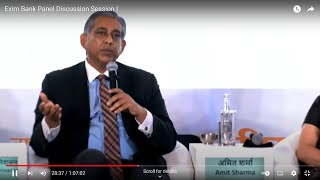
The session, moderated by Deepali Agarwal, Chief General Manager of India Exim Bank, convened senior executives from Afcons, Tata Consulting Engineers, Ion Exchange India, and BML to examine the state of Indian project exports. The panel highlighted that India’s project export value reached US$422 billion in 2022, with a concentration in the Middle East, Africa, and Southeast Asia, and dominant sectors such as power transmission & distribution, hydrocarbons, water & sanitation, and transport. Participants identified structural constraints limiting geographic diversification – high competition, unfavourable contract terms, tax‑exemption delays, lack of sovereign guarantees, logistics cost volatility, and insufficient insurance coverage. Various financing models (Indian LOC, buyer’s credit, ECAs, private‑sector funding) were discussed, noting gaps in guarantee pricing and the impact of recent RBI guidelines. The discussion also covered the service‑vs‑product export split, emphasizing CAPEX‑focused engineering services in emerging markets and OPEX‑oriented services in developed economies, and the need to leverage India’s IP in renewables, hydrogen, and modular plant solutions. Recurrent policy pain points included mandatory tax‑exemption clauses, Indian content requirements, price‑escalation provisions, and the under‑recognition of project‑export value addition. The panel called for coordinated government action – a dedicated committee involving the Commerce Ministry, Exim Bank, and exporters – to streamline guarantees, insurance, and contractual standards. Comparative analysis with Chinese, Korean, and Japanese exporters underscored the difficulty of collaborating with the former, while suggesting joint ventures and consortia with Japanese and European firms as a pathway to higher‑value, low‑cost financing and market access. Concrete project anecdotes (agricultural project in Africa under a line of credit, water projects in Africa, steel and port projects in Gabon and Liberia) illustrated operational challenges such as customs duty exemptions, local content logistics, and political risk. The session concluded with a consensus that a more robust ecosystem—standardized contracts, early bank‑exporter engagement, price‑escalation clauses, and stronger insurance/guarantee mechanisms—will be essential to unlock the estimated $57 trillion global infrastructure opportunity and elevate India’s project‑export share.
Chapters
further impetus the project exports. Today we have in this session the proficient representatives from Indian project exporters. This session is divided into two separate parts. Earlier, this session was supposed to be moderated by Sri Pankaj Kalani. However, due to personal exigency, now this session would be moderated by Chief General Manager, India Exim Bank, Ms. Deepali Agarwal. May I request the panelists, Shri Parmeshwaran, Managing Director, Afcons Infrastructure Limited, Shri Amit Sharma, Managing Director, Tata Consulting Engineers Limited, Shri Rajesh Sharma, Chairman and Managing Director, Ion Exchange India Limited, Sri Shantanu Roy, Executive Director, BML Limited, to contribute and share their expertise and long experience about project exports. Over to you, madam.
Thank you, Mitali. Am I audible? Thank you, Mitali. A very good afternoon, everyone. I hope everybody has had lunch and is settled down now. First of all, I would like to congratulate everyone today present here on this momentous feat of achievement of US$422 billion of mercantilized exports that India has achieved for 2022. It has been only possible with the support of the Government of India, the ECAs, the banks, and not forgetting the export community involved in the export markets. Under the Project Exports, the contract secured by Indian companies in the recent years has been quite diverse. The growing versatility and the technological capability is visible through the footprints which has been set up in the global markets. Today we have various diverse projects right from water and sanitization, transport, educational institutions, roads, constructions, and many other. Yet there is also a need to diversify further into various sectors and various geographies. It is only appropriate for us today to interact with this background, with all of you, the exporter community, to understand the emerging opportunities, the challenges in the overseas markets, and what support is needed to leverage the untapped potential. Based on the earlier stakeholder seminars that we have conducted and also our research and analysis group who keeps doing various research projects, they have come up with the study on project exports. As per the study, in 2020, the value of the project exports from the country as reported by PEPC is around $4.3 billion. Now, as per the study, again it is noticed that we are concentrated mostly in the Middle East. Saudi Arabia is the topmost and the most preferred destination, followed by UAE, Qatar, Oman, amongst the other destinations. In terms of sectors, the sectors that has emerged the most is the T&D, transmission and distribution. So the power sector is the highest, followed by hydrocarbons, constructions, water supply and sanitation, and transport. So with this background, let me begin with my first question with the esteemed panelists here. We observe that these geographical concentrations in the projects are being secured by Indian exporters. So we'd like to understand from the panel that what are the limiting factors for the diversification in newer geographies and what can be done to expand the geographical footprint for Indian project exporters. May I request Mr. Paramsevan to give his thoughts?
Good afternoon, everybody. Thanks, Deepali. I would say the project exports, when we talk about it, can be split into 3 different parts. One is exports happening on account of Indian LOC or Indian buyer's credit or other terms of funding. Another Second, international competitive bidding happening through international funding. Third, ECAs and other funded thing which is part of second. Third is private sector funded projects. And if you look at it, some concentration of Indian companies do happen in Middle Eastern sector. Especially they believe there is a good opportunity in Saudi Arabia as compared to other places. And there have been a lot of companies moving to Saudi and other places, and there are quite a few early entrants into Africa. But in our own experience, if I look at it, the concentration part of it, Middle East has not been a great market. The competitive intensity is quite high and the contract conditions are not so great that barring hydrocarbon and electrical transmission, other areas people have lost money in Middle East. And in terms of Africa, it gives a good opportunity and of course there are number of international competitive bidding happening and also with the commodity prices on the upswing, Investments are— private sector investments are also again taking place. Therefore, we believe Africa continues to be a greenfield. There are good opportunities in Southeast Asia, but the entry barriers are quite high. Many places, Bhoomiputra concept, and also some of the happening places, the jobs are being awarded to government companies. You type it government company, or you take a subcontract from government company. Those are kind of things which are happening in Southeast Asian market. And I would still feel the markets like, uh, Uzbekistan, Kazakhstan, all that economies, Central Asian economies, need further study and involvement. And Latin American markets are a good market, but the kind of time zones what we have Maybe this, their night is our day, those kind of thing. There is a little bit of operational inconvenience. Apart from that, people are scared of inconsistent political situation in many of those Latin American countries. Apart from many organizations like Ouroboros, those kind of thing having gone phut. So, There are definitely challenges in moving to even some of the emerging markets. Some of the emerging markets with some policy initiatives can be decluttered, like Southeast Asian market. Definitely with interaction between external affairs, commerce, and their own ministries, there could be some debottlenecking with respect to, I would say, the Bhoomiputra concept, or certain kind of things, certain facilitation can be done towards that. And those are my initial thoughts on how it is happening.
Amitji, you'd like to share?
Good afternoon everyone and thanks for the question, Madam. I'd like to talk a bit about the services sides of projects. Of course there are EPC which the earlier panelists talked about. So in services sector, the opportunities are primarily related to what we can offer in terms of intellectual property, in terms of design and engineering skills, process know-how, and a way to make projects feasible. So we see in the Middle East and Southeast Asian region, projects are primarily in the CapEx area where design, engineering, consulting firms like in the engineering consultancy fraternity provide services, whereas in the European and American context, the involvement in projects is on plant side in OPEX area. So number one is CAPEX in emerging markets of Southeast Asia, Middle East, and SAARC countries, and in the European and American side, it's the OPEX areas. So if you draw parallels to the IT industry, which has done very well, most of the IT revenues are on the OPEX side of client spends. Whereas if we go to Middle East, we primarily as Indian project providers, both in EPC and EPCM, are providing services on the CAPEX side. So number one challenges, of course, are related to FTAs, WTO categorization of services, double taxation treaties, and this keeps changing. Of course, in Southeast Asia, it's much more challenging, but in Middle East, contractual structures are challenging, which means we as exporters also have to have very strong legal contractual approaches, which unfortunately in India, the talent exists to do great projects. But because of traditional L1 concepts, contract variations or changes wasn't encouraged. So maybe our talent hasn't developed skills to become strong contract managers when you go to international projects. Having said that, if you see India itself, when we see international consultants and contractors coming, they come because of financing that usually comes from international lending agencies. Applying the same formula with Ex-Im and other banks, if we were to give line of credits in Africa primarily or maybe parts of SAARC region, then we do have a natural, I would say, advantage of positioning ourselves. Otherwise, the positioning has to be done in terms of competency, skill set. Now, the world is going through a major transition, whether you look at technologies related to renewables, the whole focus on hydrogen, methanol, ammonia is changing the power dynamics, the energy dynamics. The world is also changing because of geotechnical— geopolitical realignment that we see either because of China or the current challenges in Europe, which means that IP-focused, standardized, modularized solution, which obviously is the future for green technologies. India can provide very strong project expertise, especially when it comes to solar, hydrogen, methanol, ammonia, but also to standardize plant engineering and infrastructure projects. And as India's infrastructure grows, our reputation to produce world-class benchmark projects will become the brand itself where we could sell the skill set outside. Side. I believe the recent focus on FTAs with equivalence on both sides will favor a higher project growth beyond just the regions of Middle East, Southeast Asia, but also in Europe. Time will tell, but I think it's a good start. I'll have a few more comments on this as we continue on the panel. Thanks.
Thank you, Mr. Sharma. I'll now request Rajesh Sharma ji to give his thoughts. On the geographical concentration.
It's true that most of the Indian companies have preferred to be in Southeast Asia, Middle East, and predominantly now in Africa. As the Latin America being far off from here and also language barriers, I think that is one of the reasons. Plus, I think some areas we have not much of information available. So probably our missions, our consulate offices can help in those areas if you want to expand the geography. To inform the leading companies the opportunity available in that particular country and how to approach them and what— how— with whom to interact. That will certainly help to expand the geography. Having said that, we as a company have only concentrated in the initial stages dealing with the private sector. Most of the projects we did with the private sector. We started now with the help of Ex-Im Bank, we've gone for an infrastructure project in Sri Lanka and are looking at more projects in Southeast Asia. So knowledge of the market is very important and also the comfort level in terms of knowing people, having your own local presence is equally important, and you can't be present everywhere because earlier session we were talking that local presence is required to pursue a project. So we need to really focus on the countries where we have an advantage and we can get timely information, support from our emissions, and that will certainly help in expanding the business for project export. Having said that, there is a huge investment on infrastructure because every country is working on the SDG goals to see that by 2030 everybody meets their target, and most of the investment is coming into water sanitation, health, and these are the predominant sectors. And this is where I think Indian companies have a lot of opportunity to provide know-how technology to the developing countries and utilize this major opportunity or investment, as it was being talked about, almost about $57 trillion $1 trillion in this particular infrastructure sector is being earmarked for— to be invested in by 2017— 30, sorry. So we can focus on the competencies of the companies and the opportunity in the market rather than trying to go everywhere and trying to pursue every type of project. So look at our own competency and then go for the project where we have a better chance to succeed.
Thank you.
Thank you, Mr. Sharma. I'll request Shantanu Roy to mention his comments.
Thank you, Deepali, and a very good afternoon to all of you. Post-lunch sessions are especially very difficult, right? But I am fortunate, you know, being the last speaker. I am fortunate in two ways: that by now many of you might have come out of your slumber, and number two is that all my esteemed speakers have already spoken what they had to. So it's very easy for me. So there are just two thoughts in my mind right now. I'll be very direct. Number one, acceptability. Number two, financing. These are the two reasons why Indian exporters are concentrating on a particular territory, particular region. Coming to acceptability, except for IT, IT-enabled services, or, you know, textiles, generally the capital goods or the power equipment or the energy equipment, these are not acceptable in many of the countries, especially in Western Europe, in US, in Korea, Japan, Simply, we cannot go there. That's why we have to limit it to countries like— to regions like Africa, to Middle East, to Southeast Asia. Even Southeast Asia is becoming difficult day by day. The second point, that is the financing. Now, financing Africa— every project you need financing. As an Indian exporter, what are the options before us? The options are number one, G2G LOC. Number 2, BCNEIA. Number 3, commercial financing, right? Or else some grant, some form of grant. Uh, with, with time, over a period of time, African countries are finding it very, very difficult to give collaterals in the form of sovereign guarantee, especially after their experience with Chinese funding. What has happened is that most of the countries have exhausted their sovereign guarantee exposure and they are not ready to give it further for any kind of financing. I had been to Kenya recently. There are very good opportunities there. Unfortunately, the kind of financing that we can provide will require a sovereign guarantee, else we go for a pure project financing, which again a blended type of financing is not really available which can be lucrative for the Indian exporter. So we have to look into ways as to without a sovereign guarantee how we can finance projects in Africa, and I'm sure with this kind of approach, with this kind of model, we'll be able to address more and more opportunities in Africa. Thank you very much.
Thank you, Shantanu Ji. Since you mentioned that you'll be the last one, I think the next round I'll start with you only, Shantanu Ji, so you'll be the first speaker for the next set of questions. So my next set actually is based on the experience of each of you, since you are from a diversified field. Is there any project that you handled in the past which has been different or niche, or it was very challenging for you all to get it? And if you could share with the audience, what are the challenges you all faced? How did you click on that? Success and then what, how did you overcome whatever challenges you had faced? Shantu ji, over to you.
Well, Deepali, now again I would say I am fortunate that I am the first speaker. Thank you very much. So again, I would share a couple of experiences that we had. BML as a company is not really a project exporter. We are normally product exporters. But presently we are doing a project, it's an agriculture project in Africa. I won't name the nation. It's under Government of India line of credit. The only experience that I can tell is that we need to draw some timelines, some boundaries as to the timelines by which a project can be conceived or it can be finished. Until and unless we do this in our LOCs or G2G financing, Indian exporters will have to wait a very, very long time. And we have been waiting for the last 10 years, and now finally, after a wait of almost a year, the LC has been opened, the advance we have received. But still there are certain issues which need to be sorted out by the local government, especially in terms of the custom duty exemption. The custom duty exemption is there as per the contract, but until and unless a statute is issued in that country, it doesn't really matter, because as soon as our goods land there, we will— they will charge custom duty, and if you do not pay that, then demurrage will be there, and we will have to pay a lot of demurrage. Number 2, we did a project in Zimbabwe long back under the BCNEIA, And there I must appreciate the role of EXIM Bank in administering the BCNAIA project, and it was done very, very smoothly. Yes, the local challenges are manifold, especially in case you work in Africa where the infrastructure is still a long way off. In spite of that, the African people, I must say, they are very, very enthusiastic, they have been very cooperative. Unfortunately, because of the infrastructure, because of the local rules, many, many places there has been a political instability. So those are some of the things that Indian exporters must keep in mind. And there, in fact, we are looking at the Government of India to give us a kind of political guarantee We know we have ECGC. ECGC gives a comprehensive guarantee, but that doesn't mean much when it comes to really, uh, taking care of Indian companies. Here we would definitely look at the government. In fact, I am just coming back from a meeting which was hosted by Secretary Economic Relations, and we had raised this point there, and it has been very well taken and very well noted by Ministry of External Affairs. And let us hope that something will come out Because until and unless the government backs the Indian exporters, or for that matter any country's exporters, exports revenue cannot go up. I mean, it can go up, but only to a certain extent. And with our honorable Prime Minister, uh, his, his dream is to make India an export hub. Definitely the government support and support of financing institutions like Ex-Im Bank, ECGC, They are very, very crucial. Now coming to the next point, it is not only the financing that is important. For financing without a government support, we need very good underwriters in this country. Unfortunately, we don't have an agency which can underwrite a project, a commercial project which has to be financed. Number 2 is the insurance part. I remember for one large project with one Indian company, we could not get insurance, project insurance from India, and we finally had to go to that country to get the project insurance. Without these, without the entire ecosystem for exports, project exports will definitely be hampered, and I believe it is high time that we have the entire ecosystem in place. Thank you.
I'll start from where Shantanu just left. I think it's very important point in the current context and environment because most of these countries during the pandemic have really gone out of the way to give stimulation and which has left them with a lot of debt. Now with this current situation, there is going to be more defaults. Already we have seen two countries going into default and you would see as we go ahead more countries going for default. So the insurance for project cover— project export, it becomes very, very important to cover up the interests of the exporters and we should find some way to see that if we are pursuing a project and if we are successful, then strong insurance cover is available and whatever cost it is, I'm sure exporter is ready to cover the risk. So what we need is a facilitator who is able to provide that kind of insurance. The second challenge which engineering exports faced, we started early '90s, it was very difficult for Indian companies to secure engineering projects outside India. And so we decided the best way to do this is to learn how others are doing. And in that, the most difficult market is Japan. So if you can sell a project in Japan, then you can sell anywhere in the world. And we chose that as a path. It was crazy. It took us almost about 3 years, but we got success. And I think it was a big learning for the company. And you learn how meticulously they work, what are the expectations of international business. International customer. Because why we looked at this is we were concentrating on Southeast Asia, and Southeast Asia, most of the engineering companies were from Korea, Japan, or to some extent at that time from some big Chinese companies. But largely it was dominated by Japan and Korea, and we had to compete with them. So we had to raise our standard to that level to become successful. So we learnt and I think we have been successful. We have done many projects now in Indonesia, in private sector, Thailand, Malaysia, and also in the Middle East. So transparency, honesty, that are two very important things, and of course the quality for international projects. If you can forge the trust, the business automatically comes.
Thank you, sir. Over to you.
Yeah, so I'll shift gears again and talk about consulting, design engineering. And if I draw parallels, as India takes loans from various agencies including World Bank, JICA, and many others, most of these loans default is that you would have international consultants who would bring knowledge of that product, whether that's related to an innovative technology, say high-speed rail, smart cities, water management, and so on and so forth, or power, etc. And the working by those financial institutions with the consultants in European or Japanese context is much closer, and I think we should learn and replicate that because that solves a lot of the challenges. Working even at arm's length, strategically, if we align certain competencies that we offer to the country that is taking a loan, a line of credit, along with the competencies It's a win-win on both sides because for the lender, it's a low risk because the project will be successful, and for the person taking the loan, the country will be assured of successful completion of the project with metrics that are desired. And in between comes two aspects: the design engineering and the actual construction. Typically, the construction requires a large local component, whereas the design engineering, because of the IP and knowledge, can be from the home country. That's giving the loan. So with that parallel, we could apply the same logic as we give LOCs to countries in SAARC, Southeast Asia, Africa areas, whereas Middle East is self-funded in most cases. The other parallel is also in terms of offset clauses and the FTAs. We see this very strongly even in develop markets that if you are building a nuclear plant, a steel plant, a power plant, even though the financing is coming, the countries are very strong on demanding offset clauses with local content. We need to give this a much firmer structure. Today, offset clause in India, for example, are only on defense, but again leveraging this analogy when we do international projects, if our FTAs, India can provide and provided we have the competency and IP to provide the right skills, assured design, assured project metrics, output and performance guarantees, definitely the Indian exports will go. So from a services exports perspective, India crossed 250 billion. That's a statistic that SEPC under Ministry of Commerce released few weeks back. And out of this 250, pure design aging exports fall in 3 categories: product, projects, and plant engineering. Product are typically equipments where you do both design and fabrication. Projects, of course, involve consulting, which could be done within India and then exported to the country destination where the actual project is happening. And as I said, construction requires local presence, whereas design can be 50-50 or 70-30. And then plant engineering, which is much more complex. So if you were to build a steel plant in Middle East or a fertilizer plant in Africa, which we've been doing in past couple of years, the tacit knowledge of process, the licensing provider, and the overall engineering benefits. Now, the challenges in this whole equation are on collaboration a lot. I think as project exporters, be it on tangible or intangible, like design engineering and tangible on equipments on projects, a very strong collaborative mindset of building partnerships in your target country is a must. Codes and standards will differ, requirements of regulatory agencies, government agencies will be very critical. So one of the key quality that we in India must develop to enhance the project exports is collaborative partnerships on areas where we come on strength. I agree with Mr. Sharma as well earlier that either we choose a discipline or a sector where we provide strong, credible projects that we have executed in India and hence can be transported to those countries, or we focus on a country per se by identifying the requirements of the country. So it either can be a sectorial strategy or it can be a location or a country strategy. And it's better to do either of these because then you're very focused in your partnerships and the ecosystem that you create. We've been able to rapidly penetrate Europe as well as Middle East, especially in renewable, in process industries, in areas like steel plants, fertilizers, because of the inherent process knowledge, plant engineering knowledge. But more importantly, our challenges also were there because of partnerships, and we invested a lot to build that culture of collaboration and partnership with local partners. Any project will require you to be very strongly embedded in the way things are done in that country, to understand the code standards, approvals, expectations, timelines, and the whole cultural way of executing projects. Ultimately, you all have to deal with humans in both countries to execute a project for success. So these are my few thoughts. Thanks.
Thank you.
See, we last about one and a half decades, we have done nearly 60 projects outside of India, and we have the unique distinction of having completed most of these projects on or ahead of schedule. There are number of projects landmark projects we have done— maybe a port delivered in 18 months in Gabon, a jetty delivered in 8.5 months in Liberia— these are first-time entries. So I am not going into the making of the project or the technical challenges of the project. Thanks to the new government's initiative and thanks to Exim Bank becoming the nodal agency, last 5 years we have been into LOC and buyer's credit business also. Before that, we were never in that business. And some of my thought processes are limited to the Indian-funded projects, where the kind of challenges what we face, the kind of improvements what can be attempted That could go a long way. And on Indian projects, all the projects, it has clear clause that it is fully tax-exempt except employee taxation. Other taxations are exempt, whether it is LOC or buyer's credit. But we never insist before signing a contract that this should be in place. So many projects, even after completing, the revenue authorities are after us. Conveying, we have already paid tax in India. And they are after us, you have not paid tax in that country because they have not, in spite of the contract document having been accepted by the Parliament of the country, the loan document having been accepted by the Parliament of the country, the tax authorities, they say there has to be an internal process of tax exemption approval. It's a separate approval. Which has not been followed, which we in many places we are not privy to. In such cases, I would suggest that there has to be a mandatory clause. Unless these are fulfilled, the tender should not be out. So that is something we should make it mandatory if it comes to on the taxation aspect. On the second aspect, What I talk about is Indian content. We have been stipulating repeatedly about 75% Indian content, 65% Indian content, as the case may be. In one of the projects, at the commencement of the project, nearly about 2 and a half, 3 years back, we were incurring a logistics cost of $300,000 for a ship to go to that place. Today it It is 1.6 million for the same, and that too you accept today, otherwise ship is not available. The logistics cost increase. The second, at one point of time in one of the projects we were queried, why you have not taken steel from India, part of the steel. Today when we ask for steel, it is not available. For example, steel. For a particular project, when you looked at it, we require X amount of steel. A party from Dubai quotes 60 crores, yet party from India, public sector undertaking included, quotes 80 crores, and the delivery, no guarantee. So that is not addressed. The third part, the project exporters doesn't get any acknowledgement or appreciation. The project exports create 2.5 times value minimum from one project export transaction, because the remittances from apply more maximum employment generation, all that. A manufacturing export, barring exceptions, if you look at it, it is only about 15 to 20% value addition. All other, they import, they do some processing sent back. Here there is zero input, entire thing is export. So, and it is never appreciated. And also there is a misconception that project exports are minting money in their projects. Many projects, if you look at the balance sheet of the project export companies, barring exception, most of the projects they would have lost money. So the Serve from India scheme which was introduced for service exports and all. On that same thinking that project exports are minting money, they restricted to a maximum of ₹5 crore. I have 40% of my turnover coming from overseas markets, and I am a 3-star trading house eligible for 4-star trading house as per NOx, and my service export benefit is restricted to ₹5 crore. Why? A merchant exports who does only 20% value addition, 10% value addition, he gets full export benefit. So how? So this is another of the issues. The project exports, if they are properly respected and valued, sky is the limit for project exports. It's not happening. The fourth point what we have with respect to project exporters business You have an ex-Indian content somewhere, maybe it has fallen, or this thing. A project export is not like a merchant export or a service export where you can suddenly stop. You mobilized 500 people, 1,000 people in a project setup. You are feeding them, you are paying them salaries, you are paying them, you are— you have so much of resources in the setup and you suddenly stop payment. Your decision-making, COD has not met for 10 months. Therefore, decision-making is not happening. In the process, on a 100 million project, you don't get 20 million, 25 million. You are struck. How to run the projects? A project export business, the understanding of project export business practically is not there in the government. That's a sad part of it. Unless project export is understood and corrected, it's going to be very difficult. There are a number of procedural issues which I suggest, uh, Madam Deepali, probably Exim Bank should take an initiative to constitute a small committee consisting of Commerce Ministry, Exim Bank, and project exporters to arrive at solutions for all these issues. Project export can generate in multiple crores And project exports, today if it is somewhere at ₹18 billion or ₹20 billion, it can go minimum 5 times in the shortest possible time if reasonable support and understanding is there on project export. And Project Exporters, 100% of project exports is done from India, and there is a value addition of employee-related remittances, subcontractor employment, and on the top of it huge value creation of Brand India. Many African countries today, they speak, when our northern neighbor comes and does, all the work— worker comes from there and all the food and other thing comes there. There is no local engagement, there is no value addition to the local community, whereas there is aspiration in many African nations that local people should be employed and minimum 20% of the business should come to the locals. Many countries they specify now, and they are extremely happy when Indian companies work there. They have extensive involvement. In most of our African projects, nearly 70 to 80% of the people working in that project are locals, and, and some of the subcontractors are also locals. So we create in the process a huge brand value for India, which cannot be just valued. One has to really understand and appreciate. And many such things have been even mentioned by presidents of several nations to our Prime Minister, and there have been appreciation letters to external affairs ministries to ask how the Indian companies have performed, how they have added value to the local people. How they are involved in the CSR activities, all these. So all these has to happen, needs good amount of policy support. There are quite a number of other points. At this point, I stop here.
Yes, that does call for a round of applause. Thank you, Mr. Paramsevar. Of course, your comment about not appreciating really reminds me of, you know, the thing Hindi kahavaat hain na, ghar ki murgi dal bala bhar. So appreciation will never come, but I myself have visited and been fortunate enough to witness many of such projects overseas, especially in the African continent, and I have seen that we have really got a lot of appreciation for all the projects that have been executed over there. There is always a comparison drawn from the Chinese counterparts. And whenever we have met the overseas governments, they were showering praises for the Indian project exporter community, and a lot of appreciation and a differentiation in quality timelines has been witnessed. So kudos to you all, keep up the good work and keep India's flag flying high. With this, I would like to have another set of questions. In your opinion, what do you think that where are the project exporters? How are we different compared to the Chinese or the, you know, Korean counterparts? And would a collaborative approach, taking cue from Mr. Sharma's comment that he mentioned. Would that really help if we work together and have a collaboration and do the project execution in a proper planned manner? Would that help the project exporter community? Param Sivanji.
See, in terms of project exports on a collaborative approach, It's very difficult to collaborate with Chinese or Koreans as their method of working, their style of working, and their secretiveness, it may not permit. But the Indian government's right initiative with Japan, Indo-Japanese collaboration, at some point of time when Ms. Nina Malhotra was JS She was spearheading that initiative. And when that point of time when the Prime Minister Abe's government announced the $32 billion to African funding from Japan, and many Japanese companies come, that point of time lot of initiatives were taken by the Indian government to have an Indo-Japan cooperation by which You fund 70%, I fund 30%. In terms of working, you give reverse, 70% to India, 30% to this thing. Lot of meetings took place, at least a dozen meeting took place in India, Japan, Indonesia, many places, but it has not taken its logical end. I think with some Japanese companies With most of the Japanese companies, India will be able to collaborate. In, uh, most of the European companies, India will be able to collaborate because we will definitely bring competitiveness to the overall scheme of things. With China and Korea, collaboration could be difficult. And apart from that, in— there are many multilateral-funded agencies When we compete in the international markets, in many places there are exceptions where we have won from some— against Chinese competition and others as well. But typically, Chinese companies in— comes in group amongst themselves, they arrange and quote any price to take a job or whatever. There, if we can lobby with multilateral funding institutions that at least 25%, 30% of the employees should be from the local communities. Especially when it comes to Africa, Japanese comes 100% this thing. So automatically they will go off, Chinese will go off. So then the competition is wide open for any company. That kind of a clause if you can really lobby, and bring it around, that will go a long way in helping project exporters in winning international competitive bidding in a much better manner. So apart from collaboration, that's one area which could help.
The—
apart from that, for project export-related business, better guarantee availability if it is made at competitive pricing by the export credit agencies and also the commercial banks of India, that would go a long way. Because international guarantees, it calls for one fronting guarantee from India, one guarantee from local, the cost gets doubled. So we can become competitive if some kind of an arrangement can be worked out. That would also help. These are facilitations which would help. Today individually every company is trying to facilitate themselves. If some organized facilitation is there in those area, that could help. Apart from that, in some of the recent times, uh, there have been, uh, due to COVID impact, many countries are impacted and many countries are seeking some kind of a reschedulement of their installments and other things. Things. That is creating a problem to Exim Bank, and, uh, there are naturally from that of an aggressive approach, they become a little conservative, understandably so. I don't blame them. So whether we can find a solution for that. The fourth aspect is recent RBI guideline. The RBI has come out and said They have not equated buyer's credit and line of credit. The line of credit, it depends on a sovereign guarantee or a finance ministry borrowing. Therefore, if one installment is default or delayed, there is no need for provision of entire loan. Whereas RBI has come out of the guideline— I think they have not understood this aspect properly. That buyer's credit, which is also based on sovereign credit, sovereign guarantee, where if one installment there is a delay or default, the entire loan is to be provided for. So already COVID has introduced some amount of conservatism in Ex-Im Bank. Now on the top of it, with this guideline, there is a rethink whether buyer's credit is worth at all if this is the guideline. So, and because of this COVID-related issues, in spite of commodity upswing, there have been issues for many countries. Because 2 years there have been no movement of people. So maybe extraction of minerals, others, logistics-related cost, tourism, lack of tourism, all these are creating problems to many nations. Our, if we take Maldives, if we take many African nations, Sri Lanka, many things waiting to happen. Sri Lanka is already into distress and we are hearing Nepal is soon to follow. And so these kind of things are bound to happen in the current geopolitical situation. So we need to take a balanced value call. The value of the respective neighbor or respective country and the relationship and how they have behaved in the past. Whether it is the short-term behavior. And that combination of Exim Bank, RBI, Finance Ministry, and Commerce Ministry, if they sit together, that issue could be resolved, where these temporary issues can be parked and can be addressed later. And where if some inputs or others are required, as exporters, we can always give our viewpoint for them to take any call. Thank you.
So my perspective on this would be a bit futuristic and I would say what we've done in Sri Lanka, Nepal, Middle East, Africa is past. And yes, finance is a dominant factor in project exports and it has its own challenges, but to the question from you, ma'am, Will collaboration and partnerships help? And I think if we want to benchmark ourselves to provide the best project services across the globe, not just related to these markets, you know, we must differentiate compelling value proposition beyond just cost in terms of proven project deliveries, process know-how, and a fair degree of complexity in the project that gives us an edge over the competition, be it from South Korea, China, or the local in that country. And to do such complex projects, I think partnerships and collaboration mindset is a must. Most of the large infrastructure projects in hydrocarbon, steel, energy, and power sectors involve global collaborations between contractors, engineers, process know-how, licensors. And I think if we want to become there on the global stage, not just the traditional countries, which is what the question is alluding to. We need to go beyond the current challenges and create global partnerships. Finance being a dominant factor in many of these decisions across— yes, there could even be collaborations at the fund generation itself, and that could be led by EXIM and their counterpart, other lending agencies. But in terms of project execution, I think we would not come to a level of global benchmark and global stage if we continue to work in terms of just one entity. Consortiums, JVs, that mindset with a global partnership is a must to penetrate really interesting projects across the globe. Close to $5 trillion expected in next 7 years across, and why should we limit ourselves in terms of providing expertise in Sri Lanka, Nepal, or Middle East? I think with the expertise India has, and I think the whole transition, whether you look at the automotive value chain, you look at the energy value chain, green chemicals, the whole landscape is changing, and collaboration partnerships with the mindset of JVs and consortium with the best complementary skill sets that other country players provide and create a, I would say, international consortium to really go after mega projects rather than trying to win them one-off should be a clear focus for future of Indian project exports. And I think that's the strategy most of the project exporters in Europe and US have taken. Yes, there has been a siloed approach in certain parts from China and Korea, which was primarily cost or funding related, focused again on African and few other nations, which Africa has also realized is not a sound strategy. So I think if we want to be benchmarked to— ma'am, your question— consortium JVs with the best in the world, aided by equal partnership in terms of lending and financing, and strategically then aligning our skill sets of delivering the project and financing the projects is a way forward to become a trillion-dollar export in projects. And it's very much possible if we tie up these ends together.
Thank you.
Over to you, Sir Majid.
I fully agree with Mr. Amit Sharma that you, in today's world, you need a collaborative approach. And collaboration need not be only with an international company. Among Indian companies can be also a collaboration depending on the competencies and experience, technology. I think a consortium or a JV approach would certainly help work on larger projects and increase the competence of a company, also penetration. With regard to financing, I think we are really behind. I mean, if you look at China or Korea, I think number one is China in engineering exports, followed by Korea, Japan, France. I mean, all these countries are certainly providing that low-cost finance which is helping the exporting companies. Moreover, I think there's a lot of government support. Through the missions. They are identifying the opportunities. In fact, they are locking the opportunity with the finance, and they take the most competent company and then introduce it to the ultimate customer. So I— if we have to really grow in multiples of what we are today, so we need to really look at what others are doing and what are our disadvantages and how we can come closer to what they are able to offer. Good thing is that we have experience, technology, and a credibility in the market now. What we lack is this fundamental support on low-cost finance, as Mr. Shimazawa mentioned about low-cost guarantees and the insurance cover. I mean, if these things are addressed, I'm sure the Indian companies have the capability, technology, and experience to multiply project export. Thank you.
Well, Deepali, as far as the Chinese are concerned, we cannot be like them. We cannot beat the Chinese. I'll just— I just remember one instance where we were doing a project in Syria. It was for oil field equipment, and the price that we quoted, the Chinese quoted just, you know, one-third of that. So I was just wondering how they are able— how they are going to execute this. The thing is that they don't have a concept of cost, and for getting the order, they can do anything. And basically, the government supports them. They will subsidize them and whatever else to promote the exports. So that is a well-known fact. As far as the Koreans are concerned, they are very efficient and very hardworking, and I have a great respect for the Korean project exporters. Now, the Indian project exporters, they do plan well, but most of the times in international market where there are so many uncertainties, and especially the countries that we normally work in, there are so many uncertainties regarding the local conditions, the law and order, the local disturbances, that many a times the plans definitely go for a toss. And suddenly the Indian project exporter is left with nothing but to, you know, wait for the situation to normalize. Until— unless that time, we just have to wait and then when things get good, the Indian project exporter is able to execute it or sometimes not even execute the project and the project has to be left in between. Many times this has happened. Coming to collaborating, a thought just crossed my mind. Why not go there as an India Incorporated? That is, synergize the strengths of Indian companies, go for project exports with a complete solution. For example, India requires quite a few minerals which are not available in India. For example, phosphate, potash, cobalt, tungsten. Tungsten India is having, but we have low-grade tungsten. Now high-grade tungsten is required basically for the heavy alloy ammunition systems for our defense forces. There are abundance of these mines in many of the countries. There is no money with them, they cannot do the mining. So why don't we go as a— as a consortium or as a joint venture in those countries, have a local SPV formed, do the complete mining, bring it, bring the raw material after of course taking care of the wastages to India to use them for manufacture of fertilizers which are very, very important for our agro-economy. And we can increase our exports. Company like BML can give the mining equipment, we can bring in a concept of barter trade. So all put together there are several ways, several models which by which it can be done. So definitely a collaborative approach amongst the Indian companies, synergizing the strengths, is a much, much, much better idea. That is what I believe. Thank you.
Very well said. I know we are running out of time, but I would like to give opportunity if anyone has a question or two, we can take that. Yes, I think I'll request you to introduce yourself. Let the somebody hand over the mic to you. You can introduce your name, designation, and the institution that you represent.
Thank you. Hello, I'm VK Rai. I'm from New Age Firefighting Company. You know, I agree with Mr. Srinivasan. He had given a very good suggestions about it, and one of the thing which I was also expecting from our side, you know, we were executing a LOC project through Exim Bank only for Mauritius. And there were so many problems which were coming over there. You know, after getting that order, we waited for about 6 months for the contract agreement signing itself. Why? Because we gave them the PBG which was not being accepted by them. Though it is as per the tender document, whatever it is written over there, as per that format it is being given, but still The beneficiary name has changed. If a beneficiary name is getting changed, that has to come somewhere. So there are no system in this which can bring out the changes in between the tendering stage. And the second thing was, even after— okay, PBG's contract have been signed. After that, there were changes in the signed contract also, because the payment was to be made through LC, but subsequently they told no, we will not make the payment through LC. So that way the project suffers. So my submission to the Ex-Im Bank is that while concluding, while taking these projects, the tendering stage itself, if they can bring out all those things which are required to help the exporters, because if these are finalized in the beginning, if a change is required— though on the insistence of Exim Bank, we got through without LC, we accepted this because we wanted to execute the project. So all those changes, even though those were in the contract signed, were being deviated, but still in the interest of the project, the exporter has to do— has to compromise with many of the things.
Well noted. We'll take a note of this.
And there is one more issue which I just want to say. Why? Because, you know, while there is a LOC and some whatever project is coming, if Ex-Im Bank is having interactions with the industry for that project, it will be better for India because the indigenous things can be increased in that. So that type of interaction of Ex-Im Bank with exporter before coming out with the tendering of that project will definitely help us. Thank you.
Thank you. I think the gentleman here had some question. One second, I think we'll just get the mic for you, sir.
Yeah, good afternoon everybody. This is Sambhu Singh, Vice President Fcons Limited. I'm taking care of water division of the company. We are executing 4-5 LOC projects in Africa. One thing, the market price and all, particularly the steel plates price and all, it's escalated like anything, and there is no provision of price escalation escalation in the contract. Although some contracts are 30 months, 24 months, 26 months, so it is our— this thing is that price escalation clause should be framed in the contract condition. This is a mandatory requirement apart from the taxes and all what our MD sir has already communicated. Thank you.
Thank you, thank you for your suggestion. I think it has been an interesting and a very engaging session. A lot of food for thought as well as very valuable inputs shared by the panelists. I think we can close the session now, with your permission. And Mitali, over to you again.
Thank you, Madam. May I now request DMD to hand over the customized Sankalp Tarun certificates to our honorable guest speakers. Shri S. Paramasevan. Shri Amit Sharma. Shri Rajesh Sharma. Shri Shantanu Roy. Thank you, all the panelists and the moderator. Ladies and gentlemen, we will have a short tea break now before we enter the second session. Thank you.
More from Nathan



Can AI Read Your Heart? Unboxing DeepVessel with Nathan Qin from Keya Medical | #52







