
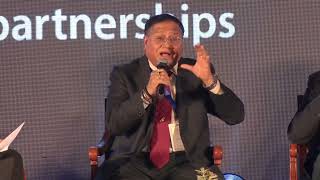
V. K. Saraswat, Prof. Govind Rangarajan, and Prof. Subhashish Chaudhuri outline India's path to net-zero by 2070 through the Panchamrit framework: 500 GW renewables by 2030, nuclear power including small modular reactors, and green hydrogen. They stress that scaling these technologies requires solving critical material shortages, sustained R&D funding, and private investment alongside government support.
Chapters
Ladies and gentlemen, policies, education, and economy drive not only the growth of the nation but also how its people shape the outcomes and the journey. Our next session focuses on aspects of policymaking, industry participation in not just the policy aspects but but also in influencing the research and innovations required for enabling growth. I would now like to invite on stage Mr. Bhanmali Agrawala, Sir, President, Infracluster, to please come onto the dais and open the floor for a fireside chat on Bharat@100 journey with focus on sustainability, energy transition, India R&D trust, Atmanirbhar Bharat, talent pipeline, and the role and partnership of collaborations.
Good evening, everyone. I hope I'm audible out there. Welcome again, and it's really a privilege and absolute delight to have such a galaxy of people here, both from industry, from government, from academia, and of course our own colleagues from the Group. I think you just heard a fairly longish spectrum of what needs to be discussed. I'd also like to put that in perspective of what you heard from the Chairman, in terms of the opportunity that lies ahead, what you heard from Dr. Rajiv Kumar in terms of what it will take, what the potential that India has and what will it take, but with a specific focus on energy. And I thought we'd spend this session, given the luminaries that we have, to kind of spend some time on what does the future of energy for this country look like. So to discuss this, May I invite perhaps the best minds that the country has onto the stage and request them to share some thoughts with us. To begin with, I'd like to invite Dr. Saraswat. He is the member NITI Aayog and also the Chancellor of JNU. While he's walking up, we did agree in the briefing session before that we will not go through the full biodatas because that itself will take about 30 minutes. Dr. Sarath, please do join us. In fact, today I believe a missile is being launched somewhere, and Dr. Sarath is also known as the missile man, so I think his phone is busy with answering a number of questions on how the missile is being launched and so on and so forth. I'd also like to invite on stage Professor Govind Rangarajan. He's the director, Indian Institute of Science, an institute as we all know has a close association with the Tata Group, and of course Tata Consulting Engineers as well does a lot of work with them. I'd also like to invite Professor Subhashish Chaudhuri, who's the director of IIT Mumbai. And as I said, I don't think we can have a better panel than to discuss the subject that we have on hand. While we were discussing the— let's say in the briefing session before, you must have read the papers about fusion having been achieved and we were wondering, so therefore shall we go home and there's no need to discuss this because now we've solved the problem. We'll have more energy than perhaps than we need. But I think it was a sobering thought when we heard even Dr. Kakodkar and others say that, look here, that might still take some time. In the meanwhile, we do need to find some solutions. If you just look at India in perspective, I think our growth rate of energy consumption is growing at about 3.5%. Our share of renewables within the energy mix has also been increasing steadily, but our energy intensity is perhaps not the best in the world as we speak, and by that I mean the amount of energy that we consume per capita, per unit of GDP, is perhaps not the best. Given this, and given the fact that we will need massive amounts of energy to move ahead for all the future that you've heard so far, I'd like to begin with you, Dr. Saraswat, to get your thoughts on, A, how do you see the future landscape of the energy mix? For the country, but more importantly, how do you feel we can get to that landscape in a manner where we would be as self-reliant as we can be and not be dependent on, let's say, the world at large for equipment, including raw materials for fuel and so on?
Thank you. Thank you very much. And At the onset, I would like to convey my greetings to the Tata Group and in particular the Tata Consulting Engineers for completing glorious 60 years and hence a diamond jubilee, and we are very happy to be part of this celebration. I would like to also greet all the leaders of Tata Group who have been responsible for making this group so potent that it has become the crown of Indian industrial setup. The questions which have been put to me have been partially answered by the chairman, Tata Group, as well as Dr. Rajiv Kumar. The journey to actually what we need for our energy transition has been very well laid out by our honorable Prime Minister during the COP26 and 27. And I think that is called Panchamrat, and that Panchamrat says that we have to reduce our greenhouse gas emissions, we have to reduce our energy intensity, we have to also set up energy transition to so many gigawatts of solar energy and so on. And ultimately he says that we have to be net carbon zero by 2070. If we are to perform this journey of net carbon zero by 2070, the pathways are many. But what is this purpose? The purpose is mainly because we are all worried about the climate change which is being affected, which is taking place due to the excessive greenhouse gas emissions due to the electricity generation, due to industrial uses, due to mobility, due to agriculture, all of them are responsible for that. And I want to just give you one figure. Today we are about 402 ppm of carbon dioxide and we are growing at the rate of about 2.3 ppm per year. If we go to 440 in another 20 years, you will get— you are going to cross that 2 degrees Celsius, which is the limit which you have identified. So that itself shows what should be our strategy. If you are going to look for technologies which are not matured today and going to take long time and wait for them to mature, then we are likely to run into problems of the business as usual. And hence the energy security today requires what we call a sustainable energy security pathway in which accessibility, efficiency, and affordability become the three parameters. In that sense, if you see today's energy mix where we are about 402 gigawatts of installed power, which is likely to grow to about 900 gigawatts of installed power by 2030, we need to go into a situation that the energy production systems what we have today, the thermal power coming from the coal, the gas, the other systems like we have started penetrating now with the renewables in a big way to reduce things, and also the biomass-based production of energy, the renewables part of this, all of them have to be pursued together. But we have to change our trajectory in such a manner that we bring down the carbon dioxide emissions in whichever pathway we follow. So if you talk of thermal power, which is today almost about 60% of the energy requirement, what we are meeting through the coal, If I have to continue in that, I have to go for improving the efficiency of the coal in terms of energy production and hence switching over to— as already we have gone to ultra-supercritical, we should go to advanced ultra-supercritical, we should go into coal gasification and things like that. So that along with that, we should reduce the carbon dioxide emissions by integrating these plants with carbon capture utilization and storage. that will certainly bring down the carbon dioxide emissions. This is one part. Second part, if you look at the penetration of the renewables, which is what we are talking of, renewables is certainly a target which we have set that we should be about 500 gigawatts by 2030. If you are going to be 500 gigawatts by 2030 and if we have to say that renewables will be an answer to the reduction in the import of the fossil fuels also, then this renewable energy has to be produced using as much as possible the indigenous technologies. We cannot be a nation instead of importing the fuel, we are importing the PV cells. We cannot be a nation like that. That will not serve the purpose. So we have this. The problem with the renewable today is the variability in the energy production, and hence to sustain that there are various pathways. People talk of energy storage, pumped hydro— I think somebody has mentioned— batteries, and so on. All of them have their own limitations. In my opinion, the only answer to meet the base load energy requirement is through the nuclear power. Dr. Kakodkar is sitting here, and we have had enough discussions on this subject. The energy, if you have to really support 24/7 with the renewables as the main grid, decarbonize your electricity grid, then we need to have the nuclear power. Now nuclear power has got twofold. Number one, we can go for large fleet as we are doing today, and I think we should continue with that. But to replace the aging thermal power plants and also to give a faster rate of production of these systems, the small modular reactors should find way in our energy mix strategy. We had a workshop very recently and we found Tata Consulting Engineers coming up with wonderful ideas and I think they should take major initiative along with the Department of Atomic Energy to indigenously develop the SMRs and we have the full capability. I would like that to happen in the next few years, that would be our requirement. Next idea is what is the good fuel? All of us know that hydrogen is the correct clean fuel. Now hydrogen production is one of the major area which we have to work on. Today if you say we are producing green hydrogen from electrolysis, it is not green, mainly because your grid is not green. The green hydrogen is green only when the grid is about 90% decarbonized. If it is 90% decarbonized, then we will need certain measures to be taken and those measures are like nuclear energy as part of that system. Second part is the cost of green hydrogen to be reduced by way of large-scale production of electrolyzers. I think TCE again will have to make a major call on this, where the large-scale production of electrolyzers can be done in this country. Similarly, in the mobility sector, when you go— hydrogen is going to be the fuel for the future with the fuel cells. We need to go into what we call as fuel cell production and hydrogen. Now hydrogen being carried as hydrogen has a problem, so we should go for hydrogen storage systems like ammonia, green ammonia, green methanol, and they can be carried onboard systems. In fact, I used to tell Dr. Rajiv Kumar when he was in NITI Aayog that one of the most low-hanging fruit today for mobility in the commercial sector is that we should take green methanol, reform it on board a truck, put a fuel cell, and then run the hydrogen to generate electricity and power. This is very much feasible within a very short time. This is low-hanging fruit, and I think we should work in this direction. So carbon particularly becomes very important in this whole game, what pathways we are following. That's why our government of India has yesterday cleared the carbon credit policy. The carbon credit policy is going to certainly make lot of initiative as far as the decarbonization strategy is concerned, whether it is the thermal power, whether it is the gas-based power, or it is the coal-based power. And life cycle emissions are very important. Sometimes we leave out the fact that life cycle emissions are not considered. For example, in the mobility sector, we are very happy to say what are the tailpipe emissions, tank-to-tail emissions, and we say battery is very happy. But if you want to have well-to-wheel emissions, you find that, as Dr. Rajiv Kumar was mentioning, IC engines and though along with the hybrid IC power becomes probably a much competitive solution. So I think we have to take our call based upon the technology maturity. Bring in more and more indigenous content in our energy mix. The trajectory is multiple pathways with decarbonization strategy in each pathway has to be done. Industry sector is one which certainly is responsible and which is a very difficult to abate sector. If we have to abate that sector, I think carbon capture and utilization has to be integrated as part of that. We have been able to now persuade many factories who are already going to— like the Dalmia Cement wants to put up a plant and so on. I think this will be the major pathway to decarbonize the difficult-to-abate sectors like industry sectors. Last point I would like to mention is all these new technologies which are coming are dependent on very, very important and exotic materials. If you want the electrolyzers, you need yttrium, iridium, platinum, nickel, and none of these materials are available in the country. Hence, we have to find alternate pathways, and hence the R&D is very, very important in all these areas to bring in such of those chemistries which will reduce our dependence on import for this, for which my two esteemed colleagues are here who will be able to highlight the R&D industry and academia and collaboration is absolutely required to bring the Aat Nirbharata as far as the energy sector is concerned. I stop here. I hope I have covered.
Thank you so much, Dr. Saraswati, and I think you've kind of led the discussion on to the next subject, which is the number of areas where a lot of innovation, development, etc., would be required. And if I may turn to you, Professor Angrajan, and again, we were discussing this earlier, One is, of course, how do we leverage the academic institutions that we have to actually make this happen in a manner which perhaps is a little more coordinated than what we have seen now— so far, rather. And secondly, again, a point that was made earlier when Dr. Rajiv Kumar spoke, which is how can industry collaborate with academia to actually bring out something which is relevant, meaningful, and enable us to be Atmanirbhar, as Dr. Saraswat said. Your thoughts, Dr. Anurag.
Thank you. Let me start on a lighter note. You know, TCE is celebrating its 60th birthday. In the Indian tradition, it's usually an elder who blesses on these birthdays. As an individual, I am younger than TCE, but I represent an institution which is an older sibling of TCE. In fact, I think only Tata Steel is older than us. Which was founded by Tatas. We are 113 years old, almost double your age. So from that viewpoint, I can convey my blessings to TC as an older sibling. So with those words, let me, you know, start with, uh, uh, the R&D efforts which Dr. Saraswat had mentioned, which, uh, IAC is engaged in. Let me start with one example which we are doing with TC that is the supercritical carbon dioxide technology. So this is an exciting— something which we are excited about. Supercritical carbon dioxide can— is essentially some— you can think of it, you know, in a replacement of steam because you can make it twice as dense in carrying capacity as the steam. And here it is agnostic to the energy source. So it can be nuclear, it can be solar, it can be thermal, whatever, you know, or industrial-based energy. So what we are doing is, you know, we want to develop a technology which is zero emission by coupling this CO2, the supercritical CO2, with a renewable energy source. So that is— that will make it something which is carbon neutral. And the technology itself is zero emission and it's also waterless technology, so it's sustainable in that sense. You know, we're talking about water scarcity in India, so it is a waterless technology. So this is something that IAC is a pioneer as far as India is concerned. In fact, we match toe to toe with Sandia National Labs in the US, which is the other leader in the CO2 technology. So this is something that we are trying to indigenize the entire technology cycle. And transferring the technology to industries so that they can make the whole thing in India. So this is— and the other advantage is also that the whole power generation becomes very compact. It is in fact so compact that the Indian Navy is interested in installing this in its submarines. In fact, one demo installation is already running in INS Shivaji, you know, their land-based entity here. So that is one area where we think we can do, you know, enable the energy transition and also enable in a way that it can be done within the country.
Another area that I would like to highlight is green hydrogen.
As we all know, green hydrogen is a critical component for the decarbonization and the net-zero transition. So here, while the technology— what happens, as as Dr. Saraswat was mentioning, many of the existing technologies, the materials that you need, like rare earth elements, etc., are controlled by other countries. So there can be in the future supply-side bottlenecks. We can get strangled in using these technologies. So we need to develop things which are— where we are self-sufficient as far as the raw material is concerned. So one— another exciting technology that we are working about— working on is converting biomass to green hydrogen. So here I'm happy to say that we have developed oxy-steam-based technology which has already reached a TRL level 7 to 8, and IOCL is already setting up a pilot plant to enable this technology. So, uh, this is something which converts, say, about 12 metric tons of biomass can yield 1 metric ton of green hydrogen. And about 2 metric tons of biomass can lead— give rise to 1 metric ton of green methanol. So this is the potential, and since we have about 200 million metric tons of excess biomass available in the country, this automatically gives you, say, about 100 million metric tons of green methanol per year and about, you know, 20 or so, 15 to 20 million metric tons of green hydrogen. So this is yet another technology which has, I think, tremendous potential, which we would like to, you know, really— and it's completely indigenous. The entire technologies which we have developed is indigenous. It is based on biomass, so there are no supply side constraints from, from any angle. And, you know, we— and it can even be exported, this technology, to other developing countries and so on. So this is yet another one which we are interested in. And the other angle which we are coming from is carbon reduction. You know, that is another very important area when you look at decarbonization. So we are looking at using computational methods. I know Mr. Chandrasekhar talked about computational, you know, AI/ML techniques. Using such techniques, we're developing catalysis techniques and catalysis materials which can reduce carbon carbon to, you know, butanol and methane. And butanol, HPCL is very interested in this technology because they can mix butanol with petrol. And methane, ISRO is very interested strangely because Martian atmosphere is rich in carbon dioxide. So if they can use that and produce methane from that, then that gives a fuel for their Mars missions, the proposed Mars missions. So these are some things which are very, you know, useful, I think, which will be very useful technologies as we go ahead. In all these technologies, we are collaborating with either TCE or other industries, and therefore the role that industries can play in this is very critical. And also some startups are coming up, and but these are deep science and deep tech-based startups There, what is required is sustained funding over a long period of time. More than the amount of funding, it's the sustained funding which is required over a long period of time. Here is where the industry can again come in, where you can, you know, if you can support such startups over a long period of time, these can really lead to innovative technologies which can, you know, lead to much greater acceleration in our net-zero transition. So with these few words, thank you.
Thank you so much. Professor Chaudhuri, I think all this, of course, to get all this done, we will need talent, we will need intellectual capability, and that too not just in ones and twos but in fairly large numbers. How do you propose, or how do you think we should be going about it, particularly in institutions like IITs, to be A, developing engineers and technologists who are kind of focused on solving some of these problems, and B, that they stay back in the country and don't go out because they've got to solve the problems here. What are your thoughts?
Thank you. First of all, in a lighter sense, I am at the same age as the TCE, so my best wishes to my non-digital twin. For their happy journey onwards, because I get the same thing back, right? Now coming back to, you know, just another thing that I would like to point out here that, you know, we are talking about energy, you know, with that context. So if you look at the price of gas, okay, the petrol I mean, in the last 100 years, it stayed more or less $3 to $3.5 per gallon. Okay, and, you know, except for only few aberrative years like Ukraine and others, you know, sometimes it happened. Now, on the other hand, so that means you have a feeling that, you know, the price is one of the things that's probably going to hold us down. What's the cost of doing it? But on the other hand, if you look at solar and others, you know, see what has happened now in the last 10, 15 years, the price has come down to 11, so it's been highly affordable. There are other issues of the manufacturing and other— that's a different thing which Dr. Saroseth has mentioned. But the reason I say that is that what made it possible so that in such kind of things that it is something which is affordable is actually the technology. And that's what the technology is where places like IIT, IISc, and many others, we can play a role. That's to add to your question. That— see, what we need is that we have to keep investigating. So is the technology— I'm not talking about the, you know, choosing catalyst for what is for your, uh, CO, you know, CO2 conversion or hydrogen. I'm talking about catalyzing in terms of the technology to give you slight boost in the, you know, the way the development happens. Because what we call the, you know, like a scale space If I can just move a little bit ahead, then everything happens at a much faster rate, right? Just like I think, you know, we had this wonderful talk on the economics aspect that you need certain percentage to grow that at that level. Technology can give you that push. And for that, I think for places like IITs, they have a big role to play. We already have several such centers, probably, you know, for example, I can tell you, that we have the carbon capture and sequestration, that particular is the DST COE. Actually, Dr. Saraswat is very much involved, he's spearheading the advisory council for that. And we are looking at different ways of doing it. It's not only just like, you know, taking, you know, whether we can use like a seawater itself to, you know, to be as an input for hydrogen generation or not only that, you know, even if you do carbon, you know, something like for steel production, for example, you know, it's highly polluting in that sense of that 10%, you know, comes from there. So instead of putting it to that whatever the carbon CO2, you convert to CO, put it in there, get CO2 back, and then, you know, you keep on doing it and that's how we produce steel. So it's already these things have been demonstrated. And also, you also have a system, finally you have to put it deep down in the geological storage. So you put it there, pump it in, right? So all these aspects we are working. Now the question is the manpower and the talent that, you know, the thing. So we have roughly about, I would say, 60 to 70%— 70-odd faculty members. We have working— they have been working on different, you know, departments and centers. I'm sure there will be similar number in all other places. We connected to several such, I would say, the, you know, this— I mean, industry like TCE, we have the very— NTPC is a big, you know, we are connecting with very in a big way. And what we realize, one thing is, that's where my request to all, particularly, you know, here it's mostly Tata Group, but the other that we find, and we try to do look at that, that many times, you know, IIT Bombay produces the largest number of PhD students, okay, in STEM education. Now we look at where this output stands. Let's say it's a master's thesis, PhD thesis. The TRL level is 2, 3 at that point, and the student goes, and it basically, you know, the whole idea dies. So we— can we now set up our translation research center, which is nothing but a TRL booster. So in our last Board of Governors meeting, we actually set it up, and we are getting certain kind of support from many places to invest there and to see that that particular TRL matches to a higher level by retaining the talent pool, not going somewhere abroad or anything. So we want to hire them, and we invite all the, you know, the industry people to come to that. You contribute there and we'll have a proper IP share and others. So finally, you know, or maybe let them allow to start the company with your own way of doing it. So we are open to all and we are also planning to have a quick way of connecting to all the, you know, maybe the CEOs of different companies, have a conclave right in the campus to listen to that, what that we can do for them. You know, because we don't want to live in the void where we produce what we think is required, rather what is needed, what the society needs, what the country needs, okay, for whatever, whatever that request. So we need to listen from you and see how you can— we can join hands and we can, you know, partner with other IITs, IISc. We are very open to all such kind of thing to see that finally the ecosystem benefits. I think I would stop at that point.
Thank you.
Thank you so much. I know we are running a little behind schedule, but I cannot resist the temptation to ask a question of Dr. Saraswat. So you've been on the policy side, you've been a scientist, you've been part of the government, and my question therefore is that all of this effort is going to need financing and funding. Either it has to come from the people or I don't know if it's possible that it comes from elsewhere, from other countries and so on and so forth. What are your thoughts on how is this— the economic burden of this change and all that we've spoken about, how do you think that would be addressed and what are your thoughts about that?
It's a very good question because we made estimates of— if we have to get net carbon zero by 2070, the money required for doing this in different pathways is in the tens of hundreds of trillion dollars. That is the kind of numbers which no country of its own will be able to handle, particularly if the burden is given only to the government, then certainly it becomes a non-starter. So my take on this is that it has been— that if you depend to depend too much on the international funding on these areas, I think it's a long-distance call because history has shown in all the programs, whether it is International Solar Alliance or the clean coal technologies, in all these cases, there has not been much funding coming from the developed countries. Even in COP26, 27, there has been some discussion on this subject and it was identified that our Honourable Prime Minister mentioned that the developed countries have to open the purse for developing countries so that we can achieve the objectives what we have. My take on this is that while the government has taken many initiatives for incentivizing the private sector to take the call, for example, the PLI schemes for the solar sectors, the PLI schemes in the mobility sectors, And now PLI scheme even in this, and a huge investment which they have declared in the case of semiconductors, which are again required for all energy areas. I think now the matching investments have to come from the private sector. One point which is very important is that if you are going to be Atmanirbhar, then whatever is being done in IITs or any other national lab or anywhere, even in the private sector, which brings the technology to TRL 4 or 5, the scale-up amount, the scale-up monies have to come from the industry. And that is what the request I'll make, that if suppose tomorrow I have to set up the advanced ultra-supercritical plant for which the technology has been developed completely, which requires about 8,000 crores, government would be willing to pay, say, 4,000 or 5,000 crores. The industry should come with matching and we will have a technology which will be first of its kind in the world. The efforts of the scientists, engineers will see the fruition. So I think the monies have to come from both private sector and the government, then only we can tide over this problem. Expecting something from the international community is a long shot.
Very well said. I'm sure that all of us have a number of other questions, especially given the expertise and the experience that we— the excellence that we have on stage. They are going to be with us over dinner as well, so we can take advantage of their presence at that time. But with that, sir, I think we would need to perhaps finish the session. There are a few more items to go. Thank you so much indeed for your wisdom, for all that you've shared, and we look forward to your being with us. Thank you.
More from Nathan



Can AI Read Your Heart? Unboxing DeepVessel with Nathan Qin from Keya Medical | #52







