
#OxygenConcentrator Prototype by #TataConsultingEngineers (#TCE) #Webinar 21st May 2021
Tata Consulting Engineers built a high-flow oxygen concentrator prototype during COVID-19, using pressure-swing adsorption to deliver 93-97% pure oxygen at 20 liters per minute. The design, based on open-source OxyKit, costs $60-80k per unit now but could drop to $35-45k at scale. TCE pledged to produce 100,000 units in 100 days.
Chapters
Good evening and good morning, ladies and gentlemen. I understand that we have attendees from various parts of the world. We wish everyone is safe and healthy during these trying times. My name is Alpna Singh. I manage corporate communication at the Tata Consulting Engineers. It is my pleasure to welcome each one of you to the technical webinar on Oxykit oxygen concentrator prototype by TCE. Before we begin, I would like you to please remember to to post your questions in the chat window. Please keep posting your questions during the sessions. We will try and address these questions in the Q&A at 6:20 PM. The brief agenda of the event is before you. Atul, if you can go to the agenda slide, please. Thank you. The brief agenda of the event is before you. You will get an opportunity to hear Mr. Amit Sharma, Managing Director, TCE. Mr. Mahesh Dodi, CEO, Oxycat. Mr. Atul Chaudhary, Chief Technology Officer at Tata Consulting Engineers. And Mr. Mandar Patgaonkar, General Manager at TCE. To start the evening, I would take a moment to remember what we at Tata Group stand for. Atul, can you please move to the next slide? Thank you. Many of our actions and values are guided by our history, our values. I take the liberty to share with you two such quotes that have had a lasting impression on me. One from our founder, Mr. Jamshedji Tata, which says, "In a free enterprise, the community is not just any another stakeholder in business, but it is the fact, very purpose of our existence." A very profound quote from our founding chairman. The other, of course, is from our chairman emeritus, Mr. Ratan Tata, business needs to go beyond interest of their companies to the communities they serve, guided by our heritage and the values of TCE. Next slide, please. Values of TCE are customer satisfaction, loyalty, responsibility to society, organization and individual growth, technology excellence, and professional ethics. And employee dignity and self-respect. We at Tata Consulting Engineers are working to engineer a better tomorrow. We are a leading engineering consulting company, and for the last 6 years— 6 decades, we are busy creating a better tomorrow for the world. We are— we have 3 primary focus areas. One is power, infrastructure, and resources, namely hydrocarbons, chemicals, metals, and mining. And we have been working towards creating a better tomorrow for more than 6 decades. Now I invite our Managing Director, Mr. Amit Sharma, to take us through TC's emergency oxygen journey.
Over to you, Amit.
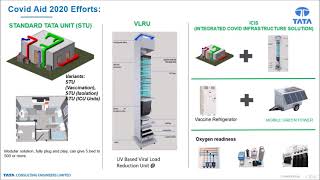
Thanks, Alpana. Atul, could you please go to the next slide? Next, please. So very quickly, I think Alpana talked about the fact that the values, the core values that the group has and TC guides us to do many things. And, you know, our passionate engineers took up on themselves last year when in 2020 the pandemic was striking across. And some of the innovations we did that time was around hospitals, modular hospitals. We studied open source ventilators. And we helped the government and authorities to focus on jumbo hospitals that came up across India. And I think this all came because of the belief that we are responsible as much towards the society and the communities we are part of. And I think these were helpful. A lot of these innovation came up amidst the crisis that impacted us last year. Well, quick forward, could you go to the next slide? Um, yeah, so this is what the team did. Could you go to the next slide, please? And, uh, with the work that our teams did on special modular units, we partnered with our group companies, and these hospitals were put up across India. We also focused on a UV-based viral load reduction unit. The design was put across and manufactured by various folks. Our teams worked on the infrastructure, vaccine refrigeration, mobile power, and oxygen readiness. And I think people were going to a lot of stability till, of course, March this year. We had the second wave in April taking over across India. And while this was happening, we were watching the challenges being faced globally. So a lot of our motivations were based on what we can do aligned to our value system to really help this global fight against the pandemic. Next, please. Next slide, please. Yeah, so starting March, April 2021, there are 4 key areas our teams focused on. The first one was plant-scale oxygen generation, which was in a shape new oxygen plants and conversion of nitrogen plants into oxygen plants, leveraging the existing infrastructure. As I speak today, we have close to 65 plants getting converted across India that produce oxygen but were originally producing nitrogen. We have also got about 45 new oxygen plants that our teams are supporting. The second one was cylinders conversion for oxygen. So beyond the oxygen cylinders which are under crisis, our teams worked to basically give the concept around LPG and carbon dioxide cylinders conversion. Okay, the third focus area was oxygen concentrator. We started on this on the 6th of May, and we were able to create a successful prototype after looking at various variants. And I'm happy to say the OxyKit was something we found very interesting, and our teams were able to prototype it rapidly And we'll talk in detail about that. So let's go to the next slide. Why are we doing it and what's our measurement? Very simply, first it started with a focus on India. And very clearly, these 4 initiatives, our focus is to consult, engineer, and enable. And our goal is to look at 10,000 tons a day of oxygen with our efforts across India. This is measurable, quantifiable, and our teams are working with this with an intent to meet these goals. Next, please. If I break this down, the immediate nitrogen to oxygen and the new oxygen plant conversion, which will be ready, almost 125 plants before May end, Already half of these are operating. This is added 60,000 liters per minute of oxygen, or 120 tons a day of oxygen production using the PSA industrial oxygen production technology. Next, please. The focus on cylinder conversion with the use of carbon dioxide cylinders for conversion has already been approved by the regulatory agencies, whereas the pilots are at advanced stage for finalizing the protocol, legality, and approval by the government on LPG cylinders for oxygen as well as CNG cylinders. We believe at advanced stage, these pilots post-success will help us add almost 6,500 tons of oxygen storage a day, and it will help the supply chain across the length and breadth of India beyond the Tier 1 cities. It is very, very important to save lives and to establish a well-orchestrated and planned supply chain for last mile connectivity. And our engineers are working on this. Next slide, please. And my last slide, most important one, is the oxygen concentrator slide. This is the masses, the passionate entrepreneurs, disruptors, innovators People like Mehr, the CEO of Oxykit, is with us, and I have the pleasure to have a quick chat with him. But the focus on this oxygen concentrator is basically to make sure that in the next 100 days, 20,000 liters per minute from a lakh concentrators in India alone can provide 4,000 tons a day of oxygen. Finally, this is not about India. This is all of us across the globe coming together, fighting together as a team. Next slide, please. And we at TCE and the group Tata also believe that our efforts could have been triggered by the Indian crisis, but we believe these efforts will help countries and communities worldwide. The open source movement, with pioneers like Mehair from Oxykit will help global communities to get access to the basic element oxygen, and that's a small but important step towards aligning with the UN Sustainable Development Goals. With this, I won't take much time. Next slide, please. And I will request Mehair, who has kindly responded, and I must share with you, I came to know Mehair less than few days back, to be precise, 17th May morning, 4:30 AM. And since then, my laptop and phone has crashed with the million messages and the energy, passion of this person, Mehr. It's an honor and privilege, Mehr, to have you live. I would like you to say a few words on the motivation and what made Mehr do this and you've spent 12 months really championing this movement with your own energy, passion, and collaborators across the globe. Please, Mayor, over to you.
Thank you, sir. I appreciate it. Am I audible? You guys can hear me?
Yes, yes, we can hear you and see you.
All right, cool. First of all, I want to start off by saying to the whole Tata Group, everybody working on this, the engineers that have done this, I met you personally. Thank you so much. The world thanks you for validating the design that not just myself, I mean, this has been a big team effort. We— I'm part of what's called the Pillar Tribe. We started the Pillar Tribe. It is the pillars of society coming together to tackle problems just like this one, and we've been working for a year. I want to give special thanks to our Chief Engineer Ed Musselli. He worked at NASA, NIH, the Navy, genius engineer. He's the one that designed the, the solution. And Robert Danger Bird, he's the one that built the first prototypes. And of course, our courageous Chief Medical Director, Dr. Ted O'Connell, who also serves as the Chief Residency Director for Kaiser Permanente and the founder of that program, along with over 200 members of the Pillar Tribe team. And Amit, we're glad to have you and your folks on there as well. So I wanted to kind of first start off by saying thanks to the group, to everybody. This isn't a one-person effort. This is a, you know, I mobilize and get people rolling and going. I can see some things, but I myself am very humbled and pleased and happy to see that the world is coming together on this. And before I get started, my biggest recommendation to everybody watching this and everybody viewing this is stop complaining and go do something, man. You know, seriously, right? Like, the government, other people who should be doing this, or that person should be doing that. What about you? Get up, take action, take care of yourself, take care of your community, take care of your family. That's what OxyContin is really about. That's what it was made for, right? So let me kind of give you guys a little bit of background on what happened, I guess. Well, a little bit of who am I and how did this come to be. So You know, I'm Maher Dawoudi, I'm the CEO of OxyKid and Shield Mission, and now I guess Pillar Tribe, a few other things. I'm a serial entrepreneur. Me and my family started the eyelash extension industry back in 2005. I was CEO, scaled that to an industry in 20 countries in under 2 years. Since then, I've created another platform called Skillvo, which is a social network platform for service professionals that OxyKid builders are going to be able to use and load up their work in there. It's free to the world to collaborate and showcase their work as well. I created this eyelasher app. It's like an on-demand, kind of like an Uber for lash extension app as well. And we're going to take that tech in there and use it for Oxygen Angels on-demand delivery of oxygen. And given what has happened recently, I'm open sourcing, uh, Scovo. I'm open sourcing, uh, the eyelasher technology that we have, just like we've open sourced OxyKit. Um, and we're going to use all this and create hopefully a new pretty cool transparent digital coin in the system, uh, so we can get the whole world world working together. It's about creating kind of like this new digital economy. So the way Oxycat came to be was I'm a problem solver, you know, I like to find things and look at them and find solutions. So whenever COVID came around, you know, as everything was going on, I started doing some research. I just look at data. I would recommend to always look at history because history repeats itself. So I looked at data, I saw that in 1918 flu pandemic, which we're tracking right now, came in 3 waves. There's a smaller first wave, the second wave is about 4 to 5 times worse, and it goes down. And by the way, everybody, get ready, there's gonna probably be a third wave if we're tracking that deal. So it's a good thing what you guys are doing there at TOTSI, getting ahead of it. I really appreciate the work you guys are doing. We gotta do this as a global effort to help one another out. Here's— I started looking at data and looked at some numbers. Here's a few key important numbers. Number 1, 75% of hospitalized patients will recover with predominantly just high-flow concentrated oxygen, which is a mask and concentrated oxygen coming in. And for the viewers, I'm going to try to kind of talk to the broad spectrum of folks here. You have 20% oxygen in the air that you breathe, What does a concentrator do? It takes the air and it uses what's called zeolite, um, and the zeolite will capture the nitrogen in the system, releasing pure oxygen. That's where we hit that 97% at, uh, 20 LPM. And, um, you guys did it in like a few days over there, Tata. So proud of you guys using local parts, you know, hitting that 20 LPM at 94. So if 75% of the hospitalized patients can recover with just high-flow oxygen, if every single bed had unlimited oxygen supply around the world, we would not have enough beds to support the surges. And the reason many doctors are on board and chief medical directors and scientists is because of the fact that if we could shift those, what we call severe patients, the ones that need the oxygen, to in-home care first, that'll free up the beds for the critical patients that are needed. And the way we do that is with an open source, you know, it's like, okay, we need to do this quickly. On the market, there is no such thing as high-flow concentrators. That's another thing that I think is important to discuss right now, actually, is most concentrators out there, they're gonna be under 10 LPM. A COVID patient requires high flow, which is between 10 and 20, so they just don't exist. And unfortunately, You know, we just saw what happened in India, just a bunch of concentrators just got dumped in there. Um, the zeolite is backed up 16 weeks because all that is going into the wrong concentrators. So that zeolite needs to go into a high-flow oxygen concentrator. So this is like, I'm calling out to all the zeolite manufacturers, guys, you got to make sure you do the right thing and put the zeolite into companies, whether it's OxyKit, builders everywhere or other concentrators that are doing high flow. That's where the priority should be right now to save lives. Otherwise, literally, you're killing people if you don't do that, right? Because that's where, that's where it needs to go. So, um, if we have a concentrator at home, then 75% of the load could be removed off the hospital. What does that mean? We could potentially keep our economies open, right? Uh, keep the beds open for the critical care patients. COVID transmission can decrease. The doctors and nurses who are our frontline soldiers, they can basically have less likelihood of getting COVID themselves and be able to serve us as well, right? And so we took that up a step further and I started thinking a little bit and, you know, I'm a technologist as well and I said, well, what if we did an IoT hub in there as well? We could have remote telehealth monitoring to do this. And so We're partnering up and working with globaltelehealthservices.com, GTS, Global Telehealth Services. They're actually the first— they're about to be the first remote monitoring IoT-enabled platform that is approved by the federal government with the VA. So we're working with integrating with their platform. So now you can have OxyKit at home with remote telehealth monitoring through Global Telehealth Services. We took it a step notch further. All this right now we're working on very rapidly. To have it so that the pulse oximeter on your finger can control the output of the device, the LPM output. All this data could go up into the cloud and be remotely monitored. We got some AI coming in as well and some machine learning. Uh, there's what's called the ROX algorithm. You guys want to look that up. ROX is used for ARDS based on 3 metrics, which is the breathing rate, a couple of others like the flow rate and LPM. It you can get predictive information how likely you are to go critical, thereby allowing the patient at home to get another— and the doctors to understand, hey, you might look stable right now, but in 3 hours you're gonna have a 75% chance of going critical. You should make yourself over to the hospital. Now, I saw this come in, and humans are reactionary creatures, and when they're going to take action, when death comes, right? So death is Death comes, everybody wants to do something else. Like, there's got to be a solution that, like, even at a refugee camp, they could get access to these parts to make this happen. And of course, everybody said, you're nuts and crazy. And I said, no, we're going to do it. And we're going to do it. We're going to grind. And I spent half a million dollars of my own cash till we got there. And we did it, right? You could get these parts locally at hardware stores and online. 16-year-old kids— and I'd like to give a great shout out to Colin and Blake Stewart and Colin Pope out in California. They're 16-year-olds. They built this in their garage, right? They bought the parts, they followed the instructions on the YouTube instructions, and they built the machine, right? And now there's everybody sprouting and starting to build these machines around the world. And, you know, really, Amit and everybody on this call, when you ask what project to do, what are you doing, and we're always told, what do we do? You know, what do you do for work? Right now, let me tell you what we're all doing. It's the most honorable thing. I don't know anything more honorable than this. This project and what we're all doing is we're helping the planet and people stop suffocating to death. And even if someone's gonna die because COVID, 'cause you can't save everybody, at least they have some relief and they don't suffocate to death. That's what we're all doing here in this meeting, on this project, in this OxyKit deal. It is a collaborative environment. We gotta come together as people, you know, just take care of our neighbors, take care of our united neighbors with each other's countries and help one another out, right? So this COVID is gonna, we're in India, we're seeing the, you know, second wave and it comes in different waves. Unfortunately, there's gonna be a third one and it's gonna roll around and hit other countries. So a plan we have and what we're putting inside of the tech also is, a GPS-enabled chip so that we can track the machines, and then we can now share open source once again. Once the machines are used in India, we can move them forward to other countries so we can beat COVID if we come together. That's the trick. You got to come together, uh, um, as the Pillar Tribe. That's what we're called. And, you know, you can join us. Go to pillartribe.com, look me up on LinkedIn, and Come on in, we got different kind of groups and levels to join there. I'm so thrilled that you guys at Tata are partaking in the open source project, right, in the open source methodology. That's the way of the future. So the first person to come up and hit, literally hit, was your— in India, the one that came in at a big scale is actually give a special thanks to Mr. Vivek Kohli. He is the owner of Stagg. Everybody knows this company but doesn't necessarily remember them, right? They make the paddles and table tennis equipment. He was a 1987 national champion for India. He's committed and he's already started rolling right now. We just met a few days ago. He's building 50,000 OxyKids in India, right? Another special shout out to the M19 Makers Asylum. They built the machine. Man, these guys, this is an epic story, right? These guys got hit by that cyclone in, in, uh, Goa, right? They're building, they're making this stuff happen. They didn't stop them. They got a generator and they got their machine to hit 96% at 10 LPM. You know, that was kind of their first step on a generator in Goa with the hurricane just hit them. Like, this is so inspiring. It's so inspiring. This is what we need. We need more people coming together to make this happen. But Vivek's gonna make it happen on an epic scale. And guys, everybody there at Tata Consulting Engineering, let me tell you something, your CEO is awesome, all right? Okay, he's taking my calls, like you said, at 4:30 in the morning, at 1:30 in the morning, he's getting on and he's prioritizing saving lives, and that's what we need to do right now. You know, my message is more of a let's get together, let's unite, let's share information. And I'd like to kind of maybe stop and then I'll turn it over for questions on this thought process that we're going to do now, right? Think of your— the people that you serve in an industry, right? Those are customers, right? The people that you serve, the others that serve them too, they're not really your competitors, not anymore. They're your collaborators. We are all in this together to serve that customer and the mentality that I gotta, you know, everybody wants to win, but we could win together. You don't have to have be number one and own and monopolize the whole thing. If you got like, if you have a slice, right? Like if the market's this big and you have 30% of this something this big. Well, if you work together, you could get something really big and you'll have 30% of a much bigger slice. So if we share our R&D departments, together across industries, if we share our information instead of like, oh, I'm gonna have this competitive advantage, right?
I'm gonna get better.
What about a collaborative advantage that way outbeats a competitive advantage? And we're seeing it happen. That's how we made Oxykit come to be so quickly. There's so many more involved in this. Like we got Adi Olteem, who's the principal software development engineer over at Microsoft. He's been with us the whole way through. He's creating the Apollo, which is AI/ML code to make this take off. There's opensourcemedicalsupply.org, Those guys got some awesome researchers. They've been grinding to make this happen as well. There's Archer over at coronawhy.org who made this awesome AI resource platform. There's Cosmic Medical, which is creating oxygen concentrator devices as well. And of course, Dr. Lakshman and Dr. Surab over at— Lakshman's an Intel fellow. He and a few doctors and some mechanical engineers somehow miraculously in just 7 weeks, guys, created an open source ventilator that's also FDA— OK, I'm supposed to use the right words. So FDA approved, it's like emergency authorized use, blah, blah, whatever. Point is, they made a freaking ventilator open source in 7 weeks, man, right? That's the power of collaboration, of open source, of coming together, right? So that's my core message here. I'm so happy you guys did this at Tata. And sure, Mehr, questions?
Yeah, so Mehr, thank you so much. I just want to highlight two of your points: teamwork, collaboration, global mindset, right? Let's be prepared before the next wave. I hope it doesn't come. And number two, there is a lot of effort, a lot of research, a lot of maths and science behind what we've done. What Mihir has done and his team has done. So while it may look simple, this device is sensitive. Please follow the steps carefully, selected parts, calculations. Don't tinker with it too much. We are kind of professionals. We've done it in 3 to 5 days, but honestly, it'll take you 30 to 40 days to master with couple of prototypes. Please use standard specifications of Oxycat or the refinements that we have prescribed, which Oxycat has also posted on their website. And with that, I will hand over to our technical experts, and we'll be taking questions towards the end. And also, please send your questions to tcconnect@tc.co.in. My team, myself, and Mehr will respond in the FAQs in coming days. Keeping the time in mind, I will now pass on to our technical teams. Atul, who's our Chief Technology Officer, and Mandar, who's our Program Manager and General Manager who headed this particular thing. Mehr, as everybody would have seen on this call, thanks for the energy. Thanks for helping Everyone with some basic requirement, which is oxygen. We should not allow anyone to suffocate because of lack of oxygen. Mayor, thank you so much. Last word from you and I pass on to Atul, please.
You're very welcome. And Tata Consulting Engineers, Amit and all the engineers that have worked on this, thank you so much for validating this in India and utilizing the local parts you guys did. You did it. You used local parts. You made it happen. You modified, you adjusted the tune. And my message to the world, please, please, please let me iterate. I've done this for a year, okay? I've done this for a full year. I've seen builders come and go, right? We builders like to build and tinker. Follow the instructions that— I mean, like Tata did this for India, for example. They did it. They said, here's exactly what you do. Here's how you do it. Here's the exact parts. Build that first. If you want to tinker, awesome, tinker afterwards. But right now, the— what's important is getting this done with what works right now onto people to save some lives. So please follow the instructions that you're about to hear from Tata Consult Engineers. These are some of the best engineers on the planet, guys. They put in the time, they put in the energy, they open sourced it, they made it free to the world. Follow the instructions. These guys know what they're talking about. You guys go ahead and get started.
Thanks, Mayor. Atul, over to you, please. Atul, you're on mute.
Thanks, Amit. Thanks, Mayor, for your passionate vision and the thoughts which have made us motivation for preparing this oxygen concentrator. So let's start building this oxygen concentrator for you on paper in this presentation one more time for benefit of everyone. Let me begin with the basic thing about how this oxygen concentrator works. What's the basic principle behind working of this oxygen concentrator? Uh, all of you must have heard of technology called pressure swing adsorption. Which we have used industrially for separation of nitrogen and oxygen from the atmospheric air. So oxygen concentrators are nothing but the same miniature kind of pressure swing adsorption plant. So how it works? The technology is very simple. An air compressor takes the atmospheric air as an inlet and This atmospheric compressed air is passed through an adsorbent bed, which I have shown in the right-hand side as an overall high-level schematic. This adsorbent beds are nothing but the material filled with the adsorbent media, which we call it as a zeolite, which is normally known as molecular sieve made from zeolites. These zeolites selectively absorb only nitrogen molecule from the air and it allows air to pass. So whatever air that is passed through this adsorbed beds is collected into the reservoir, and that is passed, metered, and sent to the patient. So the technology is very simple. We are compressing atmospheric air, sending it to the molecular filtration, and then making the oxygen from this atmospheric air, enriching it from 21% in the atmosphere to 90% plus through the oxygen concentrator. What is the important element and heart and brain of this is the material, adsorbent material, which we call— is called as a zeolite molecular sieve. You can see on the left-hand side how this molecular sieve work. They are nothing but a molecular filter, we can say. It selectively filters a certain molecule. So when it comes to our case We are selectively filtering nitrogen and oxygen. So the nitrogen molecule gets absorbed on this molecular filter or molecular sieve, and it gets passed to oxygen. So there are several kind of zeolites there available. Its structure depends— its structure varies, its application also varies. This zeolite is very commonly used for adsorbing several medium for separation of solid and liquids. It has been used for moisture removal, for impurity removal from the gases, for solids and liquid separation. What is important for oxygen concentrator is to remember that all zeolites are not suitable for all applications. These zeolites are made for selective adsorption of given molecule only. So based on its structure, we need to select the right kind of the zeolite for oxygen concentrator purpose. All these zeolites are very sensitive towards the variations into the ambient temperature, the operating condition, the environment where you are operating, what is the relative humidity, what are the operating pressures, and the fluctuations into the flow medium. Because of that, all these figures, all these factors impact the purity and the performance of the oxygen concentrator. Hence, it is very important that the correct zeolites have been selected for the oxygen concentrator use. Why we have selected OxyCate here? Most of the oxygen concentrators available today are in the range of 5 to 10 liters per minute, but the COVID patients typically require a flow rate in the range of 10 to 20 liters per minute. Hence, we have targeted and prototype development of oxygen concentrator which is suitable to give you the flow rate of 20 LPM or above. For selecting this prototype design, our TCE design teams have accessed more than a dozen designs available in the open source documentation, and we have specifically shortlisted and selected design provided by Oxykit because of their simplicity in construction the clarity in the documentation, the type of the details provided, the amount of information given for assembly, the videos, the vlog. So the clarity was there, and to the plus point of that, it provided a capacity more than 20 liters per minute, which we were targeting about that. So based on these parameters, we have shortlisted this How it looks like on the screen, left-hand side, you will see the prototype that has been given by Oxykit. And Oxykit have provided the technical flow diagram which I have explained in brief at a high level in my first slide. And we started the development based on the information given, and TCE has built this prototype utilizing the localized parts which are available in India to speed up the process. So this, uh, OxyKit key components have been shown on this slide. I would like to request my colleague Mandar, who was very deeply associated in assembling all these parts and making this prototype design construct in reality, to take over you through the journey of building this prototype. Over to you, Mandar.
Thank you, Atul. I am Mandar, a General Manager at TCE and heading Product Engineering Group, the group, the group which has decades of experience in design of critical machines, one-of-a-kind machines for space, defense, nuclear, astrophysics application. When this challenge was thrown to us, the team was geared up. The, the component looks simple, but based on our design know-how, our experience, we started this journey. So first we studied, as Atul already mentioned, the documentation was very clear. Everything was available, need a proper study and proper planning to build the prototype. Next slide, please. So we started, we studied the design, and based on our ambient conditions, we thought of improving or adding some enhancement to it. However, I want to iterate, this we could able to do only because of our strong design knowledge and design validation experience. So I suggest not to carry all these enhancements in one go. Please, please stick to the instructions given by the Oxykit, given by all FAQs addressed, and try to gain experience. Because this is— the machine looks simple, but there's a lot of maths, lot of science gone into it. So please hang on, have your built prototypes, 2, 3, 4, 5 prototypes. Gain experience and then try to do adjustments or enhancements. Next slide, please. So we studied entire Oxykit design, and when we started considering our ambient conditions, the pressure requirements, we observed by adding certain enhancement like increasing the cooling capacity, adding more desiccant dryer Adding non-woven walls at certain places will help us to build the— sustain the pressure. Atul has already explained there are a lot of parameters involved to achieve the oxygen purity, the pressure, the temperature, the zeolite performance, everything. So don't try to do anything on your own. So we changed, we added some modifications, and with these modifications we were able to achieve the desired flow rate and concentration. Next slide, please.
Uh, yes, Mandar, I would just add over here, as you can see on the top, we have shown the oxygen generator, and below we have shown the TCE prototype generator. What are the major differences? I would just highlight a couple of them. As Mandar was telling, this kit is very sensitive to the operating ambient temperatures. Considering that in India we have higher operating temperatures, we have added double the coils. So item number 2, you can see on the TCA prototypes, have 2 coils against 1 coil into the Oxykit concentrator. Based on the cost optimization, availability of the components, and optimizing efforts in the space and all, instead of 1 compressor, we have selected 3 compressors in series. It is very important that the zeolites have been kept dry. The air entering into the adsorbent beds is moisture-free. We have added one silica bed dryer, which is item number 4. That was not there in the Oxykit designs, plus several other things like the addition of NRVs and things like that. So some sort of Indianization has been done after studying the impact of various technical parameters that affect the performance of the oxygen concentrators. So we will see in next coming slides also what those parameters, how it has impacted the design. Yeah, Muthath, back to you.
Yeah, thank you, Atul. So, uh, since the challenge was thrown to us to build this prototype considering the ongoing pandemic conditions, in 3 days. We could manage it in 5 days. So the more focus was to achieve the performance, achieve the output, and not on the external or aesthetic looks. So I would like to request all of you, when you are designing your product, you can aesthetics, external, you can take care when you are going to mass manufacture. So this is what our prototype look like. and it can be a suggestive model also. We have given— next slide, please. So the assembly procedure, we followed whatever the OxyCure has suggested, the same thing. The support structure was prepared, zeolite bed was prepared. Care was taken, uh, in the preparation of the zeolite bed. The more the compaction, the more the better the performance. All assemblies compressor, pneumatic components, electronics was assembled, and then a dry run was conducted, and then we went for a proper performance check. Next slide, please. So we started our journey, started work on 6th, got first results around 60 to 85% considering the ambient conditions. Did iterations, did modifications like putting NRVs and everything. The performance improved and then we were able to achieve the same performance over few days. However, we also wanted to check the effect of other parameters like temperature, pressure, and we also did some iterations. This is only because of our design know-how, design experience. We tried to adjust the pressure, temperature, and we want to— we have also, you know, check the performance at varying conditions. Next slide, please. So if you see, we increase the pressure, we reduce the pressure, we try to see the performance of the graph. But the word of caution, there are a lot of connections, there are a lot of joints. There are a lot of, you know, PV up, we are using HDP pipes. So please don't do this. We are having know-how, we have team capable of doing it, ecosystem, so we did it. You please follow the instructions and build prototypes as per the instruction provided. So we have seen here that the performance varies as per the pressure. So there is an effect of pressure.
Yeah, you can also see the sensitivity to change into the pressure as lot of impact of the purity that we are talking about as seen by the three distinct lines. The performance is always better at a higher pressure, but as Gandhar was telling, we should not cross the limits of the pressure. This we have established to arrive at the most optimum design conditions, and we recommend to operate it at around 35 to 40 PSI. and all components must be rated to operate at this pressure. Yeah, yeah. So also, this is the second graph. We can say this is the second type of the study we have studied, the effect of the temperature. The ambient temperature greatly affects the performance of this oxygen concentrator, as you can see from this graph. And we could able to simulate to find out what are the best conditions to get these results. So the, uh, it is very necessary that proper cooling arrangements to be made for the air that is entering into the zeolite beds. Higher the temperature, lower the purity. Lower the temperature, better is the performance. The temperature varies throughout day and night. So the oxygen concentrator performance will also vary from day and night depending upon the ambient conditions that has been going through. So the prototype that we have built is using the topmost slide, which is giving us the best performance. Using the design provided by the number of cooling coils and all, we could achieve 93% of the purity at about 20 LPM flow rate at an consistently.
Thank you, Atul. So the observations from this all trials what we have conducted: ambient conditions, huge effect. The temperature, humidity, moisture content affects— it plays major role and it affects the performance. And since in Indian, if you consider Indian ambient condition, it varies from region to region. This becomes— we must keep this in mind. Compressor. Compressor is the heart of the machine. Any little drop of pressure from the compressor will not give you the performance. So please carefully select the compressor and ensure that the compressor is oil-free and also it is capable of running for 24 hours continuously. Cooling and dryer. Our conditions are hot, humid, So as Atul also explained, the cooling will help to improve the performance. Leak tightness— number of joints, the, the machine simple, the joints are there, any small leakage from any joint will lead to the lower the performance. Valve timings— arrive at the proper valve timings requires trial and error, it requires know-how of the machine. So I would suggest Don't, even if you are tempted, please don't do it. There is a lot of other parameters also which may get affected, so please stick to first basic code, gain experience, and then do some tweaking. Operating conditions. As we have already shown, operating conditions affects cyclonic conditions, heavy monsoon, extreme, you know, cold that will have effect on the performance. The last is test condition. I suggest to conduct, to conduct a test of the, on these machines in a stable condition and not in the controlled condition. The results of the control conditions may not be valid in the stable conditions. So all tests please carry out in stable conditions. Next slide, please. So it is observed that the purity or the concentration varies as per ambient conditions, it varies as per wall timings, it varies as per inlet canister pressure. We did try 40 PSI, but as Atul already mentioned, do not try this. Gain your experience from whatever the documentation provided. First, be master of 4 to 5 or 10 prototypes and then do whatever you want to do. Train also shows low temperature, high pressure, low cycle time will help to achieve the purity. So if we have all these combinations—
Can I step in for a second? Just for one second?
Yeah.
Yes, yes.
Okay. Just for the viewers listening and watching, guys, the reason TCE here, Tata, and engineers are repeating over and over, stick with this, we have the experience to do this, is because I told them to do that. Right. I kept saying that's the most important thing. Okay. We've been doing this for, I've been doing this for a year and builders and tinkerers will come in and they're like, oh, what if I did this? And what if I did that? So they're, they're, they're telling you this, not out of a sense of like dump, like, uh, uh, authority or whatever they're, they're with you. They're at your same level. But what they're trying to do is help you save time and money and frustration and stating that follow what works first, right? So because I spent half a million bucks going, burning up all types of stuff and different things, and they've spent things— so please, I know we're hammering this over and over, and we're going to keep hammering this over and over because not one builder that I've worked with was able to basically go out and just tinker around and, and mess with and, and tinker and get to the solution. They first start the The successful ones started with what these guys here are explaining to you, and they've spent a lot of time and a lot of energy and a lot of resources to put this awesome presentation together, to put all these instructions together to take it to the next level from what we started. So please just follow those instructions first and then, and when they say it's— and let me elaborate one more piece, which is when they say that it's complex, it is complex in the math and theory, uh, to come to this point. And thanks, Ed Mazzelli, for doing all that math theory to make it happen, and Robert Dangerbird for building it properly. But putting it together, if you follow the instructions, it's not so hard. We're talking about a few valves, a click, you know, it's just like Lego pieces, right? So it's not hard to build. Remember, 16-year-old kids built it following the instructions. Just follow the instructions step by step. That's what these guys are saying, this over and over, to help you out. Go ahead, continue.
Thank you, ma'am. Yadav.
Obviously, the curiosity and question in everybody's mouth is this oxygen concentrator comes at what cost? So let me put some perspective to the cost component of making this oxygen generator prototype. I have listed on this slide the few critical components which includes the compressor, all sensors and the electronics, cost of CO2 line, some miscellaneous things like valves, piping, fittings, etc. And based on the single prototype development, the cost could vary from about the $60,000 to $80,000 range kind of a thing. But when we start manufacturing this prototype on a bulk basis and outsource all these components on a mass scale, we expect the cost to be remaining in around about ₹35,000 to ₹45,000 bracket. And for a 20-liter per minute oxygen concentrator giving you the PTT in 90+, this should be a very attractive proposition. We believe that MSMEs and all entrepreneurs could come forward for, for this, and these costs are just our estimates based on what we have built our prototype. So it is necessary that the supply chains have been verified and established for sourcing of all the correct components. It has been said that the compressor must run all 24 hours without getting heat issues. With respect to that, if compressor stops, your oxygen generation will stop. Zeolite is another interesting area. Everybody will ask what kind of zeolite I should use. We have used a zeolite having particle size of 0.4 mm, sodium-based zeolite provided by Arkema, and its brand name and trade name is Nitrox 5. Similar to sodium-based 0.4 mm nitroxify equivalent, there are several suppliers into the market. They are UOP or Zeokem and some other materials. So the selection of zeolite has to be accurate. Essential that you mention— maintain the correct particle size. Zeolites come in two particle sizes. One is 0.4 millimeters, another is 1.6 millimeters. For oxygen concentrators, we are looking for 0.4 millimeters, and there are several technical reasons behind this selection as to the distribution of the flow, the pressure drop, the amount of residence time, the amount of surface area for adsorption that it will— so please stick to the correct amount of compressor selection, correct amount of zeolite selection, and with the instructions given over here, if you follow all the instructions, you will be able to manufacture Few suggestions for MSMEs, again regarding the periodic maintenance, again periodic testing, following the right kind of material. We spoke at length in previous slides as to how important it is to select the right kind of components so that we achieve the results that our prototype can also achieve. So this is just the last thing I want to address in my presentation, in my submission for this. Though it is very important that you build the oxygen concentrator very correctly, it is equally important that you select the right kind of the mask for using it to the patients. There are several type of masks that has been available as in Canada, face mask observer mask. We observe that there is lot of leakage that can happen through these masks, and the reservoir masks are the only recommended one wherein the leakages are avoided. And what patient gets is the pure 90% oxygen, concentrated oxygen, into their body for which all these efforts have been made. If the oxygen leaks into the system, you will be breathing, or patient will be breathing, concentration equal to 50%, 60%, 70%. So just make an attention that it is equally important to use the right type of the mask. The oxygen concentrator checklists are available. I'm sharing the links here on this, uh, on this slide at the below. The oxygen concentrator evaluations also state about the selection of this mask, and these links are available for you, for the user to reference. Some, uh, final, uh, slides, uh, Before we begin the forum open for Q&A, is this machine can be used for multiple patients with the proper use of NRVs and all. It can be connected into the network, it can be supplied to a single source on a network machine, and we hope that this is, this will be made possible in an attractive, affordable price range for manufacturing by the MSMEs. Note that this is not suitable for ventilator applications. It is suitable only for single-use mask-based application. Ventilator requires higher pressure. Oxygen concentrators will give you the pressure of about 1.5, 1.7 bar output, which is not suitable for ventilator applications. So with this, I stop my presentation over here. I look forward for the questions. All of you can type it out in the chat box.
Thank you, thank you everyone for an insightful session. We have more than 125 questions. I will just pick up some common ones and I will just shoot out starting with the first one. Why do people all over the world Go for PSA method, why not electrolysis or the chemical method, both of which give near perfection concentration of oxygen?
Let me give you a short answer, uh, from, from a layman's firm. Uh, uh, be careful with the electrolysis because, uh, you will blow stuff up if you don't know what you're doing, right? That's, that's, uh, be careful with that. And it takes a lot of power because consumption to do that, you know. But, um, go ahead, guys.
Right, Mayor, the electrolyzer, uh, cell typically produces, uh, hydrogen and oxygen. So there are always chances that you will be handling with the hazardous things. This is a medical-grade oxygen. We don't want any accidents to happen, and the scale and the purity matters quite a lot. For that, we don't recommend the electrolyzer technology to be used for medical oxygen generation purpose. It is strictly no, no, and no. This is not a suitable technology. Even though it has potential to generate oxygen, it is not made for medical oxygen consumption because of the various issues and safety issues involved with it.
I'm sure everybody hears you all loudly. Now the next question is, how often we need to change the zeolite in sieve bed?
Well, the life of the zeolite is pretty high. The manufacturers give that life depends on 1 year to 3 years, but it is essential that periodically these zeolites have to be inspected for, you know, moisture capture or for any problems over that. And we expect that life to be pretty long, about 1 to 3 years Based on the source from where you are sourcing this product.
Okay, great.
Um, let me, uh, if you don't mind, let me jump in because this is a question that gets asked to me a lot, right? So let me, uh, and I like to, let me, let me, uh, being in, uh, let me try to get the layman kind of perspective. Okay, all right guys, so, uh, that question, zeolite, it's not that, it's, it's like sand, okay? And the way that, in that this, they call it sieves, but it's really, here's how it works, right? Let's give it a result. You have a, you have a tank, you have like a tube, and inside of it you got the sand-looking material called zeolite, right? And what it does is when it's pressurized, when you put air and you close the, close the, the, the top so air pressurizes, the sand is actually like a mesh. It absorbs the nitrogen, right? And then when it's depressurized, when you let the air out, that's when the oxygen goes out. How long does it last? Okay, very simple. It could run 24/7 hours a day, good stuff, and last for 2 years. 24 hours a day. These cylinders, the 680 milliliter cylinders for high flow, those gonna be out in 1 hour, right? This machine, the Oxycare, can last 24 hours, 7 days a week. Just so you know, we did test it. We put it in a hot, humid, uh, garage. Everybody's talking about humidity. Hot, humid garage. 20 days straight, 24/7 running, working, producing, uh, um, high flow, 90% plus O2, right? So it lasts a long time. And what do you do after 2 years? Uh, you just replace it. This stuff's not that expensive. You just swap out the sieve or, or, or swap it out. What's more important is the compressor, right? Make sure you use an oil-free compressor. Those are the things that could kind of burn out, um And so that's that. I just want to step in because I get asked that a whole lot.
OK, great. The next question is, instead of orifice, can we use flow control?
I would like to answer.
Please don't change the design unless and until you have confidence in that. The orifices are designed to suit the performance. And to enable you to achieve that performance. So use the orifice as specified.
Let me answer that.
Like, there is, there is one, yeah, there is one difference. If you use the orifice, you will not able to fluctuate the flow rate, so it will be very constant outlet flow rate. So we don't recommend using the orifice.
And let me just step in and add something here real quick, guys. There's some people like, what's an orifice? OK, an orifice is a hole. so inside the tube there's basically, uh, the enriched air. In the design you'll see the tube with the zeolite, the air comes, the enriched air comes out from the top. So what do we do? We hacked the system. Wow. There's two types of zeolite, there's lithium and sodium, right? If you— and we went to sodium because it's more accessible in the market, you can get your hands on it more. I'm like, now it's harder, but lithium is about 5 to 10 times more expensive. It is twice as efficient. 5 to 10 times more expensive. You can't get your hands on it. So what do you do? If you go with sodium— and everyone's like, 13X, what's this, what's that— here's what's important. It is sodium. The bead size, the little size of the sand grain, is 0.4 millimeters to 0.8 millimeter medical grade. That's what you need to know. Sodium and the bead size 0.4 to 0.8 millimeter. Because you'll hear 13X and this mesh and that mesh, it's the bead size, it's half a millimeter. That's what you're looking for, sodium, right? And the reason we did that, the orifice— once again, all these questions are like, why don't we do this, why don't we do that, why don't we do this? Because we already did it, it works. Tinker around with it later, right? The orifice, the— so the way this works, the, the hack, if you will, to use, uh, the sodium is when you have 20% of the air that's coming in is oxygen and then you enrich it, right? What we're doing with the orifice— what the orifice is doing, it has a hole, right? So the air is pushing into the orifice, which is just a little small little cylinder inside of the tube with a hole in it. And what that does is it lets half the air go through and it pushes some air back and in what we call the halo, which is just the tubular structure at the top, we're capturing that enriched air. Okay, so now when it comes out of that process, you have instead of 20% air, let's say you have 70% air, 80% air with sodium, and then you push that back in. So now you got two, you know, you have enriched air coming from the top, ambient air coming from the bottom, and instead of starting at 20%, you may be starting at 40, 50%. That's how you hit the 97%. But once again, So here's what I would recommend we do with the questions, because you got a whole bunch of them. Let's do the following: why are you doing this or that? Let's skip all that. We're not gonna answer those questions, right? We know it works, right? This is, you know, this is what it is. You guys can cherry-pick them, but remember why— it's not about why. This works right now, okay? It does. These guys just showed you you could do 20 LPM at 94%, right? I mean, these machines are going for thousands of dollars. You can't even get anything about Right, this works. So instead of the why not and fix it, make it work. Just go build it, just go follow instructions. Hi guys.
Now this, this moves all the questions out of the window, but I'll still continue to ask some. Is Zeolite temperature sensitive? Is it temperature sensitive? That's the question just come by. Many of them have asked.
Absolutely it is, absolutely it is. The performance is very good at lower temperatures. It is essential that you maintain— the lower the temperatures, the adsorption patterns are better. Higher the pressure, the adsorption patterns are better. So zeolites are sensitive to temperature, pressure, relative humidity— all three parameters. That's what we have shown it when we have simulated our curves and selected the most optimum operating conditions. Have been already selected by studying this.
Okay, the next question is, is the design specification— does this design specification require changes as per the ambient temperature of any place? So does the weather decide the specifications of the design?
Uh, truly speaking, the prototype what we have built is suitable for Indian conditions, which If it is, you go towards the north and cold conditions and good conditions will not impact much onto the performance. But we have already simulated at an average temperatures. This is a peak summer going on here where we have built this prototype. So we, at this point of time, we need not worry much about this and the performance can be always enhanced further as the need to be. This is supposed to be as of now sufficient to give you the performance for Indian conditions.
Okay, how do we determine the amount of zeolite, uh, required for our device? And also, how do we calculate the decrease in flow rate when air passes through zeolite, when nitrogen being absorbed and oxygen released?
Uh, follow the instru— follow the instructions. They tell you exactly how much to use in there. And follow instructions, right?
Okay, yeah, that's right. Just for, uh, explanation, in our zeolite we have used about 3.5 kilos in our prototype. 3.5 kilos of Nitroxy 5 material. The quantity may vary a little bit plus minus based on the amount of zeolite that you are using from each supplier. Suppliers do provide this kind of graphs, actually, what is the absorption absorption capacity of the O2 zeolite.
Right.
But yes, follow the instructions as Mays says. I agree with him.
So I'm sure everybody has heard, please follow instructions. The next question is, can we use intercooler in between the compressors for better efficiency?
Yes, you can, you can use it, but you need to keep it in mind that after the intercoolers, it will take the amount of pressure drop. If there is any condensation, you need to knock off that condensation and make that air as dry as possible, because wet air going into the zeolite bed will decrease the performance. So if the, uh, if, if it is possible to put the enhancements by putting any additional cooling arrangements in between the compressor stages, it can help, it can help the performance.
OK, the next question is about noise levels. What was the noise level of our prototype and what have we done to control the noise?
Let me answer that. Let me answer that. Let me watch this. Ready? Here we go. Because I get these a lot. It's loud, it's annoying, it's loud, but when you're suffocating to death, you don't really care, right? You want to breathe, right? So the reason I'm saying this, once again, I've been dealing with what you guys are dealing with. Just right now for, for a longer period of time, right? And once again, the reason we keep coming back to this— all these are great, wonderful ideas. I love the fact that people want to build and tinker. Please, please, please build it first, and then all these adjustments— and engineers here are going to give you some adjustments and how to do something— do that after you build a successful model of what Tata has given you guys first. Go ahead, guys.
Okay, so So I just wanna add to this what Mayor said. See, a 5-liter per minute oxygen concentrator will be at 40 decibels, 45 decibels. A 20 LPM, which utilizes 2.5 horsepower or 1800 watts, will have a decibel level between 60 to 70 without the packaging and exterior. If the packaging is designed correctly, you will have between 50 to 55. So between a 5 LPM and a 20 LPM, the decibel difference between 40 to 55. It is bearable, and I completely agree with Mehr. Priority is to save life and give oxygen. It is not irritating, it's not bad, but yes, it is between 50 to 55 decibels.
And what you could do, what you can do always is run a long tube from the machine, put it somewhere else in another room, and then run a long tube over to your mask. Be careful with the noise because a lot of times you're trying to close it up and you want to, you know, soundproof it. Be careful because you need the airflow. You don't want the compressor to run too hot and then it burns out. So that's why you want to make sure that that compressor is staying cooled and open. Yes, it's a little bit louder, but Once again, the purpose is to stay alive, right? Right, guys.
Okay, the next question is, um, can this oxygen concentrator be used to refill oxygen cylinders?
No, you— that is not the intent for which we are making the oxygen concentrators. It will keep you the oxygen at a very low pressure. It will generate the oxygen at 1.2 5 bars or 7 bar at the most. Oxygen cylinders are 100 times more pressure storing capacity, and you will not able to fuel the oxygen without any substantial use of unit operation like booster compressor or something like that. That is not the intent.
I'd like to add one thing, Atul, what Atul is saying. Gentlemen and ladies, This is an oxygen concentrator. If you want to fill up cylinders, look at industrial PSA oxygen plants. Those are meant for bulk oxygen generation with a proper compressor that boosts up the pressure from 4 to 150 bars, and that's a separate setup. Oxygen concentrator are for low pressure line, 1 to 1.5 bar direct supply to patient. As Atul talked about the last slide, you can put them in series and parallel on a low pressure line in a small hospital, in a village, in any part of the world, and save lives. It is not for filling oxygen in a cylinder. Please do not do that.
Okay, let me add, let me add, let me add the oxygen cylinder. One more thing, we need to let people know this stuff out there. Okay guys, listen, High flow oxygen, right? That's 10 to 20 liters per minute. These oxygen cylinders, they're like 680 liters or something. They're gonna run out in about an hour to 2 hours. You need this on average for like 3 to 5 days, usually 24/7. You're not— the oxygen cylinders are just really, they're useless. Guys, they don't do what they're supposed to do when you have COVID. You need high flow non-stop, right? So the concentrator is made to do concentrator work, right? Um, we need to shift people over into the concentrator space. If you build a few— the cost of— what's the cost of cylinders going for right now in India, for example? What's, what's one 680, uh, oxygen cylinder going for right now?
About 300.
About $300, right? Okay, so watch this. You got a tank that's $300 that you got to wait an hour or 2 or 3 or 4 in line for, right? And it's $300. Now you go spend another— the cost of 3 tanks, because the conversion I think was about $900 or $1,000, I think, uh, $1,000, or the rupee, uh, 70 to 80, 90,000 rupees, right? You can have an oxygen concentrator that goes 24 $247 for 2 years, okay? 2 years, 24/7, if it's done right, versus $300 for a tank that's going to run out in an hour and basically be useless. And what I'd like to add in here is every man of a household, if you— that, you know, that has a family, uh, if you can click things together, uh, make one of these for you, your parents, your family, you know, for, for, you know, for your to help each other out for your community. Just build it, use your, use your hands, and you can do it. 16-year-old kids did this. You could do it. A lot of people are doing this. Anybody could do this, right? And let's get away from the tanks. They don't do anything, guys.
Okay, uh, with full flow 20 LMP, will the compressor have any reset or operate continuously?
The compressor have to be selected for continuous operation. That's it. I mean, the selection, the rating of the compressor have to be suitable. All 3 compressors must run continuously. It should not have any intermittent running operations. So the selection of compressor must be for continuous duty. Okay.
After the assembly, what is the run-in test time before using on patients? Or in other words, is there any small testing or validation to be done before using at hospital?
Uh, yes, I would say that, uh, this is a good question. In fact, in India, uh, there is no current regulation or there is no certification or standard to use these oxygen concentrators are made. I just give a word of caution over here. We have been importing lot of oxygen concentrators which are lower in capacity, inferior in quality, without any certification. But it is the, you know, it is, it is the duty of the hospitals as well to verify the oxygen purity periodically, as well as now the new regulation, uh, came from new advisory which government has issued has made mandatory to display the oxygen purity on the oxygen generators. If the purity falls below 90%, it should sound an alarm. And as far as the testing is concerned, before this is dispatched from the MSME workshop, the prototype must be tested for the fluoride as well as for the purity. We are—
can I let me—
lives of the patient. This is a medical-grade oxygen. So we must do the oxygen analyzer testing for this. And as per the government advisory, we will stick to that. Yes, ma'am. Yeah.
Yes, if you guys don't mind, whoever is controlling the screen right now, screen share, can you do me a favor? Put up on the screen, let me show you something, right? Because it is important to know what you're outputting, right? And we create a solution for that too. Let's go to hackaday.io/oxikit. Hackaday.io/oxikit.
Hackaday.io/oxikit.
And by the way, while they're pulling that up, Anul and Dan over there at Hackaday, thank you guys for doing the articles on Oxikit and making it happen. And Hackaday, thank you for the platform you built for hardware. It's the open source, the developer deal. Yeah, can we— you guys share, uh, the screen and put up the, um—
I put it—
share your screen. There we go. So go, uh, hackaday.io. Yeah, click that. Just click that in there. All right, so here we go. So you guys see where it says, uh, files? Okay, so this is— by the way, everybody can come in here and go to click where it says files right there. You see it's files, uh, down in the menu bar, right down, uh Description, details, files, uh, right there. Yeah, yeah, there you go, there you go. Click files. Okay, and then if you scroll down, like, view all, view all the files there at the bottom of that list. Okay, all right, let's scroll down some more. So there's, by the way, there's over 400 pages of industrial designs you can download in here. So where is the oxygen analyzer? Oxygen Um, yeah, O2 analyzer notes assembly PDF. You see that PDF right there? Uh, um, yeah, there we go. By the way, Krishna Reddy out in Hyderabad made this happen, guys. He, uh, this is a DIY, make-it-yourself oxygen analyzer. So you could utilize the, the notes here, uh, and the instructions here on how to make the oxygen analyzer to detect what your O2 output output is, right? As engineers, as builders, as guys like to do things right, we all want to hit that 94, 95, 97%. Guys, if you're doing over 70%, you're doing great. If you're doing over 60%, you're doing fantastic, right? Just get that machine rolling and working. And this, uh, analyzer, I think it costs like $20, right? That's it in the parts. And you follow the instruction. I think if you could go back one more, um, and then the notes, I think there's oxygen analyzer notes. Yeah, there you go. There we go. Let's scroll down. So thank you, Krishna Reddy, uh, for putting this together for the world to basically make their own oxygen analyzer using something very inexpensive, right? So you could come here to hackaday.io, uh, get files. Please join this, join, join, join, and add to the, to the mix, uh, as well in here. Let's show them one more thing if you don't mind, if we don't mind, uh, just I just really want to kind of like prove this point here of following the instructions. Can you go over to LinkedIn? You go over to my LinkedIn if you got LinkedIn account. Let me show you. If you go over to my LinkedIn profile, here's the video we want to show the crowd. It'll take less than a minute just to kind of show that 16-year-old kids did it. Yeah, my last name, Daudi, D-A-U-D-I. Alright, if we scroll down. Scroll down, down, down. Right there, there should— keep going. There's a video in there. I guess you have to log in to see it as a user. This one? No, no, of the Colin and Blake doing it. If you log into your account, you can do so. How about this? Let's take some questions. I'll pull it up and I'll text it over to Amit and then he'll get it over to you guys. OK, y'all keep going.
We'll put this up on the links, all these details. But you know, in the interest of time, I think we've had a fantastic participation, almost 450 at its peak. Passionate innovators, disruptors attending from India and outside in the US. Mihir, are you still there?
I'm still here, I'm still here. I just really, I just, if you can please entertain me just for a second. I mean, just because, you know, this is going to be recorded, it's going to be dropped around the planet and stuff, and I really want to show, you know, we got really technical here. So what I'm doing is I am pinging you right now. I'm sending you a chat with the link to put— here we go. If you could just put this up on the screen so people could see this, because this will inspire folks here, right? This is— if you could just share that link there. Yeah, sure.
Atul, is that with you, the chat?
No, not with me.
Okay, who's got the—
I just, I just, uh, I sent it to you on WhatsApp, um, uh, the, the link. I guarantee you this is going to be a hit, right? Um, it's, it's, it's a time lapse, takes just 1 minute, it shows how they built it, right? Uh, where can I, where can I, where can I text you guys this stuff in here somewhere? Okay, chat, here we go. I got it.
Put it in the chat, please.
I sure did. Where we go? Bam, there we go. There it is.
Alright, so can you open it? Someone open it. Who is presenting? That's Atul, please. Did you get the chat?
Yes.
Yeah, please open that.
Share your screen also.
There we go. Click that video. Let's put that video that right there. You see that right there with the kids? Just click the video, the play button.
That's right, that's right.
Yeah, there we go, there we go. Scroll over the way. There it is. There's the Ox kit, and they're going to time-lapse it here in a second, talking about it. And remember, guys, well, so while it's playing, I'm just going to talk because we can't hear it, right? This is Colin. Uh, Pope and, um, Blake Stewart. They're 16-year-olds. They got this machine, um, they got the parts. They actually crowdfunded. Oh, here's another solution that what they did. They went out, they created crowdfunding campaign for OxyKit. Within 24 hours, raised enough money to build this. So there you go. In the back, the left and right, that's the sieves that the zeolite goes into that we were talking about, right? You got the compressor Okay, the, the coil there is to keep things cool. So they're showing you the pressures and they're about to go into the time lapse here in a second. That's where it gets super cool. Let's be patient. And you see that compressor, the top head, you got to keep it open so that, you know, I mean, you gotta, you gotta keep it cool, right? Make sure that you got a pressure release valve. That's another big point in between where the compressor goes into the sieves. That way, uh, pressure doesn't build up too much into the, the, the sieves. While this is playing, I'm just going to shoot out some stuff. I remember you want to use what's called schedule— you want to use a schedule 40, uh, PVC pipe and fittings. Um, they, they're made to— you make sure the PVC pipes are made to handle pressure. They're just like I said, these guys are, uh, 16-year-old kids that made it happen. So I guess, uh, I don't know if we could fast forward into the video at all, or if that was it. All right, cool. But point is they're 16-year-olds. They made it happen right there and then. Um, before I finish off, let me say one last thing. Shreevas Kolipery, uh, is all over this, right? He's the founder of T-Hub. He's like, uh, look him up as well. He's organizing the whole crew. Uh, uh, Sabina over at Paytm— Sabina, who's a COO over at Paytm Loyal, she's like in this. Amit is in this, right? Your CEO, you know, all these guys are in this. Everybody jump in, right? Open source, put in, let's help our communities out, you know, like put in that effort. It's so fulfilling. I'll be quiet now.
Mayor, thank you so much. And I think great set of questions. Our teams have been responding. We've got almost 3,000 queries in the last 10 days since we went live with this. We, you know, I never knew about this movement, to be very honest. You know, and we got— I got in touch with Mihir on the 17th, and I must tell you that my WhatsApp is now 2 terabytes with his messages. That's the energy Mihir carries. So, you know, just let's go on with it. And I think it's very exciting times for engineers, disruptors, students, anybody and everybody. With that, we will be publishing all of this stuff including the recording of this webinar. Over to you, Alpana, for thanks to everyone, and we'll try to close on time. Unmute yourself, Alpana, please.
Sorry. Thanks, everyone. More than 450 participants and more than 300 questions. Sorry we could not take all of them, but we promise to come back to you with a set of FAQs The link which everybody has will be updated very soon. As we conclude this evening, I would like to thank each one of you for your time and active participation. A very, very special thanks to Mehed for being so active in the entire session and a great team that he has been talking about for creating and sharing such a great open source code for the greater good. As we sign off, we wish each one of you to stay safe Keep supporting the country in achieving a COVID-free nation. All the best, everyone. Thank you.
Thanks, Mahir.
Thank you very much.
Thank you.
Thanks, Atul. Thanks, Mandar and Alpna, for all the hard work you guys have been doing. Mahir, all the best. I hear you'll be coming to India soon. Travel safe. And thanks to Vivek for the first 50,000 lot. There are more coming, and we will touch a lakh oxycots in India in next 100 days.
Great.
I'll see you guys in India next week. I'm coming, I'm coming this weekend, Monday. I'm coming over. I'm gonna be over there. I'm gonna see you guys. I'm gonna build it right there with you guys. I'm so excited.
Let's do this.
Thank you.
Thank you.
Thank you.
Bye guys.
Bye.
More from Nathan



Can AI Read Your Heart? Unboxing DeepVessel with Nathan Qin from Keya Medical | #52







