
How to design power systems for massive industrial plants like steel mills and refineries. Redundancy levels run 20 to 100 percent, gas-insulated switchgear saves space, and the system must survive grid failures by islanding captive generators. Eight types of analysis validate the design.
Chapters
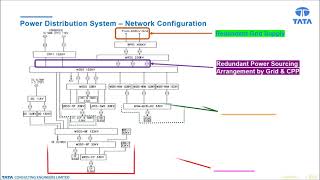
Power distribution system is different across different plants and infrastructure projects. This video provides an overview of critical factors while designing electrical distribution network and systems for a process plant. Reliable supply as well as efficient use and management of electrical power are significant factors in creating competitive advantages for industrial operations in process, manufacturing, and mining industries including steel, oil, gas, and petrochemical. Electrical power distribution requires integrated solutions. Totally Integrated Power provides support for working out suitable solutions. This comprises software tools and support for planning and configuring as well as perfectly harmonized system for integrated power distribution ranging from the high, medium voltage system to the final circuits. Power distribution system in an integrated process plant is different from any other industrial plants due to the nature of load and its magnitude. As for example, an integrated steel plant of large scale consists of various process plants, non-process plants, services, and utilities. Steel plant being a continuous process plant with high capital expenditure, design of power network should be realized from criticality point of view so that any eventuality such as grid power failure, power equipment failure, and internal power system disturbances due to poor power quality can't drive the processes into jeopardy, resulting in huge capital damage associated with financial loss due to loss of production. As an example, Interruption of power supply to blast furnace blowers or failure of blast furnace blowers may cause capital damage to the blast furnace, putting the steel plant operation into complete halt. Recovery time also is quite high as manufacturing and refractory work of capital equipment demand long delivery time. Hence, if electrical power-driven blowers are envisaged, 3 to 50% configuration is more beneficial from reliability point Top View. Technicality aspects of reliability and flexibility of power distribution network along with power sourcing require formation of robust power system that will enhance safety of capital equipment. From the feasibility of CAPEX, optimization of power network needs to be looked into as well. The criteria for selection of power distribution configuration is based on reliability, adequacy of redundancy, optimum Loading of equipment. System fault current. Optimum utilization of layout. Reliable and instantaneous islanding operation of captive power plant generators from grid in case of grid disturbances. Provision of, for expansion of power system for allowing future capacity enhancement and cost optimization. System voltage variation should not cause the tripping of critical motors and/or drives or of generators due to the operation of under-voltage and over-voltage voltage relays. Similarly, frequency variation should not trip the generators due to the operation of under-frequency and over-frequency protections. While sourcing grid power, quality of power is also to be explored with respect to frequency and duration of grid interruptions, current and voltage harmonics, among other things. Power network should be configured considering 20-100% redundancy such that outage of one transformer or feeder does not cause power interruption and jeopardize the operation of the process plant connected to the distribution network. Quantum of critical and non-critical loads has to be assessed after discussion with process and operation group. Under any contingency condition, continuity of power supply has to be maintained for critical loads. A typical power distribution system is shown depicting the connectivity of utility grid and captive power plant generators. The primary power distribution system should be arranged such that critical and non-critical loads can be operated at different islands. Power supply to critical loads are made from a bus section where grid and captive power generators are connected. It is observed that grid power and captive power are connected at 220 kV and 130 kV bus respectively. Under normal operation of power system, grid and captive power generators will be running in parallel at 132 kV bus with bus coupler breaker B2IB1 and bus section breaker B2IB2 closed condition. In case of grid disturbance, grid system is isolated from the plant power system with tripping of both the breakers so that the total power failure to the plant critical loads can be avoided with availability of generator from captive power plant. It is desirable to deploy automatic load sharing system For a critical process plant with dynamic load shedding scheme, the operation of the dynamic load shedding scheme will restore balance between power supply and load demand within frequency stability limit of the in-plant generators. In the event of failure of the dynamic load shedding scheme, the under-frequency-based backup scheme can be deployed to shed sufficient load to arrest the falling frequency to sustainable level. With reduction in cost, gas insulated switchgears are better option than air insulated switchgears as it can save 60 to 70% of footprint space with added advantage of higher reliability, safety, risk maintenance and interference caused by external factors such as environmental pollution. After various alternative studies, the selected power distribution scheme has to undergo power system analysis comprising of load flow, short circuit, motor starting, transient stability, islanding and load shedding, insulation coordination, and flicker studies to revalidate the scheme, finalize equipment rating, critical fault clearing time, time to shed non-critical loads, within stability limit and flicker limit. Reliability, redundancy, and cost optimization shall be blended and balanced during the planning of power distribution system for a large-scale integrated steel plant project. TCE has a track record of more than 5 decades in power system analysis, pre-feasibility and feasibility report, basic and detailed engineering, and design, procurement assistance, post-bid detail engineering, inspection testing at manufacturer's works, project management, construction supervision and commissioning assistance, cost optimized solution for various CAPEX and OPEX projects.
More from Nathan



Can AI Read Your Heart? Unboxing DeepVessel with Nathan Qin from Keya Medical | #52







