
STIP Forum Lecture Digitalisation in Engineering & Construction HD
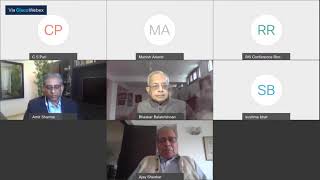
Amit Sharma, MD of Tata Consulting Engineers, argues that India's construction sector loses 30-40% of project budgets to delays and overruns. He outlines how digital tools like BIM, drones, AI, and prefabrication can cut waste and improve safety, citing a 540-bed hospital built in three months during COVID as proof the approach works.
Chapters
Hello, conference room, can you hear me?
Yes, sir.
Yeah, Mr. Sharma will be having a PowerPoint.
Yes, sir, we have given the access to them. We have given the access to them. He can share his PowerPoint.
Yes.
Okay, thank you. Oh, we have another 2 minutes to go, or it's actually already—
I audible?
Yes, you're audible but not visible yet.
Ajay visible now, I hope?
Yes, yes, perfectly visible.
Okay.
Hello, good afternoon. Good afternoon, this is Amit here.
Mr. Shankar, good afternoon. Good afternoon, good to see you. Thank you. Meet you, but nowadays we meet like this.
So let me see whether we have people who have signed up. I think we have 63 participants as of now, which is good considering we are just starting at 2. So if you are ready, then I will— shall we start? Are you ready? Okay, well, welcome to the 33rd in the series of the Science, Technology, and Innovation Policy Lecture Series, which is being organized in partnership with our friends from TERI. The Indo-French Centre, CEPHIPRA, Vigyan Prasar, and India Habitat Centre. So we all organize these monthly meetings by rotation, and it's for the public audience. We first started this series of lectures in September 2017, and we held it regularly until the COVID outbreak struck us in February. Well, since February we did not hold anything until September when we went online. So now we are doing this event online and the results have been quite good in terms of number of participants and the diverse locations from where the participants are coming. So it's been a good experience to do this online and we may do this in the future also, even though the situation may be become normal. So I, I, uh, today we have a very interesting session, uh, which is chaired by Mr. Ajay Shankar, who is a distinguished fellow at TERI and former Secretary DPITT of the Ministry of Commerce and Industry. And he has, of course, a lot of other experiences behind him. So we are very glad to have him to chair this session. And the main speaker is Mr. Amit Sharma, who is the Managing Director of Tata Consulting Engineers, which is the largest Indian private sector engineering and project consultancy firm, and he will be talking on digitalization in engineering and construction. So with these brief words, I'd like to pass on the mic to Mr. Ajay Shankar, who will be chairing the session. So over to you, Ajay.
Thank you, and thank you. I'm glad that I have the privilege of chairing this session. Uh, Mr. Ravi Chandra will be giving the address in a few moments, has an extraordinary CV. I've had the privilege of meeting him only now, but he's been— he's managing director of Tata Consultancy Services, but he began his career with Tata Motors, then moved in across a wide spectrum of firms and also spectrum of responsibilities. So he's also been in Infosys. So, so he has a very rich and varied experience before assuming his present responsibilities, of course, which are the highest in his field and very important and very critical. When I said I felt privileged in chairing this session is that one of the things which has, uh, always appeared as a bit of a paradox to me is that India's construction industry has been relatively slow in modernizing. Typically, a low-wage economy becomes a huge success in construction and makes its presence felt globally in the construction industry. The Chinese are doing it now. Before that, the Koreans did it. And even within India, we as consumers of the civil construction industry, we don't quite get the sense that this is modernized as rapidly as many other sectors of the economy have modernized. And when I was Secretary, DPPIPI, which is about over 10 years back, I felt concerned and then government And we discovered that the, the Ministry of Housing and Urban Development looked at developers, but the construction industry was not getting the attention from within government that it should. Of course, there are many people who believe that the market is the best, and the government leaves an industry alone and probably modernize much better and faster. But, uh, the topic of today's lecture, I think, in some ways offers great hope and promise, because, uh, as in other sectors in the country, there comes a particular tipping point and an inflection point, and we leapfrog, and leapfrog quite dramatically. So I keep hoping that maybe the construction industry is reaching such a tipping point. And the topic of today's lecture certainly suggests that that potential is there and that point could be reached and reached quite easily. Because another dimension of the construction industry, which is of course not sufficiently in the public domain, which again is a matter of national embarrassment— if you look at the number of people who die at construction sites across project sites in the country, it is embarrassingly large. I mean, once upon a time I was looking after hydropower projects in the country in government. And in reply to an unstarred question, I got a number which horrified me. And I was glad it was an unstarred question and didn't end up with a huge discussion in Parliament. But my sense is that— I mean, this is almost 20 years back— but my sense is that India really hasn't changed in qualitative terms as yet. So I'm hoping what we'll hear in the lecture lays out a promise and a potential roadmap for India's construction industry getting rapidly modernized, becoming globally competitive, and in this, Indian construction companies occupying the largest share of the global construction market, which will remain large enough for the years to come. So with these few words, I would request our distinguished speaker, Mr. Sharma. To enlighten us with his views, wisdom, and knowledge. Over to you, Sharma.
Thank you, sir. Thank you very much. Delighted to be here. Thanks to Mr. Balakrishnan and the team at TERI, as well as the sponsoring other entities. I think, Mr. Shankar, you've given a good context to the talk. Really, thank you for that. And I do agree with you. This is a sector that really needs a transformation. So I have a few slides to structure my thoughts and come towards certain policy-level actions that the government and the private sector, along with academia, can work together. So let me just share my slides. Please let me know if it's visible, if the slide's visible.
It is. It is visible. Please.
It's visible. Great. Quite fine.
Right.
Fine.
So before I start, just as a quick touch, I am part of Tata Consulting Engineers. You know, we are 60 years old. You know, we started in power. We have almost 140 gigawatts of work that we've done across the globe in power sector. 90% of India's nuclear. We work very closely with the DAEC and BCIL, all the nuclear work that's done. On the resource side, hydrocarbons, chemicals, mining, metal, and on the infrastructure water, urbanization, ports, transportation, and the recent work the last 6-7 years on smart city, almost 15 smart cities directly and 25 overall. And I think the teams at TCE has done a lot for nation building. And I think now is the time for us to look at what's happening post-COVID in terms of digital becoming an integral part And with that in mind, I'll kind of walk you through some of my thoughts. So that's a quick snapshot to give you the context. We recently listened to the budget, much anticipated, and I think what was very clear was a very strong foundation that the country put on infrastructure-led growth. And obviously so, for a country like India, which doesn't have a much-used global currency like dollar or large export markets in terms of the economic parameters, I think the biggest bet for India to really jump up the economic ladder and increase the GDP is on infrastructure. I think that's exactly what the government has done. And when you talk about infrastructure, it's across all the specific areas, right from railways, healthcare, water and waste, urban infrastructure, and so on and so forth. And we're going to spend a lot of money, almost a trillion dollars in infrastructure, on infrastructure for growth with a lot of investments. And when I call infrastructure, I, you know, one should look to keep in mind social infra and economic infra. And while what we see physically is, of course, economic infrastructure, And examples are energy, transportation, but social infrastructure, which is the fabric of the country that enables better human resources, much informed professionals, and of course, our focus on health, education, and housing. I think a combination of social and economic infrastructure really propels the country forward. And it's a time of careful consideration for India. I think in the post-COVID world with geopolitical dynamics, with a focus on Atmanirbhar Bharat, a young population that's proven itself in many of the fields globally, for example, IT, which kept on chugging through. I think India has come out well. And with this sheer investment in infrastructure, what comes to mind is, can we do it better? Can we make sure there are less wastages? There is adoption of better technology. And how do we go about it and what exactly are the issues? So while I was thinking about this lecture, I thought of many topics on energy, hydrogen, and I think those topics have been well discussed. But this topic to me was something which was needing attention. So it's not rocket science. Many of the things I'm going to talk about has been there in the market for a couple of years. It's about adoption. It's about change. It's about a serious push both from the private and the public sector and the government at a policy level, both academia as well as in projects, to make sure that India embraces digital technologies for engineering and construction. With the amount of stuff that we are going to put across in infrastructure, ₹100 lakh crore in the next 4 or 5 years, NITI Aayog did a study last year, and of the 1,600-odd projects with a total CAPEX of ₹20.9 lakh crore, the study revealed that close to 33% of projects, one-third of the projects, had time overruns. And without the cost allocated to it separately, the cost overruns were approximately ₹4.5 lakh crore. So you know, you could look at about 20-25% in pure cost overruns and 30-odd percentage of time. And if you overlay these two, probably the total waste, I would say, because of cost and time would be closer to 35-40%. Of course, I mean, only if we recognize this as a problem would we take actions. And it's not something that's just for India. It's a global imperative as well. Construction hasn't changed its DNA for long, and there have been some really good progresses. I would say the work that's happening in NHAI in India, for example, a lot of digitalization in the metros, high-speed rail, some of the work that the private sector has done, but a lot still remains to be done. When you look at mega projects across the country and across the globe. And hence, since it is also a global imperative, there's a big global opportunity as well. Close to $10 trillion globally gets into construction goods and services, and services is a good chunk of that, almost 35 to 40%. So we're talking about $4 trillion globally. Digital still hasn't arrived yet. There are early you know, small successes or islands of excellence, but it really hasn't arrived yet. Productivity issues are rampant across the globe. And if you just look at pure engineering, construction and operation, it's a great opportunity for budding entrepreneurs, policymakers, disruptors to really look carefully at it. There has been systematic studies with detailed analysis done. And to get some perspective before I get into the details, McKinsey did a detailed study across 20-odd countries, and parameters they extracted out of that on the productivity challenges in engineering and construction were very similar. I mean, they didn't differ whether it was developed and developing. Of course, safety remained an issue for developing countries, than the developed countries had a better control on it. But still, where it was collaboration with contracting, design engineering, huge gaps in procurement supply chain, execution gaps on the ground, gaps due to data management, and of course capability and competencies. And if you were to look at the cost savings, it throws up a number which cannot be ignored. On a $10 trillion global base, if you can save 15 to 20% optimistically and 10% realistically, that's a huge saving. I think this applies to India as well as we embark on a bold infrastructure-led growth. How does this study then further talk about possibilities? So quoting the same report, It talks about future of construction in terms of prefab, precast, advanced building materials, additive 3D printing, a lot of autonomous construction areas, use of drone technology, laser scanning, data analytics and predictive analytics, building information model. While these are fancy words one would say, Actually, there's a lot of knowledge and proven technology behind all of this. And my intent would be to demystify a bit because these are things that can be adopted in India today. And I'm happy to also say, as I mentioned, some of the leading government entities, high-speed rail, highways, some of the work that's happening in smart cities has already adopted many of these. But probably that represents maybe 10 to 20%, and there's a large room for its adoption across. So, uh, in terms of the digitalization, the adoption of digital in engineering and construction can be across all the phases, whether you're at a concept stage, design, engineering and fabrication, construction planning, cost and financial resource planning, the actual construction at site itself, and beyond the commissioning of the project in its asset lifecycle, which is operation and maintenance. And if you complete the circle in terms of its demolition, renovation, and future work. And while we have used tools for last maybe 4 or 5 decades, these tools have been 2D tools. And it's an urgent need for us to embrace 3D model design, add the time element, make planning an integral part of the design techniques, and ensure that costs are aligned with the design and time. And of course, a lot of this has been said. For example, the work we've done in nuclear in the last 25 years, we've already used many of these techniques because of the regulated industry. And most of the regulated industry, whether it's aerospace, nuclear, medicine, embraces technology because of regulations. And that's why, while we must let the industry, you know, grow with less restrictions and regulations, sometimes when it's about disruption and changes, regulation and policy interventions are a must. Whether the policy interventions relate to procurement guidelines, digital tools, and application of digital pilots and experiments as part of R&D costs, adoption of building information model like has been adopted on all federal projects in UK and the US and many of the European countries, a framework adoption at policy level. And mostly these things come from in India through Ministry of Finance, Procurement, NITI Aayog, and good work has started and some of that already has happened on the field. But the point I'm going to make is our sector must look at policy interventions to ensure that there is a push and a pull both for digital to be embraced. So talking about design and engineering phase, digital today provides a very immersive environment to create the possibilities of a physical world first in the virtual world and with virtual models way back in the '80s and '90s. Aerospace, automotive adopted a lot of this as mechanical engineers, process industry, chemical engineers do a lot of simulation in refineries. But for pure civil engineering, these are technologies that have started in the last 5 to 10 years and a lot of adoption is still awaited. Not only does the design phase allow you to do virtual models, but it allows one to look at energy simulation, productivity simulation, sustainability analysis, having a better control on quality, and creating a value engineering, design to cost analysis, design to fabricate analysis. And leveraging these things clearly close to design engineering phase, about 5 to 10% of the cost of CAPEX project. So a 10%, 20% savings in better design translates downstream into 10% savings in the 90% construction phase. So while the time for design phase is shorter, its impact on the downstream CAPEX construction phase is significant. Once we arrive at the construction phase, while there are new disruptive technologies being talked about in terms of modular, precast, prefab, 3D printing, I think a lot of the issues are around simple data integration and sharing between stakeholders, contractors, vendors, equipment providers, supply chain, raw materials. Workers on the ground, both white and blue collar, and of course, an optimal approach on project planning to ensure that projects are predictable. And as I earlier said, the delays in projects in India alone amount to 35 to 40% across all the projects that the government or the public and private sector works upon. A lot of this can be put into perspective and controlled by simple use of laser scanning, drones, cameras, and efficient use of digital tools, both in project planning, design, uh, integration, and coordination between the various vendors as well as various players involved in the construction site. If we were to do digital efficiently and effectively, in the design phase, in the construction phase, not only do we get an asset, whether it's a metro, whether it is a power plant, whether it's a smart city, not only do we get a physical asset, we also get a virtual asset. The virtual asset is embedded with smart sensors to make sure that we can listen to this asset and operate it better. Whether it's railways with bridges that can have sensors to talk about their structural integrity, or about machines, rotating equipments in plants, or about simply having smart assets used in infrastructure across the city. So smart operation and maintenance management with digital technology in design and construction phase would also help in optimal asset lifecycle of the asset, which will be for the next 50 years. And while CapEx project gets a lot of attention, usually it is the OpEx that will need improvements for bettering the O&M and extending the life of the asset. Even for brownfield construction, which is add-on to an existing asset, having a digital image of an asset helps define better engineering techniques to enhance the lifecycle or add on to an existing asset. So digital for engineering and construction goes across all these phases. And of course there are tools, of course, CAD/CAM tools, CAE tools have been there. A lot of the tools in civil world that we are today using come from the automotive, aerospace, and the process industries in past. But what wasn't there is what I'm going to talk about. Things, simple things like drones didn't exist 10 years back. Immersive AR and VR wasn't there. Handheld devices, smartphones, these provide us a way of leapfrogging and making the construction sector truly integrated and reflect the real site condition to the folks, whether they are architects, design engineers, structural engineers, geotechnical engineers, and minimize the gap between the design and construction. Also, by use of these smart tools, anyone at site with a simple smartphone could actually work in an integrated manner all the way from the financial planning to project planning, reviews, forecast, and ensuring that safety and quality goes up. Mr. Shankar talked about that in his initial introduction. India faces acute challenges when we look at site safety. And penetration of digital not only will give us benefits in terms of the financial aspects, but the most significant benefit would be on safety and quality at the site. And COVID has also taught us to make resilient and sustainable operations, for which having a real-time status of your plants and infrastructure development project site is a must. It is something that will leapfrog and accelerate as people realize the benefits of digitalization. The Building Information Model, as I said, has become a policy adoption in some of the countries outside. I think it is time for India to really look at in a policy intervention, ensure that we embrace 3D engineering. We have a lot of youth, huge number of engineering college, but real connect with the— between academia and industry with policy is a requirement. And if we were to marry, uh, and I would say there is good work happening in academia with institutions like NICMAR, some of the premier engineering colleges, NITs, IITs, RSTs, etc., truly getting our youth, young workforce, our policymakers and contractors, design engineer consultants, to come out with engineering and design purely as a model concept rather than printed 2D drawings is an absolute need. And to start with 3D and 4D, which is already coming there, getting to 5D with cost elements, 6D with operation elements, 7D in terms of sustainability aligned to the SDG goals. And of course, all of this together gives you very strong safety levers as well. And these are all inbuilt into digital tools. And all the tools today are pretty much offering similar functionalities. 10, 15 years back you had wide variations, but today all the leading vendors are able to provide the same skill set and functionalities in their tools. While I talk something that is already there and whether it's an intention of a private sector because of cost pressures, because of disruptions, or government for policy matter, future is going to be digital and this industry will not be able to go away from it. We may feel, how does blockchain, artificial intelligence connect to engineering and construction? But I would like to say, in construction and engineering, The biggest challenge on project delays has been tender management, contract management, project management, scope management. A lot of the issues and time and scope creep happens because of handling multiple documents, requirements. And not only does digital provide a mechanism to integrate multiple players, and some of that has started in few projects in India, But blockchain can be a great example of having a trusted backbone to connect these documents in a transparent manner and remove escalation of cost, delay in time, scope creep, a lot of claims management that happens. A lot happens not only because of inefficient project planning, but lack of data and and integration of data. So blockchain, which for example is being used by the shipping industry to connect the various documents required for ports and shipment and goods management, similarly can be used in construction and design engineering to transparently manage the immense amount of data documents that are generated during a large infrastructure project. Going further, Digitalization for engineering and construction can benefit immensely if we embrace standardization and modularization. And I want to share an example. During the COVID a group of Tata companies came together— Tata Steel, Tata Projects, Voltas, Tata Consulting Engineers, Tata Trust— and in a span of few days, we not only created a complete standardized and modularized hospital approach, but we got it erected in Kerala, a 540-bed hospital, in less than 3 months at the site. And I think that shows the power of standardization, modularization. The same applies, for example, to a lot of the innovations that happened in metro projects in India. But imagine standardization, modularization for our low-cost housing, for our hospitals, for the anganwadis and nangars that we need in large quantities in villages, the healthcare facilities that we need in Tier 1 to 3 cities, and so on and so forth. And if we were to truly look at marrying the civil, digital, and mechanical engineering together with material sciences, we could actually create offsite construction factories and construction industrialization where these construction factories can generate highly secure, high-quality, good, well-dimensioned, and lot of safety precast and prefab output, but also with BIM, look at artificial intelligence to further optimize and streamline the material used. We could also look at 3D laser scanned RFP tenders as we augment our legacy assets and align them either due to environmental norms or to asset sweating because of business dynamics and ensure accuracy between legacy assets and new assets. So standardization, modernization would be a benefit because of digital adoption in the engineering and construction and will result in immense benefits in terms of sustainability. And optimization, while we do have existing CAE tools which do a lot of sustainability analysis, energy footprint analysis, a lot is yet desired. And the AI tools that we can have not only can look at better material selection, efficient procurement strategies, efficient project planning in terms of constraint analysis, but also digital can provide us a mechanism to recycle waste, construction material recycling, by leveraging that material as a civil ink for 3D printing. Um, there is good work happening at some of our academia— IIT Guwahati, Chennai, IIT Bombay. We are sponsoring some of these projects where some of this material can become an ink that can go inside a civil 3D printer for at least basic level of 3D printing of houses, toilets, even hospitals, schools, and of course, enhanced use of precast and prefab. Last but not the least, digitalization requires us a lot of reskilling of our talent in engineering, project management. And while we embrace this reskilling, the worker, the construction professional at the site will also see tremendous changes. Some of this has started happening on site, and some of this will happen very rapidly. The cost of the wearable devices, handheld devices, smart helmets is falling drastically. You can actually see smart helmets with intelligent accelerometers, cameras, and sensors in terms of health of workers coming as less as $20 to $30 and maybe less in coming years. There's good action happening between academia offering digital construction program. India, after 70 years of independence, needs definitely an engineer's bill. A lot of representation has happened. NITI Aayog has worked with the private sector to come out with the project management framework. To really look at professionalizing project and program management under a premier National Institute of Chartered Program and Project Professionals coming. So in summary, digitalization with wearables, exoskeletons, automation, AI will not only provide immense productivity enhancement benefits for a country like India that is betting its growth on an infrastructure-led CapEx and OpEx, And we will surely ensure that we do justice to our professionals on the ground with reduction in safety and near misses by leveraging digital. Um, towards the last two slides, I would like to repeat this word which has become a buzzword for Industry 4.0, where digital is all pervasive. It's all about humans working closely with technology and creating both virtual and physical infrastructure. And I believe that engineering and construction, it has a cusp of change. And certain policy intervention, innovation from the entrepreneurs, disruptive thinking from the private sector and government, along with academia participation, I think a lot can be achieved to reduce the wastage, enhance safety and quality, and truly make India a leader in a sector that spends $10 trillion globally. Just like India has done well in the IT services, I think the time is for us to really look at a benchmark global engineering and construction sector which we can have focus on. Not only does digital provide enhanced synergies for construction and engineering, but it also provides us to create intelligent assets, as we call digital twins, that will have sensors embedded in plants, projects, infrastructures like stations, airports, metros, bridges, that will talk to humans through sensors and as a digital twin, allow us to manage them efficiently and effectively and extend their life. Finally, in terms of setting the context very quickly, my last slide is on policy interventions that our thinkers, innovators, thought leaders should keep in mind. Every time this subject comes, there is a debate on L1-based approach and how can L1 in construction, which typically comes from our projects, both government public sector, but even more so even the private sector starts adopting. I think we need to get away from low cost. We don't have L1-based doctors. We should not look at L1-based engineers. And my favorite line is A doctor may kill one patient, but an engineer can kill 10,000 people because of the L1 approach. So QCBS based on quality and cost combination is a must. A lot of good things have already been talked about it at the policymaker level. Both the ministry and NITI Aayog has also agreed of QCBS and going away from L1. We must adopt the building information model and integrated project delivery. BIM, by the way, is in UK, and IPD is federal projects in the United States. To be adopted at policy level in our procurement guidelines, we must also encourage innovative design contests for our infrastructure project, more Swiss challenge-based project models, payment both in terms of ensuring reward rather than penalties so that digital gets embraced because of the innovation, based on KRAs, SLAs, and KPIs, apart from the CVs and the rate cards that we use. There has to be an adequate focus on early upfront concept and design. Every project is, is hurriedly started with stuff that has to start on site, but we must spend enough time early in the project to create virtual 3D models that can give better, efficient, safe sites on the ground. Please let us not start projects without having basic areas for our workers to stay, for our safety, for our site and environment areas to be protected on. We must look at real-time data for our dashboard reviews. This is something the Ministry of Water, Ministry of NHAI has started, and I think they've become benchmarks in India. It must go across all the sectors, to have real-time data and dashboards, no presentations, real-time dashboards to look at projects. And we've seen some very encouraging results in last 5 years. Adequate allocation for digital tools, technology and innovation pilots and grants by the government and academia in close collaboration with the private sector, inclusion of digital penetration in the are into the R&D costs and why not extend it to the CSR cost as well? Because if we can get digital penetrated into engineering and construction, it's a great service we are doing to the nation by reducing loss of lives, making more sustainable infrastructure, increasing the social infrastructure as well as the economic infrastructure. Last but not the least, National Project Framework and Engineer Bill that we could look at formalizing in coming years. With that, I'm open to questions, and I hope I was able to convey some of the key factors in digitalization and engineering and construction. Thank you so much for the time. So, Mr. Shankar, back to you, sir.
Thank you. I mean, what I've heard from you was just pure music to my ears and also has made me feel far more optimistic about the future. And, uh, and it gives me also confidence that, uh, that government and the industry is now working together in trying to bring about this kind of transformation. And, and some of the numbers you put up in terms of cost gains and things like that are quite dramatic. So, so I don't think there should be much difficulty in moving forward very rapidly. So I open the floor to questions. Anybody who has any questions, please suggest that you want to speak or put it on the chat. I'll read it aloud. This will take a minute or so because the Sure. So, so while we get other questions, let me begin with a question. Your firm is on the forefront, and so are a few others, but how do we get the bulk of the construction companies to modernize in a few years? Because I mean, what you've said about tendering and going beyond L1 may happen for some of the or prestigious projects, but I see the bulk of public sector government projects remaining in that L1 mode. So how do you see the transformation of the smaller construction companies and their transition into the world? And is there anything public policy, public funds, or regulations can help in that direction?
Sure. I think I'd like to answer it in terms of 3 layers, right? I think the first layer is to make this field exciting for our youth. If we don't put digital, the best of the youth will not come into civil construction and engineering and will get attracted to the financial sector and the IT sector. So foremost is make this sector exciting for our— the new generation. And that can only happen if we promote use of tools, handheld devices, smart apps. That can happen right at the academia stage with support from the government, as well as from the, uh, project stage. So that's one— get the youth excited. I think youth has a lot of power of taking it forward. That's exactly what NASCOM did 20 years back, sir, right? So that's number one. Second, I think, as I mentioned, when there is a disruption in an industry, and especially when India is betting on an infrastructure-led growth, and we don't have the measures of what a dollar or a pound has, or an export-dominated society, our growth will come sheer from infrastructure-led, is to make certain policy decisions that make mandatory use of certain tools, 3D, 4D, and do it with cost advantages. This should not be a burden. If these tools are being used, they must reduce procurement cost. They must reduce wastage because the site conditions at the time of tendering and the actual always has a gap. There are claims because of details not being right. So if you can make the tender, as I call a 3D tender based on laser scan data, The cost of tenders have reduced by 10 to 20% because the data is accurate. So that policy will ensure that the tenders are accurate and the gains pay for itself rather than adding. And last but not the least, I agree with you, not all will change from L1 to QCBS, but there must be incentivization and procurement policy related changes that, that attract innovation. Swiss Challenge method, design contests on some of the key projects. Also for commoditized areas like low-cost housing, 3D printing, fabric, precast, prefab, completely modularized approach which could be shipped on, on, on a tractor trailer, right? Like what we did in during COVID times for a hospital was a complete fabricated modular hospital, you know, yards that could be put in. So even in the commoditized sector, which could be L1, there is possibility for digital and policy intervention to get better results and not purely L1, which just drives into cutting costs and corners everywhere. And sir, to your question, I would like to again repeat We never have an L1 doctor. Why L1 engineers?
I agree with you.
I certainly agree with you. But in fact, I'm sort of a lighter way, an anecdote. Once I was talking to some German firms, private sector, and government, and they said, we don't look at India as a market. I said, why? Because we command a price premium in the global market because of quality. Now, in India, neither your government No, your private sector is prepared to pay a price premium for quality. So don't look at the Indian market as a market for us. Your private sector is also happier going to Taiwan, Korea, or wherever.
Right, right.
But another question, do we have an active enough construction industry council or body or a part of CII or something which does policy advocacy with government with these ideas, kind of ideas, in a sustained manner, and is seen as coming with a broader degree of consensus than from one firm. Because having been in government, we tend to be a little more cautious when an idea comes from one firm, but it comes from a broader platform, right, to be far more open.
Yeah, so there are bodies, uh, and it's— I would say it's still fragmented. Why? There are two reasons. One, you know, we are not yet a regulated industry. And I say sometimes regulated industries are good, you know, pharma, medical, nuclear. So we don't need full regulations, but a certain structured approach. So there are a lot of bodies across. There is a construction body, developer body. You know, there are people in pure design consulting. FICCI has certain forums, CII has certain forums. But I think to get a mindset change, the procurement guidelines, you know, really set forth the mindset and thinking in terms of strategies that the players adopt. And I think NITI Aayog has thought through this in the last 2-3 years. And I believe with their vision and guidance, if we can create a body that purely looks at infrastructure-related innovations with focus on engineering construction and give it an initial shape, then it will be self-sustaining. But today we lack a cohesive body that represents developers, contractors, equipment providers, steel fabricators, and so on and so forth, consultants. It's in pockets all over.
I have, I think, now one question. This is about the brain drain from India and, uh, building India to next level. Youths are moving out of India. What is it that we can do to turn them to come back to India, not leave India? That's a question going beyond your sector, but I certainly— very important question.
Yeah, I think in terms of, I mean, youth will go where it gets attracted with opportunities. And we are in a world that's pretty much opened up in last many years. But I think the Atmanirbhar Bharat campaign, and the amount of infrastructure spent in India is unbelievable, you will not get opportunities anywhere in the world on high-speed rail, metros, tall buildings, smart city as India provides. I think what we need to make is to make the sector more exciting, more digitally aligned to the next generation, as I mentioned, and talent will automatically come here. You know, talent does not want to leave its nation and go to outside if there are exciting opportunities in India. And I'm very optimistic that with Atmanirbhar Bharat, with more focus on Indian entrepreneurs, innovators, the amount of spends in infrastructure, we are up for exciting times. The youth academia and some policy intervention will make digital demystify and make it more interesting for the next generation. And I think post-COVID, I would imagine the policies of ever-growing globalization will become more global and local. So let's wait and watch.
No, no, I entirely agree with you. I would add that this ₹100 lakh crore infrastructure pipeline is going to be the most exciting thing on the whole earth.
Absolutely.
And we would, and as your lecture has indicated, we could leapfrog into exciting new technologies and new ways of doing things. And the fact is that, I mean, China has completed its infrastructure development. So, so this is the big happening in the world in the coming years. And so I do hope that your thought resonates and the sector starts becoming exciting for young people. And then they see it as a great frontier. I have another question for you now. How effectively can the safety measures and details required at site be educated to planning working engineers at the drawing board, project conception in current scenario for power projects? This is specific for power projects, but you could answer this and also say something more about the transformation and safety, because I personally, I mean, I would be delighted if industry and government set a target of zero deaths at construction sites in 2025. We may not achieve it, but at least we must have that kind of goal. Over to you.
Yeah, so I think, uh, there are two aspects of site safety. One is imagine assembling a mechanical entity. There is a proper process for assembly, like you assemble a car or a laptop or a desktop. The assembly sequence is clear. The issue at site is many times we make designs, but the construction techniques and processes have never been simulated. And sometimes, uh, untested, unvalidated, and low competency-based approaches are done for heavy lifting or for basic construction techniques. So 4D, which is about marrying 3D with time, is about engineering construction simulation. These technologies 20 years back were used for simulating car aerospace or car crashes. for making them more safe, as you would have seen, many of us. The same technology is available for a cent today instead of a dollar, for a cent. And you could simulate everything at construction site from crane movement to raw material movement, the human worker movement. That simulation not only helps you better resource management, but more importantly, Saves lives. If a policy can make it mandatory for certain elements of construction, maybe tall buildings, heavy lifting, no site pass shall be provided if you haven't simulated the movements, for example, it should save lives. Secondly, uh, simple handle devices. And I think today India is at the forefront of mobile revolution. Everyone in India almost has a smartphone where a smartphone goes from ₹2,000 to ₹2 lakh rupees.
Right.
You can have apps that are able to capture images, AI that are able to process the images and look at possible safety lapses and guide people on the ground with planners, analysts, designers to reduce these complexities and demystify safety requirements and quality requirements. So I think digital has a big role to play, but policy must demand zero fatalities through use of many things, including digital, right? And I think why power plants, even during COVID times, certain startup in chemical plants, for example, had had issues because our operation folks on the ground were not that savvy. So instead of having long manuals to read, what if you had a digital movie that simply told you how to shut down a plant? A movie is worth 1,000 words. You could watch it on a sequence of shutdown on your smartphone and act in a timely manner in time of need and emergency. You don't need any language because a picture and a video has 1,000 words. So there are very simple interventions that can happen today. And I believe both from simulation as well as site, CAPEX and OPEX, digital can help save lives and make our sites benchmark sites across the globe.
This again is really very encouraging and makes one feel optimistic that India could really go through a major transformation in a few years. Any other questions from anybody else? Yeah, please.
Can we think of promoting all this in our engineering, civil engineering particularly, and mechanical engineering programs in our engineering colleges, so that the younger generation sort of gets fully attuned to all this. Over to you.
Yeah, yes, sir, you're right. So as I mentioned, there are areas— I mean, there are colleges that are offering construction management MBAs, which is a good sign in last 5 to 8 years. There are colleges, premier engineering colleges, that have started to look at construction techniques. NICMAR, for example, the specialized master's program that focuses on construction. I believe there has to be closer collaboration, and design contests are a great mechanism worldwide that have put in innovations in a disrupting sector. So for example, if you were to build the next railway station, or you were to make the next Statue of Unity, or the next metro, if it's a competition that mandates both private-public sector to work with academia in new areas, right, new ideas come out. CSR funding today has been allowed to be used by private sector in premier educational institutes. And we ourselves are sponsoring certain programs that will help construction to formalize itself and embrace digital, and so many others in the industry.
So I think it will improve.
And last but not the least, as I said, that our youth is very gadget savvy. And if these tools, which may cost even ₹10 a month subscription model, can come from a policy framework with national project and program framework that NITI Aayog is coming up with, an engineers' bill that gives a legitimacy. I mean, it's very surprising that after so many years, we don't have an engineers' bill in this country, and most of the country worldwide, you know, have a professional engineering bill. I think all of these things will combine to see the change that you saw have effectively questioned and demanded. And I'm sure there are many people who are looking for this change.
Uh, I think we have time for one or two more questions. Uh, in the entire life cycle of a project, from design to demolition, which stage is the most critical and more an urgent need for digitalization? In other words, at which stage of the project lifecycle would digitalization prove most advantageous in the next few years or something like that?
Yeah, sure.
So I think, uh, when we look at digital, I think we should look at concurrent engineering rather than sequential engineering. So our typical mindset has been a sequential waterfall method— concept, basic engineering, detail engineering, then you know, site works, etc. And that's a model of past. Concurrent engineering is leveraging information, for example, right at the concept stage. Not only architects and design engineers, but have your site engineers, construction managers, the guys on the site be part of the design immersive process so that we can simulate safe, high-quality and alternate methods of construction. We could modularize a lot of our design so that the construction techniques are not in situ, but as I said, part of construction industrialization offsite.
And only—
what happens is, because we think in a waterfall method, in a sequence-based manner, and we don't connect the dots between these stakeholders of the project, we produce disjointed decisions and disjointed outputs. Right. So first, think of digital engineering in a concurrent manner. Second, early phase is the most important phase. The first 10% has a 90% impact downstream. Once you've designed the thickness of the wall, foundation, raft, piling, height, wind velocity, etc., etc., you constructing it, changes downstream will cost you more rework. And hence, simulate, go to 4D and 5D in the first 10% of the project progress. But having said that, every part of the project has to be thought concurrently. So if in— if we were to think in a sequential manner, the first 10% is very important. Do it in a digital manner, connect the dots between the architects, designers, contractors, and the site workers to create a more holistic design that is sustainable and has elements of reusability, both in terms of new material and precast prefab adoption.
Very, very useful. Thank you. I think we are running out of time, so I may— I request Mr. Balakrishnan to give a vote of thanks, but it's been very educative for me, I must say. Thank you.
Thank you, sir, for giving an opportunity, and thanks for your questions.
Uh, we work, uh, closely with you moving forward.
Thanks a lot.
It's been an exciting and very stimulating discussion today, and I must say that Mr. Sharma has really made us think a lot about the whole construction industry and the way we approach it. And I'm sure that his your talk would be very useful to a rather large audience. We had at one time 220 people participating, and from all the questions, it looks like they have quite a few people who are serious students of construction technology. So we have benefited a lot from your talk, and it has, it has really contributed to our knowledge. I must thank Ajay Shankar for having taken time off to chair the session and to steer it also in a very interesting direction and also pose some very interesting questions based on his long experience in the government. A touch of realism and optimism was there in his comments. So thank you very much, Ajay, for those— for that effort. I must thank our Habitat Center for having participated in this partnership along with the other sponsoring organizations. We are very happy to continue our cooperation and go on to the next in the SIP lecture series in the next month and thereafter. Lastly but not leastly, I must thank our large number of participants who have attended this session and stayed faithfully engaged. I see the attendance is still around 200.
Also.
And I think a large measure of the success of this whole series of lectures is the number and quality of the participants who attend and take back with them whatever knowledge is available. And that's why I thank you all for having come here. So with these words, thank everyone, and we'll close the session and wish you all a very stay safe and healthy days ahead.
Thank you.
Thank you very much.
Thank you. Thank you.
More from Nathan



Can AI Read Your Heart? Unboxing DeepVessel with Nathan Qin from Keya Medical | #52







