
The Next Energy Frontier Hydrogen's Role in Tomorrow's Energy Mix Leadership Panel
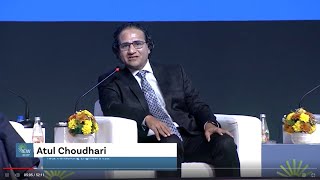
Senior experts from India's energy and consulting sectors debated how hydrogen can transform India from an energy importer to exporter within two to three decades. Green hydrogen costs must drop to $1-$2 per kilogram by 2030, while blue hydrogen bridges the gap. The panel stressed the need for regional hydrogen clusters, pipeline networks, and policy support through incentives and subsidies.
Chapters
Good morning, everyone, and welcome to the second session on hydrogen in 24 hours on this plenary table. It's very interesting that we are having two sessions on, on a similar topic. I can— only the organizers know why, but I can hazard a guess. In the overall decarbonization story, if there is one theme that's really, really important, it is that beyond electrification, we need molecules. And amongst molecules, between biofuels and hydrogen, they have to tell a large part of the story. Hydrogen in particular is important in this context at the India Energy Week because it is, as some of you might have heard Mr. Amitabh Khan speak yesterday, that it is one of those special energy vectors which can allow India to become an exporting country and not just an importing country on energy. It's over the next 2 to 3 decades. It is— we are in this country hoping to kind of use the hydrogen vector as a means of not just decarbonizing ourselves and utilizing for our green purposes, but also taking it to the globe. With that, let me just quickly kind of introduce the panel. The objective today— some of you might have seen the hydrogen session yesterday. There was a conversation around it on many, many global issues. Today's panel is very— going to be very India-focused. And in that context, I wanted— this panel is really, really equipped to to talk about those themes. So maybe I'll start with the quick introductions. Mr. Atul Chaudhary on my left, he's the CTO at Tata Consulting Engineers, 28 years I think in process industries across, he was previously with ACCAR, worked across multiple hydrogen projects. Okay, very close association with academia. I think he has a lot of interesting thoughts on R&D, which he will share with us as well. Mr. Alberto Modignani, he is a hydrogen VP at NexChem, a MARE Group company. He has— he's a nuclear engineer by training, and I think over the last many years he's done multiple projects across the world on not just hydrogen but many other kind of energy sources. And we are hoping to tap his expertise in learnings from other geographies for the country. Next to him, we have Mr. Alok Sharma. He is Director R&D at IOCL. 3 decades, interestingly, he's been the ED at the Centre of High Technology, which has been doing a lot of work on cutting-edge work at the refineries. He's been responsible for many topics on hydrogen, gasification, solar, CO2 capture, and energy storage, leading that thinking and that research at IOCL. He's a member of the Indian Association of Hydrogen Energy as well as the Hydrogen Association of India. Welcome, Mr. Sharma. Sarma. Then to his left, we have Mr. Lalwani. Lalwani— Miss Lalwani is the Executive Director, Head Technical and Projects at Torrent. 4 decades across multiple solar, wind, thermal projects, fertilizer, ammonia in India and the Middle East. And interestingly, Torrent Power is one of those companies which has actually won a bid in the site, kind of the SECI auctions recently. And so they are putting their money where the mouth is. So they're leading the hydrogen charge in that sense. And to his left, we have Dr. RK Malhotra, very experienced professional. He's in fact, he's been the ex-director R&D at IOCL. Currently, he's the director and founder of Carbon U-Turn, which looks to do interesting things around creating a platform for carbon credits. But equally importantly, he's been a DG at FIPE. He's an expert in multiple ministerial committees. And he's also kind of a— he's a professor at both currently IIT Delhi and I think soon to be, hopefully, I don't know whether it's IIT Roorkee as well. So we expect to tap his experience on this theme as well. So we have a really distinguished and experienced panel today. And what we are hoping to kind of get from this conversation is some interesting thoughts on what needs to be done to take the hydrogen topic forward. In India. So with— maybe we start with a slightly open-ended question before we're getting into specifics on and tapping the individual experiences. And the open-ended question that I wanted to start with was, as coming from your unique vantage point, how do you see the hydrogen ecosystem in India evolving and what needs to be done to accelerate it? So if you could just take a few minutes giving your perspectives on the same. So maybe we can start with you, Mr. Chaudhary.
Yeah, thanks. I mean, hydrogen is not a very new vector. First hydrogen electrolyzer was made about 150 years back, and this clean energy transition has a renewed interest and momentum with respect to deployment in several industrial elements. The potential that it brings to decarbonize the industry is tremendous, but there There are certain things being the new horizon technology implementation at a highly commercial scale and at a highly large scale. Obviously, what first comes to mind is the costs associated with the generation, cost associated with storage, cost associated with the transportation. It's the whole economy of the cost that needs to be seen. If you talk about the generation, the electrolytic hydrogen generation, most of 50 to -70% costs are related to round-the-clock power availability. About 30-50% costs are related to the electrolyzer manufacturing. The most important factor, what I believe, is the promotion of research and development framework. We have made an excellent start. Very recently, the R&D framework for development of this hydrogen electrolyzers have been announced. A lot of targets and KPIs have been set. It is a long roadmap. If India has to achieve the Atmanirbhar technology, the acceleration and fast adoption and encouragement to R&D will prove a very vital point that will definitely bring down the costs associated with round-the-clock energy as well as with respect to electrolyzer manufacturing. And with respect to the creation of the user, creation of the demand, there are a lot of policies that are being discussed. These are still Till the early days, what the renewable power electricity generation has brought, the scale. Similarly, the hydrogen scale will also bring down the cost. In the interim, it is very essential to start developing the hydrogen infrastructure in phases. Maybe a short-term approach could be the development of clusters wherein the users are nearby to the production area. On a long term, obviously we need to look for development of the pipeline network similar to natural gas pipelines across the country and cover it up as the hydrogen transportation. That will make the hydrogen clean energy transition little bit faster, faster adoption into the country. That's what I feel.
Thanks, Mr. Chaudhary. In fact, very interesting themes on R&D and cluster development, which we'll come back to later. Mr. Mordiniani, your thoughts, please.
Thank you, Arun. So from my perspective, I think we should look back at how the low carbon, whether it is green or blue hydrogen industry, has been developing during the last, I would say, 5 to 7 years. Okay, I think that there, there have been lots of improvements in trying to make the low-carbon hydrogen more competitive with respect to the conventional gray hydrogen. There have been lots of improvement from the technology manufacturing industrial point of view, but still we are not there. Still we are not there. Hydrogen, whether it is blue or green, it is, it is too expensive. Most of the projects for mostly for bankability reasons. The large-scale projects have been delayed and are progressing to FID with 1 or 2 years of delay in general. If you see them in Europe or in the US, there are also other countries like South America which were very promising and still they are almost nowhere in terms of project development. So if I look at this, With the perspective of India, I think that there is a lot of potential because India as a large country with a big industrial heritage has the big advantage of the second mover. So we can really look back at what the low-carbon industry, hydrogen industry has been doing so far and then take advantage of that. Um, I have seen, for example, several, uh, opportunities and discussions about, um, making India, um, a hub for, uh, hydrogen production for export. For example, uh, if there's— there is not a market directly and in the short term in India for, um, green or blue hydrogen applications, certainly there is for, uh, for export. Europe Europe, for example, has ambitious targets for producing and using millions of tons of low-carbon hydrogen at 2050, but only 50% of that can be produced in Europe. So certainly there will be areas in the world, whether it is Europe or Japan or other countries, where India can can act as a hydrogen hub for export. And from the manufacturing point of view also, I see already interesting initiatives that are taken in India whereby Indian industrials are connecting with electrolyzer manufacturers to create kind of licensing agreement whereby the technology The design of the technology would be coming from the original country and then manufacturing, massive manufacturing production in India. So this is something that it is maybe making a change in the way India can position as an industrial power in the overall hydrogen sector. And then we do not have to neglect, as you were saying, the potential of R&D, the potential of universities, which is huge in India. And certainly there is still a gap to be bridged in order to reduce costs when we talk about novel technologies and maybe we'll talk about that later.
Thanks, Mr. Modrignani. I think great thoughts on second mover advantage as well as the potential for exports and in local manufacturing. Mr. Sharma, if you could just elaborate on your thoughts.
See, I come from the oil and gas sector and Our company is one of the largest producers of hydrogen. We are looking at hydrogen from the two facets of it, right? I will say that storage will be a big challenge. So we are starting with the captive use of hydrogen to start with. And in this direction, I would like to mention here that the main issue which is likely to come is the supply of the electrolyzers, because a lot of companies have taken the initiatives And electrolyzer supply is becoming a big issue as far as the captive use is concerned to start with. Because in the captive use, you don't need storage. So that's a big advantage. You can directly have a buffer vessel and you can use the hydrogen directly. But once you go for the transport sector, then the challenge starts. Basically, you have to have storage, you have to have compression. So in line with the supply of electrolyzers, These things will also need to be cracked to have a good storage of hydrogen. Because as you— I can mention here that Department of Energy USA, they had set up a target of 7.58% of hydrogen storage by 2019, but they have shifted it to 2025 and still the target is about 7.5%. That's the maximum target which they have set up. So storage is becoming a big challenge. And in this direction, I would like to mention here that a lot of research is required. Already government has announced the PLI schemes for the electrolyzers and for manufacturing the hydrogen also. The subsidy will be there for manufacturing electrolyzers, ₹4,400 per kilowatt, staggering down to about ₹1,500. So that's a very big initiative which has been taken because we are seeing that supply of electrolyzers is becoming a big challenge for us. We are trying to buy some electrolyzers, but we are not able to get in time. Our Indian Oil Corporation has already taken initiative. We are setting up 10,000 tons per annum of electrolyzers. Oil and gas sector has already taken initiatives to set up about 20% of the total 5 million metric tons which has been announced by the Honourable Prime Minister. So we are taking the 20% of that will be set up by complete oil and gas sector in India. So there are challenges in the supply of electrolyzers. Then once it comes to mobility, there will be challenges for storage and compression as well as for the dispenser and other things will also become a challenge.
Great thoughts, Mr. Sharma. I think beyond just the ambition, I think getting some of these building blocks right is very, very important. I think that electrolyzer is a starting point, but as you're saying, the rest of the chain will also start feeling constraints as we kind of solve one problem one after the other. So great, Mr. Lalwani, your thoughts please.
Good morning everyone. Actually, I have— I'm coming from the developer side, so I have a different perspective as far as scaling up the hydrogen production is concerned, or derivatives of hydrogen are concerned. The main challenge is actually, as a developer, what we see is a demand creation, actually a demand of the gas hydrogen is at the nascent stage. And to aggregate the demand and to bring the demand, that is possible only when we bring down the cost. And to reduce the cost, we have 3 actually areas. One is a renewable, other one is a hydrogen, and then derivative downstream side if there is a derivative. So we know that renewable has almost reached up to the matured level where the— still there is a scope of optimization, but renewable is costing almost like a 62 or 63% of the hydrogen cost. So that is also required to be reduced. But the electrolyzer, which is actually this costing high, almost like a 25-30%, so that electrolyzer cost has come down. That electrolyzer at the moment, both AC as well as a PEM, they are— the PEM normally is used, but PEM is having an issue of the rare earth metals which are using, iridium and titanium or the nickel. So all these are very rare earth and very expensive. That is, now the research are going on to reduce the cost of electrolyzer. I think that would be the positive change which is going to happen. But at the same time, I think from the developer side to doing the pilot project— actually, pilot projects are nothing but learning blocks. We can learn the operation issues, we can learn the performance issue, we can learn the efficiency issues. And these pilot projects, at least green hydrogen pilot projects, have started. But you might have heard that recently Now government is going to start the pilot in the steel and the shipping sector. So pilot— immediately conducting the pilot projects is very important because pilot projects will improve the technology, evolve the technology, and bring the technology to a mature level. So it is very important. Like I would say, the Torrent, we are doing the pilot project in the green hydrogen. While doing the project, we came to, we learned that one, the major issue of gas crossover through the membrane, that gas cross, it is, you cannot get the full load of range of operation in the AEC. So range of operation is restricted. Now, turndown is 30%, but because of the membrane gas crossover from hydrogen from the anode side to cathode side, there is a possibility, there is a risk of explosion on the anode side. So this issue, the technical issue, technology issues, are need to be addressed immediately so that at least technology reach up to the, uh, level where it can be scaled up. So PEM is having an issue with a, uh, uh, high cost, and the AEC is having an issue where the gas crossover or the range of operation is quite small. It is not possible actually. All OEMs normally give turndown of 30%, but if you really operate, then you get only that 50% of range from 100 to 50%. So these technical challenges which are really possible to discover or identify only during the pilot stage. So pilot, when we are doing, we learn a lot and then try to evolve, improve the technology. So this period, actually what happens in India, actually that these all things are happening at the same time. We are improving the technology, we are working on the technology, we are doing the pilot, we are scaling up, we are looking for the market, and all these are happening at the same time, which is, I think, which is little bit challenging at the moment because normally in all the invention or the— when the technology evolved, you have a time where the technology evolved and then you can scale up, then you can commercialize the business. So in this case, actually, uh, the time is too less to reach up to that one. So that is causing— and there are many things are happening, like if you learn the lesson from the Europe, Europe have hydrogen hub they have developed, and the bigger hydrogen hubs have come. But India, actually, we have the hydrogen hubs, which are the— if you see that they are smaller in size of our hydrogen hubs. And hydrogen hubs are very important where the actually user and the producer coexist. And when you coexist, you see that when you have a small transportation length and you can resolve many problems in this one. So I think hydrogen hub, more hydrogen hub, or identifying the ports in India where that we can export that, and infrastructure to build in the— at the ports also. It is very important whether tankage systems or the better derivative tankage system. So I think many things are required to be done on the port side to ensure that we are making the infrastructure for export purpose. Because if you see, if 5 million ton per annum, if you have a target for the 2030, out of the 5 million tonnes, almost like a 50% component is for the export. And that 50% component, whether how we are going to export the hydrogen, because hydrogen export is also challenging, whether in the ammonia form or a liquid organic hydrogen carrier through carrier, LOHC. LOHC is also very good promising technology. Problem is the LOHC LOHC, we have not— it requires some time to improve this technology or become mature. So LOHC is a very good carrier, but it is very competitive with ammonia as far as hydrogen transport is concerned. So I think future such research or technology development will also help. So in India, I think both on market side I think there are 4 things: market, cost reduction, and then developing the infrastructure. And the last item I would say is regulation, codes, and standards. Regulation, codes, and standard also, you see, the standard now, the quality standard of the hydrogen, which are in Europe already, they have declared their quality standard. We have also declared, a lot of work is required harmonize the standard with other countries so that at least then we will be ready for the export of hydrogen.
Thank you.
Thank you, Mr. Lalwani. Pretty comprehensive coverage of the technical and technological issues which need to be solved. In fact, we didn't even touch upon renewable. I think you stayed hydrogen and downstream. There are lots of problems at the renewable side to be sorted as well. Mr. Malhotra, then your thoughts on this, please.
Actually, you know, if you have to look at hydrogen economy and you have to roll it out at a faster pace, I don't think that we have to wait only for the green hydrogen cost to come down, which we hope will come down to $1 or $2 per kg by 2030. But in the interim, I strongly feel that we should be also looking at blue hydrogen. That's— having said that, we need to focus, continue our focus, the government has been focusing on green hydrogen where 5 million target has been given, for 5 million tons is the target for 2030. We hope that we will achieve that, but our hydrogen demand by then would be about 13 million tons. So that gap of hydrogen demand in different sectors of our economy will have to be bridged through the blue hydrogen. So, and also we are a cost, you know, sensitive economy. We can't be, you know, pushing hydrogen at a cost of $6 per kg or there won't be acceptability and the demand, creation of demand is also a very big issue. So how to create that demand is one issue on the one hand and reducing the cost of hydrogen production is one. Then there is a cost involved in storage, transportation and distribution of hydrogen, which also needs to be accounted for. Government has done doing an excellent work on giving incentives for the production of green hydrogen through these incentivizing of electrolyzers, giving some intense incentives for green hydrogen production. But you know, you need compressors, you need storage tanks, infrastructure, pipelines. So these things will also require some type of government support. I agree that government cannot be supporting or incentivizing or subsidizing every every, you know, thing in the value chain. But I think some kind of support in terms of some of the expeditions, clearances, etc., or maybe some of the state governments have been supporting, giving free land, etc., for setting up electrolyzer units. So those kind of things in policy side are being taken care of. But I think one more issue which, besides infrastructure, is about standards, which which he just mentioned. You know, for storage, we have been foc— you know, PESO needs to allow 700-bar storage. If you have to roll it out in mobility sector, etc., and you have to increase the range, you have to store in smaller tanks, type 4 cylinders, etc., they need to be focused. And also, in mobility sector, you know, if I did some calculation and found that 125 kilometers, if you have to go, you need about 25 kilowatt of power at a commercial price of about ₹8, you know, you spend ₹200. And in a hydrogen fuel cell vehicles, in ₹200, $2.50 per kg of cost, you know, you can be competitive. So if you can bring that cost down, use any kind of hydrogen, you will be having more efficiency in terms of hydrogen fuel cells. We are a net importer energy country. So if you can have more efficient devices like fuel cells to be used in mobility sector rather than IC engines based on hydrogen, maybe coming from blue hydrogen, you will be saving on energy, net energy savings can happen for this country. So I think these are some of the issues on which we need to focus upon and also then we can maybe blue— biohydrogen also is one. One more thing which I would like to say, you know, if when we talk of green hydrogen, it is not only electrolyzer-based hydrogen. The biohydrogen, we have plenty of biomass available, we have lot of municipal waste. There are technologies now available which have been developed and you can even go— if you integrate CCUS with that, you can even have negative, you know, carbon scenario. So carbon markets creation is is the last thing which need to be done because hydrogen will be an enabler for decarbonization. And when you do decarbonization of any sector, the carbon credit scheme which is going to be implemented in this country through the Bureau of Energy Efficiency can incentivize and reduce the cost of hydrogen production, storage, usage, etc., in different sectors. So I think that is also equally important that we expeditiously move towards carbon creation of carbon markets, appropriate system of methodologies for measurement of carbon emissions, etc. So I think these are my initial views on this.
Thanks, Mr. Babuta. I think a number of interesting additional themes that you brought in, going into mobility, going to carbon markets, going into the need for supporting infrastructure. Now, a common theme that at least I heard across many of what you were saying was on the technical and the technological challenges And this panel in that sense is uniquely gifted on that theme. Many of you are technologists by nature, are technical kind of problem solvers by nature. As you look at what needs to be done, the challenges that need to be solved, okay, and what breakthrough technologies needs to happen, and do you see anything— do you see anything that is striking in terms of what needs to be done and whether there are any near-term solutions that you see are available that we can pick up from the rest of the world. It'll be good to get your thoughts on how we should be thinking about it from a technical and technological perspective. So maybe we'll go in the same sequence for now and then continue the conversation.
Yeah, very interesting. See, from engineering perspective, I would put one requirement. The lack of codes and standards is always a hindrance for the actual commercial large-scale deployment of any new horizon technology. And when it comes to hydrogen, these are still early days. India has ambitions to export hydrogen. So therefore, we need to harmonize and synchronize our standards with respect to the international standards those are available. There are several gaps while at Tata Consulting Engineers executing several large projects, first of its kind. What we have felt is the need to develop, Let's take few examples of the categories of the standards wherein we are looking for an active development in the coming years. Number one, let's say hydrogen production. So the electrolytic hydrogen production standards have been adopted from ISO standards. I guess it is IS 16509. That doesn't talk about SOEC, which is a very futuristic technology. The IS standard 16512, which is for the hydrocarbon-based reforming. That also doesn't talk about very emerging technologies like natural gas pyrolysis or the biomass pyrolysis to generate hydrogen. When it comes to storage, the present IS standard talks for the compressed hydrogen storage only up to 400 liters. So as the hydrogen scale goes on increasing, it is imperative that we develop certain standards which talks about beyond 400 liters. We do not have presently any standard about large-scale liquid hydrogen storage. Maybe India can adopt, uh, international standards like NFPA 55 or something like that. When it comes to transportation sector, metal hydride storage technology, we do not have any Indian standard as of now. When it comes to distribution segment of the standards, first is the hydrogen piping. So equivalent to ASME B31.12, we do not have any Indian standard with respect to that. Maritime transport of hydrogen, we need to develop several standards. When it comes to the user side or the application side, number of new users of the hydrogen are coming up. So say for example, use of hydrogen in internal combustion engines, or the fuel cell qualification and fuel cell certifications. Very basic thing that when hydrogen is used as a heat or as a fuel into the process industry, the basic safety and operational standards needs to be defined. For hydrogen retail outlets, the dispensation standards needs to be defined. So I feel that As we evolve around, around rapid acceleration and deployment of hydrogen technology, from engineering perspective, it is very imperative that emphasis is given on active course and standard development, harmonize it with the international, international standards. That's what I would sum up.
That's an interesting theme, Mr. Chaudhary. And I think logically, Mr. Marignani, a lot of these, uh, do we need to learn from scratch? Do we need to build this from in this country? I'm sure there's a lot of learning coming from elsewhere. Your thoughts on what we could adopt as well as other technological themes that you would want to reflect?
I think I fully agree with your statements. I would emphasize the fact that we should look probably at the development of the hydrogen industry under two angles. The short term and longer term. Honestly speaking, on the short term, I do not see major technology breakthrough needed. Uh, electrolysis is there since centuries, right? Uh, the way of storing and transporting and handling hydrogen is known since decades and very well done in the industry. What we need is probably innovating business models, an innovative, innovative way of integrating the different pieces of the puzzle. There are things out there which, by the way, we also have developed among, among others. We have been thinking about small-scale green ammonia, for example, as a concept. It is having a tremendous success. The innovation there is not in the technology itself, it's in the way we have redesigned the, the SYNLOOP, in the way we have integrated it with the hydrogen value chain in order to capture reasonably small quantities of renewable power. If you want to make 3,000 metric tons per day of ammonia, as many are dreaming, you need 1.5 gigawatts or 2 2 gigawatts of renewable power, it's not easy to find in one shot, right? So this is the innovation which we should look at probably in the short term. Other ways, not to forget other ways to produce hydrogen. We think about green, we think about blue, but hydrogen and syngas in general can be also produced from the gasification of waste. This is also something that we have developed integrating existing technologies. So it is something that is ready in the short term. Then if you look at the— in the longer term, there are certainly breakthrough technologies that we— that are under development that we should accelerate. You have mentioned metal hydrides. That's certainly something that could be applied in certain cases. There are cases where metal hydrides can work both as storage and compression. It's a combination of the two which can bring some advantages. Then is this technology scalable? Is it going to be cost-effective? We have to work on it. Something I really see as a missing building block in the entire value chain is ammonia cracking.
Among—
you have mentioned LOHCs, right? Liquid hydrogen, other LOHCs. Today, the main and the most promising hydrogen carrier is ammonia. And I mean, it's clear why. The infrastructure is existing. We know ammonia since decades. It is easy to be transported. There is a market, there is— there are trading routes and everything is there, right? So it can be, um, hydrogen can serve the production of green ammonia by itself to use green ammonia, but green ammonia can also be a carrier of hydrogen. So if you produce hydrogen in India and then you send it to Rotterdam, uh, it can be used as ammonia, but we must also get hydrogen back as well. So ammonia cracking, it is also something that many companies would be— are already working on and this is an opportunity also to develop. And then the third point to come to the question of the standards that have been mentioned already a couple of times is digital. Make uniform standards and following the respect of the specifications of hydrogens in terms of quality, in terms of, um, uh, in terms of CO2 emissions, all right, direct and indirect CO2 emissions, it's, it's an issue. If you, if you produce a green hydrogen here and you want to sell it into European or US market respecting, uh, the, uh, the, uh, um, the standards that are required for the premium price that the final users are going to pay, you have to demonstrate it. So there is a whole of a chain to be followed, to trace and to track, and there are not yet suitable digital tools that can be— that are already in place. So this is also something that the industry and the digital industry— and I think that India is very well placed for that— have to work on.
Very interesting themes, Mr. Mr. Sharma, I think you've been looking at this topic very— from a very IOCL, Oil and Gas India perspective. So would be good to get your thoughts on this.
See, I will, I will take this in two steps. One is again captive use and then the transport. So as far as captive use is concerned, again I would like to mention that though we are using electrolyzers for years, I have been using electrolyzers. Maybe set up first electrolyzer in at IOC R&D in 2005. So then we— that was only 5 nm³ per hour, a small electrolyzer. But now the issue I— which I see is the use of electrolyzers at the big scales like 10,000 tons per annum. That's a very big scale. We are not aware of the reliability and durability of these electrolyzers also at such a scale. So that I see as a big challenge for the electrolyzers for the captive use. Now coming to the Standards basically for the all the refineries and other places like industry. OISD has already made some standards for setting up these electrolyzers. So those are in final stage. So as far as the setting up the electrolyzer is concerned, standards will be in place in time. Now coming to the hydrogen production R&D side, I will say that electrolyzers, we are trying to set up 3 different types of electrolyzers. One is alkaline, then PEM, and then Solid oxide electrolytic cell, which is a high temperature electrolyzer. That's a very efficient electrolyzer because in the other types of electrolyzers, 1 kg of hydrogen, you require about 55 units of electricity. And for solid oxide electrolytic cell, you require about 30 to 32 units. That's a big advantage. So I think we should— India can take a lead in this direction, like working on the SOEC rather than going for the other types of electrolyzers. Though we can parallelly work on those also, but I think we should start working in the SOC side to start with. And then this storage side, I think Indian Oil— regarding production also, I would like to mention that Indian Oil has already taken initiatives for biomass gasification also. So we are trying to use biomass for production of hydrogen. We are getting some good results. We are getting about 8 to 9 kgs of hydrogen per kg of biomass, per 100 kg of biomass. So that's about 10%. We are 10 kg of hydrogen per 100 kg of biomass, or 10% of conversion is there. So that's a very good pathway for producing green hydrogen. Again, coming to hydrogen storage, Indian Oil has taken initiatives again in this direction. We are working with Indian Institute of Technology Kharagpur. We have developed a 350 bar hydrogen storage tank which is a Type 3 cylinder. So that is already developed indigenously and it is under testing in the US labs. So once it is done, I think we can take it forward. We are also trying to start in— take initiative in the direction of Type 4 cylinders. Because see, there are Type 1, Type 3, Type 4 cylinders. So Type 1 can be used for stationary application, but once you go for automobile application, you have to have some Type 3 or Type 4. They are smaller and low weight cylinders. So we have to work on those types of storage options. As also said that liquid, LOHC, and other hydrogen storage options are also being worked upon. Already Toyota has developed one based on toluene and cyclohexane. They have already developed one technology. But the issue I see in these type of technologies is that you have to have— if you are using it for a maybe a retail outlet or hydrogen supply for the vehicles, then you have to have a small plant at the retail outlet also to produce hydrogen back from the either toluene or cyclohexane. So those type of things are— will be a challenge for using these type of supply of hydrogen for the— for the different applications. What I see is the ultimately we have to go for hydrogen pipelines in a big way. So that I see that is the safest and best way to go for hydrogen transportation.
That's a pretty comprehensive coverage, Mr. Sharma. Thank you for that. Mr. Lalwani, in fact, in your opening statement, you'd already covered a lot of the technical and technological challenges. It'll be good to see, since you cover the entire value chain from RE through to hydrogen and also consumption at CGD, what else do you see as technological breakthroughs that you need? Yeah.
So I will start with the RE actually. Now the main problem of the RE is—
just come closer to the mic please, I think it will be useful.
Yeah, main problem of the RE actually is its vulnerability to variable power. Its variability is there, it is not rather the steady state power. So there is a variability because of the resources, either because of the solar is because of the radiation and wind turbine is because of the wind speed. So both these are the variabilities of the major challenges which we get. And to, to make it RTC or the round-the-clock at the steady state, you need the storage. So there are two options are available how to improve that one. That is through the battery storage and another is through the pump storage. Now at the moment, base is a little bit expensive than the pump storage. Storage projects. So most of the now developers are focusing how to use the pump storage project plants to make it a little bit RTC to the maximum possible. Even at a 90% availability of the RTC price, now at the moment the price is going more than 5.45 rupees or 5 rupees with a pump storage storage projects. But if you add the base or the battery energy system, then it is going above ₹6. So in that case, if this is going to happen, to have RTC and have a steady power supply, there is a, there is an increase in the cost of the power or the price of the power, which increases the hydrogen cost. So in that case, how to minimize that one? How to have the RTC at the same time. So something is required to be done on the electrolyzer, something so that at least there should be a trade-off between the electrolyzer operation and the renewable variability. So in that case, some— at least some level of variability you can accommodate in the electrolyzer. So some flexibility is required in the design of the electrolyzer which can accommodate this variability. Variability, because this variability are sometimes very adverse. You have to shut down the electrolyzer. So in that case, even with a battery energy storage, you should bring down to the RTC level of 85 to 90%, which gives a tariff of almost like a ₹4.5 or ₹4.7 per unit. Then, then also that you get the hydrogen of almost like a ₹5.5 $5 per kg. So in that case, how to improve that variability in that one? So major problem in the AEC is that membrane. That membrane, which is initially it was a 460 micron, now it is being reduced so that at least that one, uh, resistance or the between the electrodes can be minimized or current density can be increased. When they increase the current density density, you are going to, uh, get that better efficiency. The current density at the moment, all the AECs are around in the range of 0.2 to 0.5 ampere per centimeter square. So this current density is need to be improved to improve the efficiency. Now, so AEC, this current density will definitely— there are some, uh, research are going on, but it is expected by 2030, this current density may reach up to 2 ampere per centimeter square. So, uh, one is on, uh, this AEC, and other previously I said about the gas crossover, which these are the two issues. These are to be addressed in the AEC. And on the PEM side, that cost to be reduced by reducing that major cost is there in the PEM is because of the bipolar plates which is between the two lactoids. These are made of titanium. So there actually the titanium is the major cost in the PEM. That is to be reduced. And the PTL also, PTL is also is expensive and it is because of the titanium cost. So now that one to Toshiba is doing a lot of research. If you see the research paper, Toshiba has found the alternate material to address this issue of bipolar plates and the PTL that will bring down the cost almost of the PEM by 90%. I think some of you might have seen this research paper. So this would be a good, I think, technology development as far as PAME is concerned. And I think SOEC is already— we talked, SOEC is a very preferred technology, but I think it is not matured, but it is going to become a future. With the SOEC and the PAME, I think, uh, next one is AEM is going to come, an anion exchange membrane, uh, module electrolyzer. So that will be the— if this efficiency is improving and at the same time, like, at the moment, the life cycle cycle is almost like 8 years or 9 years. So life cycle is also to be increased. Stack life, I am saying, the stack life. And the other area of the technology is iridium. Iridium is actually limited in the world. So recycling of the iridium, actually research are going on how to recycle the iridium. So there also the works are going on. So that is on the electrolyzer. And on ammonia plant also, I will say something. At the moment, all the ammonia plants are normally in the fertilizers or in the refineries are SMR-based, steam methane reforming. But this change which has happened, if you see, none of the plant is at the moment commercially operating or maybe operating somewhere at the lower capacity, which is working directly from the gas from the electrolyzer to the ammonia plant. So there is a little bit change in the process of the SMR also. There also technology is not scaled up, although the licensor are claiming that commercially available, but it is— there also some research is required to increase the derivative of the— to have the derivative option for the export also. So this is, I would say, there are issues and technological issues. These can be addressed progressively as we evolve technology.
Thank you, Mr. Langhari. That is very comprehensive coverage across the chain and very necessary if you want to meet the standard of 2KG, especially some of the aspects that you spoke about on electrolysis. Mr. Malhotra, you're very closely in touch with academia, with research institutes as well on an ongoing basis. Your thoughts on this would also be very appreciated.
Actually, you know, on the electrolyzer side, lot of talk has already been mentioned. You know, you need to improve efficiency, you have to have new technologies, you have to have the better utilization, that's also important. So government on policy side, they have done the interstate transmission Substitution charges, waiver, etc. So those things I will just add on biohydrogen. You know, there's an opportunity which I also mentioned if you are talking in terms of green hydrogen. Then, you know, maybe one more thing which has not been mentioned is about microalgae. When you talk of algae, it's about 50 times productivity of switchgrass. You know, you can— if that uses the sunlight and the CO2. So CO2 also is getting absorbed. You can get microalgae at a much larger quantities in small area. If that technology is focused upon in R&D more, you know, although some R&D has been going on, but I think we need to focus more on production of microalgae, then we can produce large quantities of hydrogen through a cleaner route and that will be absorbing CO2. CO2 also. Having said that, I also mentioned in my initial remarks about blue hydrogen too, and the green hydrogen in my view will have to piggyback on, on blue hydrogen for, for some time, you know, till such time the green hydrogen costs come down. So in that context, India has large reserves of coal also. I chaired a committee on coal to hydrogen where we did mention that the cost of coal to hydrogen is pretty, pretty low. And since we need low-cost hydrogen to create infrastructure to roll out hydrogen economy in the initial phases, till such time the green hydrogen comes down, we can produce coal to hydrogen at about $1 to $1.5 a kg. That's the estimate which has been made. And you can— you can— under the gasification technology, initially it was thought that Indian coal is high ash and technologies are not available. On that technology front, some of the, you know, projects on coal gasification have been done by some of the companies in India and successfully gasified that through fluidized gasifiers. And syngas, you get CO plus H2 and then water gas shift reaction, you can get hydrogen. Then further, whatever CO2 is coming out, we also need to focus upon developing CCU technologies, CCUS, CCU. I particularly like CCU because I think the— we should not treat carbon as a waste, we should convert it into some useful chemicals, we should monetize that carbon. And once we do that, I think the cost will also— the cost compensation, whatever you incur on CCU, you know, can be recovered through the utilization of that carbon. So CCU technology needs to be focused upon because if you If you do it along with biomass, biohydrogen, you can have negative kind of CO2. So if we have to go to net zero or accelerate our move to net zero, I think there is no option but to focus upon these kind of technologies. I think on the utilization side, on vehicle side, I also mentioned in the fuel cells there is a lot of scope for innovation. Actually, India has been focusing more on battery electric vehicles, but I feel that the hydrogen fuel cell vehicles can reduce the CO2 emissions further by 67% of, you know, whatever you are doing with battery electric vehicles, electrification. Because you are using grid power and grid power is based on coal thermal power at this point of time. You know, if you gasify that coal rather than burning it in the thermal power plants, gasify it and convert into hydrogen and use it in hydrogen fuel cells, I think, and even in ICE engines, I think you are doing a remarkable job in reducing the carbon emissions and accelerating our move to net zero. So I think these are some of the thoughts which come to mind. And fuel cell developments, you need some catalyst development. You, you have to reduce the dosage of catalyst and also the membranes. These are the costly areas. So if we can develop some low-cost fuel cells based on innovative catalysts and reduce cost of membrane, I think we will have a very successful story to write in terms of energy transition.
Thanks, Mr. Malhotra, for that. I think that those options are very inspiring. We have a red flashing screen in front of us that says time's up. So I don't think we have opportunities for each of us to give closing comments. But on behalf of the panel, I think what— while we focused on a very specific set of areas today, largely focused on the practitioners and the implementers' challenges on the ground of getting green hydrogen to take off, I think the benefit of having this particular panel today here was because they have seen it, they have done it, and they're facing the challenges today. And we We have a concrete set of issues that we need to address. Look, hopefully these are, these are topics that we can address over the next few years to help hydrogen take off in the country. Appreciate all of your thoughts and kind of contributions. Have a great India Energy Week for the rest of the days. Thank you. [MUSIC] [MUSIC]
More from Nathan



Can AI Read Your Heart? Unboxing DeepVessel with Nathan Qin from Keya Medical | #52







