Ep 57 Bounce Back to Presence A Conversation with Simon Severino
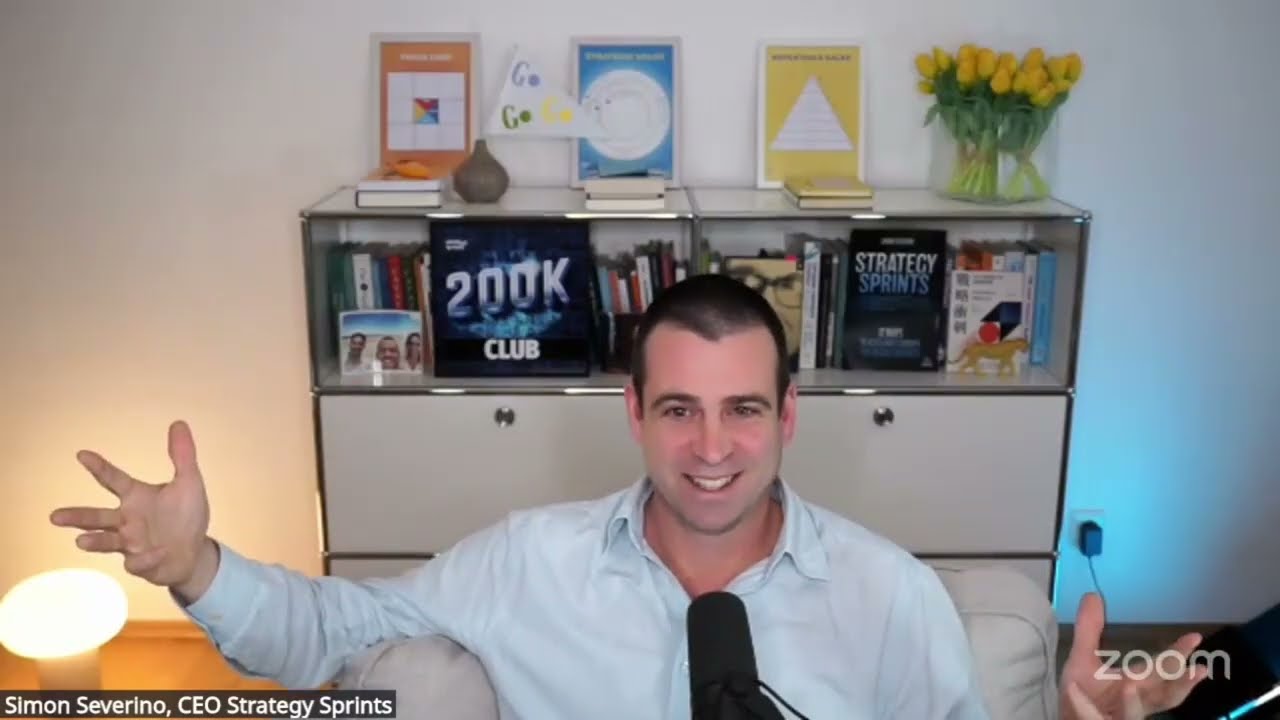
In this unscripted episode of "Remembering the Forgotten," host Markus Neukom talks with sales‑acceleration expert Simon Severino about building lasting business systems through personal coherence, daily cadence, and deep‑rooted values. The dialogue moves from Simon’s practice of Shambhavi Mahamudra with Sadhguru and how that meditation deepened his sense of service, love, and embodiment, to the practical mechanics of his Sprint coaching program that has touched over 1,600 entrepreneurs. They explore why sales is the "oxygen" of any firm, the importance of committing to sales internally before scheduling prospecting time, and how a clear why fuels bounce‑back resilience, illustrated with tennis legends Djokovic and Federer. Throughout, they stress the need for internal activation—identifying limiting thoughts, visualizing commitments, and aligning body‑mind‑emotion—to create sustainable, low‑noise systems that prevent burnout and allow entrepreneurs to move from a mid‑life crisis of ego‑driven performance to a purpose‑driven flow.
Chapters
Welcome to Remembering the Forgotten, a space where leaders think out loud without polish or performance. No scripts, no performance, just 2 people thinking out loud. These conversations are not about delivering insight. They are about thinking together in real time. Exploring what emerges when 2 open minds stretch each other. The intention is simple: to create a space where clarity can emerge and where listeners don't just consume perspectives but feel permission to engage their own thinking more honestly. There's a moment in building a business when effort stops being the problem. Structure is. Today I'm joined by Simon Severino. Simon is known for sales acceleration, for building systems that increase win rates and move stalled pipelines forward. From the outside, it looks like precision, but this conversation isn't about tactics. It's about what it takes to build systems that actually hold. We explore the discipline behind simplicity, the patience required to repair what most people keep patching, and the long-term thinking that allows a business to run without consuming the person who built it. This exchange is not about persuasion, not about scripts, not about pushing harder. It's about structure, about choosing clarity over noise, compounding over chasing, because underneath every system that works is a moment when someone decides to stop reacting and start designing. And with that, Simon, welcome to the show.
Markus, thank you for having me. Great to be here.
Pleasure is all mine. So before we begin, when I speak of coherence, I'm pointing to a state where nothing inside is in conflict. Body, thoughts, emotions, and action aligned, moving as one. No push, no urgency, no fear driving the moment. And when I speak of stillness, I don't mean silence. I mean the part of you untouched by expectation or performance, the place that knows before the mind tries to manage it. And that's the ground I'd like us to meet on today. So, Simon, where can you just be yourself? Untouched by expectation or performance?
That's a great question. And I think in every moment, it's a recalibration, right? Well, where am I? What is pulling me? And where do I say yes to and where do I say no to? Which Which impulse do I give full freedom? I think it's about saying no and about saying yes. Yesterday I was talking to Claude. I said, Claude, interview me until you find my top 3 values. My top 3 values.
An interesting question.
Because I, I want clarity in every single moment. It's not that, you know, I'm 45. I, I have some clue about what my values are, but I don't think that you, you know them and that's it. I think it's a recalibration, is a constant recalibration. When I meet somebody, I meet people and, you know, you know me since 10 years and I I meet people every week. There is a specific cadence in my work, in my being, I would say. I'm a weekly person.
Yeah, you're very structured.
I stopped saying yes to projects where people said, no, weekly is too intense for me. You know, many corporations said, Simon, let's do a bimonthly strategy meeting.
I
said, I don't do bimonthly strategy meetings. Oh, let's do it monthly. I said, I don't do monthly strategy meetings. Why, Simon? But that's our cadence. I understand. But if you can, if you don't want to commit to, to a true intensity of being, I'm not the right person. I think it's wonderful that you have monthly meetings. It's just not how I live. And so I stopped saying yes to things where people said, no, weekly is too often. Because, okay, different intensities, fine. They will find a better coach for them.
Interesting. So since I know you for quite some time, I recall the time when you went more into meditation, when you went into Shambhavi Mahamudra with Sadhguru. Would you say that in regards to values and it becoming such a cornerstone in your life, was that something that was determining that? Or would you say values was something that was always something you have followed and basically put almost everything underneath?
It's interesting because the values that Sadhguru embodied and made present for us during those months of learning and practicing, they were actually very far geographically— India, and I'm Italian— but they were very near. It's basically Jesus. It's the yoga version of Jesus. And this Adiyogi, he looks like a blue Jesus even. And the core message was love. Be a mother to the world. I mean, love everything and everybody. Every sentient being is you. That's the Jesus message, right? Love above else. So on one hand, geographically, Totally different. But the core message, the core Italian Catholic message that I, that I grew up with. And so from the values perspective, it wasn't that different. But he gave me a deeper, a deeper understanding of how to, how to coach people. So I got so much clarity. His mandala. He told us this practice and then he said, now you do this 40 days long every day. He wasn't saying maybe you do it 3 times a week. Every day.
Every single day.
Every single day.
And remember when you stopped, you had to begin with the 40 days.
From the beginning. And he had this visualization, looked like an amphitheater.
Yeah.
And you would see your progress. And it was on an app.
Mm-hmm.
That stayed with me because it was hard to do it. I did fall back, and the app reminded me, hey, Simon, did you do it? And it would visualize. And so that helped me a lot. And now in front of me, there is a similar mandala, and this is from our coaching. And so this inspired me a lot and stayed with me. the idea of not just a weekly cadence. So I meet you every week. I do not expect that I see the same Markus. I do not expect that you are the same. I ask you who you are being right now.
Mm-hmm.
That's the weekly cadence. But on a daily cadence, I became much more aware of my commitments with myself. Hey, I committed when I was in the program to do this daily, and I'm not doing it daily. I'm very curious what is going on here. There is a gap.
So what would you say before you went into Shambhavi? You started out saying that back in Italy, you had your beliefs, you had your faith, and I assume that personally you kept that quite close to you because, you know, how you got grown into it is almost like an indoctrination. It becomes your second nature. How much did it actually impact positively your business life? Or was it only when you met Sadhguru, got reminded of what you might have forgotten a little bit? That you actually implemented it into your business as well? I'm really curious.
I didn't think about it yet from that perspective. He brought some spaciousness into how I coach. And I always watched him as a CEO of his organization. As a role model.
And you've been a donor for quite some time before, right?
Also, yes. And I was like, okay, how does he do that? He has so many people. He has hundreds of trainers, teachers. They're all voluntary. And he talks about that. He said voluntary employees are the worst. They do what they want.
Yeah.
Whenever they want.
And they stop when they don't want it anymore. They stop.
Yes. And so he had a difficult leadership situation, very complex over geographies. And then he was on the road every day because he is the spokesperson. You never see a second person speaking for Isha organization. It's always him.
You're absolutely right. Yeah, that's so fascinating.
There was— we were saving soil and then the next thing. So there was always a campaign. And then, and then he was on the road and he was giving multiple interviews every day. And I never saw him tired. There was one day, special day, because that's the day where he invites us to to spend all night awake chanting and then being together, being present. And that night he was very, very sick. He was sick for 2 weeks already, and we didn't know. He didn't tell anybody, but his team was nervous. They wanted to bring him to the hospital. And he— there was one leg wasn't responding anymore. He was on stage. One leg wasn't responding to his brain anymore, and he still was content and present and in service. So he was there for everybody in the first line. And so this service, which is one of my 3 values, also according to Claude, service, beauty, and truth. This service resonated with me so much. I also want to be in service and am being in service, but sometimes I'm just tired. I need to be alone to recharge. I cannot do a full night with so many people. I would need a break. So I was like, how does he need no breaks? I think he's in full coherence. Mm-hmm. He gets energy from being in service.
Mm-hmm.
And it's full circle. There is no— there is no doing. He's in being.
So let's stay here for a moment. This is such a fascinating pivot we're taking right now. Would you say Sadhguru is an Übermensch, or is he A person who has detected something, has become diligent and literally stuck with it and made it his.
I think he's everybody in flow, right? In coherence. When you are saying yes to the things that are on your values, On your purpose. And when you're saying no to the rest, you're kind of unstoppable.
Mm-hmm. Let's stay here for a moment. Why are so few people on that path? Because let's be honest, it's what produces noise. It's what creates jealousy. It's what creates wars. It's a lack of coherence. Why are we so intelligent people not capable of going into that coherence? That's craziness if you think about that.
Well, children are in that coherence. So we start out, we are in that coherence. We are in flow. My kids are in flow all the time. They sing and sing and sing and dance and play. Then we spend time in systems that are designed to train that out of people.
Mm-hmm.
And then most of us lose it. And then there is the second stage in life. Carl Jung says it's around 40 to 45 years old when now you have built up your, your your status and your ego. And now the game changes. Second part is shifting gears and finding the bigger why.
That's what I call the, is this it or is there more to life? That's that phase.
And that's complicated. That can take A while. So it's complicated, I would say. We start out pretty clearly, but then there is a whole educational machinery and industry poised to interrupt that because then it's about memorizing things and learning to sit still.
Mm-hmm.
And then with around, yeah, 45, it's really about that shift. And I think I'm describing the male journey here. It's really about shifting, because I'm talking about me, I'm talking about Sadhguru right now, and shifting into that, in the end, the highest good, right? What am I here to do for the highest good of everybody?
Would you say that almost everyone gets to that point sooner or later, whether they acknowledge it or respect it, that they actually do get to the point where it says, Markus, is this it or is there more to life? And we just become masters in ignoring that voice? Yeah.
There is a lot of avoidance. And for example, my avoidance was pushing even harder the status and the ego. So I was one of these Lycra guys, 40-year-old triathletes, right? So we try to be, you know, fit like a 20-year-old.
I remember that.
Yeah. So that's— and everybody has their style of avoiding it, right? So you can try, you can push. We laugh about it, it's the midlife crisis, right? There's the other guy who goes in Porsche style, etc. So you can go multiple styles, career, corporate career style. Mm-hmm. And probably, yeah, I'm I hope that everybody finds something that is bigger than themselves, because then it's easier, right? And in the end, it's God and, and the divine in, in us, in everybody. And in— and that's my, my reason why I'm a coach, because when I see somebody, I see the potential, right? Not just what's in front of me. But actually that light inside of them. And I see it in full fledge. And then I get curious and I want to play with it and say, come on, let's—
So would you basically say that, you know, like we know each other for 10 years and there was a development, let's say. At some times I felt it's more about helping clients to generate more revenue because that's what they wanted. And somehow it's shifted into, you know what, I'm actually seeing the actual potential of that person. And now it sounds like the money part is almost a consequence of the actual work you're doing. Like, it's the easiest part for you to help someone to generate money, right?
It's both.
But the other shift is almost required that money becomes so easy to generate.
Yeah.
Because that's an interesting aspect.
In theology, there is this discussion about the body, right? In Catholicism, there is a whole discussion about the body. Is the body even important? One of our popes wrote a whole book about the theology of the body.
Interesting.
That book is fascinating. And you realize, and that's a big difference, by the way, to the Asian religions. For them, the body is nothing. I'm not the body. I'm not the mind. In Catholicism, it's different. The body is pretty important because God cannot— you cannot see God without the body. That's why there is embodiment. So why am I getting there? I forgot what the initial question was. Just go ahead. But it's the same with sales. So is money important? Not really. It's one resource like knowledge, like relationships, like space, time, It's all resources are important, but they're just resources. At the same time, it's the oxygen of a firm. You can live without an HR department, but you cannot live without a sales pipeline or somebody selling. Impossible. If you're a one-person company, half of the day you have to do distribution and the other half you do product. If you're 2 people, one does distribution, one does product. So it's such an essential part of being a corporation, being a team, being a firm that, or being in the market.
So how many clients would you believe you guided through the sprints in the meantime?
We had an estimation at some point. We wanted to put it on the website and we went and estimated in all spreadsheets and CRMs that it was 1,600 people that we touched.
Which is quite a few hours spent with those people.
Yes.
So you are an expert to answer my next question. When one of those Sprint clients failed. What would you say it mostly came down to? Can you maybe pinpoint it to 3 reasons?
There was an Australian guy who was unhappy, and I sat down 90 minutes with him and with his sprint coach to find out what went wrong. It was the only 3-star review that we ever got on Google.
That's painful.
And meanwhile, it's disappeared, but it was painful for me to see that, right?
I know you.
Yes, very painful. And we had also a hard discussion internally, right? The sprint coach and me, who was his supervisor, What are we— what— where did we cut corners? Where did we miss— misalign, right, with this client? And there were multiple things. One is how I set up the certification process. It wasn't enough time on each coach to really ensure that they— that they are excellent at their craft. So there was one part on me, the certification needed more attention, like the process of certifying people. Also, I saw that much later how much time Sadhguru and others spend on these programs. And so that was one element. I did not spend that much time with the coaches. The second Element is always communication misalignment in the end between coach and client. And every year we are getting better at this. For example, one thing is commitment. You would think between a business coach and a client, you don't need so much commitment, right? Let's just improve the sales process. You could think so, right? And that was maybe an assumption and the reason why we failed that client. Now I take this much more seriously. I think this Monday, I think I, I opened the 200K Club with the question, and I think you were there, and I asked—
I was missing last time.
From 1 to 10, from 1 to 10, guys, how committed are you to being the sales engine of your company?
That's a deep question. Yeah.
Deep question. And I realize we do this commitment implicitly when we start a company.
Yeah,
sure, I will be responsible for sales. But we don't really write it down. We don't really put it in our calendar. Tomorrow morning, 2 hours of prospecting. So there is this gap in commitment to ourselves when we start a business. And you can see it in people. If you know friends who are on their own, ask them, how committed are you? What's tomorrow in your calendar? How many hours prospecting have you blocked in your calendar? You will see that gap.
Mm-hmm.
Let me ask you something here for a moment. I'm
curious about one aspect. It is one thing to be committed in your calendar, right? What if there is actually a factor that is even before becoming committed and put it into your calendar? And for people who don't know you, You are originally a psychologist, so you know very well what I'm talking about. What if that commitment actually has to be embodied first? Because when you ask, why do you believe that you should be the sales engine for your company? That's when you start shocking people, by the way, because that's what I do on a daily basis with my clients in my field. That I actually make them understand, why do you actually want that change? And in your case, why do you want to be, or why do you believe you should become the sales engine? Because otherwise it almost becomes an extrinsic motivator versus— because that would actually be interesting if we could give it a try in the 200K Club. Because you literally hear why do people think that they actually should become the sales driver in their company. And then it becomes intrinsic. Because, you know, let's be honest, today so much is driven extrinsically. You have a coach. The coach is responsible for my results at the end. If I fail, oh, we lost the coach. It was the curriculum. And as you know, I literally call myself a reformed executive coach and a reformed business consultant exactly because, because I realized if I teach someone a process, it's like having a bucket with 10 holes. I can patch up 3 to 4 holes, very much knowing that 6 or 7 will still leak. seep through every single day. That's what you, you know, recognized as well. And it's frustrating. So I said, at first, I need to work with the person behind that. So if they are in that right mindset, they have the right attitude, the right understanding, because the buck stops with me. Yeah, everyone knows that. But why? And why am I committed to actually doing what we talk about? Because otherwise you become the slave driver.
There is this saying, we didn't start it because it's easy. We started it because we thought it's easy.
Exactly. And I believe, especially with sales, like, like if you look at the people you know, how many people would you say are inclined to be native salespeople? Not many, right?
There is a few top talent in the world and they're a special, special breed. But everybody who starts a business for multiple reasons, one is it doesn't feel right to be an employee. The other one is I lost my job. The other one is I want to travel more. The other one is I want to be around my kids and my corporation kind of splits children and meetings and so it doesn't feel right, right? Because I'm a family person. So multiple reasons why, but then we start our own thing and on the way there we go, oh, wait a moment.
It's about sales.
There is a— I am the hunter here. Did I ever Did I ever sign up for this?
In corporate, people were the gatherer and the gardener, right? And now they suddenly have to freaking hunt for food.
Is it in my job description? Who wrote my job description? Oh, I write my job description?
That's exactly it. So I'd be curious if we actually just spend like 10 minutes on the next call with the friends to ask, what is sales for you? And how do you feel about sales? Because then when people understand, gosh, it's actually the engine for what I'm doing, because everything else is wishful thinking.
Yes. And that's back to the Pope Ratzinger who said the Theology of the Body. The body is the paradise and the body is needed for God to be on earth. That's where heaven and earth come together. That's the body. So, and that's why you have, you have to, to maintain it. It's important. And, and it's for a reason that Adam and Eve are shaped in form of their body. And it's a specific body, not any body. It's not the barba papas. It's a very specific physiology. So it is important. And sales is oxygen. And at some point we realize it. Hopefully earlier. That's my job, my mission to help people realize it early before it hurts. Because then you can still learn it. That's what I teach. And then you can learn prospecting, you can learn pipeline management. And then if you do it too late, oh, it can be far too late. It hurts a lot.
And it's expensive. Yeah.
Yeah, same with the body, right? You have to maintain it. You have to learn how to train, how to eat, how to sleep. You don't do it, you will have a problem.
Because, you know, it's interesting when, when I recall the shrink process, it's almost implied that somebody understands the relevance of sales and all I need to do is I have to teach it. But I feel there is a step before. Let's go back to Shambhavi Mahamudra for a moment. Do you recall that Sadhguru often mentioned there are 2 different kinds of people who go through Shambhavi? They are the ones who come here because they want to learn a technique and believe that going through Shambhavi will change them. Those are the ones who are the loudest. Those are the ones who cry all the time and, you know, have like— movements you cannot even imagine. And I remember on that weekend where Sadhguru showed up in person, he got so angry at that group because he said, the ones who are the loudest now are the ones who will drop off the soonest, the earliest. And then he said, then they are the ones who understand why they go through Shambhavi. And I believe it's the same with sales. Once I understood, it's not wishful thinking whether I learn sales or not. If I want what I want, I have to commit myself to sales as the oxygen for that engine to drive. And I believe many people don't get it even when they work with you. They believe they implement what you teach them, but they don't really get why they should become the ambassador, the sales ambassador for their company. So think about if one understands that, that they are actually the sales ambassador of their company, and that ambassadorship literally is almost a guarantee for success. They would say, Simon, do you have more material for me to implement? Because now I begin to understand how that entire machine works together. That was so fascinating for me when I went through the sprint, because I began to see the entire system coming together. And I assume many people pick this one, then they do this one, then they do this one. But they never really get to see the entire picture. And I believe it has to start somehow with the internal activation first. And I know you're big into internal activation. That's why I wanted to talk about that. It's fascinating.
Yes, we're integrating more and more of talking about our commitments, talking about daily adherence to our commitments, visualizing when we are on our commitments and when we fall off our commitments. So we're integrating it more and more because you're right. Otherwise, it's technique, right? And technique, you can swap technique. Technique doesn't matter. And like software right now, software doesn't matter. You can— you use software this week, next week is a different software. But the process will be the same. The process of getting attention, starting a conversation, nurturing that relationship, committing to work together, activating their success, their results, and then expanding from there. This process will always be the same. The technique, the software, the tools in there will change.
Do you see what's interesting? For me, it almost feels like If we just go for the technique and for the process, it's like pushing a boulder uphill. That's how it feels. And let me just make an input. While I was teaching for 20+ years, I developed one thing. And as you remember, I was basically an executive coach helping people who got fired to get back into the job market. And I had like 10 colleagues who taught the curriculum, which was nice. It was absolutely okay. And I put the curriculum away and I said to myself, how can I get someone who just lost their job to activate the right motivation, which is drive, movere, right? In order to get to where they want to go. And then I did something crazy. I had a big flip chart, turned it around, and I said to my entire class of 14 people, draw a mountain and start where you start and show me the journey up to the peak. As you can imagine, everyone started at the foot of the mountain. I did the same thing, but the flip chart was to the other side. They couldn't see it. Guess what? I started at the peak. So I showed them how it will look like when they get that job. So think about if somebody wants to learn how to do sales, if they understand how important sales is for their actual goal, they don't want to become good at sales, right? That's not their end goal. Their end goal is to be successful as an entrepreneur. And why that is, is probably even 3, 4 steps deeper. For some is, I want to be abundant for my family. Like in your case, for example, I want to have enough kids to have the college journey. Okay, the good thing is in Austria, you don't have to pay for college. But here in the US, it is.
You never know where they end up. Yeah.
Oh yeah, you never know. Absolutely. So basically, you want to make sure that your little girl has almost like a carefree life and that she can do what she wants to do because she can afford it. And I believe if somebody understands what really drives me— so I said to those people, look, Imagine you just received the phone call. You got the job. And now you tell it to your wife. What happened the step before? What happened the step before? And I brought them into the 3rd interview. Now you see yourself at the interview. Then you go to the 2nd interview. And I did not have to teach them. And now we get to the point. Remember Saint-Exupéry? Do not teach someone where to get the wood and the instruments and the tools and the nails and the kind of stuff, but instill the longing for the far white sea. And this is what I did when I taught sales. I made sure that people understood what is possible through sales. It's not the sales process one wants to learn. It's an end. It's a means to an end. But that's why I'm curious if you, if you would do it one of our next calls to see why do we actually want to be better at sales? I don't think anyone wants to be a sales—
Stop oxygen.
Yes, yes. But I believe people have to kind of feel it. You know, you were a union, right? Originally.
I am?
A Jungian, right? Carl Jung trained.
Yes, yes, yes.
Okay. So if you think about how much emphasis he put on what drives us, what's going on inside, why would we take this almost out of our businesses when it's so logic? It's almost when you said your kids, They are still in that coherence. They are living in that stillness, in the stillness where mind and heart are in coherence, so the original self actually can live itself out. And I believe we kind of have to get back to the roots. It's beautiful as you said it. Um, and by the way, at what age would you say does that adaption process of I don't trust myself anymore, I start adapting stuff from society kick in in the development? What would you say? What age?
Oh, it happens 10 times a day to every person at every age. Um, it happens to me today.
Happens and happens early in childhood, huh?
Today I will have thoughts that are limiting. I was like, no, I'm too tired to do— to send this email now. And I will say that to myself.
Mm-hmm.
I will look at what do I need to do next? How will I show up there? No, don't prepare so much. Come on, improvise it. I will have multiple thoughts that are weakening and that are limiting. They come from somewhere, from a movie that I watched on Netflix, from friends that I had 10 years ago where I internalized something, from a book that I read, from people that I think I have to impress subconsciously and I want to impress them. And then that's why I behave that way. So I will have hundreds of these thoughts today, today, that are actually not serving me, that are against me. And that's also an exercise that we have been taking more seriously, writing down those thoughts and writing down how we speak to ourselves and changing that. For example, a few weeks ago, I wanted to I was almost done with the second book, Time Freedom, and I was in this phase where I ask for endorsements, book endorsements. And I wanted to ask Chris Voss for a book endorsement. We are in a mastermind together. We know each other from being on stage, but not really know each other, you know, but we know who we are. And I was like, I can't call him. I have his number, but I can't call him. Something prevents me from calling him. And I even know that he says, I have respect of people who called me.
I'm sure he would love to hear from you and would give you the endorsement.
I couldn't call him. And so I go back to— to this vision document, uh, and I add that one sentence which says, I powerfully ask for what I want. And I read that aloud a few times during that day in the morning, and in the afternoon I called him.
Mm-hmm.
And so this is one exercise that you will see more in the 200K Club when we find a non-useful thought, we actually go back and write the opposite in there because these thoughts create reality. We create our reality with our thoughts. And so if I say, you know, I'm tired, I will be tired. And from— so the next part of my life where I learn a lot from is the sports life, right? I have usually coaches. I had Triathlon coaches and doctors, and people doing my training plan. And right now I'm in the rowing team, so I have rowing coaches and colleagues, and we coach each other a little bit. We're a little bit too old to have coaches, but we coach each other, right? And what I learned from there is that you continuously have to work on your thoughts. Mm-hmm. So you train and you're tired. You think you're actually tired. Your body is now tired. But you will be surprised. There is 30% probably still in the body. If you change that thought, no, I can do another kilometer. I can breathe this out, this tension. You will be surprised how much more there is in the body actually right now. This is physics. You would say, no, there is a limited capacity of the body. Yeah, but where is the limiting factor? It's, it's in the, in, in the mind.
And now let's add something to it. When you're tired and you say, I want to move on, I want to go further, ask yourself why, what for. And you will see this is almost like a 30% additional boost which actually pushes you forward Instead of having to push the boulder uphill.
Yeah.
And that's what it is. Think about rowing. Rowing is quite a strenuous thing. I did rowing for a while on the Lake of Zurich. You really have to know why you go onto that lake. It's not just for fun because as soon as it rains, you go off. No, you want something to accomplish. And once you're aware of what for I'm actually doing it, it pushes you almost immediately. So the why is almost more important for me than the reversal of my belief system, because when my why is strong, the belief system almost corrects itself. You see, like when I go, let's say, into the gym, And I feel tired. I don't say, actually, I'm tired, but I continue. No, no. My question is, why should I continue? And that is my why, the what for. That's what energy almost comes automatically. And that's the fascinating aspect of our birth.
Yes. And there is—
And that's what differentiates us. Yes. And that's what differentiates us in the end. So I want to be mindful of your time, Simon, but go ahead.
Being interviewed recently, he crushed it against Sinner, and he's so much older, uh, but he crushed it. And Sinner said, well, he is the GOAT, that's it. And then they interviewed him, uh, why are you this kind of GOAT? What makes you the GOAT? And he says, well, being older I've learned about my mind a little bit, so I catch myself being negative quickly, quickly, and I don't stay there. I don't stay there. I make a mistake. I don't dwell in that mistake and being sad and being victim of my mistake. You know, I quickly snap myself out of it with the body, with whatever I have techniques from my coach. I have techniques. I snap myself immediately out of that. And I snap myself back into the moment. That's that was his answer to why he won, and I think it's a big part of it because they're all fit. They all have you know training regimen that's very very solid, and they have volume in training. That's that's clear. But in on that level, the one percent difference is really your mindset. How quickly can you snap back to presence? When things go wrong. And in entrepreneurship, it goes wrong all the time. In sales, it goes wrong intensely.
Yeah. And it has to. That's what people don't get. The number 1 out of 10 is not there for nothing. That's logic. That is literally logic. So you have to go on 10 calls, 9 have to be a failure in order to land 1 client. That's math and physics. Right.
Yes. Yes.
Simon, this brings me to my last question. I want to be mindful of your time. We are in quite challenging times right now. If someone feels overwhelmed right now, What would you want them to return to?
Think of Djokovic, how fast he snaps back. And there was another tennis guy, Roger Federer, from your country, actually.
Yeah, yeah.
And Roger, he was asked a similar thing. He's like, how do you do it? Like, why are you so good? And he said, it's the bounce-back rate. And they were like, what is the bounce-back rate? He says, most of my activities, they go wrong. So I shoot the ball there, it goes wrong. And he said a percentage. He was so precise. I can't remember the percentage, but it was something 50%, 60% of the time he shoots somewhere else than he intends to shoot. So basically, he said, most of the time I have to deal with frustration. So now we think now that the time is intense. Well, if I ask my grandparents, they will tell me my time was more intense. And so time has always been intense and in sales, always intense, always. So what do we got? We got frustration as the general Buddha would say suffering, right? Jesus would say suffering. But Let's go with Roger Federer. We have frustration and a bounce-back rate. What we can take away from this is you have a bounce-back rate, and that can be 20 seconds, 20 minutes, or it can be 2 seconds. Go for 2 seconds.
Interesting. And I'm pretty sure if you talk to Djokovic and to Federer, they would tell you absolutely clearly why they do what they do. And that makes that bounce rate so small because the failure is nothing compared to what they gain. But especially as business people, we don't even know what we gain. We are so in that hamster wheel every single day. And I think talking more about why we do what we do. what we want to get out of it. I believe that will change the entire game. So I look forward, brother, to seeing you on the Monday call. And with that, thank you so much for having been my guest today.
Thank you, everyone. And thank you, Markus, for showing up for your community day in and day out.
You're welcome. This was Remembering the Forgotten. As you move on from here, notice what may have been quietly remembered. Perhaps something set aside while trying to survive, perform, achieve, protect, or optimize. If something shifted for you, let it stay. A few quiet pointers are waiting below.
More from Markus







Ep 66 Breath, Trauma, and the Fear of Being Fully Seen A Conversation with Matt Ritchey

Ep 65 Truth, Trust, and the Courage to Be Seen A Conversation with Troy Gregory

