#1 Method To Optimizing and Lowering Your Costs On Facebook Ads (and other ad platforms)
Nicolas Korvessis breaks down the four metrics that matter most in Facebook Ads Manager: link clicks, CTR, CPM, and unique outbound CTR. He shows how to spot whether your problem is audience, creative, or placement, then walks through a live campaign to demonstrate the optimization loop: diagnose, test, adjust, measure again.
Chapters
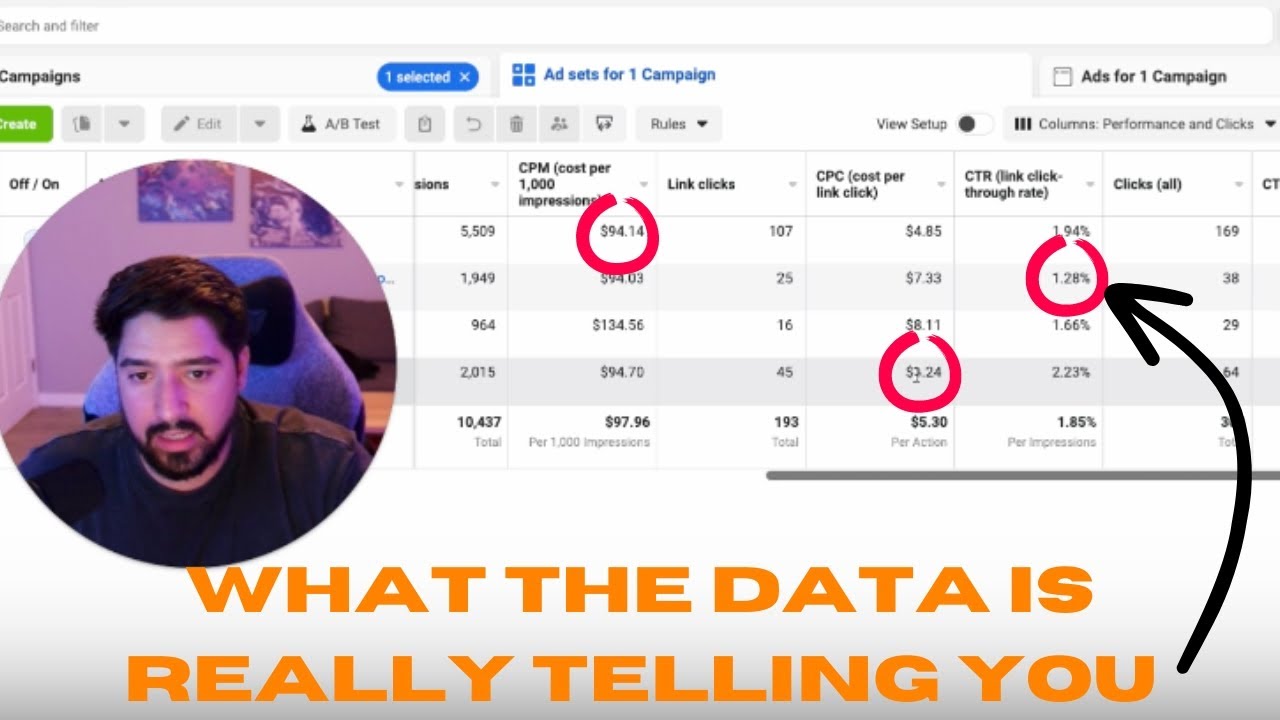
Hey everyone, how's it going? And in today's episode, we're gonna be talking about data and why you should be ensuring that every decision that you make in your business, especially in paid ads, is done based off of the data. I think this is kind of a case of this is common knowledge, but not common practice. And this actually came about because I was having a conversation with some of my team. In the past couple of the weeks. And they've obviously worked with different marketing companies and different companies across the board. And they've obviously been taught different things and have discovered different things by themselves, what works best for them. And the one interesting thing is we've really been making it a big focus to only— and make every decision that we make based off of data, right? Especially inside of ads and Ads Manager specifically. And what I realized is that a lot of them outside, before they started working with me and worked with my company ScaleLab, is that they didn't really look at the data too much, or there wasn't a way of, hey, look at these numbers, here's what the numbers mean. We now need to act on the numbers to make this result happen and kind of rinse and repeat. And I think that's something that's really important that I want to talk about in this quick kind of episode here today is just making sure that you always go after the data first to then influence what decision and what action you take. And I wanna show you some of the top data that I love to look at inside of the ads manager when I'm making decisions. And this is something that's really allowed me to scale campaigns up to spend a couple thousand dollars a day just on one campaign and remain to be profitable. It's allowed me to make campaigns where we can book tons of calls at a really good cost and they're great quality. And it all comes back to the data. It's like if there's a problem, look at the data and that can influence And just as a quick precursor as well, because creativity is extremely important in marketing and advertising as well. And it's almost just as important as the data, but you can use the data to determine what actions or what needs to be fixed or improved. And you can use your creativity to then improve that data and get that to the next level. So that's what kind of this illustration is showing right here. If you guys are watching this on a video or if you're listening to it on the podcast, it's just making sure that all of your data is feeding in. To every single level of your business, regardless of what you're doing. And on top of that, everything should be an iteration of each other, right? Between that data and that creativity is going to create a machine and a business that's going to allow you to really scale to new heights, right? If we're talking about ads specifically, Facebook ads, YouTube, TikTok, whatever that is, same thing. You're going to use that data to let to determine what creative steps you need to take in order to scale your business. So let's look at this real quick. This will be in the show notes section if you're listening to this, if you're watching it, it'll be in the description as well. I've got for you a full cheat sheet here on different KPIs that are important to look at inside of Ads Manager specifically. There's some stuff in here in terms of the funnel side of things, and I can do a separate video on that. But I wanted to have this one really focus on the ad side of everything and kind of give a good idea of what every KPI means and what you should do based off of it. So I really wanna start with these right here. And if we look at the link click, so link clicks, click-through rate, CPMs, and unique outbound click-through rate, I think these 4 metrics right here are so useful and so undervalued, especially when it comes to the creative part afterward. And these can really drive a lot of the decisions that you make. So let's start with link clicks first. Link clicks are just the number of times that someone clicked the button or the link on your ad to go to your landing page or go somewhere outside of the platform where you're advertising. And the purpose of this thing is to give you a better picture of how well is your overall ad doing. Usually I'd also relate it to more copy than anything else. It, it could also be the creative, Like I said, this is an overall picture. I, I think it depends. And you can use the context clues from the other pieces of data to tell you if it's copy creative driven or audience driven. But usually this is just overall effectiveness, right? If you can get a, a link click, and I'm not talking about a click, this is a link click. This is, they clicked specifically to go to your landing page. It's completely different to just a general click. If you can get this at $4 or less per link click, And this is a general average across lots of different industries that I've worked with after working with over like 250 companies. This ends up being a pretty good average, like around $4. If you can get it lower than that, I've seen it at a dollar, I've seen it less than a buck. And it also definitely depends on the objective, right? And you in Google Ads and Facebook Ads, they always give you an option for an objective, right? You can choose lead generation or conversions or traffic or engagement. That's gonna fluctuate these numbers. These numbers right here, I'm really talking about like a conversion-specific objective, right? So this isn't really gonna apply to if you're just trying to get a ton of likes, if you're just trying to get a ton of clicks to your profile, this is really gonna apply to if you are going to get something very tangible like a lead, a sale, a booked call, um, an application being completed, um, someone subscribing to your list, something like that. This, that's what this applies to. So link click, that's what you wanna get it at. That gives you an overall picture of how well everything is doing. The next one is click-through rate, and in most ad platforms it'll be labeled as just CTR. And this is CTR all. This is the percentage of times that someone saw your ad and then performed a general click. Now this is gonna tell you, and I've seen this really attributed to how well your ad creative is doing. At actually stopping the scroll and then getting someone to perform some kind of an action on the page. And we've seen that if you can get this at 2% or higher, that's good, that's solid. Next one is CPM, your cost per 1,000 impressions. And this tells you really how good is the audience that you're targeting? How are you in the right niche? Are you in the right target market on that platform? Now this can be niche specific, right? I say $30 or less is a pretty good baseline. However, if you're in a really competitive world, very competitive industry, and if you're trying to run video ads only, I've seen that the CPM on a video ad can be a lot higher than the CPM on an image ad. And that could be related once again to other metrics that could then, you know, a video ad may have a higher or a lower link click-through rate, um, or sorry, it'll have a higher cost per link click. Just because it's a video, you gotta have people watch it longer. It may have a lower click-through rate, which then can influence the CPM. But usually I'd say that CPMs has to do with audiences. It can be industry specific. If you're in a really big blue ocean, you may have no problems. I've seen them even on conversion campaigns get as low as $10 or even less. So those can work very well. The last metric I wanna talk about is unique outbound click-through rate. This is usually a custom metric that you have to set up, but unique outbound click-through rate is a really, really powerful metric. And it allows you to see how your copy and your audience are actually working together. And this tells you how well the ad is resonating with your audience. Once again, with this one, the objective here is if you can get the, this unique outbound click-through rate to be as close to the click-through rate all is the better. It's never going to exceed it, uh, just with the math and it's just never, never gonna exceed it. So if you have a click-through rate of 2%, you wanna try to get your unique outbound click-through rate to as close to 2% as possible. 'Cause let's say you see something where your click-through rate is like 6, but then your unique outbound click-through rate is like a 2. Well, you're not even getting half the people to click off. Essentially you're getting half that. You're, you know, you're doing good at stopping people, but something isn't getting those people to click off. Something's not resonating with them. And I'd say that's either audience or copy kind of working together. It could be the creative. It depends what's in your creative. If it's like a lot of video or if it's a very detailed creative showing a lot of stuff, it could be related to that. But if it's just more of a creative to catch attention and stop the scroll, it's gonna be more related to copy and audience. Okay, now let's talk about one of the most exciting things that I wanted to talk about in this video is, and Now that I did kind of the intro of all these in the crash course, and that's how all these relate together and how you can actually leverage this thing in your business. Here's what's so cool about it is you can have an ad campaign that you're actively running, and what can happen is you can see that it has a link click, a cost per link click of $10. Like, oh my gosh, that's like so high. You're like freaking out. Like, that's just crazy, right? Now, some knee-jerk reaction would be just turn it off or leave it. Maybe it needs to do something. My rule of thumb is if I ever turn something off, I wanna see what can I learn from this campaign and how can I improve that? And it's the same if the performance is on the other side, which is the example I wanna use here, is if the performance is really, really good, where is it lacking so I can even make it better, right? I think that's one of the biggest things. Being able to make those relations between things is really, really helpful. So let me find an example really quickly to show you guys how I like to do this all the time. Either one, if the stats are really, really poor, where are the bottlenecks where I can improve these things? Or if something is performing well, same thing, what's holding it back in these metrics? And what can I see from these metrics that I can take in creatively make something that can beat it. So let me find an example real quick and share that. All right. So these are some of my ads. And for people not watching, listening, I'm gonna read out kind of some of these numbers really quick. And some of them aren't that great, which is the example I'm using in this one. This is one specific ad set. So we've got a $94 CPM, we've got a $4.80 cost per link click. Yeah, we'll actually do this one, $94 CPM, $4.20 cost per link click, 2.2% click-through rate, or link click-through rate, and then a 3.18% CTR all. So overall, if I'm looking at this initially, my immediate reaction is that the CPM is really, really high. Now I'm targeting a pretty saturated market, or not saturated market, it's a pretty competitive market. It's just marketing and business, biz op generally. So the CPMs have been a little bit higher in this account. And to compensate that, we just need to do more audience testing. And that's the first knee-jerk reaction. However, what can these other stats tell me? Well, cost per link click, that's at $4.24. That's not that great, right? It's okay, but it's definitely not great. So something generally with the ad isn't working too well. Let's dive deeper and figure out what's going on here. So the link click-through rate is actually at a 2.2. So that's actually doing really well at getting people to click off the ad. Now what would be great is let's add in here the unique outbound click-through rate. So unique outbound click-through rate, we'll add that in and we'll see that our unique outbound click-through rate is at 2.7. Um, so if we relate that once again to the CTR all, cuz it'll never go past the CTR all. It'll never be greater than the CTR all. It's at 2.74. So the copy and the audience is actually gelling well together, even though it is expensive to get in front of this audience. Whatever I am saying in this ad is actually doing a very good job at getting people to click off. It could do a little bit better. Um, but it's very, very tight. If we think about some other ones, we've got another one where The click-through rate is at 3, but the unique outbound click-through rate is only at 1.8 versus this one. This click-through rate is at a 3.18 and the unique outbound click-through rate's 2.7, which is great. Like that's doing its job. So where the heck is the bottleneck on this one? Well, one, I wanna see if this is a dynamic ad because that'll kind of give me and Let's see. No, this one isn't dynamic. It's one single ad. Yes, it's been— Facebook pulled this into some auto-generated videos from an image. But check that out. Still across the board, this ad on average is doing pretty well. But whatever these auto-generated videos were, looks like it's not available, I think because the ad is off. But whatever the video was, that's interesting. Now there's one step further where we can take this to see where the heck the bottleneck is and how can I optimize this ad. I think the biggest optimization can be made in the audience. I could probably write the copy a little bit better, um, and do something a little bit differently to get the link click-through rate higher, the click-through rate higher, and the unique CTR higher. Uh, the cost per click as well seems a little bit expensive. Um, but those are kind of related cost per click. And cost per link click. So if I get one of them down, the other one will drop. So those are my biggest concerns right now on this one is CPMs and cost per link click. Now take a look at this. Let's go ahead and filter this down by delivery. And let's see what platform or platform and device— or sorry, what placement delivered us the cheapest CPM. And this will be super interesting cuz I bet you we'll have some in KPI. All right, look at this. Look at how crazy some of these are. And let's look at the ones with the clicks because I think that's more statistically significant. So for example, we had a Facebook Marketplace one where the CPM was $12, but it didn't get any clicks. So I don't really want to use that one as an example here. I'd rather use something that actually did get a click. And that spent a little bit of money out of the $190 we spent. So let's take a look here. We've got something here that spent $5, just about Facebook right column on desktop, and it had a $15 CPM. On top of that, it had 3 link clicks at $1.55. It had a little bit of a lower link click-through rate at almost 1%. The click-through rate was 1%. The unique outbound click-through rate here was actually higher surprisingly than that. So that's super interesting. So Facebook right column on desktop and Facebook video feeds on mobile. Oh, sorry. Yep. Nope. Just Facebook Marketplace on mobile that actually did get a click on desktop. Facebook Marketplace didn't. Facebook right column and so on and so forth. And you can even see some of these other ones with, the really, really good cost per link clicks, even though the CPMs were higher. So this gives me something really, really great to go and test with, right? By looking at the data, it tells me exactly what I need to do. I should take this ad, relaunch it and do right column desktop and Facebook Marketplace mobile app, Facebook Marketplace desktop only, like anything with these low CPMs, that's where I should gun for. And that's where I can see how to improve this thing. It's as easy as that. The other thing to do is instead of looking at just the, just the placement, we could just look at platform specific. So if we look at Facebook versus Instagram, we can see that Facebook gave me cheaper impressions across the board is pretty similar. But that's something else that can help. And this is a really important thing because I've once again, this came up with my team, they were like, wow, I never think about doing it that way. I've never taught about doing it that way. It's like, why? Why weren't we taught to look at it this way? I think looking at the data is the easiest thing because it shows you and lays out your exact next steps. Let's say, you know, let's say, let's do one more example really quickly. Let's say we did have one that had a really low CTR, like this one. It had a 1.85 CTR. Something in here did obviously something in here, whether it was the audience or, and these audiences look real specific, right? So that's what's interesting as well. But once again, if something is bad as well, we will take that and say, okay, is it the create, identify what is wrong with the ad, creative, copy, audience, then how can I take my creativity and make that better? So in the example that I also just shared, let's say we figured out that Facebook mobile feed was doing really, really poorly or really, really well. How can we optimize and create an ad literally designed for Facebook mobile feed and leverage that immensely? And that's how I really wanna challenge you to think when you're looking at ads or when you're looking at data in your business is to use the data to guide the creativity choices that you should be making next. So I hope you guys enjoyed this. Once again, if you want this cheat sheet, there's a lot more stuff on here. Check it out below. It'll be in the show notes, it'll be in the description. And this is a really great resource for you guys to use and make sure that you crush it on ads. I'll see you guys in the next one.










