Facebook Ads CPMs Too High? This AI Creative System Cut Mine 43% (Full Build)
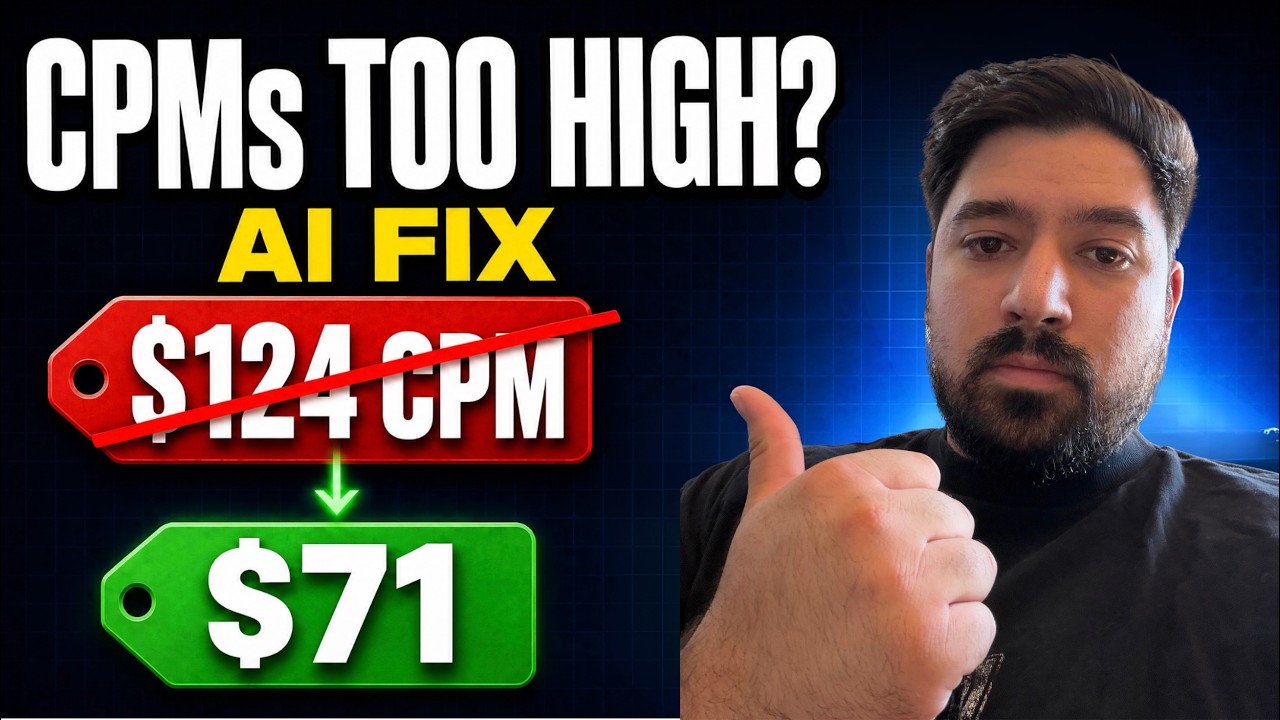
Nicolas Korvessis cut a Facebook ad account's CPM from $124 to $71 in a month by fixing creative fatigue and audience saturation. He uses AI tools like Claude and Groq to generate "minority hooks," ultra-specific pain points for narrow segments, then tests each ad in its own ad set before scaling winners in a CBO campaign.
Chapters
If you are struggling with high CPMs inside of your paid ads, I wanna show you how we took an account from $124 CPMs down to $71 CPMs in just about a month using a few very simple tactical things that you can implement today inside of your ad account. Now, this was a really, really big shift, but really simple change that we made inside the account that I think a lot of people are missing. So like I said, we went from $124 CPMs down to $71. We actually ended up spending more money as well. That month when we were doing around 124 CPMs. And then we actually bumped up spend to $16,000, lower CPM, lowered our cost per acquisition, boosted our profit, and we saw really, really great results. So let me just show you exactly what we did so you can implement the same thing inside of your ad account as well. So 2 things that happen here, CPMs don't just spike randomly. Usually at launch, sometimes you're gonna see that your ads will just naturally have a higher CPM. And sometimes that could do with just you not having enough data, the kind of offer that you're promoting, the domain or the URL, or what your landing page is saying. But if all that stuff is kind of good to go, there's usually 2 big elements that you should look at. One being creative fatigue, and 2 being audience saturation. Sometimes, for whatever reason, Facebook will actually keep delivering your ads to the same group of people, And your frequency will be really high from the get-go, which causes your CPMs to go up. Make sure you have really clean audience exclusions in place, 'cause I've seen people with totally different ad accounts, and each ad account reacts truly totally differently. So for some people, you may not deal with audience saturation as much. For other people, you may. Just make sure you have those things set up in place where you can put in really good exclusions and all that kind of good stuff. With creative fatigue, same thing. And with Andromeda nowadays, you need to be having new creative, but what does that new creative actually look like? You need to stop hooking the majority of people and hunt the minority of people, the really small 1%, 2%, 5% of people that are having a very specific situation. Minority hooks are the way to really break through. In this ad account, so this is here in May when our CPMs were $124, I'm not gonna show all the ads just to protect the identity of the client, but a lot of these ads were more broad-based across the board. It wasn't attacking like a very specific problem. You can even tell just by glancing at the ads over there, if you zoom in on them as well, it's very big statements, broad statements, and it's nothing too specific. Whereas what we changed everything to is to very specific situations. You can't see the text in these, but every single ad is hitting a very different pain point for a very different kind of person. So the example I gave here is let's say you were doing a weight loss campaign. Most people would say, oh, are you struggling to lose weight? Try this, or lose 10 pounds with this specific kind of routine, right? And this targets everyone and it stops no one. And it's just gonna compete with every single other advertiser in the vertical. And Facebook's gonna punish you for that with higher CPMs. Instead, you really wanna target one situation, where that one person that sees it, they're not gonna wanna scroll past. So in this example, new mom, 4 months postpartum and nothing fits, this is exactly for you. There's a lot of people in that situation, more than what you would think. And even if they aren't, if they were recently in that situation, if they're going to be in that situation, Facebook is gonna read your copy and read your creative and put your ads in front of the right person. So it's super important to test as many minority hooks as you possibly can and very unique angles as well. And the hook is that main mechanism that does it. So in these ads, the first, you know, few lines of the creative, the first few lines of the copy, that's really what's gonna make the biggest difference across the board is making sure you really focus on that. So now that we understand why your CPMs may be high and a few tactical ways to fix them in the Ads Manager, I actually wanna show you a very simple AI workflow to make a ton of these minority hooks essentially on autopilot as well. Now, this is a really basic version. This is assuming that you don't wanna set up a crazy AI agent, but if you If you have an AI agent in VS Code, Claude Code, whatever it is, you could totally take this and run with it and make a really full-fledged system. We've done exactly that using Higgsfield, using VS Code and Claude Code. We'll make something where we want creatives on demand. We message it, it generates 20, and it does a great job. If you're interested in that, check out our school group below where we kind of break that all down. But for this purpose of this video, I just want to show you a really practical way of doing it without building anything crazy. So I find that Pinterest is great inspiration for ads that work very, very well for a lot of business owners. So first thing that I really like to do is have kind of an offer brief somewhere, whether it's for a client or for an offer that I'm doing. I'm just gonna use the example of a real estate coach that is coaching and training real estate agents how to excel in their market and how to get more listings, close more listings, All that kind of good stuff. So in Pinterest, I'll literally just look up real estate agent and you could do like aesthetic, you could do photos, marketing, or you could just look up the person or the target market that you want to go after. So we'll go ahead and do that. Let's see if we can find a few things. So this is a great one and I'm going to screenshot it. I'm going to use this one exactly. Obviously, this is a great one for this open house thing. Sold ones. This new listing one is pretty good. And the idea is you're just looking for kind of native-looking ads or native-looking pictures that could potentially work well as an ad. Once again, the end result of this offer that I'm talking about is how can we help real estate agents sell more homes and get more listings, all that good stuff. So I'm looking for pictures that kind of are showing that, that that's happening, right? Oh, let's see. I'll just grab one more. This is an interesting one as well. So now once we have that, you can use something extremely simple just like Nano Banana 2, Groq. You could use really whatever you'd like. And what we're going to do is we're actually going to take those images that we just got from Pinterest and we're going to have Nano Banana with them. So we'll just say, please recreate these 3 images with AI avatars. Um, we're actually going to add in some different hooks. Okay, so I've got 2 hooks that I've just pulled from landing page, sales pages, client testimonials, whatever it is, and I'm going to fire that off to Nano Banana and we'll see what it comes back with. Okay, cool. So I made a few of these. Obviously we could adjust some of them, but if we pull them down from Canva and maybe have Nano Banana make them one at a time, it wouldn't be this like collage. But this is such an easy way to make really, really solid ad creatives. It's just going to Pinterest, pulling them down, taking those hooks that are hitting a very specific kind of person or people that want a very specific result and kind of recreating them this way. You could take it a lot further if you do use something like VS Code, Higgsfield, and kind of extrapolate it a lot further. But just doing this really simple creation process where you go back and forth, probably better with one creative at a time, get some different avatars in here so you're not just using the people on Pinterest, but really easy way to make a lot of really strong creatives that I've seen work very well. So go ahead and give that a try. Pairing that with what we just spoke about would be good as a kind of initial start to everything, and you can take that a big step further as well. But check out Pinterest, hugely underrated, and I think that's really a good thing to start with if you're trying to get your CPMs down. Now, now the next thing that actually helped us out a lot is restructuring the ad account. So Everyone will say that you have to do one campaign with a CBO, or at least it's a very big, like something that's talked about a lot, is you do one campaign with a CBO, multiple ads in one ad set, and you just have 2 or 3 ad sets. But you'll have, you know, 4 or 5 ads in one ad set, doing it all through a CBO, and you're kind of letting Facebook pick and choose. The problem with that is every ad account is totally different. I have accounts where that crushes, and I have accounts where that totally just bombs, and it does not work at all. So you need to do the due diligence inside of your ad account. If you're struggling with CPMs and you're just pushing creative like crazy and you are doing minority hooks or very specific things like this, you need to revisit and see, okay, well, maybe what I can do is restructure my ad account. If all you've been doing is CBOs, multiple ads per ad set, try setting up an asset testing campaign where you do everything with an ABO budget, one ad per ad set. Every creative gets its own budget. It's all clean and isolated. And then the algorithm can't starve 9 ads just to feed 1 if you're launching those 10 creatives. Super important that you test this in your account and you see, how does my account react to a CBO versus an ABO, multiple ads per ad set versus 1 ad per ad set, and all the other combinations in between. This actually allowed us to spend more faster and drop our CPMs in combination with those new creatives. But I've seen plenty of accounts and plenty of ad accounts and other people that are running ads Where all they do is they're stuck on doing the ads one way, and they're trying to force the system to do it the one way that they want, whether that's CBO only, ABO only, dozens of ads per ad set. There's no like one right way. Facebook will even tell you, oh yes, we're optimizing for CBO, and let Facebook kind of move things around in the algorithm. In my experience, where we're spending and managing anywhere from like $2 to $5 million, I don't really see that. Some accounts react totally differently to CBO only versus other ones. So that's just been my experience with that. So make sure you test that in your account to see what actually works. As far as actually setting this up and what it'll actually look like, this is kind of previously, you'll have the CBO where the budget is decided at the campaign level. And then each ad set has a few ads. Most creatives will never get a real test. Fatigue will set in fast because Facebook's just gonna pick one. And sometimes that's good and it works, but if you're fighting with CPMs, that could be the issue. However, what you'd wanna do instead is you'll have one campaign where you're testing your new creatives and have everything at the ad set level budget. Each ad set should be testing a very unique hook or a different minority hook or angle. And then you'll see, okay, well, ad set 2 and ad set 4 are the ones that worked. Let's scale those up. 1 and 3 didn't work. Let's add new ads in to kind of test and see if we can get more winners. And then what you can do is you'll take hook 2 and hook 4, those ads, put them into a CBO scaling campaign and see how that does work. We've seen that work well, but that way you're allocating to proven ads only. And one thing that I'll see a lot of media buyers do is that once something is winning, and this is maybe more old school, but once they see ad sets winning, they will not scale them up here. They'll only move them into CBO and only scale them there. I don't think that's needed. If something's working, scale it. It's got the data behind it. Keep scaling it in this current setup. But also throw it in a CBO and see if you can scale it there. Once again, things will react differently a little bit each time. So you doing the due diligence to test and see what's best in your setup is super important. So 3 big things I want you to take home from this: make ads for someone, not everyone. Build each ad creative for a very specific person in a very specific situation, and a volume of minority-based hooks will beat one kind of universal ad that blankets the broad market. Second, separate proven from scaling. Asset testing campaigns where you're doing one ad per ad set and you're testing it that way, and then moving them into a scaling CBO is something that we've seen work very, very well. So try that. Don't be stuck on just one method either. Every once in a while, I still will test a CBO with multiple ads per ad set in an account where we see one ad per ad set working. So you can still test that, but don't be tied to the one thing. Whatever the one thing is that you're doing, don't be tied to it because things change. Facebook could update the algorithm. and just the way that your ad account is managing the data could definitely change. With all that being said as well, CPMs are just one metric as well. If your profits are crushing it and if things are going very, very well, yes, try to get your CPMs down with some of these tricks. But on top of that, don't not scale because your CPM is too high. If things are profitable, if things are working, you can scale even with a high CPM. Yes, if you're doing comparison and trying to see if someone else has a lower CPM, You could definitely try to get it down, but if you can scale, you could do it as long as all the other backend numbers are supporting you. So just keep that in mind. Don't get too tied down on, oh my gosh, my CPM has to be $20 or else I can't scale. It's not true. We have accounts where CPMs are near the hundreds, but we're spending $3,000, $4,000, $5,000 a day and scaling past that, and they're still working very well and still doing what they need to do. So with all that being said, I hope you enjoyed this video. If you like this kind of tactical hands-on stuff, we have a school community that goes through stuff just like this, but in even more detail. Gives you guides, templates, plenty of more stuff. So click below if you want to check that out, and hopefully I'll see you inside. If not, I'll see you in the next video.










