How I Generated Over 16,000 Leads In Just 30 Minutes (Facebook Ads Strategy 2023)
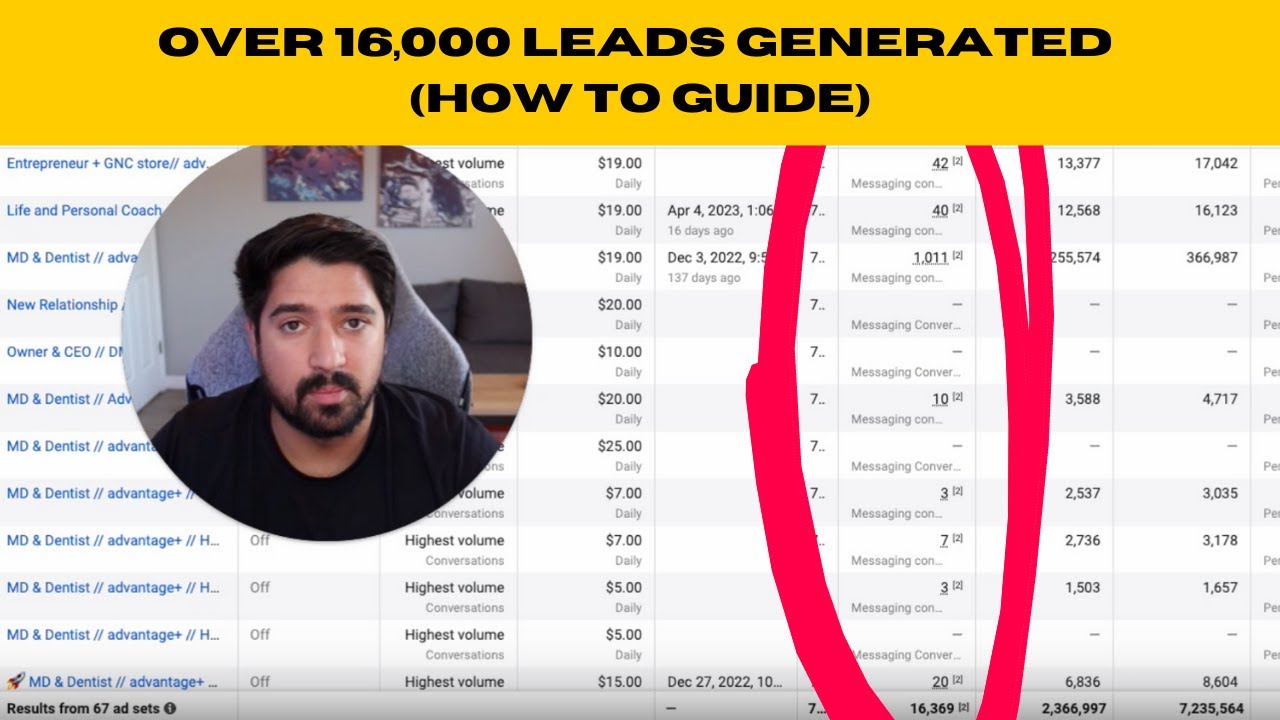
Nicholas Corvessis shows how his "Blump Post" framework generated over 16,000 leads for coaching clients using Facebook and Instagram ads. The strategy costs $2 to $8 per conversation by asking people to DM instead of filling forms. One client spent $150 and made $1,500 in sales.
Chapters
In this video, I'm gonna show you how we generated over 16,000 leads for a partner of mine in the coaching and consulting space. Now, this strategy that I'm gonna show you is literally transferable between no matter what business you're in. We've done it with coaches and consultants. We've done it with mortgage brokers. We've done it with real estate agents. We've done it with SaaS companies. We've done it with every company out there. So this strategy is transferable across the board. I'm gonna give you a breakdown of how it works, the numbers behind it, and then just a couple of other advertising and optimization tips for this strategy. So let's just get right into it. So let's first kind of look at the strategy, what it actually looks like. And you can see here for this one, for one of my partners, 16,369 leads messaging conversations started at $8 per lead. So You may be wondering, hey, you said leads, why is it messaging conversations? Well, all conversion happens in conversation. So when you can talk with people, that's where, you know, a conversion is gonna happen. So I'd actually vouch that getting a conversation with someone is worth so much more than just getting a name, email, phone number. And through this process, we do get their information like name, email, phone number, so you can follow up with them, but it really starts a conversation. Which can bring some really, really great benefits. So for example, in this case, the strategy here, and I'll start with this one where we generated 1,000 messages at $6 a message. The strategy here is to launch these little ads called Blump Posts. And it's a super simple thing where you're literally calling people out and you're saying, hey, I'm looking for 5 motivated coaches who wanna launch their successful coaching business in the next 90 days. DM me now if you're curious to learn more. The kind of framework for this thing is to basically say, put the promise that you can deliver to them. So in this case, it's turn your passion for helping people into a full-time business. And then you want to call out exactly who you're speaking to. So we're looking for 5 motivated coaches. For you, it may be we're looking for 5 driven investors, we're looking for 5 ecommerce stores, we're looking for 5 hair salons, right? You're going to put in who you're looking for very specifically in that line, and then reinstate that promise again, who want to launch their successful coaching business, and then the call to action, DM me now, or let's go, or whatever you want to do. If you're curious to learn more, what happens from here is that someone will actually click send message. And you can do this on Facebook or on Instagram. And once that happens, you're going to have a conversation with them, ask them some questions, see how everything's going with them, See if you can help them and then get 'em on the phone call and close them. And then even if you don't close them, you can still get their details through the chat. Let me show you exactly what a chat looks like, and I'll show you one that I've personally done for myself, and we follow a very similar framework. And then I'll show you some more of the numbers and some really neat optimization tricks for this strategy. So here's an example on my account. You can see the Blump post right here. I have start attracting more dream customers and generating predictable profits. I'm looking for 5 coaches, and it goes through that whole spiel. You can see here, this person messages me the attract call to action, says he has an online fitness business, I talked to him back and forth. I asked when he's available, I get his email to send the invite. And then we had a good chat, we ended up signing up moving forward. And it was a really great thing. And I've done this with a ton of people, not just myself, but just to show you how easy the conversations are. They work really, really well. Just as another couple examples, I really want to show you guys how this can work. So here's another one where it's a little bit of a smaller budget. It's like this month as a whole, we've spent $400 and generated 191 conversations at $2 per lead, lead conversation, which is good. It's not like a ridiculous expensive budget, but just from this one as well, these are their stats from the Blump posts on Facebook ads. From April this month, so from March to April, let me actually tweak those settings. So it's like from the end of March, all of April, we spent $306. With that, if we go back here, you can see we've generated $6,000— or sorry, we've generated $5,366 in profit. Right, because of the $600 in ad spend from March 20th through April 16th. Overall, really not that bad for kind of the work that we're doing here. And I'm looking at the wrong ad account. Let me go back here. March 20th to April 20th. There we go. It's at $776 in spend to get one $6,000 enrollment. Not bad. And overall, they've spent $8,000 on ads as they were starting to optimize and build things up. They've enrolled 2 people at $6,000 a pop, $12,000 overall in revenue, giving them a total profit of $3,721. So this is something that can work really, really well, and I've got one more example for you. I mean, this is a little bit of a different angle. We are actually running this through video ads. So you can see here for him, we've got 2 campaigns, we've got a couple of campaigns, and we're really just in the initial testing stages, and this is the big part of the optimization that I want to show you. From the DMs prospecting one that we've really been running, we've spent $150 total, which isn't bad. We've started to test, started to figure out what works and what doesn't. You can see here we've got 3 different ad sets. Some are doing better than others. In this case, we actually did this through a video and we have that same call to action, the same copy that gets them to click and to DM us. The objective is the same. However, in this case, we're actually doing video. Video, which is very interesting with him. He's just starting this off, spent $150. And you can see here, just this just happened today, got a first close-in, $150 spent for a $1,500 sale, which is awesome. $145 spent for that. That's super cool. Once we start getting more sales, we're going to start to scale the spend. So this is a super, super cool way to generate conversations with leads and actually be able to close them and fill your pipeline at the same time. And it's super inexpensive and you can really pick and choose what kind of assets and how you wanna run this thing. In some cases you can do these blunt posts. In other cases you can do a video like he's doing and both can work. I've seen the blunt posts work very, very well because it's straight to the point. People know what you're offering. And it just filters people out very well. However, the video can work well also. I would try either or some people's brand, they're not gonna love this, but like I've talked about in my previous videos, things don't have to be perfect for them to work. And this is a starting point. You can see what works. And these messages serve as such a good testing ground because you can see what people are actually interested in. You can actually have conversations with potential prospects and see what they actually want. And then you can go and adjust your other advertising based on what you're actually hearing from people, which is super, super cool. It's a huge underrated benefit of this campaign. Sure, if you get leads but no sales, you've not only gotten leads, but you've had conversations with them. You know what's going on, what they're struggling with, and how you can help them. So it's a huge benefit. Now moving on to the optimization side of things with these campaigns, it's kind of an 80/20 split. 80% of it is reliant on the volume of the campaigns itself. And 20% on is reliant on the actual optimization of the campaign, the copy that you're writing, the creative that you're pushing out there, the copy— I think I said that— the audience, it's reliant on those things as well. It's a volume game, you're going to get bad leads, you're also going to get great leads. Like with this guy, James, my partner before, and I wish I took a screenshot of this, but we had some leads that were not great at all. He was like, oh, we got our first lead and he sucked. Like he did not know what he wanted. He was a horrible lead. And that happens. That is totally normal. And you should not overreact and go and change everything. Because what we could have done is that one lead that came in, and I think, let's see when we actually started this. It looks like on Monday of this week, we started it. Tuesday started getting messages, we could have easily said, oh my gosh, we got a message. And it's really bad. Let's turn everything off. We said no, it's just one message. Let's at least get a handful before we even decide to do anything because it's all about data. And even if you start to get a ton of consistent, really bad messages, the first spot that you're gonna go and look, just like we've spoken about in previous videos, is the cost per link click section. And more importantly, the link click-through rate, because this is gonna tell you if people are resonating with what you're saying. And on your DM ads, if you get a link click-through rate, 1% or higher, you know what people are resonating with the things that you're saying in the ad. And I've done this campaign with some real estate agents, even some lenders, mortgage brokers. And for them, this has been so big because what it's allowed them to do is have conversations with their prospects. And even if they don't close them, they get them in their pipeline, they get them in their database with the email, they actually have a conversation with someone. And then what they can do is they can take that data that they learned, like let's say a specific headline or a specific hook was getting some really good people to message you, you know, to go and deploy that across your other advertising campaigns, which is huge. It's, it's such an easy thing to implement. They're very, very cheap and you get a lot more than just data. You get real conversations. So that's that example, the video there. And then I can also show you guys this one for these people that closed $12,000. You can see it's just a super simple blunt post. Keep in mind the first line of what we're saying is very important as well as the headline that's gonna dictate who you're kind of getting. The audience is super important here, but I'm a big believer in what you're saying in the ad is almost more important than the audience. Yes, you want them to align. Like in this case, we're actually going after, uh, business softwares, right? So women that are in business interested in business softwares, but they're also interested in self-confidence and self-esteem. This talks directly to them. Ready to end emotional eating. 5, 5 women who are ready to end emotional eating. This talks right to them, right? We're going after those business professionals, even though we're not saying business professionals in here in some cases. And sometimes we do just that audience. And with some of the alignment on the copy and the creative, it's a huge help. This has been a campaign that has been so big to our success because we start with testing small things like this. And once they actually start to work, then what we do is we deploy them across our other campaigns, our purchases campaigns, low-ticket offers, book-a-call funnel campaigns, and all that good stuff. So I hope that makes sense. Um, if you guys want more in-depth stuff with this, please let me know. And I'm gonna end this off by going through the sheet that I've been showing in the past couple of videos. So this right here is a funnel diagnostic sheet. I've been talking about it in the past couple of videos. Um, there's a ton of really great resources in here, and a lot of this stuff here is applicable to what we've spoken about. If you've got a bad CTR, you know that your creative and your DM campaign isn't doing well. So if you want access to this thing, um, because there's so many resources and, and I update it each week, there's gonna be at least 1 to 2 new videos every week in here, tell walking you through each KPI, what it means at a 3rd grade level, what it actually affects, and then how you can influence and improve the statistics so you can get better results with your ads. And there's a little mini video training session for each one. If you're interested in getting access to this, there's 2 ways you can get it. One, shoot me an email. I think it's somewhere on YouTube. It's nicholas@scaillabgroup.com or just message me on Instagram. My name is Nicholas Corvessis, same as it is on the channel. Shoot me a message and you can get access to it just so you guys can kind of see this thing. Let me show you guys my profile. This is my profile right here. So if you see this one, you're talking to the right person. Just shoot me a message. I can get you access to this funnel diagnostic sheet. And make sure that you can utilize it, 'cause I want you guys to crush it with your ads. So I hope this helped. Let me know if you have any questions and start testing these DM campaigns. It's a really easy way for you to go after your market, see what people are interested in, and have conversations, because no matter what anyone tells you, conversion is going to happen in conversation. So the more conversations you can get, the better off your business is gonna be. I'll see you guys in the next video and have a great one.










