How I’m scaling facebook ads in 2025
A system for scaling Facebook ads from $1,000 to $30,000 monthly spend in 30 days. The presenter splits strategy into marketing (creative, copy, offer) and media buying (bids, budgets), noting 80% of results come from marketing. He walks through testing one ad per set at low budgets, increasing winners by 10-50%, generating creative variations weekly, and scaling via budget multiplications and bid adjustments.
Chapters
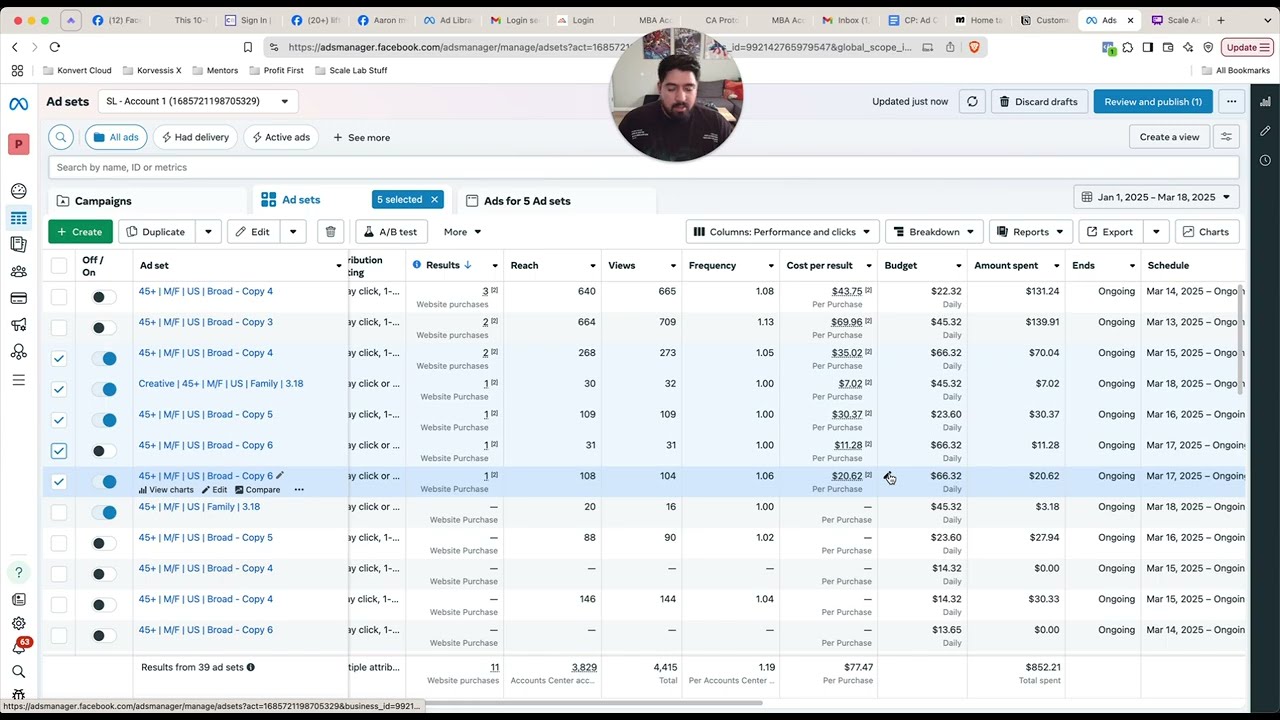
I went from spending about $1,000 a month to over $30,000 a month in just 30 days with these very simple ad scaling strategies. And in this video, I wanna show you exactly how we do it, take you behind the scenes on what we test, how we scale, and how we maintain that scale. You can see we did this over here in the past year. We scaled up to close to 2,000 sales. And this is actually just from one campaign. We had a lot of other campaigns running, and just from that one campaign, over $90,000 in spend. About $30,000 a month over this timeframe. So let's get right into it. And I'm gonna show you how we're doing this exact same thing now and how you can do it too. So how I'm scaling Meta ads in 2025. A big thing to understand is the really foundation to scaling and actually having success in paid advertising is understanding the difference between marketing and media buying. Marketing is really the core and really 80% of your results are gonna come from the marketing side of things. The marketing, I would think of that as like the ad itself. Excuse my handwriting. But the ad itself, the headline, the offer, the creative, the copy, everything to do with the ad is going to be marketing. Media buying is the media buying stuff, right? Bid caps, frequency, how much reach you're getting, how much your budget is, how your budgets are set up. Cost caps, all that different stuff is media buying. And most of the time, 80% of your results or 80% of the things that you change that drive the results are gonna be marketing related, not so much media buying. I'm gonna go into media buying changes and media buying optimizations, but a lot of scaling comes down to ad variation and then direct scaling through media buying. But I'll tell you right now that 80% of the results that you're gonna get are gonna come from ad variation tests and ad variation scaling. Opportunities versus the media buying side of things. Media buying has a lot to do with it. And what I'm gonna do first is go into an ads manager of mine that we're running some ads in right now and show you what's kind of normal to see. So you'll see in this account, we haven't really done too much here. We've only spent about $800 this year as a whole. And I'll actually filter this down to this year as well. Yeah, so this year we've only spent about $800, gotten 11 sales, but we're testing. This is a brand new offer. We're trying to figure out what's working and what's not. And this is pretty normal. What you'll see inside of an ad account is at first you're gonna be running just a couple of campaigns, kind of figuring out what exactly works, one ad per ad set, and testing budgets anywhere from $15 to $60 a day. This is super standard, and this is exactly how I like to set up my ad campaigns from a media buying standpoint. Is making sure you're doing one ad per ad set, testing slowly, figuring out what works, what doesn't, and then starting to scale, refine, and just go from there. So that's really the biggest thing there. Now, after that point, we kind of go into this workflow here, which I'll kind of draw out and explain as we go. So the first stage here is testing. And this is what I just showed you where you're basically throwing ads up into a campaign, Figuring out what works, what didn't. Once again, the media buying side of this, make sure that the structure is one ad per ad set. So you give Facebook and the ad that you're running on Facebook the best chance at success. You don't want to give it not enough chance to run, scale, and actually find out what works and give the algorithm a chance to figure out if it's good or not. And before I keep going, this Whimsical document will be right below in the description. So if you want to grab it and reference it in the future, just go ahead and grab that below. And so that's really the first step here is just throwing those ads up, seeing actually what worked. Once you figure out what's actually working, then we go down from testing into refining winners. And you'll see how I actually go back up and down into testing and vice versa. But I'm just gonna go through the kind of standard flow that I would see. So after you figure out what works, then let's refine winners. So on the media buying side, you'll do things like boosting the winners, And you'll make more variations of those winners as well. So media buying side, what I would recommend doing here is increasing your budget on the things that have worked between 10 to 50%. And that range is there just depending on how much you're willing to spend and how much the product is itself. In these cases here, like let's say I did some of these tests and I see that like these are all doing exactly what I want them to do, right? Getting purchases for less than $40 in this case. Well, I'd probably bump all these up by about $10 to maybe probably $20 a day is where I'd end up bumping all these up to. You wanna be careful about not scaling these things too quickly, 'cause it can throw the algorithm out of whack and you need to give it time. And ideally, once you throw these ads up, I'd really recommend waiting 3 days. If you don't wait 3 days, it's not gonna give the algorithm enough time to figure out what's actually good, what's actually not. And you're not gonna actually be making the best decision when it comes to where to put more money or where to take money away from. Now, if you see a big problem and something's not working, just cut it. Don't spend more money on it if you're seeing like really high CPMs or really high cost per link clicks. But if it's not bad, leave it for 3 days and then determine what won and boost those winners by about 10 to 20, or maybe even 10 to 50%, like I said. 'Cause you could absolutely double the budgets on some of these if you're being a little bit more aggressive. Like I'd maybe do that on this one, but it's just not enough data. If I left it for a bit longer, 'cause this one only launched on the 15th, I'd probably leave it for a bit longer and then decide to scale it up. So that's on the media buying side. The, and this is just at this point. After that, you wanna actually start with making more variations of winners. This is more on the marketing side. It's gonna drive more of your results. I'll show you what that looks like in a moment, but we're gonna make more variations of winners, change the headline, copy, creative, Et cetera. After that point, you could jump over here and try some micro tests with some audiences, maybe some bid caps. I would probably stay away from bid caps at this point. That's why we probably see that down here once we have more of an established winner. But we can come back to that shortly. After that point, scaling with minor variations. Let's actually jump down here. To this ad creative testing structure. It's really simple, just flowchart that I set up. So a very easy way to do this is let's say you've got your original ad here, right? So we'll just call this like ad 1, and this is like the OG. So we'll call it 1.0. After you have 1.0, whatever that ad is, you want to start by basically taking it through this ad creative testing process. And you could actually chunk this out into weeks if you wanted to. So this right here could be week 1, this could be week 2, this could be week 3, and this could be week 4. You could actually be doing these basically at the exact same time, these last 2 video ad ones. So what I'll actually do is erase all that stuff, and these altogether could be weeks 3 and 4. Right? So ad 1.0, week 1, let's just start with testing performance versus a lifestyle benefit. So easy way to kind of describe this and to give a good example is if you were a business owner and I was helping you make more money, the performance would be you are going to double your ad spend and triple the amount of results that you're getting, or even better, you're just gonna double the amount of money that you're making in 2 weeks. That's it. That's the performance. Nothing else. Or you're gonna double the amount of leads you have. I'll take you from 0 to 1,000 leads in 3 weeks. That's performance. Lifestyle benefits would be more so timing. So you could say, hey, I'm gonna take this off your hands. You're gonna have more leads, but not only that, you're gonna be able to spend more time making content, serving clients, doing whatever you wanna do, hanging out with family, hobbies, et cetera, friends, whatever you want. You'll have more time. So testing those 2 different styles of ads, you're basically gonna come out of week 1 here with another 2 variations of ads, right? You'll have ad 1.1 and ad 1.2. That is not 2. There we go. And those will basically be the performance one and the lifestyle one. You'll test those, you'll see which one works. And what you can continue to do as you go through this pipeline is you can keep making variations of them. Like let's say performance ended up winning for you and lifestyle didn't. Well, go make another angle of a performance-based ad, right? And that'll be ad 1-3, and you can keep going all the way down. A very easy way as well to think of like, okay, well I did the performance one of making $2,000 or having X amount of leads. Different people are gonna want your product for different reasons. It's like when someone's selling a chair, this is a great example, is you, some people may want a chair because it's comfortable. Some people may want the chair more so because it looks good. And some people could want a chair because for both of those reasons combined. So make sure you're hitting on all the different benefits from your ad. And then you'll do the same thing. You'll do a price first versus value first in week 2, week 3 and 4, you'll take those and you'll do a video versus static. You know, do a UGC ad versus professional content, super simple process. And that's basically what you're gonna be doing right here in these minor ad variations, as well as here in this headline copy, creative, and audience tests. So some of these variations you'll be doing here and plugging in here as you scale, but you'll also be doing some minor variation testing, which is headline copy, primarily headline copy and audience, I'd say. So if I pull up an ad in here real quick, I'll show you some of those micro tests, which is a very easy way to scale. All right, so here I am inside of a winning ad. A very simple thing you can do for some micro tests is to just change the headline very slightly. Facebook can give you a lot of examples as well that you can pull from, but a great way to scale is to take a winner, duplicate it at a little bit of a lower budget, and just change the headline. Don't change anything else, just change the headline. And if you're duplicating it even at the same spend, So say you're spending $50 a day, you duplicate it, change the headline at $50 a day, even half of that, you're effectively going to be doubling your budget on that ad set with a winner with a very small variation. And you can do the exact same thing for headlines like I just showed, copy. For the copy, I would mainly focus on the lead-in here. So the first 2 to 3 lines that people see when they're scrolling on your ad, test that first. You could also test the creative or the copy on the creative I think is better. And then audience testing. For audience testing, there's a lot of different angles you could go here. You could go for just simply testing a different age range, a different gender, with and without interests, Advantage+ and not Advantage+, to see really which gets you the best results. From there, just directly scaling. So these scaling variations here are gonna be more on the marketing side. On the media buying side, you could just 1 to 4x budgets based on what's working. You could also duplicate winners into a CBO campaign or a lifetime budget campaign. And how I would go about that is let's say I had this one. I'll just do a live example here. So let's say I had this one that was working. Ideally, I would do this if I had more ads that were winning, but I would duplicate it into a new campaign, call it whatever you'd want to call it. And I would act, like I said, I'd ideally have a couple of these, but you would duplicate this one at least 4 times. I'd want 4 inside of this campaign. And you'd flip on Advantage Campaign Budget, and I would have the spend set to at least $100. Super easy way to scale. You're adding $100 to your daily budget, all based on proven winners. The test here is a media buying test. Does a CBO or an Advantage Campaign Budget work better than ad set budget optimization or an ABO. And last but not least, another easy way to scale is by adjusting the bid caps and delivery schedules. So it's in the ad set level here. You'll see that your ads attribution setting is by default set to a 7-day click, 1-day view, which is really what I'd recommend. But I have seen times where switching to a 1-day click and a 1-day view is super useful. So give that a shot, see if that works as well. And then last but not least, we can go ahead and drop in a cost per result goal. So whether we did this as a campaign budget or an ad set budget, we could switch here to a cost per result goal, go to the ad set level, and then drop in a cost per result. I have some other videos on my channel on this, 'cause you could do a bully campaign method where what you're doing is you're telling Facebook, hey, I'm willing to spend $100 per sale, but you're not really. And then you make your budget really, really high. And Facebook, it basically gives you all the bids and has you win all the bids and all the placements. And your cost per result ends up being a lot less than the higher cost per result goal you're telling Facebook you're willing to do. So that's super important there. This is pretty much a very easy way to scale your campaigns. And what you can do is once you have more of these winners from a lot of these tests that you'll do up here, is where these scaling methods more on the media buying side come into play. It's a lot harder. And you can see on this example account here, I don't have a lot to play with yet. So my focus should be on testing and refining those winners and just testing them in different ways, testing, finding some small wins, making variations of them, keeping everything at a low budget and just finding what works and have a bank of a ton of creatives that work. And then from there you can scale up. If this video was helpful, let me know. Check below for this whimsical document. You can check it out and mess around with it all you want. And if you're looking for more help and resources, join our free community in the Predictable Profits Mastermind. You can ask for help. I'm glad to audit your ad accounts as well. I'll see you there and I'll see you in the next video.










