How To Structure Facebook Ad Accounts For ROAS and Scale
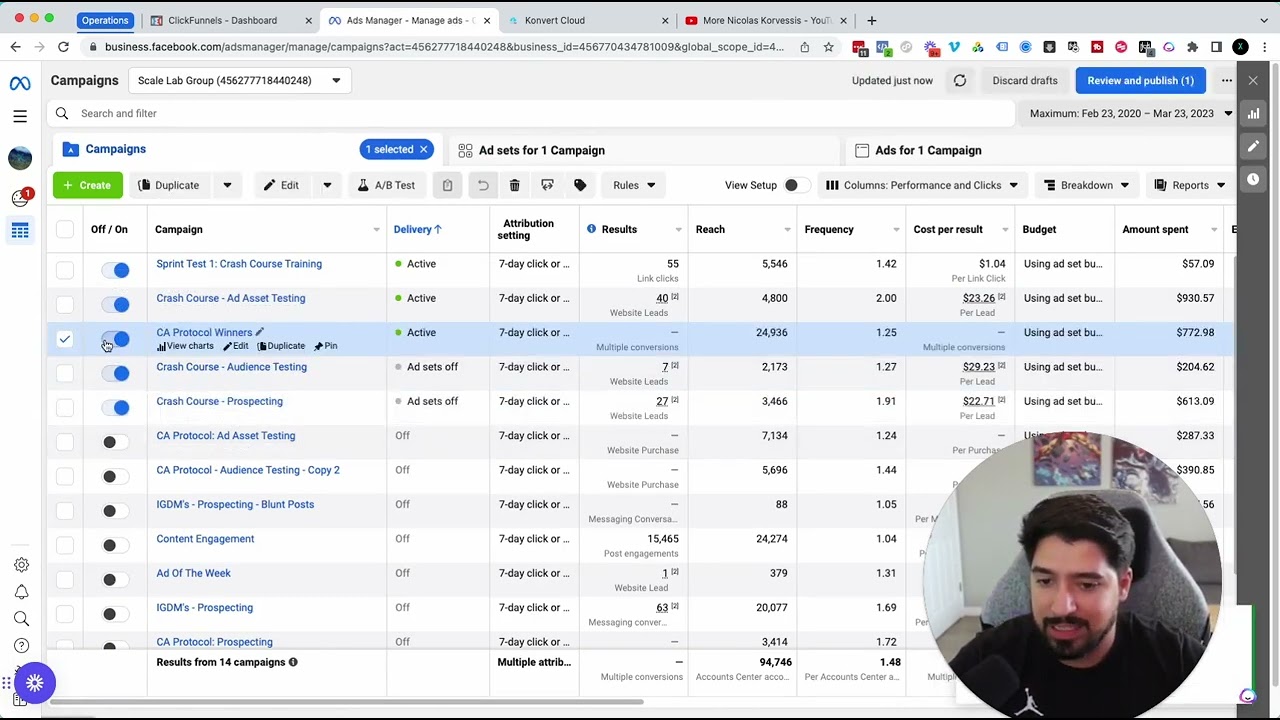
A Facebook ad manager who handles millions in spend shares a framework for organizing campaigns into testing and core buckets. The structure includes audience testing, creative testing, a main prospecting campaign, and a winning campaign for scaling proven winners. Move assets between campaigns as they perform, and keep your total campaign count low to stay organized.
Chapters
In today's video, I'm gonna show you one of the best ways to structure your ad campaigns so you can boost profits, lower your cost per lead, lower your costs across the board, and just get better results and feel a little bit more comfortable inside of the Ads Manager as well. So let's get right into this. This is my Ads Manager. This example that I'm using, it's actually got some ads that we've been running in here. So let's show you kind of how everything here is structured. And this is just one of the ways that I've found to really have success in structuring your ad campaigns. There are a million different ways under the sun that you can do this. There are other ways that I have structured my ad accounts in the past that I have found work best for me. And just as a little bit of a background, if you don't know who I am, like, why should I listen to this guy on how to structure my ad accounts? I manage around a couple million dollars in spend every month between all the people and partners that I work with. And we do it on Instagram, or Facebook, YouTube, a little bit of TikTok, a little bit of Google. But my main wheelhouse is in Facebook and Instagram. You can definitely apply these tactics to other areas. And a lot of the partners and clients that we're working with, they average around a 2x return on ad spend pretty quickly out of the gate when we start working with them. So this is based on all that learning, managed millions and multiple millions of dollars of spend. So I've found kind of a flow that works best even when the algorithm changes or something like iOS 14 happens. So let me kind of break it down. How I really like to start things off is in 2 categories. You will have your sprint test campaigns and you will have your kind of bread and butter meat and potatoes campaigns that are always around. So in this particular example, you can see I've got a sprint test campaign where I'm looking to test something very, very specific, whether that's a new offer, a new angle of an offer, maybe just a new audience altogether, maybe some new headlines that I'm not too sure about. It's really just to test assets. So I, most of the time, the, a sprint test or a quick test isn't always gonna be a campaign that's live, but maybe once or twice a month I'll have something in here that is just the dedicated purpose of this campaign is to test a ton of different things at once at really low budgets to see what the world is really interested in. So I do these sprint tests, sprint tests. There are great uses for them, but that's kind of an outlier here. Then there are really 3 primary campaigns that I'm gonna be running with here. There is going to be an audience testing campaign, an ad asset testing campaign, and then a winning campaign. So like where you put all your scaling and whatnot. Now sometimes there can be one other campaign outside of that, which is just a general prospecting campaign. And this may be like the very first campaign that I launch when I'm just testing things out of the gate, or it's maybe like a holding silo for other campaigns that I'm maybe not using anymore, or maybe that I used when I started, but I may go back to them. And it's kind of just the ones that are just around right now. With that being said, let's break down first off the audience testing campaign. So the audience testing campaign, this is where you're gonna be testing your different audiences. These are usually low budget. Now I will decide to scale these things up if I've seen them working. I would try to move them out of this audience testing campaign and into the winning campaign where all my winners are held. But I really like to just be testing something in here constantly and always making it work and always make it just something really valuable that I can always pull from in the future. So I always like to have audience tests running. Basically, like if I turned off this audience Mailchimp, because it wasn't working for whatever reason, I'm gonna replace it with a new test. I always like to be testing audiences. I really recommend the same, even if it's a small budget here and there, like $2 to $5 a day. The purpose of the audience testing campaign isn't for you to necessarily become profitable or get the best cost per lead. It's simply to validate the audience by looking at different metrics in here, like your CPMs, Like your cost per link clicks and like all this good stuff. The purpose of these campaigns, this audience testing campaign is just to validate an audience. Now, if I see an audience that starts to work, I will absolutely start to scale that audience up in this campaign. But ideally I wanna move that out into either my prospecting campaign or my actual winning campaign. But I'm not gonna throttle the performance in here just because it's an audience testing campaign. I think some people, what I've noticed where mistakes have happened in the past for even us, is we'll find like, let's say this Elon Musk audience is just crushing it, it's doing really well. I'll start to scale it up. And I'll say, oh, I gotta stay organized. This is a winner. Now, potentially, I'm not going to leave it in here, it's no longer testing, I'm going to move it out. And then right when I change those initial conditions, the ad campaign will just shit the bed, which obviously is not helpful at all. So don't Don't be too worried about, oh, if it's winning, I must move it out of the testing campaign. The bottom line is you wanna find winners across the board. This is just to keep you organized and to find your audiences that are winning. And if the audience is winning and it's working, just keep it in here, scale it for however long you can, and keep this campaign running or these ad sets running, and then still move it to your winning campaign or to your next level while this one is still running kind of as a, as a holder. So that's the first campaign that I like setting up. Now next, once you find some audiences that are winning, some ads that are winning in your general prospecting campaign, then you can move it to the next stage, which is your ad asset testing campaign. Now in here, we're gonna be testing a multitude of things. You can either test, and really it's only 2 things you're gonna be testing, copy or creative. And that's all this campaign is dedicated to. This campaign is dedicated to just testing the assets of your ad. So copy, creative, Pretty simple. Whatever's been working on audiences, you wanna take it to the next level. Say something is working in your general prospecting campaign where you've got all your stuff, you can move it in here and test the thing that's lacking. So say you notice you have a really low link click-through rate, um, and you wanna test some copy to kind of bump that up a little bit. You'd move it to this campaign, you test the copy and see if it works. And then either once again, scale it inside of this campaign or move it out to your winners. Or back into your prospecting. And that's kind of like the crux of everything, right? You have this prospecting campaign, turn these on just so it's visually easier to look at. You'll have this prospecting campaign right here, which is really like your home base where you'll have kind of stuff running all the time. It's some of the campaigns that you've started off with that you know work well, or maybe you don't know work well, you just started with them. And then when you see what's lacking on these ones, Say you see you have a really high CPM in this prospecting campaign. Great, no problem. You're just gonna start to test some different audiences. You're gonna take that copy creative, test a ton of different audiences with it and see what works. Say you then notice that, okay, there's another ad set inside this prospecting campaign that the click-through rate and the link click-through rate just isn't that hot. Let's start testing then some creatives or ad copy with it and you move it to the ad asset testing. Makes it a really nice way to organize it, but you can always bring it back to your home base and kind of have it as a really good melting pot. Facebook likes this as well because they want you to aggregate everything and keep everything tight. So you only need to have a couple of campaigns running at a time. Now I've actually, I mean, some people would say that having 4 campaigns at a time may be too much. I have found this to actually work very well for us and the objectives that we've been using. Now I also have some clients where we literally will only have 2 campaigns. We'll have a prospecting campaign and we will have a retargeting campaign. And from there, once again, that's great to have, but I think it's good to kind of have it organized a little bit, but it's up to you. I would follow the same kind of flow of finding something that works. What's the bottleneck? What can I test to remove that bottleneck and then kind of go back to home base? So whether you're doing that all within one ad set or a campaign, or whether you're breaking it out across a couple, I think this is maybe the maximum I would do. Obviously the sprint test is a separate thing within itself. And so is the winner campaign, which I'll touch on in a minute. But this is how I really like to structure things. It, it worked really well for us. The other one that I've left out here is obviously a retargeting campaign. I think that's really big. Everyone should be spending just a little bit of money on retargeting. You wanna make it purposeful. You don't wanna spend just to spend. And I'll probably do another video on retargeting specifically. But I think if you have a prospecting campaign, an ad asset testing campaign, audience testing, that's great. You could even throw your retargeting in this prospecting section right here. And it would be totally fine. Facebook wants you to kind of keep things in one campaign and limit the amount of campaigns that you're having and ad sets in total. They'd rather have you have more ad sets and ads than more campaigns. I kind of like to limit it around here, and this has worked really, really well for us. Obviously in the winning campaign, you can have things like CBO, lifetime spend, even things like a bully campaign. Those work really well. On top of that, you could even do something even easier or something else that's really neat. And in this prospecting campaign, say, you know, that this ad set's working for you inside the prospecting campaign, you can duplicate it and just test something really small with a micro variation, like what placement you're running it on, The learn more button, maybe change it to sign up and smaller things like that you can test inside of here, as long as you're tracking it inside the ad set level. So let's say this was the original one that was working for me. But the, I don't know, the CPMs are really high, which they are, or whatever it is, let's just say that they're not doing too well. And I just want to test the placement, I would then duplicate it inside the prospecting and test the placement. And I would just make sure I say IG feed only. That way I can see exactly what's going on from an ad set level and I can see kind of what's working and what's not. Even if it's like so small tests, like micro tests like this, I like to keep them in the prospecting campaign. You could also choose to bucket them in the ad asset testing, but I think this is just a really way that we've found to work well and that I've found to work well just with spending a ton of money on this stuff. Makes it easy to scale, jump around and try a lot of different things in new places. So this is something that's worked really well for us. This is more of a general overview. There's lots of other strategies depending on what kind of objective you're trying to achieve. You want more booked calls? Do you want more sales? Do you just want leads? What are you looking for? And depending on that, sometimes the structure can be a little bit different. And like e-commerce is a really big different structure that would be different to this. But this is kind of like overall, you're a coach, course creator, consultant, or you're running ads for someone. This is a really good strategy that I've seen work. It makes me feel good when I look in the ad manager, I can just see where everything is, makes it really easy to navigate as well. And Facebook likes it because we're trying to aggregate once again, the campaigns. So let me know what your thoughts are. If you guys have any questions, let me know. I'm glad to make more videos going over different structures besides this one. Because this is just one of many that I have seen work very, very well. And that's the big takeaway that I want you guys to take from this is that there's not one structure that's gonna work. I'm sure there'll be people saying like, oh, this structure doesn't work for me. And that's fine. You gotta find what works best for you. And how I've learned is by taking things from other people that I think would work well, putting my own spin on it, and then just after spending so much money and learning about it myself, figuring out what makes the most sense for us. So that's everything for this video. If you guys enjoyed it, please let me know. And I'll come back soon with some more Facebook ad hacks and strategies.










