How To Sustainably Scale and Guarantee The Success Of Your Facebook Ads
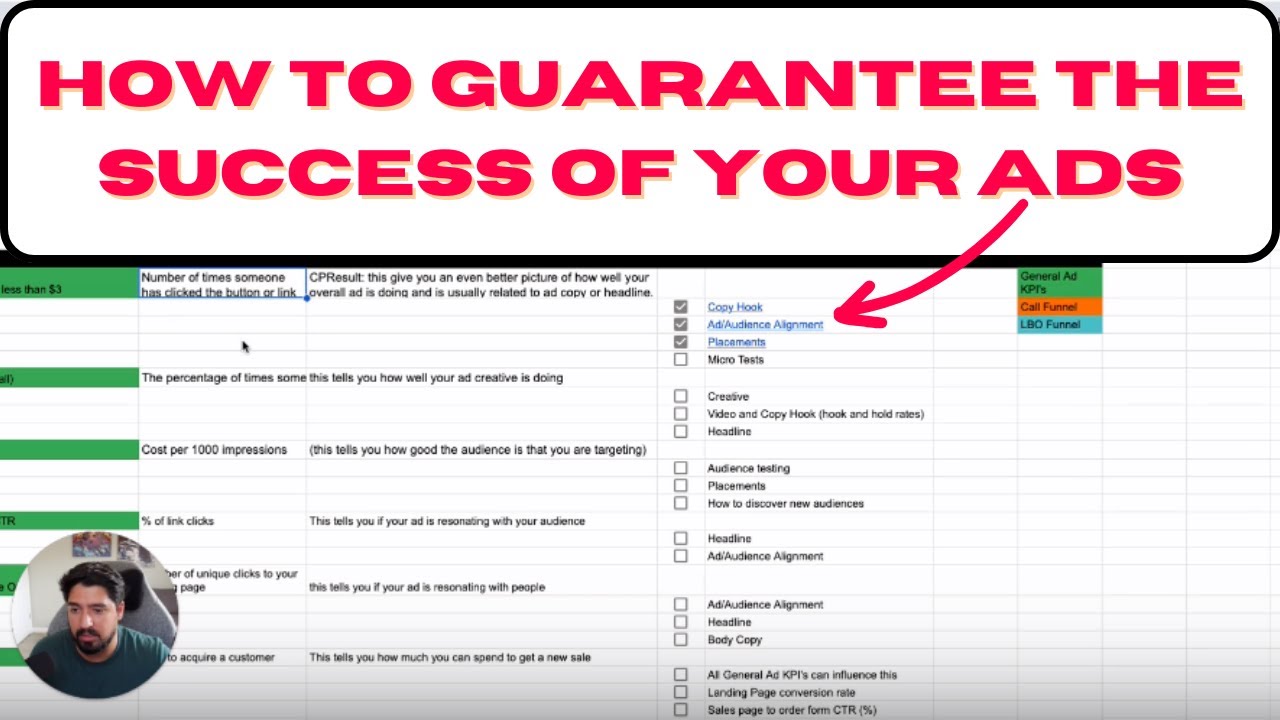
Nicolas Korvessis breaks down how to scale Facebook ads by lowering cost per link click through two levers: aligning ad copy hooks to your audience (like tailoring headlines for TechCrunch readers) and moving budget to placements with the lowest CPLC and CPM. Focus on specific metrics instead of broad testing.
Chapters
There's one thing that I see happening time and time again when people are trying to scale their ads, scale their marketing strategy, spend more to get more, and just optimize their marketing across the board, no matter what paid channel that you're working in, or even if it's organic. And that's that they're not looking at the numbers. They're not looking what you can do to actually influence the number that you're trying to fix. So that's what we're gonna talk about in this episode today. We're gonna talk about some different KPIs and I'm gonna hone in on one specifically, which is gonna be cost per link click, like how much it costs you to get someone to your landing page or click on the thing that you're trying to get them to click on. And the reason that I'm focusing on this one more than anything else is because if you can get a click cheaper than anyone else, you're probably gonna win and you're gonna be grabbing more attention and you're gonna be able to sell more of your thing or get people on your list. So, I've actually put together this really simple cheat sheet. If you want access to this, you just need to reach out to me on Instagram because this is an ongoing project that I'm working on. Or just comment below or let me know if you need access to it and I can give it to you. It should also be in the description. I'll share it there. It's an ongoing project. You'll see that I'm making this funnel diagnostic cheat sheet that actually goes over general ad KPIs. If you're running a call funnel or a low barrier offer funnel, it categorizes them in that. And then it shows basically what the KPI is. So in this case, we're talking about cost per link click, explaining it at a 3rd grader's level. So all it means, cost per link click means is how many times has someone clicked on the button or link of your ad, what it affects. And in this case, it's really gonna affect the cost per result. And it gives you a better picture on how well your overall ad is doing. It's usually related to copy and headline. And then I've got a couple of different ways that you could actually influence it. And for cost per link click to influence that, there are 4 ways that I've seen that you can influence it most. We're going to only go over 1 or 2 of these today. And this is a really great way to lower your ad costs and it gives you a great testing pad and a great launch pad really just to scale your campaigns to new heights profitably without losing or wasting money. So let's talk about it, how to influence it. Your copy hook and your ad and audience alignment is what I wanna talk about first. And I'm gonna give you a real life example here. This is on one of my ads. I've done this on a couple of our partners' ads as well, and it's been a huge success. So this is one of my initial ads. It says, revealed, here's a 16-minute crash course in how to add 5 figures a month to your coaching or info product business without building a brand. Click below to film the video. Now the audience that I'm running with this one is actually like different publications, right? So we're doing things like Digital Trends, TechCrunch, TechRadar, and Wired Magazine. So I'm trying to go like a roundabout way, which I found is a very great way to hit the right audience and hit the right people, is to kind of go roundabout like, hey, what do entrepreneurs read? What do people in my sphere, like, what are they interested in? Well, TechCrunch, TechRadar, like they're interested in that kind of stuff sometimes, right? It's the big thought that I come back to is, well, If someone's an entrepreneur, they're probably going to the gym, probably going to Lifetime Fitness, right? They probably shop at Whole Foods. Why not target people that are interested in that stuff? Because you're gonna hit people that are in your niche, right? With that, you can see this initial campaign, this initial ad, it doesn't really talk to that audience, right? It's just very general, like, hey, Revealed, here's what this is. One of those levers that I mentioned here is the ad and audience alignment. How can we have our ad aligned with the audience that we're targeting? Easy. Just change the hook in your copy, change a couple of small things, and it could make the world of a difference. So here's what I changed it to. You can see, change it here to revealed successful startups and 7-figure companies are leveraging this simple framework to add more high-quality leads to their pipeline. That is so much more direct. Like if you just go and look at like TechCrunch, specifically. And if you go to like their startup and technology news, first off, startup and technology news, it's literally based around startups and tech, right? Which is crazy. When I looked at it the other day, and I'm sure it's still on here, lots of stuff about AI, right? Tons of stuff about AI. So with that, how can I relate more to that audience? Well, let's just talk about it here in the ad. We can say, hey, revealed Successful startups and 7-figure companies. That's gonna talk to people that are interested in those kinds of sites, right? The second thing I did is I just tweaked the headline, how I use this anti-AI method to attract high-quality clients. Once again, relating to what other people are talking about, relating to the audience that I'm targeting by speaking about things that they're probably looking at, right? If someone is interested in TechCrunch, they probably are interested in startups. They're probably interested in AI. AI is a pretty big buzzword right now as well, but the successful startups, not necessarily, but it's a really easy way to lower your cost per link click and relate to the audience that you're targeting as well, which when you start to scale is probably one of the most important things you wanna make sure is in play. You wanna make sure that your link click-through rate and your outbound click-through rate are as close as— so you wanna make sure your click-through rate and your outbound click-through rate are as close together as you possibly can get them. That's telling you if you're having that alignment, right? So just to repeat that, your outbound, your unique outbound click-through rate, your outbound click-through rate should be as close as possible to your click-through rate all. If those 2 are close together, you know you are hitting that perfect audience and ad alignment, and that gives you a great launchpad to scale in the future and test different things. So make sure that your unique outbound click-through rate and your click-through rate Or as close as possible. It's never really gonna exceed that, right? Like if you have a click-through rate of 5 and a unique outbound click-through rate of 3, that's pretty good. How can you get it as close to 5 as possible? It's never usually gonna be more than your general click-through rate. Um, so that's kind of the goal here. That's the first one, right? Copy hook, add audience alignment. I kind of covered both in one. The next thing that you can really go after is look at your placements more. I do not see enough people looking at their placements to see how they can leverage those things. To lower their ad costs or go in front of a smarter market of people, get in front of a higher intent audience and scale their campaigns. So here's a really easy way to do that. I will find some ones from the past for my ad account specifically. So let's say we're gonna go here. I tested all these different audiences, right? With all these different dynamic ads. And some did okay, some didn't do too well. There's a mix, right? Some got me leads at $14, some got me leads at $30. Whether or not Facebook is actually accurate or not. We'll just assume that it is just for the example of this, right? But let's say this one right here, 2 leads, $14 a lead, right? $4 per link click, 1.57 link click-through rate. Pretty good, right? This one actually had a really good— this one's actually really solid. How can I improve this? Well, easy. Why don't I take a look at the breakdown here? We're gonna go to by action, sorry, by delivery. Scroll down, we're gonna go to placement, and that's gonna basically unfurl all this stuff for us. And let's go to the one that I'm selecting, this one, and it's gonna show us where those results are coming in that are even better on what placement. Facebook feed on desktop, look at that cost per link, like $1.64. Facebook feed mobile app, that's pretty good. Facebook video feed, Instagram feed on mobile, All that stuff's good. What I would do when I relaunch this is relaunch it to those placements that have done the best for me to lower my cost per link click. It's the exact same thing if I wanna lower my CPMs, because I can see that I'm getting cheaper CPMs on Facebook right column on desktop than I really am almost anywhere else, right? Except Instagram Explore home, right? But some of that, they need to spend a little bit more money, but these are great leading indicators to show you what you should do next and improve your advertising. And it gives you, like I said, a great springboard, an excellent launchpad to take your ads to the next level. So be sure to be looking at these things because they're extremely important and I see too many people missing out on them and too many people worrying about too much testing, but not enough focused testing on very specific metrics. Facebook, YouTube, Instagram, obviously TikTok, uh, Google, they all give you these metrics. we should use them because they're guiding indicators on what we should be doing next and how we should be testing things. If you or your ad team is not mentioning this to you, I would ask them about it. And just outta curiosity, right? It's not that they're doing anything wrong necessarily, but I'd ask, say, hey, what's placement? What placement is doing best for us right now? Like, is it feed? Is it mobile? Can we make more ads for mobile? And then secondly, how can we align the audience Right, to the copy and how we're speaking to that audience and how can we improve that? Those are questions that I would always ask yourself. I hope you guys enjoyed this video, a little bit of a shorter one. But if you have any questions on this stuff, please let me know. And let me know if there's anything else you want me to cover around ads. I'm definitely going to be getting into the funnel side of things. And I'm going to continue to build out this funnel diagnostic cheat sheet. So if you guys want to see it, you guys want access to it, you guys want to check it out for yourself, there's basically one little like video per each, how to influence it. So it's super valuable. So if you guys are interested, just let me know. I'll shoot it your way. And, um, I'm looking forward to seeing you guys in the next video. Let me know if there's anything else you want me to cover. Talk soon.










