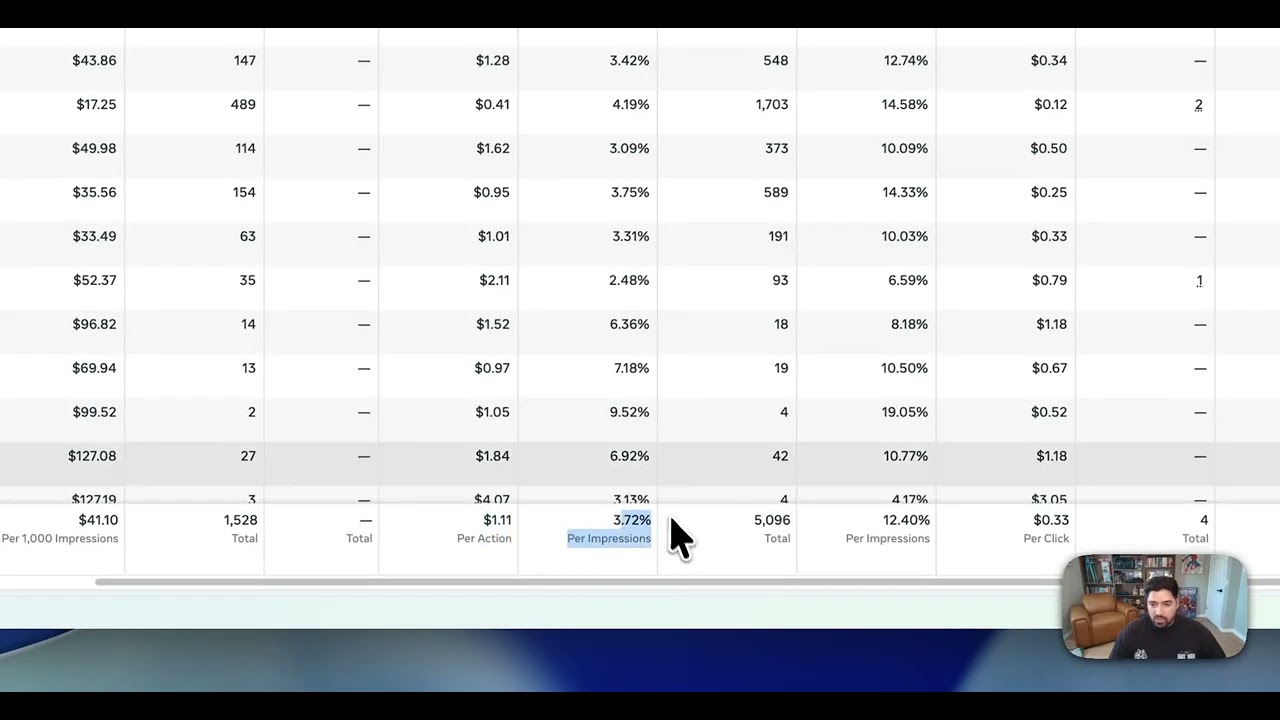
An advertiser ran the same Meta campaign two ways: full Advantage+ AI features versus human-managed creative testing. The AI version spent $1,600 for 19 sales at $88 each (unprofitable). The human approach spent $1,000 for 18 sales at $58 each and turned a profit. AI boosted clicks but raised costs and diluted brand control.
Chapters
I ran the same ad campaign with AI versus a full human media buyer, and I wanna show you which one worked better and why we should still be cautious about using AI full out when it comes to running paid ads. If you're advertising in Meta recently, you'll know that whenever you get to the creative section, it's always prompting you, hey, you should add AI-generated images. It's gonna give you an X% higher of a click-through rate. You should do our creative image generation. You should do our, um, advanced optimizations, like you should, you should do all these optimizations because it's going to help you do better with your paid ads. Is that actually true though? Is it actually going to help? I actually tested it. And what we did in our test is we basically took a winning ad that had been doing well historically, and we applied these settings. And the main one that we applied, we applied any setting that we could, but the main one was actually adding all these AI-generated images. So you'll see here Meta will actually generate like a ton of these AI images based off of your winners or based off of like your original upload. And it estimates that you'll get an 11% click-through rate lift and an 8% conversion rate lift. This is just in my specific situation, but you can see some of them are pretty simple. Some of them are a lot harder to like read. Like some of them aren't edited that great. But let me show you exactly what happened. Okay, so here is the ad that we actually applied all of these Advantage+ creative image generation stuff to. So I had my main image and then I applied basically all of these different images to that main product or to that, to that main ad set, right? So you can see there's 4 extra medias being used in this ad. And then on top of that, we applied every, pretty much every single Advantage+ creative optimization. So like the overlays, visual touch-ups, the music, Multi-image animation, text improvement, pretty much everything, right? And we did some other tests where we like actually applied all of it and we applied all these to enhancing the CTA, showing summaries, all this stuff. So what actually happened? Because we've had ads and I'll show you the baseline. And my biggest kind of fear with turning these ones on is A, it dilutes the brand. It doesn't really hold that like same brand strategy or that brand analysis that needs to be there to make it seem uniform from ad to landing page. Because that connection between the two is super important. If you're running ads and your ad looks like one thing or says one thing, and it's not connected to the landing page, there's gonna be some disconnect and your conversion rate's gonna drop. And that's a big thing that I worry about with these AI enhancements is it's just making enhancements for the sake of enhancements, but it doesn't necessarily solve the root problem, which people are not solving themselves, which is not just more creative testing, But more of the right creative testing, like actually designing creatives around a certain unique value proposition, designing creatives around certain know, like, and trust, different pain points, different hooks, different pieces of body or like meats and different styles. People aren't doing that. And that's why Facebook's like, hey, here's the lazy way to do it. But I don't think it's the right way to do it. But we can still leverage how Facebook uses these in other ways where we have a little bit more control. So let me show you exactly what happened. Okay, so in that test, we let Facebook run, we spent about like $1,600 just to test it to see what happened. We generated 19 sales at $88 per purchase, which is not profitable for us. Our average order value ranges from like $60 to $70, sometimes $80. So we were losing money on this one. We had a $41 average cost per 1,000 impressions, we had a $1.11 link click cost. 3.72% link click-through rate, and then a 12% CTR. So like not bad click-through rates, pretty good across the board on most of these numbers. It just was causing a higher cost per conversion. And let me show you kind of how we tweaked it and did it our own way while still leaning into what Facebook wants. Okay. So then what we did is we took a lot of the same creatives, but we made a lot of new variations ourselves. We did a mix of video and images. We spent $1,000 on it so far this week. We have 17 purchases at— or it looks like just a few more sales came in literally right as I'm talking. We've had 18 purchases now at $58 per purchase. This is profitable for us because on the front end of the funnel, we're getting people, like I said, to spend between like $70, sometimes $80. So at $88 per purchase, not profitable. $50 to $60, that's okay because we have a higher ticket backend as well. And pretty much all we did is we did a CBO, big budget. It doesn't have to be a big budget, but we did a CBO, decent-sized budget, and basically just dumped in as much creative as we possibly could with as many different variations as possible. Some of these ad sets have multiple creatives per ad set, like this one here had 4, but this is the one that was the main winner. Other ones, I believe, only have just a couple. This one only has 3. This one had 4 and got a purchase for $6, which is pretty crazy. But we're just basically feeding Facebook as many creative variations as possible, and then we'll get some really cool results like this. We'll start to trim off the ones that are losers as we go. The issue with that, like, AI-enhanced creative is it's a lot harder to control. What happens next, right? So right here, it's suggesting again, you could get an 11% click-through rate just by adding these AI images. But if we look at like the winner, which is this one, okay, let me go here. I don't want to apply that. So it looks like it's keeping the same headline for pretty much all of them. Then it's just applying different visual backdrops, which isn't bad. But I don't know, I really don't know how these ones would work because it's a different winner. So I think they're useful to test if you're willing to want to test and spend that money on it. But I almost think it's better to look at the winner and say, okay, cool, this is what's worked. Let's deconstruct why did this work? How can we make it better? How can we put a different headline on it? How can we actually like hit the problem or the solution that people really want or want to avoid? And then that tends to make it a little bit better. So I hope that gives you a little bit of insight. I don't think Facebook is at the point where AI is going to do a lot of the media buying for you. And even some of these creatives, they're not ready. But the concept is there. And I think if you do it strategically, and you break it out with one ad set, multiple different ads at a high-level CBO budget, It can be something really powerful. So think about that next time you see these optimizations. Don't do it the lazy way, do it the right way, and I'll see you in the next one.