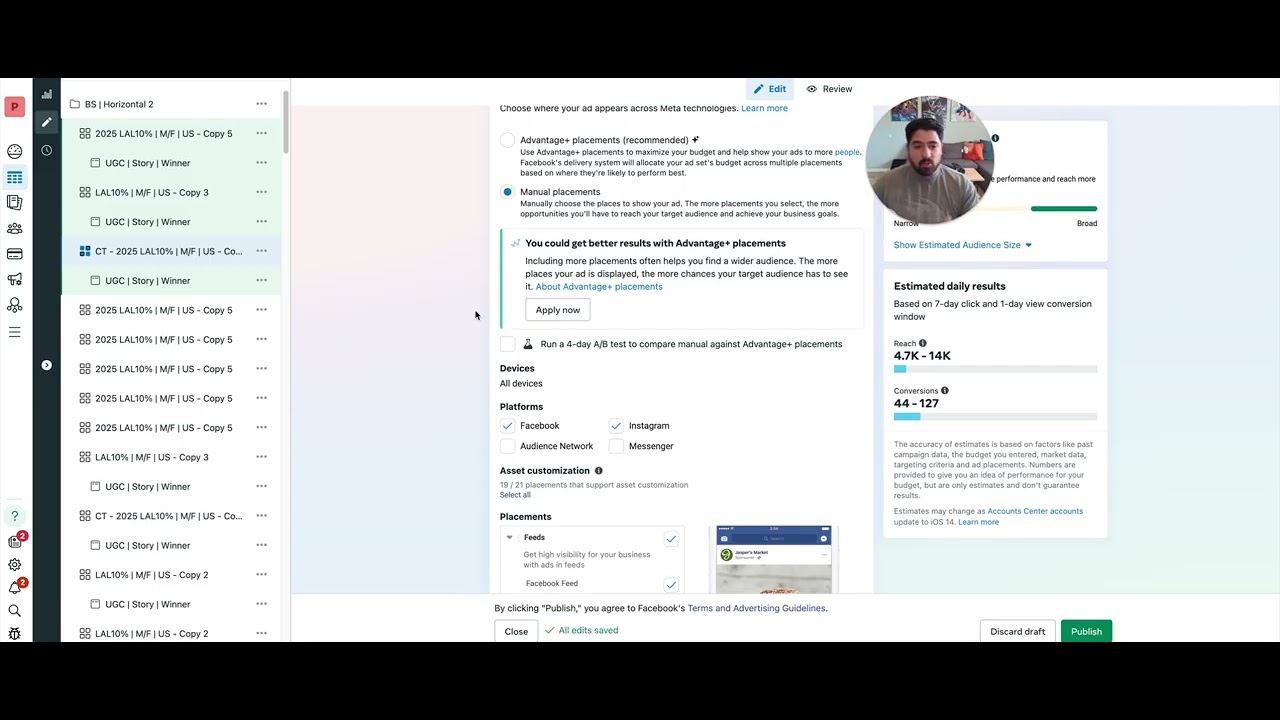
Scale winning Instagram and Facebook ads by duplicating high-performing sets into multiple campaigns with slightly odd daily budgets like $1.56. This spreads risk across your account so one failing ad set won't tank everything, and small audience tweaks reset Facebook's delivery to prevent over-optimization.
Chapters
So let's talk about scaling your ad campaigns in a really easy and effective and easy way that you can actually repeat this over and over again without necessarily needing to spend a ton more or make a ton of new creatives. This is all about scaling your ad account, and we're going to go over the setup process and actually seeing it in action with an ad account that we're actively working on. So the first thing to really understand when it comes to scaling your ad accounts is making sure that you're building it on an antifragile base. And basically having a multitude of different ad sets or campaigns to support your scaling. So you don't run into a problem where you have 3 ad sets that are doing all the work for everything, or 1 ad set or 1 campaign that's doing all of the work. It's just gonna put you in a bad spot and you're not really gonna be able to scale. So this video, I'm really gonna be focusing on this, this scaling framework, which is a super rare, really, really useful resource, can be found in the school group. Which you can join totally for free below and get access to that, as well as the show notes that go along with everything. So with all that being said, let's actually go through and walk through the strategy of how to actually set this up for yourself. Okay, so we're inside of an ad account here that has got some decent winners, but we want to scale things a little bit further. So over the past week, you can see there's a decent amount of sales in here. The first thing that I like to do when I'm scaling things that are working is just go down to the ad set level and really just pick off what's actually working. So I'll usually filter by ones with the highest results and the lowest CPA as well that I'm comfortable with, or an even lower CPA than what I like. Select some of those and then duplicate them. Now you can duplicate them instead of the same campaign or an existing campaign, whatever really is best. Facebook does like a decentralized ad structure, so the less campaigns you can have is usually the better. But across the board, if you just duplicate them, this is gonna create this antifragile base that we talk about. And the reason why this is so important, like I said, if one campaign and one ad set is being ran at $200, $300 a day, and you're scaling, you're scaling, you're scaling, we've had campaigns where we're pushing $1,000 a day, but let's say they stop working. Well, then that puts you in a bad spot. If you have one campaign or one ad set that just stops working, you have nothing else that you can really lean back on. So it's important to have a few of them, even if they're not too different. However, when I do duplicate them, what I like to do is kind of set up the budgets for whatever I'm comfortable with. So for each one, I'll do around $1.56. And a lot of people ask me this or see me do this is I'll put like odd numbers. So like I just did like $1.56 and 32 cents. The reason I do that is Facebook's bidding at the end of the day. And if someone else is going to do like, let's say, 100 or 110 flat, I'll try to do extra numbers. It's really not like a huge game changer, but it is something that I've noticed that over time I think does work and does help. So after that's done, then an easy thing that you can do is actually just change the audience age, gender very slightly to kind of help reset those initial conditions. Because a big problem that you can have inside of Facebook and a lot of ad platforms is you've got the same ads going to a lot of people, which is fine. But what happens is if Facebook notices one group of people engaging with it, it'll keep delivering it to that same group of people, which is either both good and bad. It can put you in a doom loop if you're retargeting or targeting not the best people, but it'd also do great if it's obviously hitting the right people. So I like to just change a few small things. So I'll change like the placements, I change the age range like you saw. And this one, what I'll do is I'll just do women only, and I'll change the age range. And then in this one, I'll do all instead of women only. And then I'll actually change the placements as well. But these are pretty easy tests that you can do in order to scale your, your ad sets and your campaigns. From there, once I'm happy with all that, I'll essentially duplicate all of those. And let me make sure that none of these have spent anything. Yep, so we've got these ones here, and I'll publish them. And that's a super easy way to scale your campaigns. So this is super important. And why this is important is, once again, if you only have one ad set or one campaign, you're running on a fragile structure. There's a single point of failure, and there's a high risk of performance fluctuations. Whereas if you have multiple campaigns sharing that same budget, you're simply just distributing the risk across the board. And I really like to do this with budgets that are going over $500 a day, and you can concentrate those across really 1 to 2 campaigns across the board. And what this helps is once you duplicate those like I just did, you can make these small changes. You can do different audiences, different ad angles, different faces, so different spokespeople or different creative. And then even different funnel formats as well, whether you're doing a direct sales letter or a video sales letter as well. So those are really easy things that you can change. What I'll do is I'll flip all these on. And it just allows you to scale a lot more effectively and a lot simply. You don't need to overcomplicate it. Sure, you can drop in some CBO campaigns. You can drop in some different methods as well to scale lifetime budgets, bid caps. But this is one of the easiest ways to take something that's working scale it and do it with a solid risk tolerance as well. So you're not necessarily digging a hole for yourself or making a bigger problem for yourself than what it needs to be. So I know this was a simple and short video, but that's really all this strategy is. If you want access to this presentation that kind of walks you through everything, as well as the framework, join the free school group, the Predictable Profits Mastermind. It's the first link in the description. I'll see you on the inside, and I'll see you in the next video.