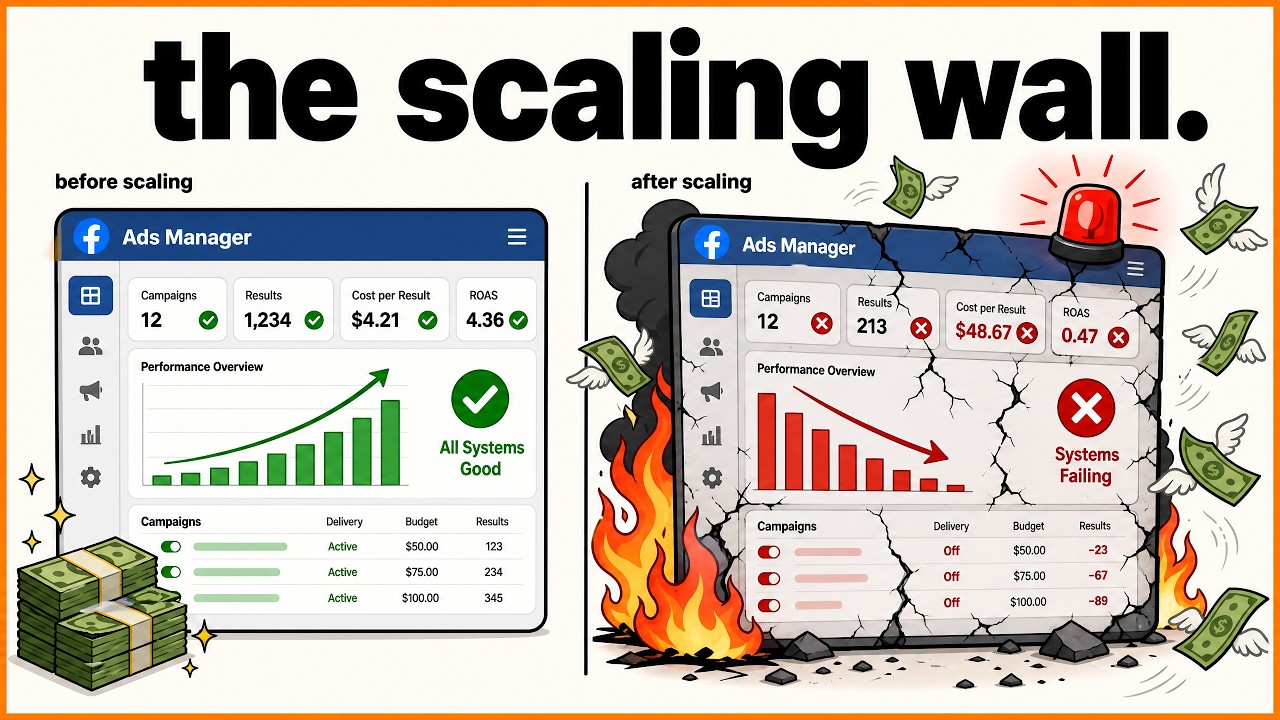
Nicolas Korvessis explains why Facebook ads that work at $100/day collapse at higher budgets. The three culprits: you need 5-10 creative angles and multiple formats, not one winning ad; audiences get saturated and need colder segments; and landing pages can't handle the traffic. He shares tactics like grouping winning ads into campaign-budget-optimized campaigns and tolerating modest CPA increases.
Chapters
You increase your budget from $100 a day to $300 a day. Your cost per lead triples, your ROAS tanks, and you panic, and then you drop the budget. If that sounds familiar, I wanna show you exactly why this keeps happening, and it's not the algorithm punishing you. Every business owner I talk to has the same story at some point or another when they're running paid ads. My ads work great at $100 a day, but the second that I try to scale, everything falls apart. They think that it's a Facebook problem, like there's some invisible ceiling that Meta just puts on your account. But what's actually happening is that the system that you have was built for that first budget, right around $100 a day, maybe less. And the second you try to go to $300, $500, or $1,000 a day, every crack in that system is exposed. And scaling doesn't break the ads, scaling reveals what was already fragile. And the first reason that I want to cover is that your creative can't handle the volume. At $100 a day, one good ad can really carry your whole account. Meta shows it to the best slice of your audience, performance looks great, and everything is going well. However, just tripling that budget, going to $300 a day, you now need to reach 3 times more people. Meta will push it beyond your warm audience into colder, less interested people. Your click-through rate could drop, your CPM could go up, and your cost per result climbs. And it's not necessarily that the ad didn't get worse, it's that you ran out of the easy audience and your ad can't speak to 3 different audience segments. So the most important thing to do here is to actually have creative diversity, 5 to 10 different angles running simultaneously to each segment, a different audience. So every segment of that audience will see something that resonates specifically with them. And because of this, if you don't have a creative production engine behind them, not just one winning ad, but a full system that produces new variations every week, without that kind of an engine, every scaling attempt can hit the exact same wall. So what I wanna show you really quick is the engine that we use inside of our company, ScaleLab Group. We'll really, at a very high level, we'll have 2 big groups, a stack of angles and a stack of styles. And if you just work on every week creating 10 to 20 new hooks and new ideas for ads, you can then apply them to these different angles and these different styles to get a ton of different image ads, video ads, UGC ads, Whatever it is. So I think it's really important first, once you have some hooks and you have some new ideas, maybe some problems or pain points or outcomes from ideal clients, apply that towards every single one of these angles. Problem solution, personal story, us versus them. Go through this whole list and try to make an ad that matches each one of these angles. Then on top of that, and that same hook could be used for all 13 angles here as an example, then you could do the exact same thing but apply it to the right format. Image ads, video ads, UGC, memes, carousels, slideshows, testimonial montages— the more formats that you can apply with that same hook and that same angle is going to give you almost infinite combinations. So it's super important to have this engine where you're actually able to create a ton of ads that aren't just new ideas but new angles, so you're hitting every single variation of what the audience is really looking for. Based on that individual. The second reason why you're hitting a wall when you're scaling is that your audience is saturating faster than you think. This kind of ties into the creatives, but at $100 a day, it could take 3 to 4 weeks to exhaust a well-defined audience, if not even more. Audiences are really big in Facebook. But a thing that a lot of people won't look at is making sure where is your frequency at. A lot of people will kind of ignore this. In some markets, the frequency is good when it's high, in some it's really not good at all. But if you're looking to scale, you really have to pay attention to your frequency. And the way to break out doesn't mean targeting new people, it's the same thing, a different hook, a different angle, a different format. It's not that they didn't like your offer. It's that they maybe rejected the specific presentation of it. And if no one's producing creative on your team fast enough to keep up with your spend, that's where you're always going to hit that roadblock. The third reason, and this is something that a lot of people won't look at because it's outside of the Ads Manager, but it's that your landing page can't convert at scale. If your landing page has a conversion rate of, let's say, 3%, You're sending maybe 80 people to that page at $100 a day. You get a few leads, a few booked calls, whatever that is. But those extra people that are sending to the page, once you scale, that page conversion could drop and it could really start to stress test your funnel. And if you haven't stress tested it before, gotta make sure that someone's monitoring that page as you scale, because you'll blame the ads first. But you could look at the page and see where can we actually improve this thing now that we've really stress tested it. With new ads across the board. Those are just a few reasons of why your ads break at scale, and those are the most common ones that I see: creative diversity that can't sustain volume, audience saturating faster than spend, and your landing page that can't convert colder traffic. Notice that only one of these is an ads problem— the audience saturation. The other 3 are creative, funnel, and operations problems. So you've got to make sure you pay attention to everything surrounding the ads, not necessarily the media buying itself. However, I do want to go over something really quick which is some of the media buying stuff that we have seen work very, very well. So inside of this ad account, we've actually scaled. You can see just in this one campaign here, this is not all the campaigns that we're running. We spent $62,000 in the past month. This is for a book a call campaign. And the cost per call may seem a little bit higher on some of these, but at scale, I'm actually okay if the cost per call goes up a little bit because we're still closing. We're still extremely profitable. For every dollar we put in, we get between $5 and $6 out. So it's a 5 to 6x return on ad spend. Which is amazing. At scale, be comfortable and be okay with your CPA rising a little bit. At lower spend, I'm gonna want my cost per call to be close to $300. I want it to be $100 to $150. But if it doubles, that's not a reason to contract. You need to keep pushing out that creative volume and group some of these ads in a little bit of a different way to have that work. Something that we've seen work is once we do find a winner and something that's working well, I'll actually dump all the winners in one campaign. Campaign-style budget, and these are all the winners, and Facebook will really pick and drive a lot of the spend there. So you can see here over the past month, this ad has been crushing it even at scale, spending almost $7,000 a month, which is awesome. That's what, $233 a day? That's like a good consistent ad that's getting us schedules consistently at a really solid cost that's scalable. So super important, make sure that your system is built around scale, and you can't see which piece is the bottleneck just from looking inside of the Ads Manager. Look outside of that, It's super important. Listen, we do free audits for businesses spending $3,000 or more per month on paid ads. I'll look at your creative, your page conversion, and tell you exactly where that bottleneck is, especially if you don't have someone on your team dedicated to doing this. It's a huge windfall for a lot of business owners that want to scale. So if you're interested in that, check out one of the links in the description. Glad to do a totally free audit on your account. And if we end up wanting to work together, there's opportunities for that as well. So check that out. Try this out, stress test everything that I just mentioned in this video between your ad account, your landing page, your creatives, and see how that improves your scale. I'll see you in the next one.