A recorded talk by Dr. Nikhil Varma titled “Imagining a future with Blockchain.” Varma gives a simple primer on blockchain using a shared "book" metaphor, then applies it to real-world vignettes in India: Sunita (a loom artisan earning about $2/day), Pawan (a farmer seeking funding for sustainable inputs), and Aditi (a local government official constrained by high servicing costs). He outlines how digital IDs, encrypted provenance, NFTs/tokenized land, proof-of-effort, and para wallets could enable traceability, direct access to global markets, fair/timely payments, and lower verification costs—potentially improving livelihoods for artisans and small farmers. The talk is narrative-driven, example-focused, and closes with an audience visualization.
Questions this video answers
Dr. Nikhil Varma — associate professor at Rampo College and technical lead for Algorand's India Initiative.
About $2 per day.
Chapters
A lot of traffic in Delhi. Part of the challenge. All right, thank you, Anil. It was incredible, the work they've done in only a year, which is pretty remarkable. So we're going to begin kind of the substantive content of this summit right now. And we're going to start with Nikhil Varma and he's going to take us on a short journey on the kind of life on the blockchain. And he is going to kind of lay out what the kind of the positive effects are. He's going to give us a quick primer on the basics and he's going to, I think, be very entertaining because he is a very entertaining speaker. So I hope you enjoy what he has to say and I'm going to give you his bio right now. Dr. Nikhil Varma. He's an associate professor, Rampo College and he drives blockchain adoption as the technical lead for Algorand's India Initiative. Algo Bharat. He partners with universities and companies and he accelerates diffusion after bringing lots of different expertise into this position. He's been an entrepreneur, he's been an analyst, he's been a consultant, he's been a developer. He's writing a book called Blockchain Capitalism and he writes about how blockchain can address some of the flaws that we see currently. So please welcome to the stage Dr. Nikhil Varma.
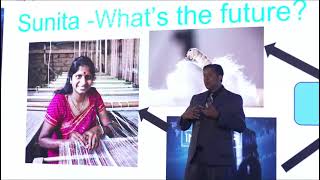
Good morning. How's everyone? So I'm going to be talking about a future with blockchain. And you know, the idea is imagining a future with blockchain. To be able to imagine. The first thing that we need to do is to have a picture, right? So let's do a small exercise before I start talking. Let's all close our eyes, please, and let me take you through a journey. Okay. It's. It's 1047. So there is a farmer who is been working for the last four hours in a village in India. He woke up at 5:30am in the morning. How many of you actually woke up? Okay, you're imagining. Let's not trouble you here. Okay? So he woke up at 5:30am in the morning and he, he has been working hard and hard and hard. Now what have we done for this farmer so far? Are you able to imagine the farmer now? You have a picture. Okay, I'll let you open your eyes now because we will try to do something that will change or possibly change the life of this farmer. That is the future that we are going to imagine. I want to get started with a very basic construct as I Was introduced. I'm a college professor and, you know, I'm very used to giving boring lectures, But I'll try to make sure that I'm not boring here. For centuries, we've been trying to get things to be able to get things that we don't have with things that we have. Yeah. So you have something and somebody else has something else. You want that thing. So you've been trying to get that whole exchange. This whole construct has been called value exchange. Now, this value exchange has been studied by economists over the years. They looked at how people interact with one another. They looked at how communities interact with one another. They looked at what are these complexities in these interactions. And that gave rise to institutions, institutions like banks that we see now. Many other institutions came about. This is how the world is able to exchange value in the current times. But this exchange of value in the current times, as we all know, has some problems. And the problem is that the value of that exchange, people are not getting a fair value of the exchange. There are some people who are controlling more power in this system. And there is so much of turmoil in this society. In comes a technology which could possibly transform this value exchange. Now, I know what you must be thinking. This technology is for geeks. Stacey started her talk by asking everyone, how many of you know blockchain? Yeah, many people think blockchain is for nerds. I don't know what they're talking about. In fact, there are a lot of nerds in the other room. Full room, yeah. So how do we understand this complex technology? In very simple terms, when we look at value exchange in the current times, what's happening is we have one institution which we all rely on to be able to be the centerpiece of how value would be exchanged between different parties. Yeah, but that center exchange, or the centerpiece is becoming more and power more and more powerful over the years. And that is why there is so much of problems in the society. To be able to exchange, to be able to present to you this new value exchange model. I know some of you already know blockchain. I'm going to introduce the construct of a book on all of you know what a book is. A book has several pages. Yep. Now imagine one page of the book that has all these value exchanges recorded in some form. In a simple way. We are recording each of those value exchanges in one page of the book. And this book or this page happens to be in various places. So all of us have that value exchange page. Over a period of time, new value exchanges happen and we keep building more pages in the book, okay? And what ends up happening is all of us have the same book, which has the same. Which has all the pages are the same. Now, the interesting part over here is that you cannot pull out a page from the book. If one person tears a page in the book, suppose they had to pay somebody some amount of money and they just take that page off. If it was a bank, you will have to hack the bank. I'm not teaching hacking here anyways. But if you want to take that page off that book where you owned somebody, you had to pay somebody some amount of money, your book will not be consistent with the other books. And that is how we will be able to make sure that you are doing something which is not right. And you'll have to come in terms with everybody in the network. So this book is a part of a network. Each of those pages are called blocks. They are connected with one another as a chain. That's blockchain for you. Okay, I hope that's a simple explanation of blockchain. But to just move further, I would like to introduce to you three people. Sunita, she's a loom worker in India. She's learned this art from her family. Wakes up early in the morning just like the farmer you imagined and, you know, tries to make sure that she does enough work and she's able to sell her finished good to get food for her family. But she ends up making just $2 a day. And what happens with that $2? She's not able to make ends meet. Her only objective in life is that I won't let my kids do this. I won't let my kids do this. And I will. If I have an opportunity to move out of this life, that is the first thing that will end up doing. Not very far from Sunita is another person, is a farmer. Actually, did you imagine him is a farmer, Pawan, who worships Earth. It's Mother Earth. But what he does to Mother Earth, he puts fertilizers on the Mother Earth just because if he doesn't put those fertilizers in the mother Earth, he's not going to get the kind of crop that he needs. He understands that sustainable initiatives could possibly increase his produce, thereby increasing his income. But he doesn't have that kind of means to be able to put in 300 to $400 on these kind of sustainable initiatives. Aditi, on the other hand, is working for the government at the local level. Her job is to be able to provide funding to people like Pawan. She is looking for different kinds of avenues to be able to fund Pawan. But the cost of servicing these kind of loans or these kind of benefits to Pawan is much more than the money that she's going to lend to Pawan. So she's not able to give money to people who actually need that money. She's able to give that money to bigger farmers, not to smaller farmers. Now this problem that we see here. Sorry. This problem that we see here is a broken system, a disconnected system. And what do we need to do to be able to fix this problem? It's something like when YouTube came in and it fixed the whole music distribution industry. What if we bring in decentralization? I'll quickly show you how decentralization could possibly change things here. So now Sunita, who is working hard with her in the loom, is able to create more information, more information about what she's making, which means she will be able to get some traceability of the product that she's weaving every day. There is access to global markets, direct access to global markets. I'll show you how that happens. And fair and timely payment. Again, these are things that she's longing for. How does she get into this? This is where blockchain comes in. This is the page that I showed you where we would be storing all that information. We start with Sunita's digital id. We'll have a session with ID very soon where they'll talk about identification, we'll talk about IDs. So Sunita has some kind of an identification in the network. That's the ID that we get started with. Then Sunita is working from a particular place in India. Of course, for privacy reasons, we don't want to put that information over there. So we encrypt that information. Now what happens is when somebody wants to verify where Sunita is from, this happens to be by the encrypted information of Hisar Haryana. So they will be able to match the digital signatures that it is the same digital signature of Hisar Haryana. What are the product details? I'm just showing you a small name, which is Resham Kichadar. And last, to be able to get her the fair wage, the proof of effort. How much time did Sunita put in to be able to make this Chadhar? This would be the founding premise for someone to pay her fairly. Right now there are other people who are actually building things, who are making things. And these handicrafts are actually getting a lot of hit because of machines. Now if we have to really find out whether this was a sustainably weaved or a machine weaved. Resham Ki Chadhar. We will be able to identify that. Now this is just a starting point. This is just a starting point which gives us data integrity, which increases efficiencies so that we don't need to go about finding more details about Sunita. Everything is out there. You can get that information in the axis of a click. What happens after this? Let's kind of go to Pawan for a bit. We were talking about Pawan, his sustainable initiatives. We get Pawan on the para wallet, we create his identification. We create an NFT of his of his land. We create all the initiatives that he's putting. He put that information around that token and then now Aditi will be able to fund Pawan very easily. She need not go verifying the documentation with. The cost of verifying those documentation is way more than the amount of money that she needs to pay for. What happens in Sunita in the future would be an investor coming in. So we start with traceability. But traceability is just the starting point. What happens after that is the real magic. This is where the global markets can start coming in and putting in money for more sustainable raw materials that Sunita is going to have. In turn, these markets can fund Sunita in the future and would change the quality of life of artisans like Sunita. With blockchain, we have the ability to change the lives of people like Sunita and Pawan and millions of people around the world. It's all about us having faith in this technology, understanding this technology and redesigning how we will exchange value. I'd like to close your eyes. I'd like all of you to close your eyes one more time and imagine the future where we will be able to change this world. Thank you so much.