What is AI? – Ep. 1 (Ft. Dr. Nikhil Varma, Associate Professor at Ramapo College)
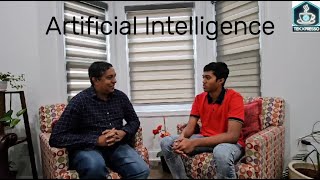
Podcast interview with Dr. Nikhil Varma explaining what artificial intelligence is, emphasizing that AI primarily automates analytical tasks (decision support rather than decision making) while human creative intelligence remains distinct. The conversation covers historical and illustrative examples (Turing/Colossus, Archimedes' Eureka), practical distinctions about types of AI, and everyday applications such as navigation, voice assistants, sensors and expert systems.
Chapters
Hey everyone.
Welcome to TechXpresso, the podcast where we serve up hot, fast and focused conversations about technology. Each episode we break down one specific topic with an expert guest by asking him three key questions. It's all about getting the insights you need without wasting your time. Today I'm thrilled to introduce Dr. Nikhil Vorma. He's an associate professor at Randpah College of New Jersey and the technical lead for the Algorand foundation of India.
Al, with his deep expertise in tech.
He'S a perfect guest to help us explore the basics of artificial intelligence. We'll dive into what AI really is when they're trying to replicate human intelligence and his potential to shape the future. Grab your cup of tech espresso and let's jump right in.
Hello everyone. I'm here with Dr. Verma and today we'll be talking about AI. Alright, so for people who are new to this concept, how would you define artificial intelligence?
Well, before we talk about artificial intelligence, I want to actually take a step back and talk about what intelligence is. Well, when you look at intelligence, there are different types of intelligence that we have as humans. One is an intelligence which talks about analytical intelligence where we are able to look, analyze and understand things. Then comes the practical intelligence where you are able to apply your knowledge into something. Okay. And the last one, which I think is the highest order, is called the creative intelligence. So when we talk about artificial intelligence, we are essentially trying to automate a few things. And I'd like to invoke some examples of, you know, scientists in the past, like Alan Turing. Alan Turing was a scientist who created the machine called Colossus. This was during the World War II where the Allied forces were having a lot of problems because Germans were using a ciphertext. So their messages were sent in encrypted manner and they were intercepting the messages, but they would not be able to parse those messages. And if they did not parse the messages fast, then they would not be able to. I mean, during the war they would get into the attack would happen. So that ciphertext that they were receiving from the Germans, if they were able to decode it really fast, they would be able to know what the next reaction is going to be. And that is when this Colossus machine was built, which had this analytical understanding, it was able to do it much faster than humans. And actually that contributed to the Allied forces winning over Germany in this war. And I think that's the kind of basis of building a machine which has this artificial, artificial intelligence. This is basically the Analytical part of that intelligence that we have, which can do things faster based on things that, you know, as a human, you and I can do some computation, but then we need a computer which will be able to solve that computation really fast. Right. In imagine there are some complex decision making processes. Like suppose you want to drive from here to New York City right now. Yes. You can look at the map and find out where to go. But then if we have an AI engine which is able to pass through the routes and say, okay, this is the route you have to go and this will take the least amount of time, that's what artificial intelligence is. So that's what I see artificial intelligence as something which has analytical intelligence to be able to help us do things.
Interesting, really interesting. I like to think of AI as it's mimicking human thought processes such as decision making.
So there are a few things which I just want to kind of mention here. You said mimicking human intelligence. That's true. The way it mimics is essentially it gets data. So we give a lot of data to an AI engine. And with that, that AI engine gets more and more intelligence. Right. So suppose with more interactions with me, an AI engine will become more friendly with me and get to know me, my likes and dislikes, my tastes, and based on that will start kind of putting things more customized for me. So more data, more richness. Yeah. But I still kind of have my doubts on this whole decision making aspect that you mentioned. I don't think AI is meant for a decision making tool. It is meant for a decision support tool. And there is a subtle difference there, which means that, you know, if I am the one who's going to make the decision, but AI is going to help me in that decision making process by providing me answers faster. That's the little thing that I just want to kind of point out.
So then, is AI trying to essentially recreate human intelligence off of that?
Well, it is going to automate a lot of processes. As I mentioned to you, there are three types of intelligence. Right. So that whole analytical intelligence is something which AI will be able to kind of do a lot. It will be able to analyze things. You feed something to it. And, and since it has had previous experience, it will be able to do things like, you know, you feed a picture of a cat and say, okay, what is this? It has had lots of data where it has passed through cat. It will say, oh, it looks like a cat. Yeah. And if you just feed a picture of a leopard, it will be able to differentiate between cat And a leopard, even if they are in the same family, but over a period of time with data. Yeah. So the analytical aspect is definitely something where the AI is going to help us, basically building more efficiencies in us. But I still doubt the creative aspect, the application aspect also slowly AI will be able to connect the dots and say, hey, why don't you do it here, why don't you do it there? But I feel that the creative aspect is still going to be very human. I don't think AI will be able to replace humans there.
All right, that's a really interesting perspective. I agree with you. I believe that AI is trying to. AI won't be able to replace human intelligence. But the, the thing that it brings is how it is able to show a different outlook out output, like a different perspective on human thought and different type of solutions. So my third question is how. So AI is a really big topic, right? How would you say AI? How do you think we use AI in a daily life? Like in a daily.
Well, see, the thing is that machines are all around us. You have a phone, it's a smartphone, right? What does it mean by smart? It has intelligence, right? You have a car. We have so many things in the car. You have so many monitors, it keeps telling you your air pressure is down. All these are machines which are helping us. There is some form of intelligence right now to be able to have more structured intelligence, which an artificial intelligence system has. Right. From navigation that we do on a daily basis, to ordering groceries, to be able to buying tickets, airline tickets, all these places. Artificial intelligence is going to come into play on a daily basis. We will see more and more of AI interfere with our daily activities. I mean, I remember when I moved to North America, we did not have smartphones that time. And we had smartphones, but they were not like, you know, did not have that much of application. When we used to go from one place to the other, we used to print the maps in Yahoo and go through those maps. Now we just enter the address, sometimes even the location. Sometimes the address is not there, just the latitude and longitude. And the AI takes us, helps us build those routes. Of course, in known places, many of you, you must have seen like, you know, when I'm driving, sometimes the AI tells me to go through a certain route and I say, no, no, I'm going to this route only because I know this route. It's going to save me a minute. But then, you know, I'll have to have go through five stop signs. Then I might as well go on this route. So there is a human aspect which will keep. Will be there, but AI will start kind of making us less and less analytical. I, I fear that. But when it is making us less and less analytical, it is still there is one aspect which AI will not be able to kind of take away from us, which is our creative aspect. And that's what I urge people to kind of be, think, dream. You know, sometimes they say the AI hallucinates. Yeah, the AI hallucinate is its form of creativity. But people hallucinating their form of creativity would be the Eureka moment. Right. You know, if you, if you study physics and you look at this whole Archimedes principle, Archimedes had this whole problem, right? When we say the Eureka moment. The history is that Archimedes had a problem when his, the king said, you know, I have a crown which is made out of gold, but I don't know whether this person who made this crown actually stole from me and did not put pure gold. But I want you to find out whether this is pure gold or not without breaking the crown. And Archimedes was in big trouble. He didn't know what to do. And then he went into his bathtub and he was sitting there and then suddenly he had this whole Eureka moment. He saw the water go up and then he. The story is that he actually did not even wear any clothes and he ran on the streets of, you know, in the streets and saying, eureka, Eureka. Which means he got it. He understood. He understood that the whole concept of buoyant force, where, you know, when you put a metal or anything of any volume, it displaces the equal amount of water. And just by that he was able to determine that, you know, I will be able to find out whether this is pure gold or not. So that eureka moment is something which I don't think an AI engine will be able to do in the future. And AI can, yes, solve your computation, define a route for you. But that Eureka moment, that Archimedes, Eureka moment is something which will always be ours. And we will be able to kind of maintain that and keep with ourselves.
That's a really interesting example. And I feel like, yeah, that really went in depth about how, how a really good AI example. So one of my examples was obviously not in depth as yours, but my example was how we use Siri or Google home. Pretty sure everyone has that at home. And how we are able to ask them questions, how, what the weather is, whether we should wear a jacket or not. So that is like how I Feel it could relate to AI, in other words?
Sure. So see, AI is of multiple forms. The AI that you are talking about is the text to the speech to text or speech understanding, which is a very complex form of AI because you're talking to the AI engine and they would understand that it is you. In fact, when you're speaking, it also understands your profile. And the AI engine can be configured to your profile. And if you say dial my mother, it'll dial your mother. If I say dial my mother, it'll dial my mother. So it doesn't get confused also. So that's very interesting. That's another form of AI. So AI comes in various packages. AI is not only the ChatGPT, which we think is the generational AI, but there are many more forms of AI. AI can be in form of sensors that you have in smart cars. AI can be form of, you know, voice to text. AI can be form of expert system where you have a database and you say, okay, give me some information, goes and rolls that information out from the database. So AI has different, different facets to it. And in our daily life, yes, AI kind of makes our life easy, makes us lazy. But then, you know, when we are lazy, then we have more energy. Then when you don't put in too much of the energy is still constant in our body. Right. Either you are moving around, which is kinetic energy, but if you're not moving around, then you have potential energy and you can use that potential energy to drain to be able to be more creative, to be able to think of things that an AI cannot.
Yeah, right.
Yeah.
I think we can all agree that AI has made us somewhat lazy and. But we've definitely opened a creative side and innovated new things and that will be the end of our discussion. And thank you for coming and thank you for having a good discussion on AI.
Sure. Look forward to more discussion in the future. Thank you. Sa.
More from Nikhil
The evolution of trust from calculators to smart contracts | Dr. Nikhil Varma | TEDxSVECW

Imagining A Blockchain World Keynote With Nikhil Varma | Algorand Impact Summit Day 1